

 LinkedIn
A monthly report and three bid tweaks are not done-for-you ChatGPT ads management. I learned that lesson managing Google Ads accounts: the tracking fix at 1am usually mattered more than the polished deck. This list is for owners who want ChatGPT ads run for them, not another course to finish. Done-for-you is a claim you can audit. Ask who does each of these 12 jobs, in your account, and what they did this week. If the answer is advice rather than execution, you have bought consulting with a management price tag.
1. Build conversion tracking that follows a lead to the sale
This job decides whether ChatGPT ads look profitable or look like a leak. A hands-on manager installs the OpenAI Pixel plus Conversions API with a shared event ID for deduplication, adds UTMs to every destination, and connects the CRM so a lead that closes six weeks later still traces back to the original click. That plumbing matters because Ads Manager defaults to 30-day click and 1-day view reporting, while GA4 cannot see impressions and can miss conversions because of blockers and consent.
Ask who runs Pixel and CAPI together, what event ID they deduplicate on, and how a closed deal gets tied to the click. A GA4 dashboard alone is not an answer. Start by requiring utm_source=chatgpt on every ad. ChatGPT appends an oppref click reference, but without manual tagging, paid clicks can land as chatgpt.com referrals mixed with organic traffic. That is a poor foundation for a channel test, especially when LLM traffic is already frequently misclassified as direct in HubSpot’s comparison.
2. Set up the ad account and billing in your name
A manager builds ChatGPT Ads Manager inside your business account and connects billing directly to OpenAI. Spend goes to the platform; account history and records stay with you. A course shows you where to click. A consultant sends a checklist. Neither necessarily leaves you with an account you can keep using after the engagement ends.
Ask who owns the account on day one. At groas, the rule is simple: your accounts, pages, and data stay yours, media goes direct to OpenAI, and you pay one flat fee whatever you spend. Before anyone writes a hint, require admin ownership and monthly invoicing in your business’s name.
3. Write landing pages for the buyer’s question
ChatGPT clicks arrive mid-conversation, with context a keyword alone cannot carry. A hands-on manager builds or rewrites a page for that buyer moment: one promise, proof beside it, and a short form. A course says landing pages matter. A consultant marks up your homepage in a document and leaves you to brief the developer.
The mechanism is relevance. A page that continues the buyer’s thought gives the click somewhere useful to go; a generic service page makes the buyer start over. Early advertisers reported cheaper local clicks alongside five-second visits and low-quality leads in WordStream’s roundup. I used to send test traffic to a main service page. I was wrong to treat the destination as an afterthought.
Ask who will ship a dedicated page for each ad group and edit it as the evidence comes in. At groas, landing pages for ad groups sit inside the flat Search Ads service, which covers Google, Bing, and ChatGPT together. Start with your highest-intent conversation. Give it a page whose headline answers the question that brought the visitor there.
4. Build campaigns around buyer intents, not keyword lists
ChatGPT does not buy keywords. A manager builds ad groups around 5 to 15 context hints each: short, plain-language descriptions of buyer moments. OpenAI matches them to conversations in a relevance-weighted second-price auction, with no guarantee of exact delivery as WordStream’s launch guide explains.
Structure matters because the hints tell the system which situations belong together. Five tight hints about one kind of buyer give you something coherent to measure. Fifty loose hints spread spend across conversations that may never turn into customers. A course gives you example hints. A manager writes yours, groups them by intent, and revises the losers after delivery starts.
Ask to see one ad group and have the provider read you its hints. Then write down three buying conversations you would pay to join, in full sentences, and build one ad group per conversation. If the provider cannot explain the grouping, the structure is not finished.
5. Start with a cap and require approval before it rises
A manager launches a capped test and treats each budget increase as a decision you approve. ChatGPT inventory is narrower than Google’s: ads show to logged-in adults on Free and Go plans, not Plus, Pro, Business, or Enterprise users; they are also suppressed near sensitive topics such as health and politics per HubSpot’s comparison. A loose cap is no substitute for knowing which buyers the channel can reach.
OpenAI sets a $25-per-day minimum per campaign in the US and recommends starting max CPCs around $3 to $5, with reported CPMs falling from $60 in the pilot to roughly $25 to $45 in WordStream’s pricing breakdown. A manager can start near those floors, watch cost per qualified lead, and ask before scaling. A consultant can recommend a test budget without being the person who watches it burn.
Ask for the starting daily cap and the name of the person who must approve an increase. Put both the cap and the cost-per-qualified-lead condition for raising it in writing before launch.
6. Review intent signals without pretending you can read chats
You will not see the conversation behind an ad impression. OpenAI keeps ads separate from answers and gives advertisers aggregate information, not private chats; paying also cannot put your brand inside the model’s response as vendors tracking the launch note. That limited visibility makes regular review more important, not less.
A hands-on manager checks the intent patterns OpenAI does share, hint-level delivery, conversation categories, and what visitors do after the click. Then they rewrite hints that attract curiosity rather than buyers. Early data gives that distinction teeth: about 14% of ads had limited connection to the query, while testers reported cheap clicks followed by five-second visits in WordStream’s roundup.
I used to mine Google search terms every morning. This is the same discipline with less visibility. Ask what the manager reviewed this week and which hint changed because of it. Start by requiring a weekly note that ties one hint change to one observed mismatch.
7. Write new ad copy and retire the losers
ChatGPT copy sits underneath an answer, not above a page of search results. A manager writes variants for each ad group, tests the first line, and replaces weak copy using click and downstream lead quality rather than taste. A course hands you templates. A consultant approves what your team wrote. Neither necessarily comes back to pause their own favorite line.
Hands-on scopes already include creative testing and ongoing optimization with a dedicated strategist in these agency examples. The practical version is less grand: keep one control, test one challenger, and make a decision when there is enough data. What the deck calls synergy, I call two people doing the same job.
Ask who writes the next variant and when the loser gets paused. Start important hints with two different first lines. Set a review after seven days of data, and judge the copy by qualified traffic, not by which sentence won the meeting.
8. Pause spend that produces no qualified pipeline
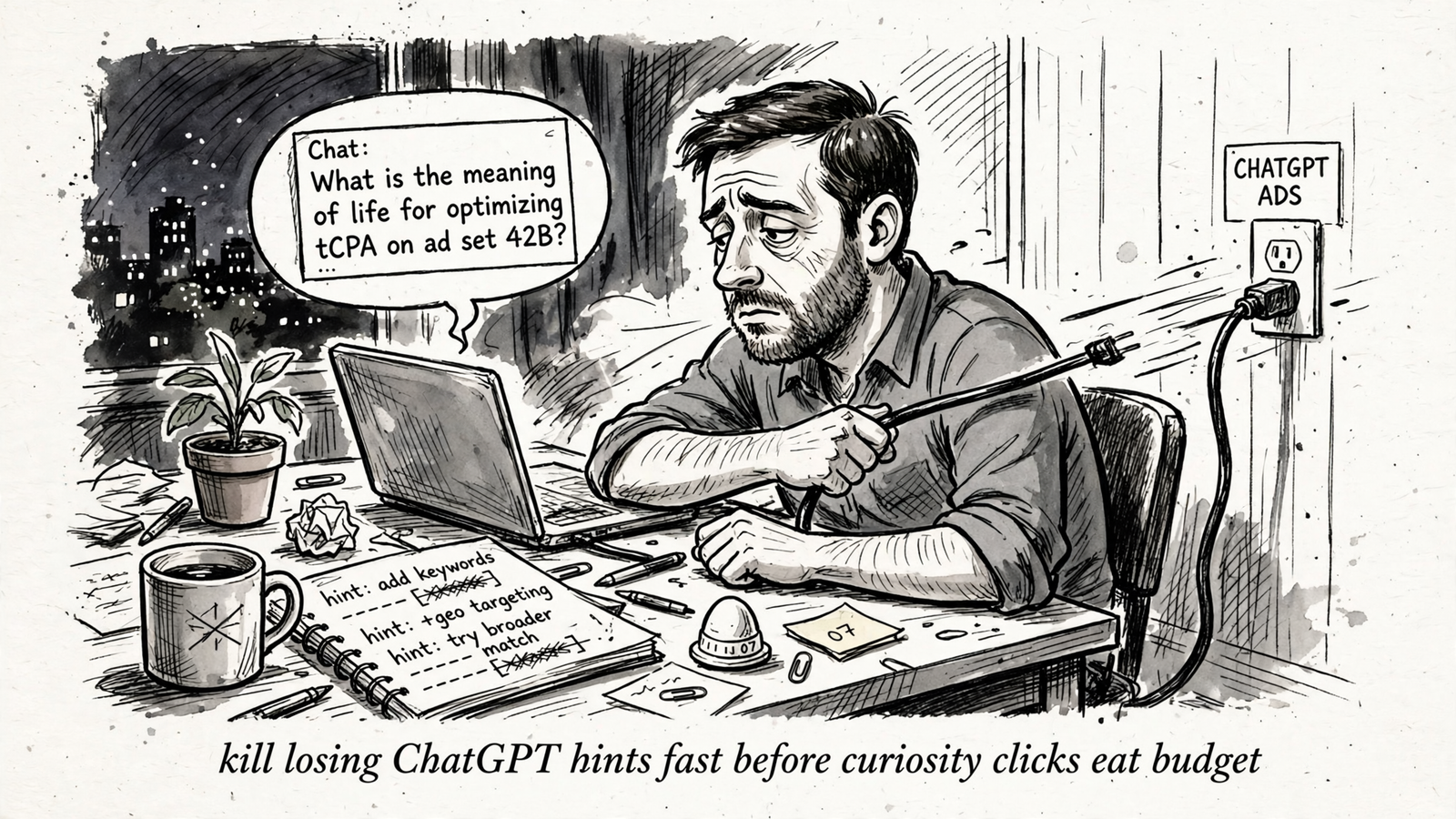
ChatGPT traffic can fail politely. People click, skim for five seconds, and leave. CTR may look respectable while cost per qualified lead climbs. A manager sets a stop rule before launch, then pauses the hint, cuts the bid, or rewrites the page when spend crosses that threshold without pipeline.
That discipline matters when early results are mixed. In an Adthena survey of 30 enterprise brands from July to September 2026, 52% said spend outran return, 22% reported mixed results, and 26% said performance matched or beat Google as reported in WordStream’s roundup. I have kept losers alive too long because I wanted a test to work. The algorithm did not care.
Ask how much a hint can spend without a sales-accepted lead before the manager pauses it without a meeting. Write the number down before launch. Say it is $75: once that limit is reached, someone has to pull the cord, not schedule a discussion about the cord.
9. Check whether ChatGPT adds revenue beyond Google and Bing
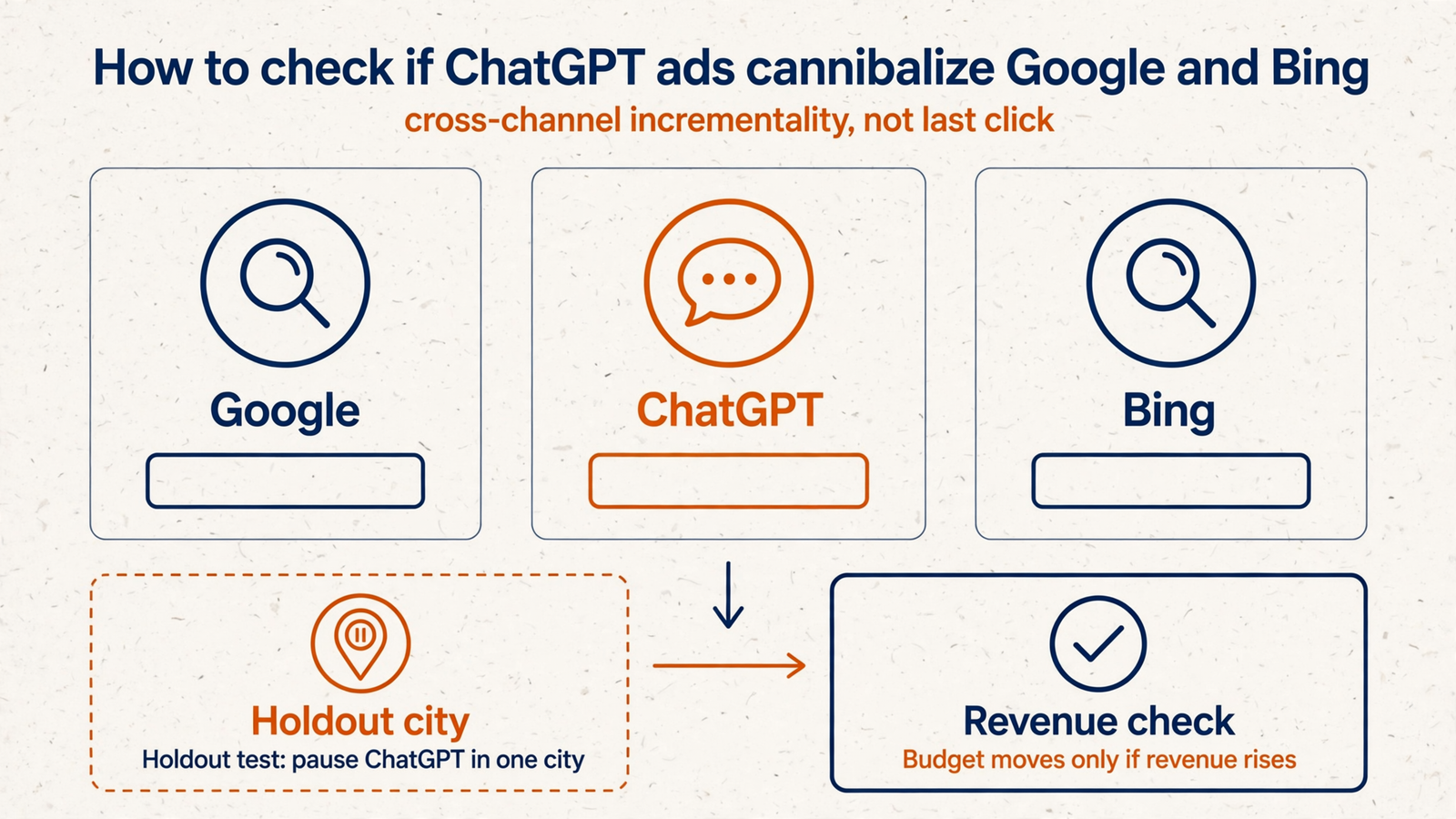
Someone who clicks your ChatGPT ad might have clicked your Google ad tomorrow. A manager checks incrementality instead of celebrating the same lead twice, comparing ChatGPT with Google and Bing on lifecycle revenue rather than last-click credit. Where feasible, that can include a geo holdout: keep ChatGPT dark in one comparable market and watch total pipeline as launch vendors recommend.
If total business revenue rises as ChatGPT spend rises, there may be something to investigate. If Google conversions fall as ChatGPT conversions rise, the apparent gain deserves a harder look. A course may never get to this question. A consultant may put it on slide 14 without running the test. For more on that distinction, read how to decide between a course, a consultant, and a done-for-you service.
Ask how the provider will test whether ChatGPT added revenue your other channels would not have captured. Start with a 30-day holdout in one comparable city and look at total pipeline, not just channel CPL.
10. Move budget across search channels under one strategy
A hands-on manager treats ChatGPT, Google, and Bing as one search budget, not three separate retainers. When one channel produces lower-cost sales-accepted leads, money can move without a new scope call. That is a different decision from increasing your total budget: your approval gate for more spend stays in place.
Percentage-of-spend fees can make that move awkward for the provider. Flat-retainer scopes with media paid directly to OpenAI avoid that particular incentive as in these market examples. At groas, one Search Ads service covers Google, Bing, and ChatGPT for $1,499 a month, so shifting budget between them does not add another service fee.
Ask who moves the money if ChatGPT beats Google on qualified leads for two weeks, and how quickly. Start with one monthly search budget. Agree that the manager can reallocate up to 30% between platforms without a meeting, while any increase to the total still needs your approval.
11. Send a weekly log of changes and reasons
A manager records what changed, why, and what happens next in sentences a busy owner can read in three minutes. Hint paused. Bid lowered. Page headline rewritten. Each action gets a reason. Impressions and CTR can sit in the report; they are not a substitute for the record of work.
That log lets you audit done-for-you service without learning Ads Manager. It also stops the account from resetting whenever someone new touches it. I keep the format short: date, change, cause, expected effect. groas follows the same principle, attaching plain-language reasoning to its actions so clients can see what changed and what comes next in its operating principles.
Ask for last week’s log from another client, with identifying details removed. Start by requiring your own every Monday, including weeks when the right decision was to change nothing. If there is no record of a decision, a monthly deck will not fill the gap.
12. Tell you when not to run ChatGPT ads
A hands-on manager should be willing to talk you out of spend. If your buyers use Plus, Pro, Business, or Enterprise, if you sell into topics where ads are suppressed, or if a sale takes a demo, six stakeholders, and 90 days, ChatGPT’s narrow inventory and $25-per-day campaign minimum may not beat Google on cost per closed deal. A flat-fee manager can say that without protecting a percentage-of-spend fee.
A course is unlikely to tell you to skip the course. A provider chasing the next retainer may be reluctant to reject one. Neither response proves a channel will work. There are not years of ChatGPT ads results to lean on yet; there is the evidence the account produces each week.
Ask what kind of business should not buy this service. If I were starting the hiring process tomorrow, I would start here, before asking for pricing. A provider who cannot name a no-fit case has given me no reason to trust their judgment with the other 11 jobs.