

 LinkedIn

A client once swapped a landing page without telling me. CPA wobbled, Quality Score fell, and I blamed a Smart Bidding reset that had not happened. I used to tell clients to leave every big edit untouched for two weeks. I was wrong. This list is for anyone running Google Ads who needs to know whether an edit actually triggers Learning, merely changes performance, or does neither. Google now limits the Learning status to seven days, but the label clearing is not the same as performance settling. A strategy can still need one or two conversion cycles to show what an edit did. Make the cheaper change, then log the date.
1. Change your primary conversion action only when the goal changes
Reset: yes. Swapping Purchase for Add to Cart, or Demo Booked for Form Fill, changes the outcome Smart Bidding is trying to find. Its estimates were built around the old action; the new one may convert at a very different rate. Google calls this a goal change that triggers Learning. Do not make the switch just to give a thin account a healthier-looking conversion count. That is better-looking math, not necessarily better business.
The cheaper move is to collect data on the proposed action before making it primary. First step: add it as secondary, watch it for two weeks, then make one deliberate switch if it measures what the business actually wants. Do not flip back and forth because the first few days look ugly.
2. Edit campaign conversion goals in one deliberate pass
Reset: yes. Keep Purchase as your primary action but add Store Visit to a campaign’s goals, and the strategy now has a different mix of outcomes to value. Removing Phone Call does the same in reverse. This is another goal change, even if you never touched the bid target.
The cheaper way is to settle what counts before editing campaigns one by one. Google’s guidance favors a consistent primary conversion goal. First step: check Campaign > Goals. If two actions measure the same sale, choose the one you want the strategy to optimize toward and make the other secondary. Where account-default goals fit, use them instead of building a patchwork of campaign overrides.
3. Test a new bid strategy before switching the live campaign
Reset: yes. Moving from Maximize Conversions to tCPA, from tCPA to tROAS, or from Manual bidding to an automated strategy gives Google a different optimization problem. A new or reactivated strategy enters Learning. It can draw on existing signals, but it still needs conversion data under the new setup before you can judge it.
Volume matters more than watching the label disappear. As a working check, tCPA needs about 30 conversions in 30 days to evaluate; tROAS needs 15 to run on Search and 50 to evaluate, per campaign or portfolio. First step: put the switch in a Google Ads experiment. Keep the control running while the test gathers a full conversion cycle instead of making your whole campaign the experiment.

4. Check conversion volume before splitting a healthy campaign
Reset: yes. Splitting one campaign with 60 conversions a month into three with 20 each changes the strategy’s composition and thins the signal available to each new campaign. A tidy account diagram does not pay the bills. Google lists composition changes as a Learning trigger and advises advertisers to consolidate where that pools useful data.
The cheaper way is to get the reporting distinction without automatically creating three bidding problems. Labels or a portfolio strategy may do the job. First step: calculate the last 30 days of conversions for every proposed child campaign. If one would fall below the volume you need to judge its bidding, leave the structure alone.
5. Batch new keywords instead of feeding them in all week
Reset: yes for a meaningful composition change. Adding or removing keywords and ad groups changes the inventory a strategy can learn from. Forty new keywords can bring in queries the campaign has not priced before, particularly if you widen a tight build. Google names composition change as a Learning trigger. The effect is not mysterious: the strategy has to test bids against a changed query mix.
The cheaper move is one planned build, not a fresh batch every time someone remembers another keyword. Consolidation also keeps the data in fewer places. First step: prepare the set in a draft, add it in one edit, and log what changed. Then allow a conversion cycle before deciding the new keywords worked or failed.
6. Test AI Max or broad match away from your control
Reset: expect Learning when the change materially alters campaign composition. Turning on AI Max or replacing a tight exact-match structure with broad match opens the campaign to a different query mix. That is not the same as nudging a target. The model has to price inventory it was not previously buying.
I would not make that change across a healthy control just to see what happens. The cheaper test is an experiment with a matched budget and a clear CPA comparison. First step: keep the exact-match core running and put AI Max or broad match in a 20% test split. Wait for a full conversion cycle of results before rolling it wider.
7. Fix tracking before you touch bids
Reset: not necessarily. A broken tag can look worse than a learning reset without triggering the Learning label at all. If a lead fires twice, the bidding strategy sees more conversions than the business received. If it stops firing, a productive keyword can appear worthless. Changing the conversion goal to repair the problem can trigger Learning, but repairing a faulty tag is not automatically a goal change.
The cheaper move is diagnosis before optimization. I check measurement before touching bids or budgets on an account spending over $5k a month. First step: compare the last 14 days of Google Ads conversions with CRM or Shopify orders, then check Tag Assistant and GA4 for duplicates or missing events. If the counts differ by more than 10%, fix measurement first and give the corrected data time to come through.
8. Put landing-page swaps behind one owner
Reset: no Learning-status trigger. This one burned me. A new page can change load speed, message match and form friction while bids still reflect how the old page converted. CPA moves, but the label may not. That is why calling every landing-page swap a learning reset sends you looking for the wrong fix. A weaker page can also hurt landing-page experience and Quality Score.
The cheaper change is process, not a bidding setting. Keep the current page as a control when you can, and make sure the person running ads knows a swap is coming. First step: give one owner sign-off on landing-page changes and log each new URL with its launch date. You cannot explain a CPA swing caused by a page nobody told you about.
9. Stage a large budget increase
Reset: no. Google says budget changes do not remove history or trigger Learning. Doubling a daily budget can still change what the campaign buys. With more room to spend, the strategy may enter auctions it previously skipped; conversion data from those auctions arrives later. A rough week after a budget jump is not proof that history was wiped.
The cheaper move is to check whether budget is even the constraint, then climb in stages. First step: look at Impression Share Lost to Budget. If it is under 20%, examine targets or creative before assuming more budget is the fix. If budget is the constraint, raise it 30–50% at a time and let a conversion cycle close before the next large move.
10. Step bid targets instead of making one big jump
Reset: no. Moving Target ROAS from 500% to 400% does not itself trigger Learning. It does change which auctions the strategy can pursue at the new target. That can move CPA or ROAS while the Learning label stays off. No label does not mean no consequence.
The cheaper approach is to make the change readable. I move targets roughly 15–20% at a time and wait a full conversion cycle between steps. First step: if tCPA is $50 and you want $35, try $42 first. Log the date, then wait for the conversions from that period before deciding whether to take the next step.
11. Plan for Learning when you reactivate a long-paused strategy
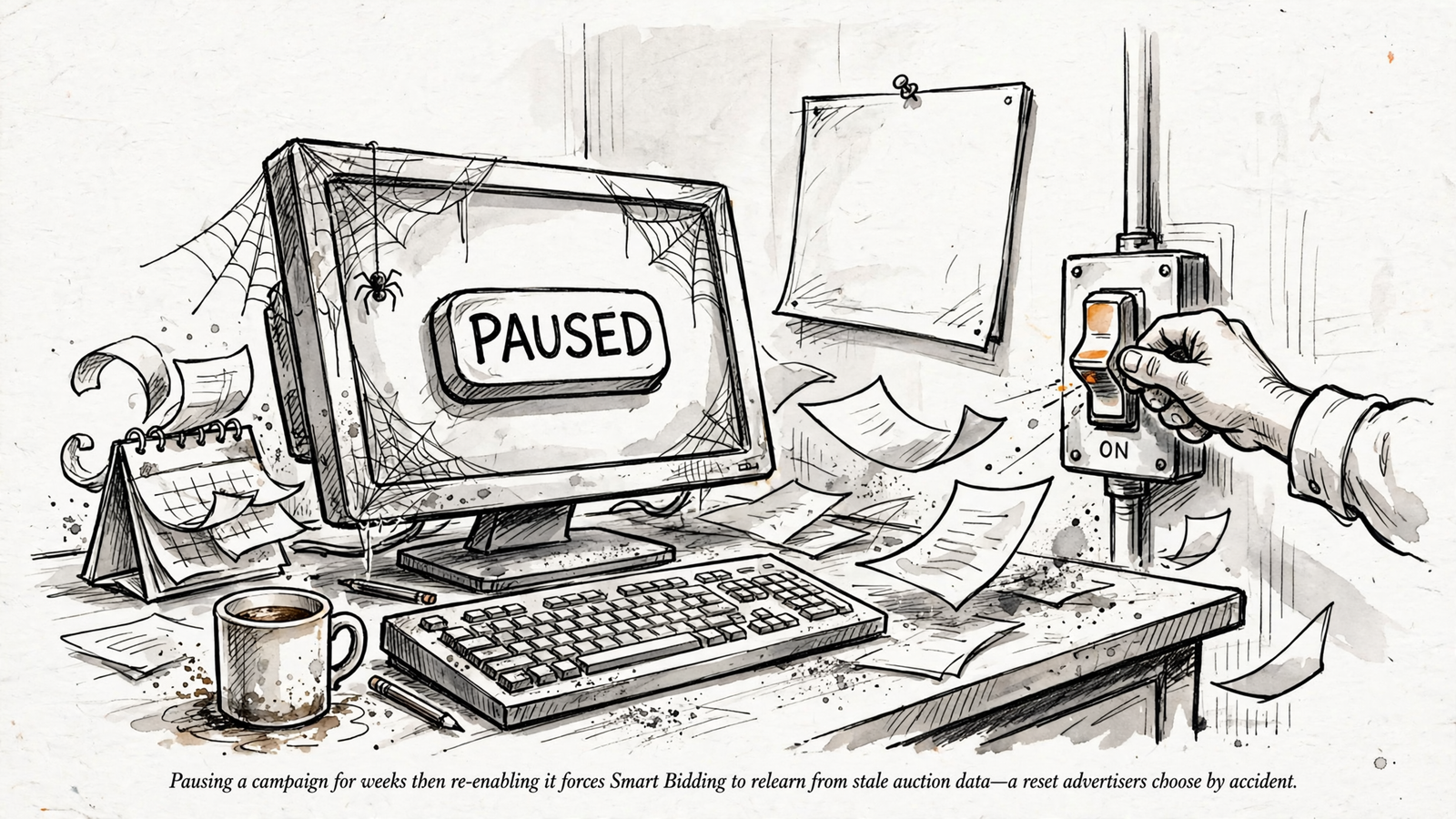
Reset: a reactivated strategy can enter Learning. Pause for seasonality, budget pressure or a site rebuild, then return weeks later, and the old results may not describe the auctions you are buying now. Google lists strategy reactivation among its Learning triggers. A short pause is not a reason to declare the account broken, but a long gap deserves a fresh evaluation window.
The cheaper way, when it suits the budget, is to avoid a full stop by keeping a maintenance level of spend. First step: decide whether the campaign truly needs to pause or whether a lower budget will do. If you must pause, log the return date and avoid piling strategy and structure edits onto the reactivation.
12. Give seasonality adjustments an end date
Reset: no Learning-status trigger. A seasonality adjustment tells Smart Bidding to expect a conversion-rate change for a defined event. Use it for a short sale you can reasonably forecast; leave it running past the sale and you are asking the strategy to bid for a spike that is gone. The resulting CPA rise can resemble relearning, but the cause is the instruction you left in place.
I reserve adjustments for events under seven days with a predicted rate change I can defend from earlier data. First step: set the start and end dates before saving, and scope the adjustment to the campaigns in the promotion. Do not leave one open as insurance against a sale that already ended.
13. Nudge budgets when you do not need a leap
Reset: no. A modest budget edit does not remove bidding history. It is a simpler way to add spend than doubling a campaign overnight, though extra budget is useful only if there are worthwhile auctions to buy. That is the distinction: the strategy keeps its history, but the traffic you purchase can still change.
First step: if the campaign is budget-constrained, raise the daily budget 20–30% and note the date. Watch spend and the conversions that follow before making another move. Do not mistake a quiet Learning-status column for proof that the extra spend paid off.
14. Add clear negative keywords in small batches
Reset: not for routine targeting cleanup. An exact negative for an obviously irrelevant search term trims traffic you do not want; it does not change what a conversion means. Google says targeting refinements do not remove history or trigger Learning status. That does not make every exclusion wise. Cut too broadly and you can remove useful queries along with the junk.
The cheaper move is to be specific, not aggressive. First step: review search terms, add exact negatives for the clear misses, and leave borderline terms until you have more data. Log the exclusions so a later drop in volume has an explanation.
15. Test a new headline beside the current ad
Reset: no. Google says creative changes do not remove bidding history or trigger Learning. A new headline can change which message earns the click, but it does not by itself change the campaign’s conversion goal or bid strategy. There is no need to freeze ad copy because the account has a Smart Bidding label somewhere else.
The cheaper test keeps the current ad available while the new copy earns impressions. First step: add one new headline per ad group rather than replacing four ads at once. Give the comparison enough impressions to read, then keep the stronger copy. If you change everything together, you have made the result harder to explain for no good reason.
16. Change one schedule or location setting at a time
Reset: no for routine targeting refinements. Schedule and location changes can remove a slice of auctions without changing the conversion goal. Google says targeting-setting changes do not remove history or trigger Learning. The important question is not whether the label appears; it is whether the slice you removed would have produced worthwhile conversions.
The cheaper way is a bounded edit you can evaluate. First step: change one dimension, such as a time window or one location, and keep the adjustment modest. Give the resulting CPA a week of data before stacking another change. Otherwise you will know performance moved and have no idea which edit did it.
17. Add Observation audiences before rebuilding anything
Reset: no. This is where I would start. An audience added in Observation mode gives you a reporting split without restricting who can see the ad or changing bids by itself. The campaign keeps its goal, budget and available inventory. You get a chance to see who converts before spending money to chase a theory about who should convert. That is a cheaper first move than rebuilding a campaign around an audience you have not measured.
First step: add two relevant audiences in Observation, then let 14 days of results come in before considering a bid change. Keep the observation separate from the later decision: a bid adjustment can affect performance even though adding the audience did not trigger Learning. Inside groas, continuous execution and a log of changes make that distinction easier to track; the fuller routine is in how to exit the learning phase faster. I would start with Observation because it answers a question before it asks the campaign to pay for my guess.