

 LinkedIn

You have a $3,000 cap and 30 days to make Meta leads worth calling back. I would spend $100 a day on one broad campaign, add creative once a week, and leave the audience knobs alone.
That sounds too simple until you watch the standard approach eat a small budget. Five ad sets at $20 a day, three interest stacks, a lookalike, separate prospecting and retargeting, then daily tweaks because someone got nervous on Tuesday. Each slice spends just enough to produce a few clicks and too little to give Meta a useful conversion signal. I used to build accounts that way. I was wrong, and small budgets paid for the lesson.
Here is the constraint: $3,000 maximum, 30 days, one decision-maker. I would do the setup before spending, then run $100 a day from day 4 through day 30. That is $2,700 in media, with $300 left unspent. I would rather leave money on the table than force it into extra ad sets or pretend three setup days never happened. Each step below says what it costs and what it buys.
1. Days 1–3: Tell Meta what a good lead is
Cost against the cap: $0 in media. These three days buy a definition of success before the first dollar goes out. Skip them and $100 a day can buy 27 days of cheap leads sales will not call back.
Meta looks for more of whatever you count as a conversion. Count every form submit, and you give it no reason to distinguish a serious prospect from someone who fills out forms for fun. Connect your CRM through Conversions API for CRM, which syncs lead updates from the CRM about every 15 minutes. Map one downstream event: qualified, sales-accepted, or booked call. Write down what that label means so sales and marketing do not quietly use different definitions.
The goal is cost per qualified lead, not the cheapest form fill. That does not mean switching optimization to the qualified event on day 1. At this budget, you may not produce enough qualified events for Meta to learn from. Start by recording the event and reading quality in the CRM. Move optimization toward it when volume supports the change.
If you cannot send qualified updates back yet, use an instant form set to prefer quality rather than volume. A cited Meta finding put instant forms at 20% lower cost per qualified lead than website forms, but only with the quality setting. The same account of CRM-integrated Conversion Leads campaigns reports a 16% reduction in cost per quality lead and a 21% lift in lead-to-quality rate. Those are reasons to build the feedback loop, not promises about what your account will do.
What gets cut: elaborate forms and any claim that a raw submit is automatically a win. Leave with one pixel and CAPI check, one qualified event defined in plain words, and a form with three or four fields at most. If follow-up takes more than five minutes, fix that before you spend.
2. Days 4–7: Put the first $400 in one place
Cost against the cap: about $400. You now have 27 spending days at $100 a day. Put the first four days into one campaign, one broad ad set, and Advantage+ placements. This buys enough concentration to start reading the account instead of comparing five tiny piles of noise.
No prospecting-versus-retargeting split. No five-interest stack. Even a consolidation approach that allows three to five ad sets at this monthly spend is looser than I would run. A second ad set needs a reason and enough budget to stand on its own. At $100 a day, it does not get either by default.

The mechanism is arithmetic. Meta’s learning guidance points to about 50 results in the week after a significant edit. Split the budget five ways and each ad set has a much smaller chance of reaching that volume. At $20 a day and a $15 cost per click, one slice buys roughly one click a day. A click is not a conversion. The structure creates more places to spend without creating more signal.
Set one review day each week and batch planned changes there. Significant edits can disrupt learning, so do not treat every bad Tuesday as a fresh strategy brief. What gets cut: lookalikes, narrow interest layers, zip-code splits, and daily budget shuffling. If an ad set cannot spend enough to learn, it does not get to exist.
3. Days 8–14: Spend $700 testing creative, not audiences
Cost against the cap: about $700, bringing media spend to $1,100. This week buys a small, readable creative test. At $100 a day, I would make three or four new concepts for the week, not ten.
The spending limit forces a useful choice. Guidance for a creative test suggests $50 to $200 in spend for signal, with roughly 10,000 impressions or 10 conversions before judging it. Four concepts given $100 each use $400 and leave $300 for the strongest existing ad. Ten concepts at $30 each produce ten opinions with thin evidence behind them.
Test one thing at a time: hook, offer, or format. Keep the rest comparable. My week-two lineup would be two opening hooks on the same UGC video and one static ad with the offer in the first line. Put the new work live on one day, say Monday, then let it run. Review on the next scheduled edit day rather than rewriting a headline every morning.
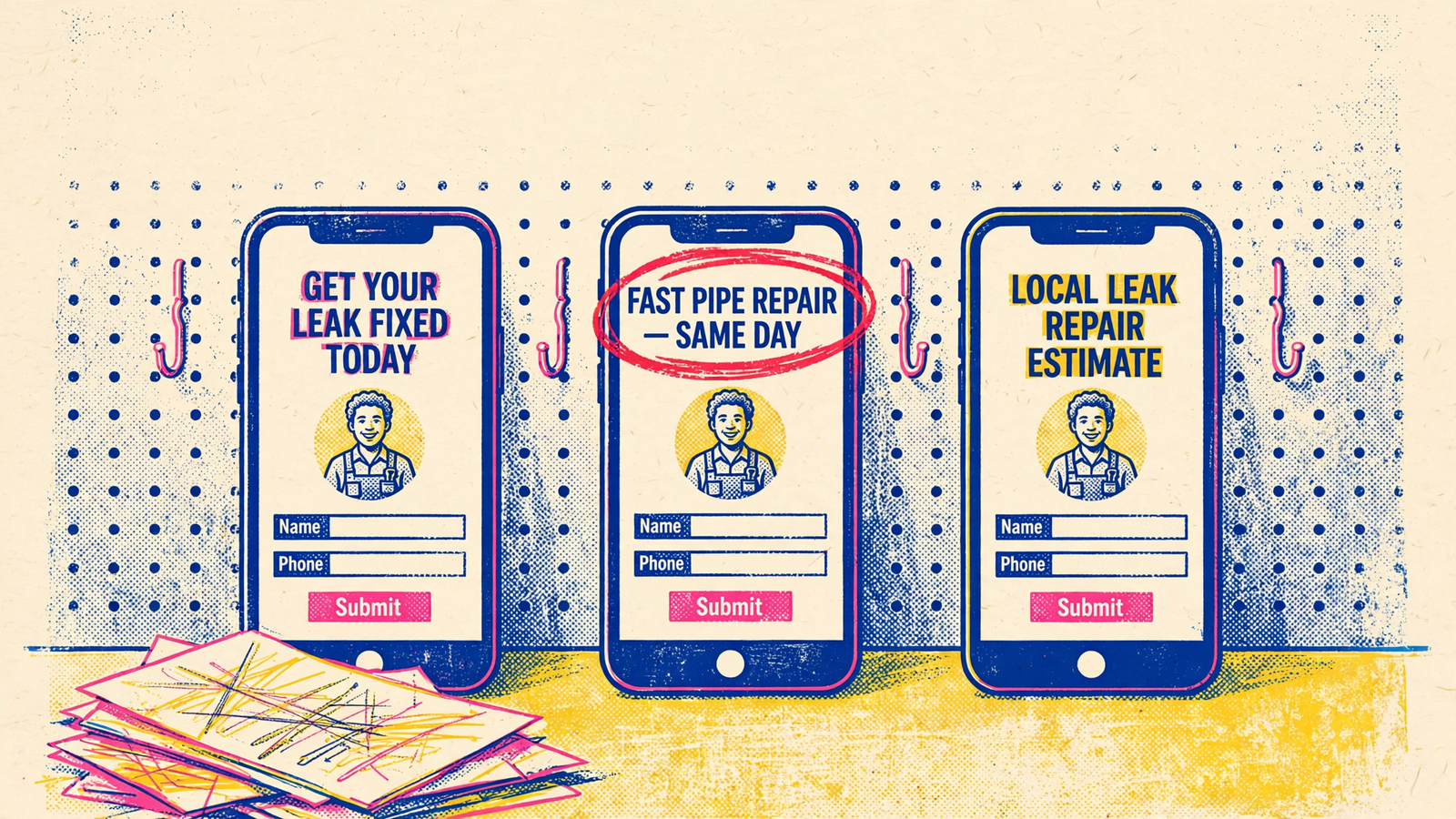
Use a kill rule, but do not mistake it for certainty. A creative that is 30% worse than the account average after 5,000 impressions or five conversions is a candidate to pause when you review comparable results. If qualified-lead data tells a different story, read that first. Roll the freed spend to the survivor. Do not rebuild a lookalike, swap audiences, and exclude placements at the same time; you would lose the ability to tell what changed.
At this budget, creative is the targeting you can afford to test. Keep the cadence fixed and the comparison clean.
4. Days 15–21: Judge the $700 by qualified leads
Cost against the cap: about $700, bringing media spend to $1,800. By day 21, you have more than two weeks of delivery to inspect. This step buys a decision about lead quality, not a prettier CPL report.
I match each creative to booked calls or qualified tags in the CRM, then divide its spend by that number. Suppose one ad brings in leads at $11 each and 40% qualify. Its cost per qualified lead is $27.50. Another brings in $7 leads but only 10% qualify. Its cost per qualified lead is $70. The lead that looked expensive in Ads Manager is the cheaper one for sales. That is why the first three days mattered: without qualified outcomes syncing back from the CRM, you cannot build a useful feedback loop.
Keep the decisions mechanical. Pause a creative that has used its $50 to $200 test allocation, has enough comparable delivery to assess, and sits well behind the account average on qualified outcomes. Give the survivor the freed budget on your weekly edit day. Do not increase total daily spend merely because one ad won; the plan still runs at $100 a day.
Here is why I keep one ad set. At a $12 raw-lead cost, roughly 50 results require about $600 a week, or around $85 a day. Your $700 week can support one such ad set, not three. A qualified event costing $150 would take roughly $7,500 a week to reach the same 50-event mark. This account cannot fund that by changing a dropdown.
What gets cut: duplicating winners into new campaigns, adding retargeting, and switching optimization to the qualified event before qualified volume supports it. Stay on the lead event for delivery; use the CRM to decide which leads are worth paying for.
5. Days 22–30: Spend the last $900 without inventing a new plan
Cost against the cap: about $900. Nine more days at $100 bring media spend to $2,700. The remaining $300 stays unspent under the $3,000 ceiling. This final stretch buys confirmation that your best hook can keep producing leads worth calling, not a licence to launch another campaign.
Keep the two or three creatives that survived the previous review. Introduce no more than two challengers on the next scheduled creative day, and change nothing else unless something is broken. By day 30, you should be able to write three numbers for each creative: raw CPL, qualify rate, and cost per qualified lead. The account you hand to month two has one campaign, broad targeting, Advantage+ placements, a short list of tested hooks, and a CRM feedback loop. That is the asset. The unspent $300 is not a failure to use the budget.
Write a one-page readout before touching spend: winners kept, losers paused with their spend noted, and one change planned for the next edit day. If one hook produces qualified leads at a cost you can live with, make two variants of it rather than five unrelated ideas. If nothing qualifies, do not raise spend. Check the offer and the speed of the first call. Running small ecommerce and services accounts taught me that a new audience was rarely the fix for a weak offer or slow follow-up.
A similar approach to a tight search budget appears in this lean Google Ads playbook. For this Meta account, the instruction stays simpler: finish the readout before you fund another experiment.
6. Before month two: Check what management would cost
Cost against the cap: $0 in media unless you choose to hire. Do the fee math before you let anyone sell you a more elaborate account structure. Pricing guides put some small-budget agency arrangements at 15% to 25% of spend, with $2,000 to $5,000 minimums. At a $3,000 media cap, a fee near the low end of those minimums would be substantial next to what the ads themselves can spend. Paying for more ad sets on top of that does not create more learning data.
I have sat on the other side of the percentage-fee equation. The report can arrive on time even when the work is mostly periodic checks. So ask three questions before paying for management:
- How often will you review an account this size, and what will you actually change?
- What is your written kill rule for creative?
- Will you judge performance by raw leads or qualified pipeline?
If the answers are vague weekly checks, no fixed decision rule, or cheaper CPL as the entire goal, walk away. A percentage-of-spend fee rises when spend rises; it does not reward someone for saying that one ad set and $100 a day are enough for now. For search, groas’s flat-fee model is the kind of fee structure I prefer to percentage-of-spend account babysitting. That is a search comparison, not a claim that it runs this Meta plan. For Meta, keep the test: any management fee must earn its place without starving the media budget.
When the $3,000 constraint lifts
If a hook holds under your target cost per qualified lead for two straight weeks, you have a reason to consider more spend. Scale the winner before you scale the structure. A deeper explanation of moving from raw leads to pipeline signals is in this guide to optimizing from leads to pipeline.
- Raise the winning campaign’s budget by 20% to 30% on the weekly edit day, then watch cost per qualified lead.
- Open one challenger ad set only when it has enough weekly budget to pursue its own roughly 50-result learning target.
- Test optimization toward the qualified event when qualified volume is steady enough to support it, around 50 events a week rather than a handful.
- Pause the scale-up if cost per qualified lead slips for two edit cycles in a row.
Thirty days at $100 a day will not fix a weak offer or a slow sales follow-up. No manager or machine can spend around that. It can show which hook earns a callback at a price you can afford, with receipts. Run one campaign, feed the CRM one clean quality signal, test a few ideas each week, and cut what fails. When the cap lifts, fund the winner, not the clutter.