LinkedIn

You have eight weeks to take Meta spend from $4k to $8k a month, one new creative batch per week, and no new campaigns until week five. Double the budget in one move and you may get the spend you asked for. The CPA is another matter.
I used to tell clients to push harder on winners. I was wrong. A winner at $4k a month is winning with a particular budget, audience reach, frequency and set of creatives. A large edit can disrupt delivery, while the extra spend reaches impressions the old budget never had to buy. That is why doubling the budget in one move is a poor scaling plan. I would rather earn each increase: raise spend, leave it alone long enough to read CPA, then decide whether the next step is allowed.
1. Before week 1: set the cap and the CPA gate
Cost against the constraint: no extra spend yet. What it buys: a decision rule you can use when the numbers get uncomfortable.
At $4k a month, you spend about $133 a day. At $8k, you spend about $267. Those figures are total account spend, not the scaling campaign plus an uncounted test budget. By week eight, the scaler and tests together must fit inside $267 a day. This is the accounting rule for every step below.
Start with a scaling campaign that has delivered a usable cost-per-purchase baseline for at least seven days, not two good afternoons. Record the last 14 days of CPA and choose the highest CPA you will accept before you raise anything. For the running example, the baseline is $42 and the ceiling is $48, roughly 15% higher. Your business may need a different ceiling. What matters is writing it down before a bad day tempts you to move it.
Keep the scaling campaign and an existing isolated testing campaign in place. This plan assumes that testing campaign is already there; it does not quietly create one in week three and call that compliance with the no-new-campaigns rule. For illustration, the current $133 daily total is $110 in the scaler and $23 in tests. Check your own split before copying the numbers.
I would also look at whether prospecting frequency is still around or below 2 and whether two or three concepts, rather than one ad, can carry delivery. An account with thin conversion volume will produce noisy four-day CPA reads. If you cannot distinguish a change from ordinary variation, do not pretend the spreadsheet has granted permission to scale. Cut the schedule, not the gate.
2. Week 1: buy the first clean read
Cost against the constraint: raise the total from about $133 to $160 a day: $130 in the scaler and $30 in the existing test campaign. What it buys: the first read on whether more spend can hold the $48 CPA ceiling.
Make the change once. The scaler moves from $110 to $130, an increase of about 18%. Then leave budgets alone for at least 72 hours and judge CPA after four full days, not the first afternoon. The familiar guardrail is an increase of about 20% at a time followed by 24 to 72 hours without another edit. It is a way to avoid piling changes on top of changes, not a guarantee that delivery will behave.
Ship one creative batch this week. Add it to the testing work already underway; do not launch another campaign to house it. What gets cut is the Monday-morning impulse to double the winner because last week looked good. Two 20% raises in a day amount to a 44% increase. Calling them two small steps does not make the auction agree.
If four full days of CPA are at or below $48, week two is available. If not, hold. The increase buys evidence only if you give it time to arrive.
3. Week 2: take the next step only if week 1 held
Cost against the constraint: move the total to $192 a day, with $155 in the scaler and $37 in tests. What it buys: a roughly $5,700 monthly run rate without asking one campaign to absorb the entire increase.
The scaler rises from $130 to $155, about 19%. Keep testing in the existing campaign, and ship this week’s creative batch. Do not add audiences, change the offer and raise budgets on the same day. If CPA moves, you need a plausible cause, not four suspects standing around the account.
Check the first step against the $48 ceiling before making the second. After the week-two move, wait through another four full days before judging it. If CPA is above the ceiling, hold at $192 rather than scheduling week three by force. If it remains high, the rollback rule in step seven applies.
This is where a calendar-led plan and a gated plan part ways. The calendar says you are supposed to spend more next week. CPA gets the vote.
4. Weeks 3–4: fund creative before fatigue takes the budget
Cost against the constraint: if the preceding gates pass, week three rises to $225 a day ($185 scaler, $40 tests); week four rises to $245 ($200 scaler, $45 tests). What it buys: more delivery plus a funded search for the next working creative.
By week three, you have asked the original winners to absorb two increases. Higher spend can build frequency; if people see the same ad more often and click less, CPA can climb even while the account spends exactly as planned. Creative is not a garnish here. The draft’s creative-production guidance puts a useful warning on the problem: faster spend can mean faster fatigue.
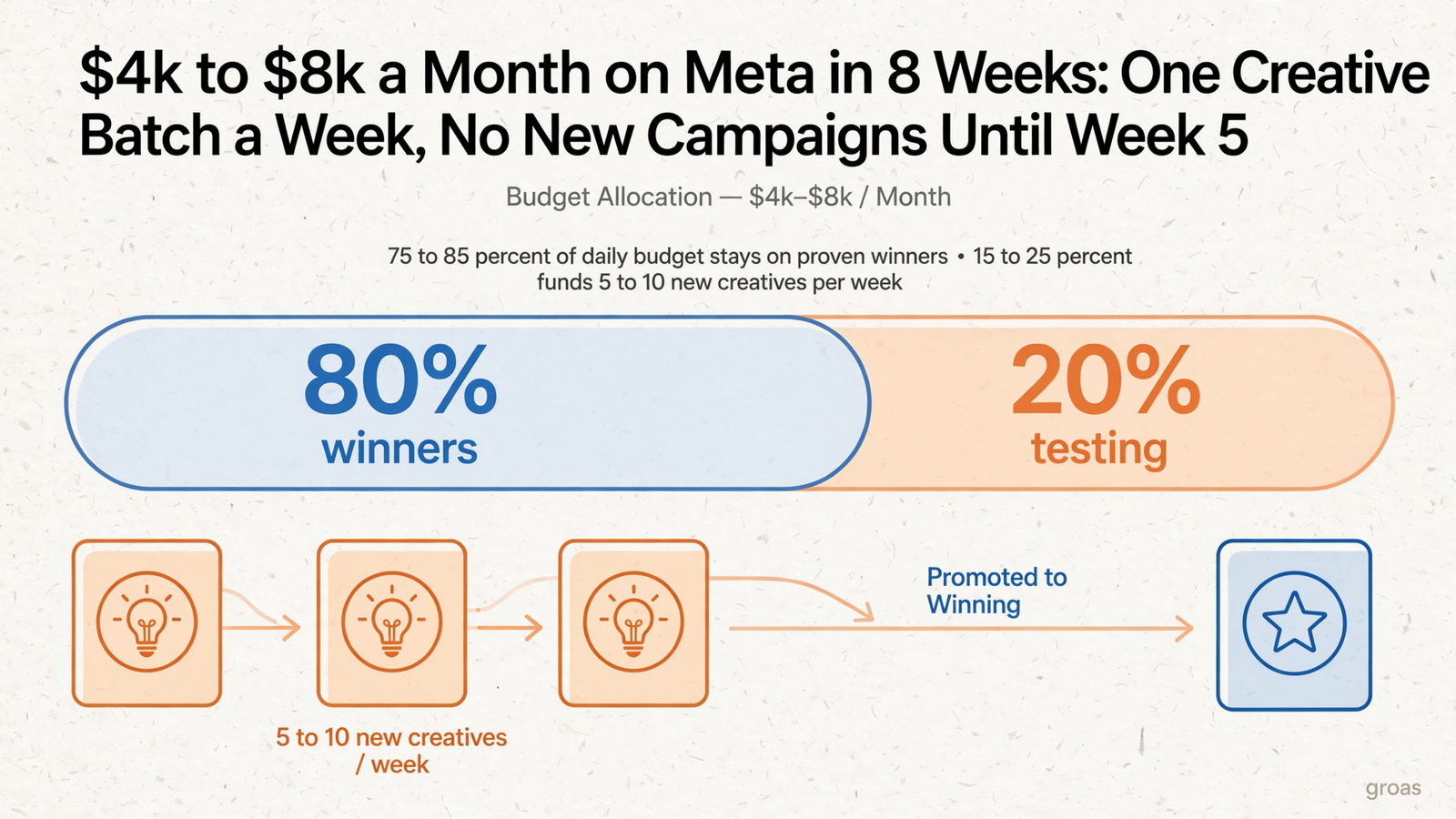
Use the week-three test budget for a batch of five ads: two hooks on the winning concept, two UGC variations with different opening seconds, and one static or carousel treatment of the same offer. At $40 a day, the test campaign has about $280 over a week. That can give five ads roughly $50 each, though delivery will not divide itself neatly. Do not call a loser after a handful of impressions, and do not promise that every batch contains a winner. The point of paying for tests is to find out.
Week three’s scaler increase, from $155 to $185, is about 19%. Take it only if week-two CPA passed. Week four’s move from $185 to $200 is smaller; take it only after week three passes. Keep one new batch in week four as well. Move a tested winner into the scaler, cut the ads that have had a fair test and failed, and record which hook worked. Keep the testing allocation visible rather than letting it disappear into the scaling campaign. The suggested 15% to 25% testing slice is a useful discipline when every extra dollar needs a job.
What gets cut: new campaigns and speculative audiences. You are still working inside the structure you brought into week one. No new creative batch, no next budget increase.
5. Weeks 5–6: allow one structural test, then reach $8k
Cost against the constraint: if CPA holds, week five goes to $255 a day ($210 scaler, $45 tests). Week six goes to $267 ($220 scaler, $47 tests). What it buys: the $8k monthly run rate while keeping tests inside the cap.
Week five is the first time a new campaign is allowed, not an obligation to create one. Pick one new audience or one offer angle to test. If you have been scaling broad, that might mean a single interest stack or lookalike in an isolated test. Or keep the audience and change the offer angle. Do not change both and then claim to know why CPA moved.
Cap that structural test at $30 a day within week five’s $45 test allocation. The remaining $15 a day funds the weekly creative batch in the existing testing setup. Keep the batch small enough to give each ad a meaningful chance. In week six, the $47 test allocation still has to cover the weekly creative batch and any continuing structural test. If it cannot, pause the structural test. The $267 cap does not bend to accommodate a promising idea.
The scaler steps are deliberately modest now: $200 to $210, then $210 to $220. Before each, check the preceding four full days against the $48 CPA ceiling and look at conversion quality, not just the number in Ads Manager. Do not move a new test into the scaler because it produced a cheap result or two. Wait until it has enough results to compare credibly with the control. If that evidence is not there by week six, leave it in testing or cut it.
Read failures by cause. Rising CPM with steady CTR can reflect a more expensive auction as you reach further. Rising frequency with falling CTR points toward fatigue. A sudden jump immediately after an edit may be delivery settling after the change. Those patterns call for different actions; none is a reason to raise the budget again and hope.
6. Weeks 7–8: prove the new run rate can hold
Cost against the constraint: no further increase. Hold the total at $267 a day, including the $47 test allocation. What it buys: two weeks to find out whether $8k is a stable run rate or an expensive visit.
Keep shipping one creative batch a week. Do the daily maintenance. Do not open another audience because the budget has stopped climbing. If a new test is not earning its share, pause it and keep the money within the cap; you do not have to spend every dollar merely because the plan permits it.
At this stage, look beyond the account-wide average. Is one creative carrying most of delivery? Is frequency rising while CTR falls? Is the apparent CPA win coming from conversions that do not turn into qualified customers? Those are ways to hit the spend target and miss the business target.
Then reset the baseline honestly. If the original CPA was $42 and the account settles at $45 under the higher spend, write down $45. Decide what ceiling the business can support from there; do not silently reuse or raise a ceiling because you want another increase. What gets cut is the victory lap after one good day at $267. You leave week eight with a baseline you can defend, not just a larger invoice.
7. At any failed gate: hold, roll back or cut
Cost against the constraint: time, and possibly the spend you hoped to add this week. What it buys: protection from turning a temporary failure into the new normal.
A failed step means CPA remains above the ceiling after four full days, not one ugly morning. Hold the total budget flat for another three days and ship the scheduled creative batch. If CPA returns under the ceiling, advance late. An eight-week target is not permission to ignore the gate that makes the target worth reaching.
If CPA stays materially above the ceiling, roll back to the last total budget that held and give that level a full week. If frequency is climbing while CTR slides, cut the fatigued ad or unsuccessful new audience rather than waiting for the same impressions to become charming again. If the spike follows a budget edit, first stop editing and let delivery settle. If CPM rises while CTR holds, accept that some additional reach costs more, but only while CPA stays within the ceiling you chose.
I used to tell clients to wait out weak performance for longer. I was wrong when the problem was fatigue. One variable at a time gives you a chance to tell patience from paying twice as fast for the same mistake.
8. Every Monday: run the go/no-go checklist
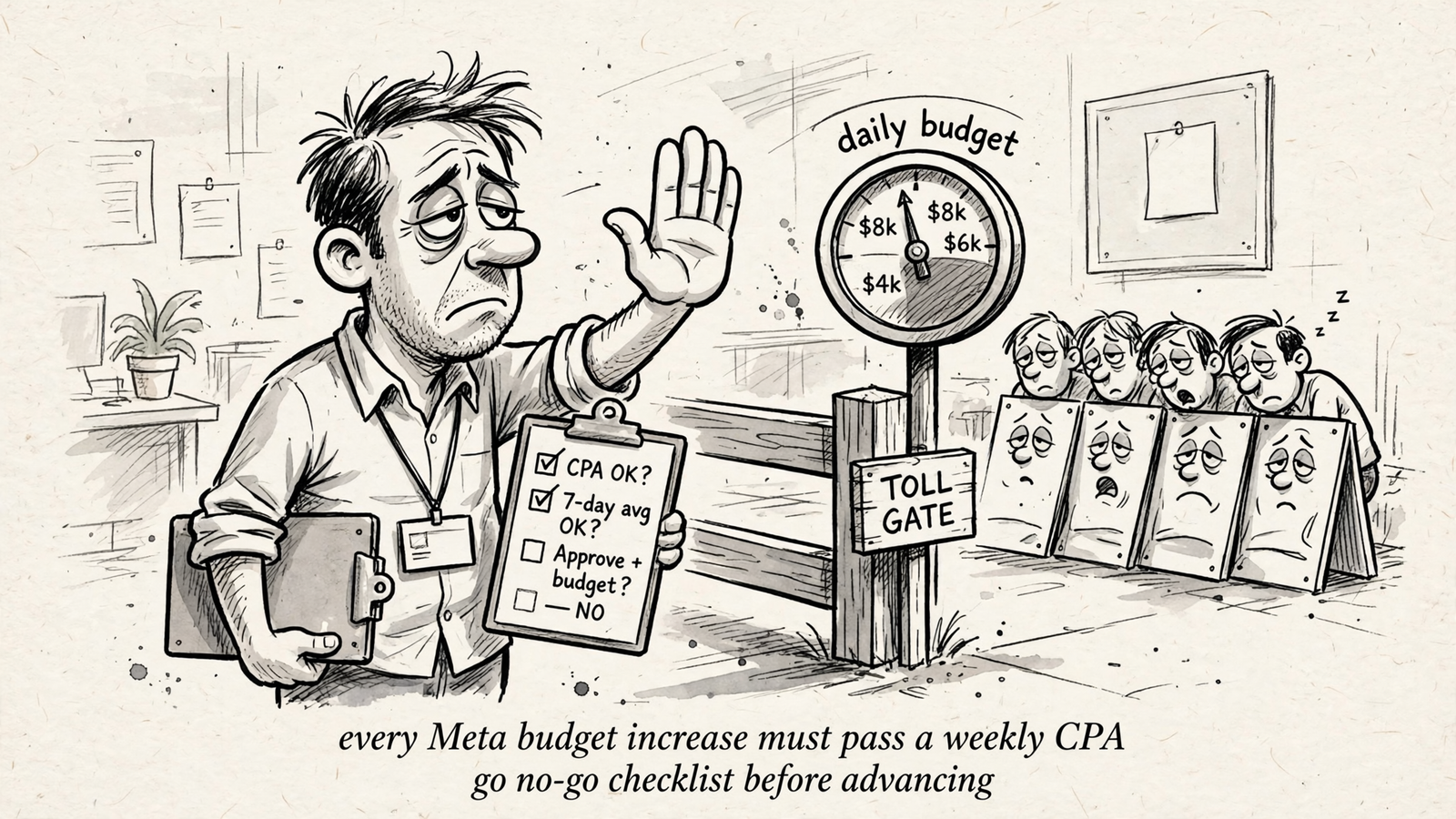
This is the one-minute check before anyone touches budget. Each item has to pass for the next increase to happen; the weekly date on the plan is not an override.
- CPA versus the written ceiling: use four full days after the last change; over $48 in the running example means hold.
- Enough results for a useful read: if conversions are too thin to interpret the move, hold rather than declaring a win on noise.
- Frequency and CTR together: rising frequency with falling CTR calls for creative work, not another increase.
- More than one working concept: if one ad carries delivery, ship the next batch before asking it to spend more.
- Total spend within the weekly cap: count the scaler and tests; week six onward means no more than $267 a day in this example.
- Conversion quality checked in the CRM: a stable cost per lead can hide a falling qualified rate; skip this and you can scale junk to $8k.
9. Before anyone sells you a faster plan: ask who gets paid
Cost against the constraint: no media spend. What it buys: a clear answer about whether the person recommending a faster increase is accountable to your CPA ceiling.
Ask an agency what size step it will take, how long it will hold after the edit and which CPA stops the next increase. If it cannot name the ceiling, it has a spend target, not a scaling plan. At $4k to $8k, percentage-of-spend pricing of 10% to 20% makes that distinction worth discussing. A 15% fee is $600 to $1,200 a month on top of media across this range. The fee rises when spend rises, whether CPA holds or not.
I would rather pay a flat fee and remove that incentive. groas lists Meta Ads at $1,499 a month flat, regardless of spend, with budgets and ads worked continuously while new ads are tested. That is a better fit for this playbook than paying someone more to increase the budget and review the damage next month. The work is not to admire the dashboard. It is to check the gate, make the permitted change and leave a record of what happened.
When the eight-week constraint lifts, do not return to big jumps. Hold $8k until the new CPA baseline proves durable, keep the weekly creative batch and retain a funded test slice. If $12k is next, build another sequence of small increases with a ceiling set before the first edit. Scale is permission your CPA grants you, not a decision you make for it.