

 LinkedIn

Most agencies won’t tell you this: a daily publishing calendar is the wrong first deliverable when your pricing page contradicts the proposal and nobody can inspect your proof. I have audited accounts publishing 20 posts a month with exactly those problems. More pages will not repair them. If you own a business and are comparing done-for-you SEO and AI search services, send this list to the provider before you sign. Ask for a repair queue, not another promise about posting frequency.
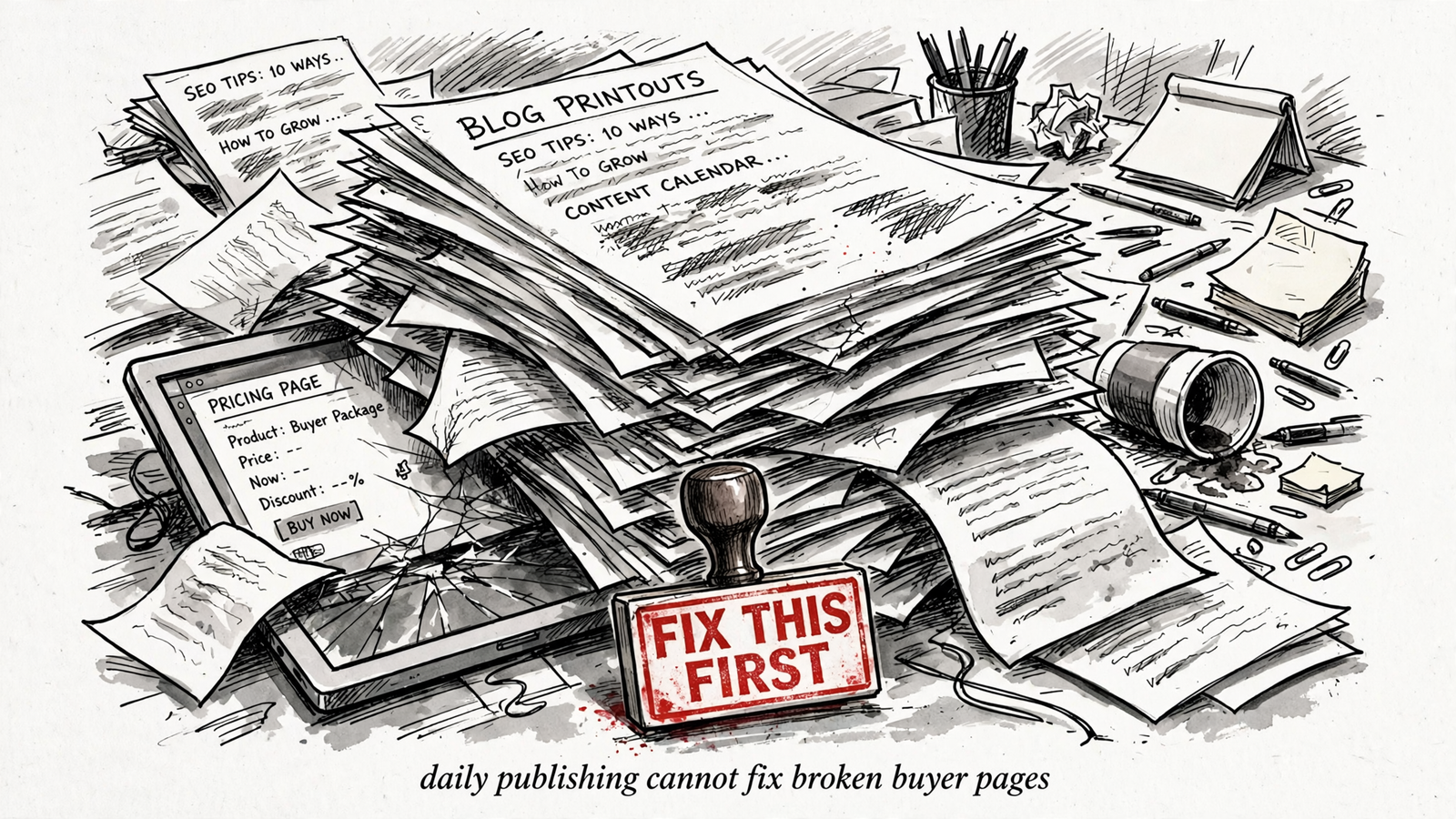
1. Put the real price and the exit on one page
A pricing page that says “starting at $299” but leaves out the minimum, the term and the extras is not a price. It is a hook. For context, small businesses pay $2,500 to $5,000 a month for comprehensive SEO, the median retainer sits at $1,000 to $1,500, and agencies average $3,209 a month versus $1,348 for freelancers. A $299 promise for competitive terms sells volume, not strategy. I have seen that movie: you sign, receive two thin posts, then find the landing page build and the “extra” links on invoice two. Content and links beyond a token allowance, plus landing page builds, are documented second-invoice surprises.
The page must show what you pay, what costs extra and how you leave. Ask the provider to put minimums, separate charges and cancellation terms together before they publish a word. Name the traps explicitly: a 12-month minimum with no 90-day review, auto-renewal requiring 30 to 60 days’ notice, and the agency owning your Search Console, Analytics or content. I hear the same complaint repeatedly: a long contract, monthly payments, vague reports and an exit that means owing future payments regardless of performance.
Compare that with groas pricing at $1,499 a month per service, month to month with cancel anytime, no setup fees and a 7-day money-back guarantee. The point is not that every provider needs the same terms. It is that you should be able to read the commitment before making one. First step: request the pricing URL and mark every cost or exit condition that still requires a sales call to explain. If they will not put the exit in writing, you do not have a service. You have a lease.
2. Rewrite the offer page until the scope fits on one screen
Most offer pages I review say some version of “full-service SEO and GEO to grow visibility everywhere.” That sentence commits to nothing. It does not say what gets audited, what gets built, what counts as a mention or how anyone will know the work helped. A buyer cannot approve that scope. An AI answer cannot cite a clear service description that was never written.
A useful offer page names the work: an audit with a prompt list, a crawler review, content and entity work, earned mentions with URLs, and measurement. Judge the provider on scope, evidence, honest measurement and refusal to promise citations. If the offer page cannot name those five parts, do not buy the publishing calendar underneath it.
Ask for one paragraph of scope, one line saying who the service is for and one line saying what it excludes. I used to tell clients broad scope meant flexibility. I was wrong. Broad scope is where the invoice-two extras hide. Say you pay $1,500 a month and “content” turns out to mean two short posts plus five links, with no owner and no dates. You have paid for activity without a way to judge it against revenue or pipeline. Reporting rankings alone will not fix that gap. First step: make the provider write down the exclusions before they write a new post.
3. Say who should not buy on a fit page
Most SEO and AI search pages welcome everyone. Plumbers in Leeds, SaaS in Austin, ecommerce in Sydney: come on in. Then the work starts and stalls because nobody can edit the site, approve content or say which location drives revenue. Publishing volume cannot solve an access problem.
I used to accept “we will sort access after kickoff.” I was wrong. If nobody can edit pages or approve content in week one, you do not have a campaign. You have a subscription to waiting. A useful onboarding diagnostic establishes who approves work, who implements it, what business outcome justifies the cost, and whether one improvement ships in week one.
The fit page should let a bad-fit buyer rule themselves out. Ask the provider to state, in plain lines:
- The minimum budget and term.
- The service areas covered for local work, and who is outside them.
- The site access needed and who must approve changes.
- The expected review turnaround and what happens if approval takes 14 days.
This is not paperwork for its own sake. Those answers determine whether the provider can do the work they intend to sell you. First step: ask them to publish the prerequisites and the exclusions together. If they cannot tell a bad-fit buyer to walk away, they will tell a good-fit buyer to wait.
4. Compare the alternatives without selling a trick
Every buyer comparing done-for-you SEO has the same silent question: why not hire a freelancer, buy a one-time audit or do nothing for three months? If the provider has no page that answers it, the buyer goes elsewhere for an answer.
A useful alternatives page names tradeoffs. A freelancer costs less per month but stops when the hours stop. A checklist audit hands you tasks without someone to run them. Publishing without technical fixes can leave pages uncrawled. The comparison should explain the work each option leaves on your desk, not pretend every alternative is foolish. It should also make the case for a managed service like groas when you need the work carried through rather than handed back as a list.
What it must not sell is a trick. Do not accept llms.txt, chopped-up copy, AI-only rewrites or inauthentic mentions as substitutes for a clear offer and work someone can verify. An llms.txt file is not a promise that an AI answer will cite you. Neither is a screenshot of one answer. Nobody can guarantee that citation, and a provider who writes the guarantee into an alternatives page is showing you what they are prepared to sell.
First step: request a page comparing three choices—doing it in-house, hiring hourly help and hiring a done-for-you service. For each, ask when it fits and what it costs you in time. Check for duplicated work, too: you do not need a GEO agency stacked on an SEO agency doing the same work. You need SEO that measures AI mentions in one run. If the provider cannot name a buyer who should choose something else, they have not thought hard enough about fit.

5. Make one proof page inspectable
I read the evidence page before I read the blog. If it shows logos, percent lifts and no dates, I close the tab. Useful case-study evidence gives a named client or an industry and size, dates, baseline metrics, specific actions, commercial outcomes and a timeline. That is enough to let a buyer inspect the claim instead of admiring its typography.
Be sceptical of overnight wins for competitive terms; real growth can take 3 to 12 months. “Conversions up 135% in 7 days” without a baseline, spend or a list of changes is not proof. It is a screenshot wearing a suit. Ask for the baseline, timeframe, method and what the provider will show you when a month goes flat. Traffic alone cannot answer whether the work helped the business.
AI search adds another problem: answers vary between runs. The same prompt on a different day can return different citations even when you changed nothing. Judge the measurement method: which prompts were tracked, how often they are re-tested, how variance is separated from change, and what a flat month looks like. Ask for the platforms, locations, dates and rule for calling something a win. Without them, you cannot separate work from luck.
First step: have the provider replace one vague win with one you can inspect. If they do not have one, do not ask them to manufacture case studies to fill the page. Fix what the page claims before approving more claims elsewhere.
6. Show what happens after yes on an implementation page
I have watched more retainers die in week two than in month six. The contract is signed, the kickoff call ends, and nothing moves for 19 days because nobody requested logins in order or named who publishes. One implementation page can prevent that drift. It should say what the provider needs from you, what they handle, and what happens in the first 30 days. Access requests need an owner, a deadline and a fallback, covering Search Console, GA4, a named CMS account, Tag Manager, Business Profile, log files, and paid search and CRM data where useful. No shared passwords by email. No “we will figure out publishing later.” If they cannot publish, they do not have a content plan. They have a wish.

I look for a live date in writing: pick services and pay online, share the access you have, book an onboarding call to agree goals, then work starts within 24 hours of that call. With groas, you stay with the same account manager from there. Ask for one shipped improvement in week one, even a small technical fix, before you approve a calendar. A 90-day content-volume promise is not an answer to “What ships first?”
Make this page the basis of the brief you send before signing. Ask for a URL-level repair queue for all six pages, with owners and dates. Get the five proposal must-haves in writing: a baseline with prompts, platforms, locations and dates; a diagnosis of the failing stage; scope and exclusions; a rule for measuring variance; and exit terms that say who owns what. Any promise of guaranteed inclusion or position zero ends the conversation.
For AI search, add the technical check many providers skip: confirm that you allow OAI-SearchBot in robots.txt and its published IP ranges through the host and CDN. Sites opted out of OAI-SearchBot will not appear in ChatGPT search answers, and firewall rules can block AI crawlers accidentally. Track Google visibility and AI mentions separately. The work and the measurement are not identical, and nobody can guarantee an AI will cite you. Ask for the prompt list and re-test rule, not a screenshot.
That is the queue I would send. But if I could get only one page fixed before signing, I would start with No. 1: pricing. Price and exit decide your leverage. Get the real commitment and the cancellation in writing, then make the provider earn the publishing volume.