

 LinkedIn

A 0.9% CTR screenshot makes a tidy slide. It does not make a proven ChatGPT ads playbook. The channel is young enough that performance benchmarks do not yet exist across advertisers, industries or campaign types, yet agencies are already selling results you can supposedly borrow, Google tactics you can supposedly port, and cheap clicks you can supposedly lock in. The bigger risk right now is the pitch, not the platform. I would rather buy a small test with a stop line than pay someone to present a confident case study while they learn on my budget.
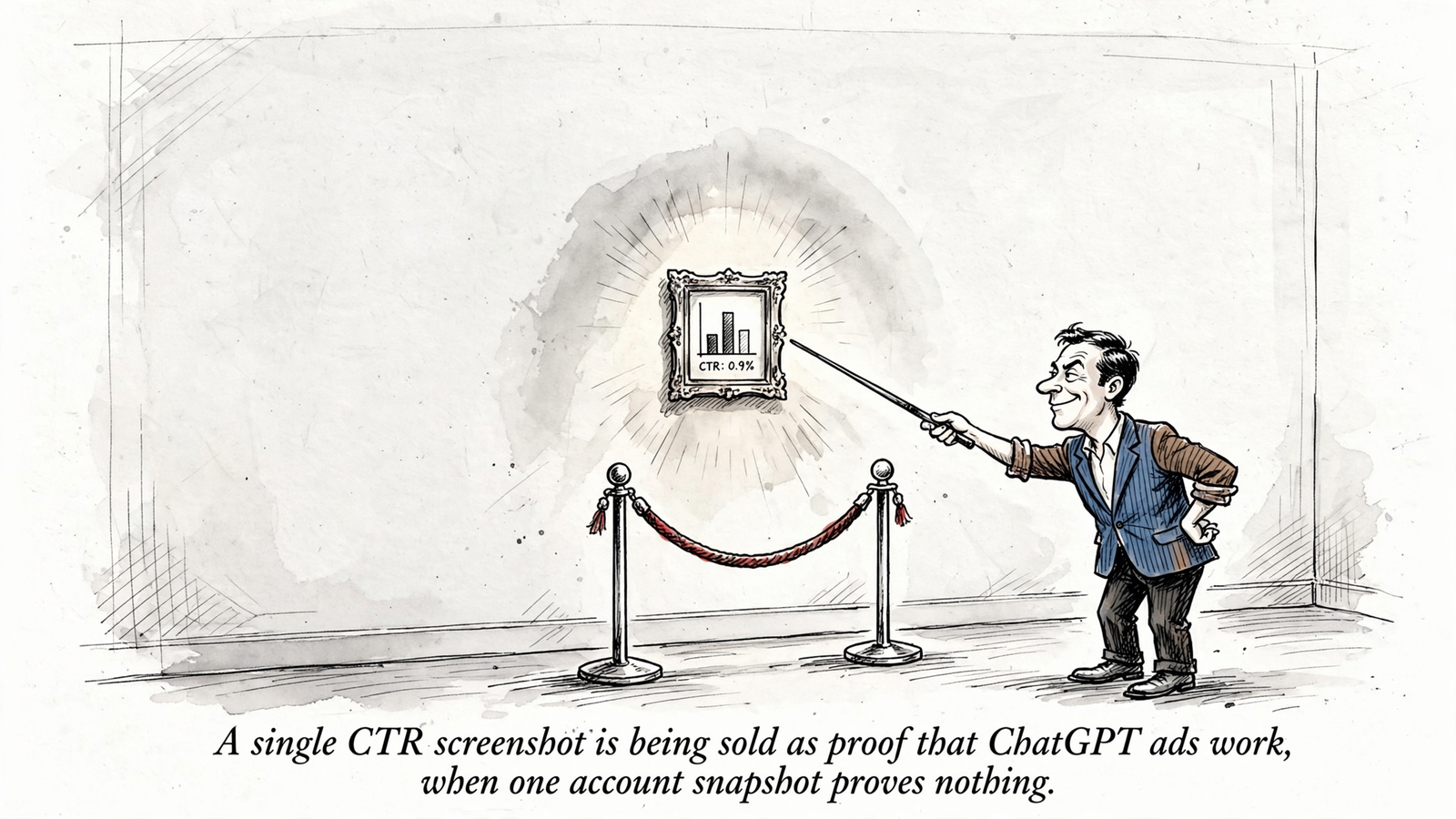
Myth 1: ‘We have case studies proving ChatGPT ads work’
I get why this lands. Before you pay someone to run a new channel, you want proof they have run it well. I managed Google Ads for years, and I learned to ask what a screenshot left out: the timeframe, the spend, the before period, and what counted as a conversion. A CTR slide without those details was thin evidence then. On a channel without established benchmarks, it is thinner still.
ChatGPT ads are live, but their reach is limited. The US test started February 9, 2026, and has since expanded to more than 60 countries for viewing and 63 for self-serve buying. Ads appear only for logged-in adults on Free and Go plans. Plus, Pro, Business, Enterprise and Education users, people under 18, and users in Temporary Chats do not see them; neither do users in health or politics chats. That is a specific slice of inventory, not a mature search market you can forecast from one account’s week.
The public pilots show why the distinction matters. Choice OMG spent $415 for about 9,000 impressions and 60 clicks, roughly a 0.6% CTR and $7 CPC, with zero buyers. Windmill spent $1,470 over a month for 39,284 impressions at a 0.66% CTR and $5.68 average CPC, also with zero conversions. A working paper across 102 ecommerce sites found $0.89 in revenue per ChatGPT ad visit versus $2.45 for paid Google search, with conversion rates of 0.37% and 1.17%, respectively. Those are useful observations. They are not a result you can borrow.
Ask on the call: “Show me the control period, exact dates, spend, and qualified sales after the click.” If the case study cannot answer all four, call it a screenshot. Pay for a test with a kill rule, not someone else’s highlight.
Myth 2: ‘It’s just Google Ads in a chat window’
I understand the appeal of this one. I used to build match-type structures by hand. If that work transfers, a Google veteran can bring a familiar toolkit to a new channel and start billing. But the part that made the toolkit useful is missing.
Advertisers do not port keyword lists into ChatGPT ads. They write Context Hints describing their ideal customer, problems, and relevant conversations; OpenAI matches ads to conversational intent. There are no match types or search term reports to mine. The early controls also lack the familiar demographic and remarketing options, apart from custom audiences requiring 25,000 matched users, and offer only country-level geography. The ad itself appears as a labeled sponsored card below the response, on a system separate from the answer. Reporting gives advertisers aggregate impressions and clicks, not the conversation that produced each one.
So when a seller promises negative-keyword mining or a SKAG-style build for ChatGPT, ask what they intend to operate. The console does not give them those levers. Your Google experience still matters where the mechanics genuinely overlap: offer math, landing pages, and deciding what a qualified lead is worth. It does not conjure a search term report into existence.
Ask: “Show me where search terms live in the ChatGPT ads console.” If the answer is a Google report and a speech about transferable expertise, keep your budget. Hire for conversation matching and post-click tracking, not keyword surgery.
Myth 3: ‘You need a big budget to learn anything’
Agencies like big budgets. Percentage-of-spend pricing likes them too. I am not against spending enough to reach a decision; I am against calling a large commitment a prerequisite when the first useful decision may be whether the tracking works at all.
Campaigns can start at $25 a day, with OpenAI suggesting a $3 to $5 max CPC. Say you spend $20,000 a month on Google and someone tells you to match that in ChatGPT or learn nothing. Start with the clicks instead. At Windmill’s $5.68 average CPC, $25 a day buys about four or five clicks. Over 30 days, that is roughly 130 to 150 clicks. With early CTRs of 0.6% to 0.91%, versus about 6.4% on Google search, impressions may arrive quickly while evidence about buyers arrives slowly.
That smaller budget can tell you whether an ad serves, whether people click, whether tagged visits reach your analytics, and whether any of those visits become qualified leads. It cannot establish a winning CPA just because the first week looks tidy. Bigger spend does not fix a vague question; it lets you ask it more expensively.
Ask: “At my expected CPC and conversion rate, how many clicks and how many weeks until we call this a no?” If the agency cannot put numbers beside the decision, it is selling spend, not learning. Fund the test to reach a decision, not to impress the rep.
Myth 4: ‘Ads in LLMs change what the assistant recommends’
I hear the hope behind this one. If you pay to appear near an answer, surely the assistant will start naming you in the answer itself. That would be a convenient shortcut. It is not what this ad buys.
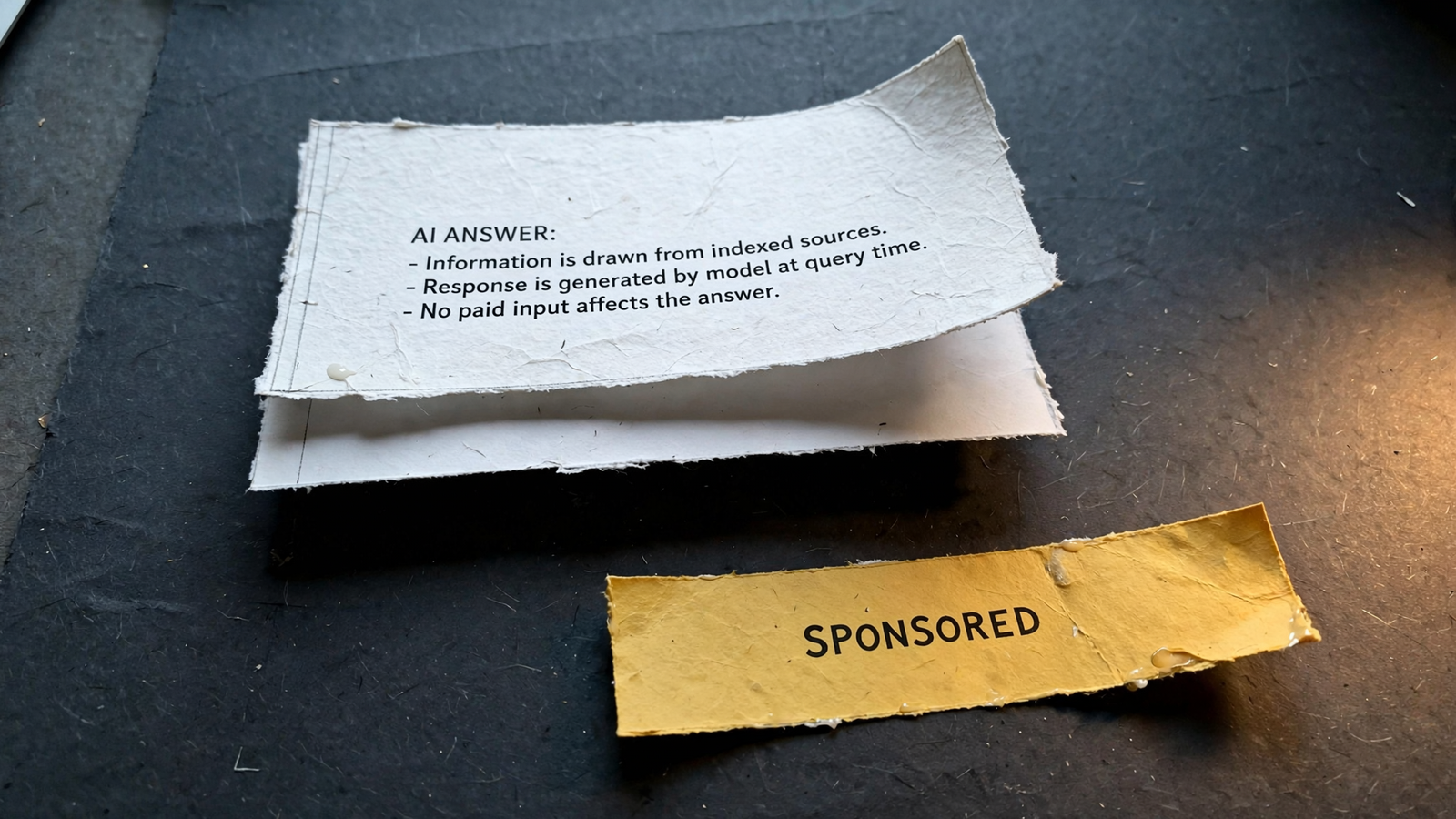
OpenAI places a labeled sponsored card below the response, on a system separate from the answer. Advertisers receive aggregate impressions and clicks, not chats or personal data. The difference between appearing nearby and being recommended matters: across 100 brands tracked, the median owned-domain share of AI citations was 6.8%, the median mention rate was 19.8%, and the recommended rate was 0.2%. A sponsored card does not close that gap by rewriting the answer.
Ask: “Will my brand be named in the answer itself, or only in the card underneath?” If the seller blurs that line, they are selling organic visibility with a paid-media invoice. Buy the card if the placement is worth testing. Earn the mention separately.
Myth 5: ‘Early movers lock in cheap traffic forever’
The early-Google story does a lot of work in this pitch. Some buyers did get cheap clicks for years, so the promise sounds familiar: enter now, establish yourself, and keep the discount. I believed a version of that story when Performance Max CPCs looked soft for three months. Then they snapped back.
ChatGPT ad supply is limited by who can see ads and where they can appear. Demand can grow without that supply growing alongside it. Early public CPCs already range from $1.72 to about $7, with CTRs of 0.6% to 0.91%. One ecommerce analysis put a break-even click price at about $0.26, versus a $0.72 Google search CPC, well below OpenAI’s suggested $3 to $5 starting bids. Among 87 advertisers buying both, 84 earned less per ChatGPT visit.
None of that proves your clicks will follow the same pattern. It does expose the hole in the guarantee: buying early does not reserve a future CPC. If more advertisers enter the same conversations, you still have to decide what those visits are worth to you.
Ask: “What keeps my CPC low when ten competitors enter these conversations next quarter?” If the answer is first-mover advantage rather than budget caps, intent coverage, and a stop line, you are hearing an old auction story dressed for a new one. Rent the learning early. Do not prepay for a discount no auction guarantees.
Myth 6: ‘A ChatGPT-only specialist will outperform a team running your search channels together’
Specialists sound reassuring when a channel is unfamiliar. You want someone who knows the console, catches its quirks, and does not have to learn where the buttons are on your dime. I have made the case for channel specialists myself. The trouble starts when knowing one console becomes a substitute for deciding where the next dollar belongs.
ChatGPT ad inventory is narrow, and a paid card cannot buy a mention inside the answer. Other assistants offer no comparable paid lever in the examples we have: Perplexity ran sponsored follow-ups then walked away from ads, Anthropic said Claude stays ad-free, and the Gemini app had no ad product at the time covered. A ChatGPT-only operator cannot solve visibility on those surfaces by buying another card. They also need to know when Google or Bing produces a qualified lead at a lower cost, rather than treating every ChatGPT click as a victory for their contract.
That is the reason groas runs Google, Bing, and ChatGPT as one Search Ads service for a single flat fee, instead of selling ChatGPT as a separate fiefdom. The comparison should happen at the level of qualified pipeline, with someone accountable for moving budget when the evidence changes. A specialist who never has to make that call can be very good at reporting activity and still be the wrong fit.
Ask: “If ChatGPT loses to Google on cost per qualified lead for two weeks running, who moves the money, and how fast?” If the answer requires two contracts and a sync call, you hired coordination overhead, not coverage. Test ChatGPT inside your search program, not beside it.
Myth 7: ‘Clicks and impressions tell you if it’s working’
This is the hardest one to kill because I want to believe it too. A clean CTR in week one feels like progress. On Google, it can tell you something useful about how well a message matches intent. In ChatGPT, it may tell you little more than that a card beneath an interesting answer got attention. The visit still has to arrive, qualify, and become a customer.
The published funnels make that uncomfortable. Cleverly saw a decent CTR, then paused after zero conversions; OpenAI reported 57 clicks against fewer than 20 GA visits. Windmill bought 39,284 impressions and found no pipeline. The ecommerce paper reported zero sales from 18,726 ChatGPT visits for 73 of 87 advertisers buying both systems. Those results do not make testing pointless. They make clicks a poor substitute for the outcome you meant to buy.
Tracking can widen the gap between a platform report and a useful decision. ChatGPT Ads appends an oppref click ID by default, but no source or medium. Leave paid links untagged and GA4 can group their visits with ordinary chatgpt.com referrals, including organic mentions. You cannot separate those visits reliably after the fact. Tag links up front with utm_source=chatgpt.com and utm_medium=cpc, then put a ChatGPT Ads rule above AI Referral in your GA4 custom channel grouping. That does not create sales. It lets you tell which clicks were paid for.
I would use the sales call to get three answers in writing:
- Show me the control. Give me dates, spend, clicks, and qualified sales after the click. Do not stop at CTR or impressions.
- Show me the tracking. Open a tagged campaign URL and the GA4 rule that keeps paid ChatGPT visits out of organic referrals.
- Name the kill rule. State the spend or click limit, the outcome that triggers a pause, and who moves the money back to Google or Bing.
Then buy the smallest test that can produce that decision: one campaign at $25 to $50 a day, tight Context Hints, full UTMs, three to four weeks, and a written stop line before launch. For example, pause at $750 in spend or 150 clicks with zero qualified leads. That is a rule for the test, not a promise that 150 clicks can prove a scalable CPA. If cost per qualified lead gets within shouting distance of Google, keep the experiment inside the same search budget, where Google, Bing, and ChatGPT can be managed together.
I still catch myself checking CTR first out of old habit. It is a useful diagnostic, and a terrible finish line. Clicks feel like progress. Qualified pipeline is progress.