

 LinkedIn

I used to warn clients away from AI Google Ads agencies. I had cleaned up accounts where automation spent freely with little to show for it, so the warning felt earned. But I aimed two objections at the wrong target, and the other five confused bad agencies with AI itself. Most objections are either true of Google’s own automation and false of specialized agents, or true of bad human agencies and false of AI. The useful question is not whether an agency says it uses AI. It is what the system does, who controls it, and what you can verify.
Myth 1: “It’s just Smart Bidding with a markup”
This is one of the two I used to believe. When I managed accounts by hand, every “AI” pitch I saw seemed to boil down to turning on Smart Bidding and charging a retainer to watch it. Google uses that term for automated strategies that set bids in each auction for conversions or conversion value. Target CPA, Target ROAS and Maximize conversions count. Smart Bidding does not, by itself, build account structure, mine negative keywords, move budgets between campaigns, fix tracking or write ads.

A specialized agent works around that bidder. It can act on budgets, keywords, audiences and creative in the account rather than merely recommend changes. One specialist breakdown draws the distinction at auction-time bidding: Smart Bidding calculates the bid; an autonomous layer handles other controls. That distinction matters only if the work actually appears in the account.
Here is the check. Open Change History and look at the last 30 days. Count substantive changes beyond bids, then ask for the log behind them. Look for negative additions, query-driven changes, creative updates and reasons for budget moves. Ask separately for evidence of landing page tests; Change History alone will not tell you that story. If the record is mostly bid settings and a monthly explanation, you may have bought Smart Bidding with a markup. Make the agency show you the difference.
Myth 2: “No human is accountable when AI runs the account”
People believe this because they have lived the alternative: an automated mistake, followed by a meeting in which everyone points at the platform. Google’s Advertising Program Terms language authorizes it to format, select or generate targets, ads or destinations on the customer’s behalf while leaving the customer responsible for the ads served. If nobody watches the machine, you still own the mistake. That is an argument for named ownership, not against AI.
The better pattern is specific. Anomaly detectors and scripts can flag spend, click and conversion swings for human review; agents can operate within defined permissions, daily caps and an emergency stop. At groas, that human has a name: a dedicated strategist agrees goals and guardrails with you during onboarding, stays available on private Slack with 24-hour replies, and signs a weekly report listing actions and reasons.
Ask who owns your account by name and what stops the machine at 2am. If the answer is a rotation pool and “Google handles it,” walk away. Accountability is a person plus a way to stop the system, not a promise that AI will behave.
Myth 3: “Autonomous means it runs wild without guardrails”
Say you spend $20k a month and someone proposes letting software move budgets overnight. Your first thought should be: what stops it from chasing junk at 2am? The fear makes sense. Unrestricted automation can move faster than a person can notice the bill.
The answer is to put limits where the software operates, not in a reassuring paragraph on a sales page. AI Max, for example, offers brand inclusions and exclusions, unbranded-only settings, location-of-interest controls at ad-group level, URL inclusions and exclusions for final-URL expansion, and plain-language text guidelines. Those are platform controls. They do not replace an agency’s own operating rules.
I look for layered control: daily spend caps, CPA ceilings, geo fences and negative lists the agent cannot overwrite, followed by detection that forces review when spend or conversion rate moves outside norms. The point is to let the machine act quickly inside a fence and stop at the fence.
Before you sign, ask to see the guardrails and the shutdown rule. Who sets the limits? Who gets alerted? Who can intervene? If the agency can show you the caps, exclusions and escalation path, you have autonomy with brakes. If it asks you to trust the system, you have neglect with better branding.
Myth 4: “AI ad copy is generic by default”
Most AI ad copy deserves the criticism. Feed a model “write ads for an accountant” and you get adjective stacks and benefits so broad they could sell an accountant, a mattress or a project-management app. I have audited accounts full of that copy. It reads like it was written to please everyone and gives a searcher little reason to choose anyone.
Bland copy can also hurt performance. Generic benefit lines can weaken expected click-through rate and ad relevance, putting pressure on Quality Score and CPC. The mechanism is not mysterious: the ad fails to speak to the query, so the people seeing it have less reason to click.
The better explanation is generic inputs produce generic outputs. With no pain points, outcomes or banned-words list, a model falls back on marketing-speak. Without constraints, it can drift toward clickbait and unapproved claims, as practitioners working through these setups have noted. Give it real search terms, landing page language, offer specifics and a rule that each headline maps to one query intent. I cover the longer version in my piece on AI copywriting agencies.
The check is to ask for the inputs, not just the polished outputs. Where are the banned words, the offer sheet and the landing page language? If the agency cannot show you what shaped the copy, expect the usual adjectives.
Myth 5: “It only pays off at big budgets”
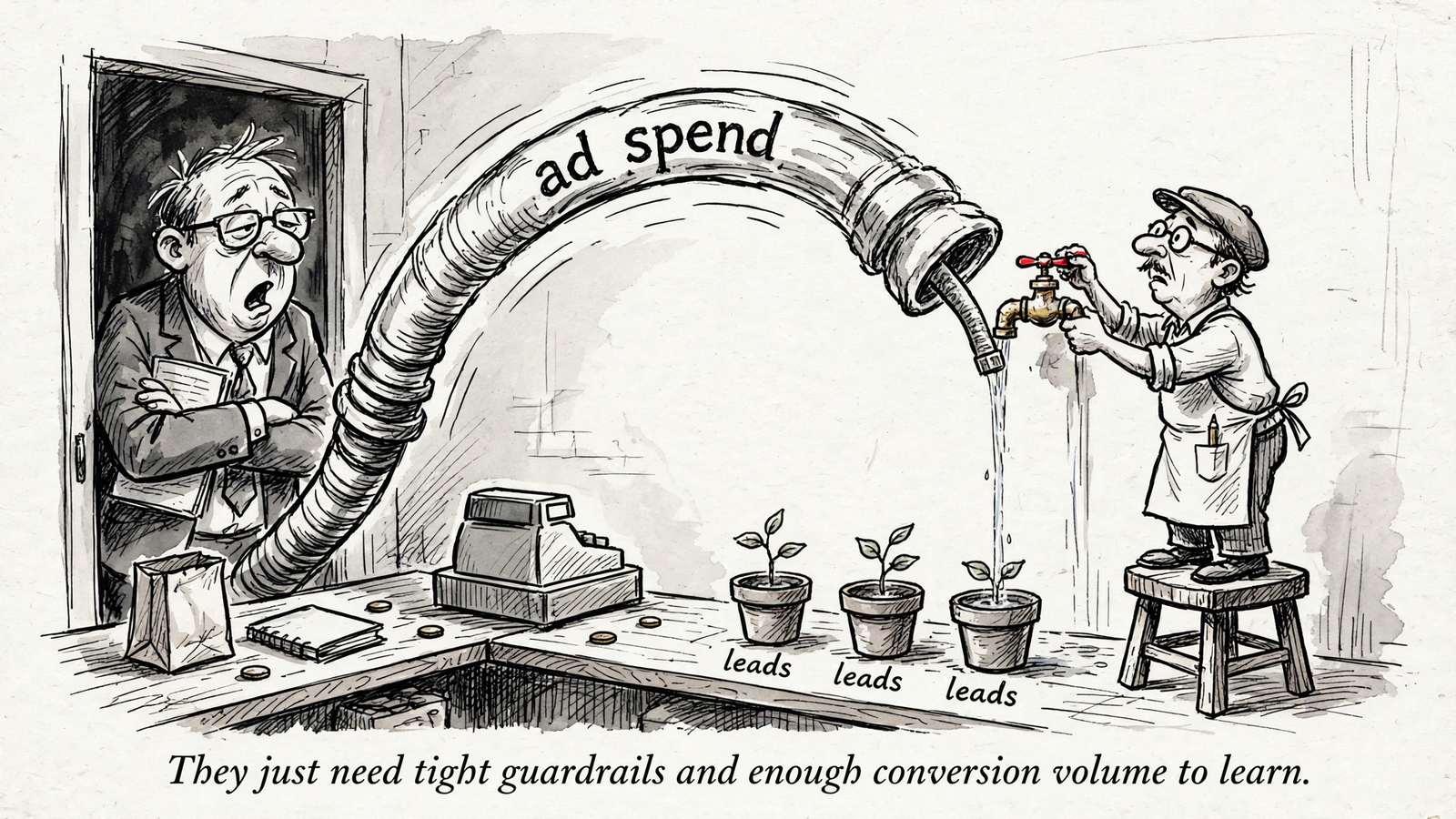
This is the second one I used to believe. I watched small accounts starve Smart Bidding, so I told clients under $5k to stick with manual management and a spreadsheet. The volume problem was real. Guidance cited in small-budget discussions puts a general benchmark around 30 conversions in 30 days, with more needed for Target ROAS. A small account with too few conversions cannot buy its way past that constraint by adding an AI label.
What I missed was the management-cost problem sitting beside it. Traditional agencies often charge a percentage of spend, with minimums and retainers that can make frequent attention expensive for a small account. At $10k in spend, 15% is $1,500 a month; that fee rises with spend whether performance improves or not (clicksgeek.com). A $3k account paying $600 for four hours of attention still has search terms appearing between those four hours. Waste does not wait for the monthly call.
Continuous management can catch junk queries sooner, add negatives and move budget toward what converts. But the fee must make sense for the account. groas charges $1,499 flat per service, with no minimum spend and no percentage of spend. That removes the incentive to charge more simply because you spend more. It does not make $1,499 an easy purchase for every $3k account.
So run two checks, not one:
- Count your monthly conversions and verify tracking before you rely on conversion-based bidding. If volume is thin, do not assume a new agency can manufacture a learning signal.
- Compare the fee with the spend and the work you actually need. A flat price can be a better deal as spend grows; at a very small budget, the math may say wait.
Small budgets do not need less management. They need management they can afford to use.
Myth 6: “You lose your account and data when you leave”
This happens often enough that I understand the fear. But account ownership is a contract and access decision, not a feature of AI. The sound arrangement is straightforward: you own the Google Ads account under your own ID and billing, while the agency receives linked MCC manager access that you can remove without surrendering the account’s history.
The alternative is a hostage arrangement. One SME audit cited 60% of accounts as being held by someone other than the business paying for them. When a business must leave an account behind, it can also leave behind its history, audiences and Smart Bidding learning. A human agency can create that problem without a single autonomous agent in sight. At groas, your accounts, pages and data remain yours.
The check costs nothing. Open Admin, then Access and security. Confirm that your email has admin access to an account billed to you. If the agency controls the account and you are the guest, you do not have an agency. You have a landlord. Never pay to train someone else’s asset.
Myth 7: “AI agencies are cheaper because they do less work”
I understand this one. Under the old math, a lower fee usually bought fewer human hours, which meant less attention. A $1,500 retainer might buy a handful of hours and a monthly call explaining what had already happened. So when an AI agency quotes a flat fee below the incumbent, it sounds as if someone has simply taken work off the schedule.
But a traditional team sells hours. An autonomous operation can run repetitive checks across queries while a strategist handles direction and exceptions. The work has not vanished; its cost structure has changed. That is why flat-fee pricing behaves differently from a percentage-of-spend fee: the effective percentage falls as spend rises, while a percentage fee rises with spend.
Say you spend $20k a month. At 15%, you pay $3,000. Scale to $40k and you pay $6,000, whether the extra spend improves performance or not (clicksgeek.com). At a flat $1,499, the management fee stays $1,499 at both spend levels. Repetitive query checks can continue without buying more hours of someone’s evening. A lower fee does not prove less work; the action record does.
I used to defend percentage fees as alignment. I was wrong. A percentage fee tracks what you spend. A flat fee and a clear action log at least let you judge the work against what you care about, including CPA. Ask for last week’s changes and the reasons behind them. If the cheaper provider can show the work and the expensive one can show only a meeting agenda, you have your answer.
The three questions I would take to the sales call
I would not buy an AI agency from a demo alone. I would ask for three things:
- Show me the work. What changed in the last 30 days beyond bids? Put Change History beside the agency’s action log so I can see negative keywords, query decisions, creative changes and the reasons for them.
- Show me who is responsible. Whose ID and billing hold the account? Who is the named strategist? What stops spending when a limit is hit? I have written about what genuinely runs unattended and what can still break it. The stop rule matters more than the word autonomous.
- Show me the boundaries and inputs. Where are the caps, exclusions, banned words, offer details and CPA ceiling? If those live only in a sales deck, they are not controlling much.
The myth I find hardest to kill is the first one: “It’s just Smart Bidding with a markup.” Plenty of sellers still deserve that charge. Make them prove they are not one of them.