

 LinkedIn

Your best-converting landing page may be the worst page on your site to pitch to Google’s AI Overviews. I keep hearing the same plan from founders and growth leads: buy a tool, optimize the paid landing page, and wait for citations. I usually tell them to leave that page alone. It was built to persuade a buyer, not answer a retrieval system’s questions. Force it to do both, and you risk weakening the conversion page without earning the citation. Build the answer beside it instead.
Myth 1: “Our best-converting landing page is the natural choice for AI citations”
I understand the instinct. The page generates pipeline, targets your commercial keywords, and has links pointing to it. Surely, if Google wants to cite a solution in your niche, it will pick your flagship product or demo page. That assumption is how a good landing page ends up with three paragraphs of definitions stuffed above the call to action.
Persuasion copy and citation copy need different structures. A conversion page leads with a buyer’s problem, makes a focused claim, and moves toward an action. It often keeps technical detail out of the way. A citable answer needs the detail up front. In CXL’s audit of Google AI Overview citations, 48% of cited passages sat within the top 20% of their pages, and 55% sat within the top 30%. If your opening screen offers an aspirational headline, a button, and a logo carousel, there may be little there to quote. Replace it all with an encyclopedia entry and you have a different problem: the buyer who clicked your ad now has to wade through it.
The mistake is treating that tension as a copywriting challenge. A sharper headline cannot make a short sales pitch answer every technical question, and a longer explanation does not automatically help someone decide to buy. Keep the commercial page good at converting. Put the fuller answer on a page built to give it.
Myth 2: “AI Overviews only cite the top three organic results”
For years, the organic playbook rewarded a simple ambition: reach the top of page one and win the click. It is tempting to assume Google’s generated answers choose their sources from the same shortlist. A team sees its homepage ranking for a head term and expects a citation to follow.
The numbers make that a poor bet. In an analysis of 863,000 SERPs and four million AI Overview citations, Ahrefs found that 37.9% of cited URLs ranked in the top 10 organic results for the primary query. Another 31.2% ranked from positions 11 to 100, and 31.0% sat outside the top 100. A study accepted at ACM SIGIR 2026 found only 18% source overlap between AI Overviews and standard organic results. Ranking well matters, but it does not reserve a seat in the answer.
One reason is query fan-out. A prompt such as “best inventory tracking software for cold storage” can lead a retrieval system toward narrower questions about sensor protocols, batch recalls, and pricing tiers. Your product page might rank for the broad commercial query while a technical page elsewhere supplies a cleaner answer to one of those narrower questions. That distinction changes what I would inspect: not just where the sales URL ranks, but whether any page actually explains the detail the answer needs. The useful target is not merely a higher-ranking sales page. It is a passage that answers the question without making the system dig through a pitch.

Myth 3: “Adding FAQ schema gets a page into the answer”
Structured data has long been easy to sell because it looks like a direct line to Google: paste FAQPage JSON-LD into a template, wait for the machine to notice, invoice the client. I have seen consultants charge $3,000 to add nested schema to pages that had no useful answer in the visible copy.
Markup cannot make a thin answer substantive. Google deprecated FAQ rich results in May 2026 and later removed its FAQ structured data documentation. More importantly for this job, adding an FAQ label does not give a retrieval system the clear, accessible explanation the page itself lacks. Discussion of tests shared on r/SEO points to the same practical distinction: facts confined to JSON-LD or llms.txt, rather than present in the visible page, are a weak substitute for readable content.
Before touching the markup, read the page as someone looking for the answer. If the explanation is missing, naming its container more precisely will not put it there. Write the answer where a visitor can see it. Then worry about the wrapper.

Myth 4: “AI assistants mostly read our homepage and product pages”
People picture a retrieval bot browsing like an executive with ten minutes before a meeting: homepage, product overview, pricing, done. That picture flatters the pages marketing teams spend the most time polishing.
Our server edge logs told a less flattering story. In our teardown of AI crawler activity, one dry, dated technical changelog post, /post/google-ads-updates-2026, recorded 845 verified crawler hits and 561 live-answer fetches over 30 days. Our polished commercial landing pages drew far less retrieval interest. That does not mean every site needs a changelog. It means specific facts, dates, and figures can be more useful to an answer than polished positioning. The page nobody nominated as the flagship may be doing the useful work. Check what your own logs show before assuming the homepage is carrying your AI visibility.
Myth 5: “Thin, fast landing pages are fine because Google understands intent”
PPC landing pages are often stripped down for good reasons. A fast mobile page with one clear action can beat a sprawling product manual at its actual job. The trouble starts when the details that do matter, such as specifications, pricing thresholds, and integrations, exist only inside client-side accordions, tabs, or toggles. Teams assume every fetcher will run the JavaScript and find them.
That is not a safe assumption for live answers. An audit of major AI web fetchers found that three out of four did not execute JavaScript during a user-session fetch. A fetcher trying to answer a prompt quickly may see the initial HTML, not the interface your developer sees after it loads. If that HTML contains a navigation bar and empty containers where your product details should be, the page gives the system little to work with.
Keep essential facts in the initial HTML. That does not require turning a lean conversion page into a textbook. It requires making the claims you chose to put there readable without a click or a rendering step. Fast and clear still serve the buyer; hidden and inaccessible serve neither reader particularly well.
Myth 6: “A tool that scores our AI-readiness is optimizing it”
Every search shift produces a software market for measuring the shift. Enter a URL, receive a score of 68 out of 100, and get suggestions to “expand semantic topicality” or “boost entity density.” Those phrases look busy on a dashboard. They do not publish an answer page.
In our breakdown of tools for getting featured in Google AI Overviews, the useful dividing line is whether the work gets done. A diagnostic can point out a missing answer or a rendering problem. It cannot, by displaying a grade, write a clear explanation, make that explanation available in the server response, or deploy supporting documentation. If the team still has to interpret every recommendation and ship every fix, the tool has measured the workload rather than removed it.
I have no objection to a useful diagnostic. I object to paying $300 a month to turn a yellow indicator green while the pages stay the same. Recommendations are cheap; execution is the product.
Myth 7: “Once we earn a citation, we can move on”
A citation screenshot feels like a win you can file away. I understand why: organic rankings often move gradually, and teams are used to watching positions rather than checking whether a source appears at all. Someone posts the AI Overview in Slack, the domain is right there, and the next campaign takes priority.
Citation behavior does not always give you that kind of warning. In BrightEdge’s weekly analysis of AI search citations, 96.8% of cited domains saw no week-over-week change, but 87% of the changes that did occur were declines. A page may remain cited for a stretch and then disappear from a particular answer when the sources selected for that answer change. Yesterday’s screenshot cannot tell you what appears today.
Monitor citations as appearances, not trophies. Check whether the answer still cites you, not just whether the page still exists and the old screenshot still looks good. A useful answer page needs attention after it earns its first mention. Otherwise, the team may learn it has lost visibility only when someone happens to run the query again.
Myth 8: “One perfect URL can do every job”
This is the myth I find hardest to kill. A founder wants one page that loads in 800 milliseconds, converts Google Ads traffic at 12%, ranks first organically, and supplies the definitive answer across AI search. I understand the appeal. Maintaining one URL sounds cheaper and tidier than maintaining two kinds of pages. It also asks one document to serve buyers in very different moments.
A paid visitor who already understands the problem needs a clear offer, enough proof to trust it, and a way to act. A retrieval system answering a narrower question needs an explicit fact it can extract. Packing 2,000 words of background definitions into the landing page makes the first visitor work harder. Stripping a technical answer down to a headline and button gives the second reader nothing to quote. Keep the conversion page and the answer page on separate jobs. They can support the same commercial goal without carrying the same copy.
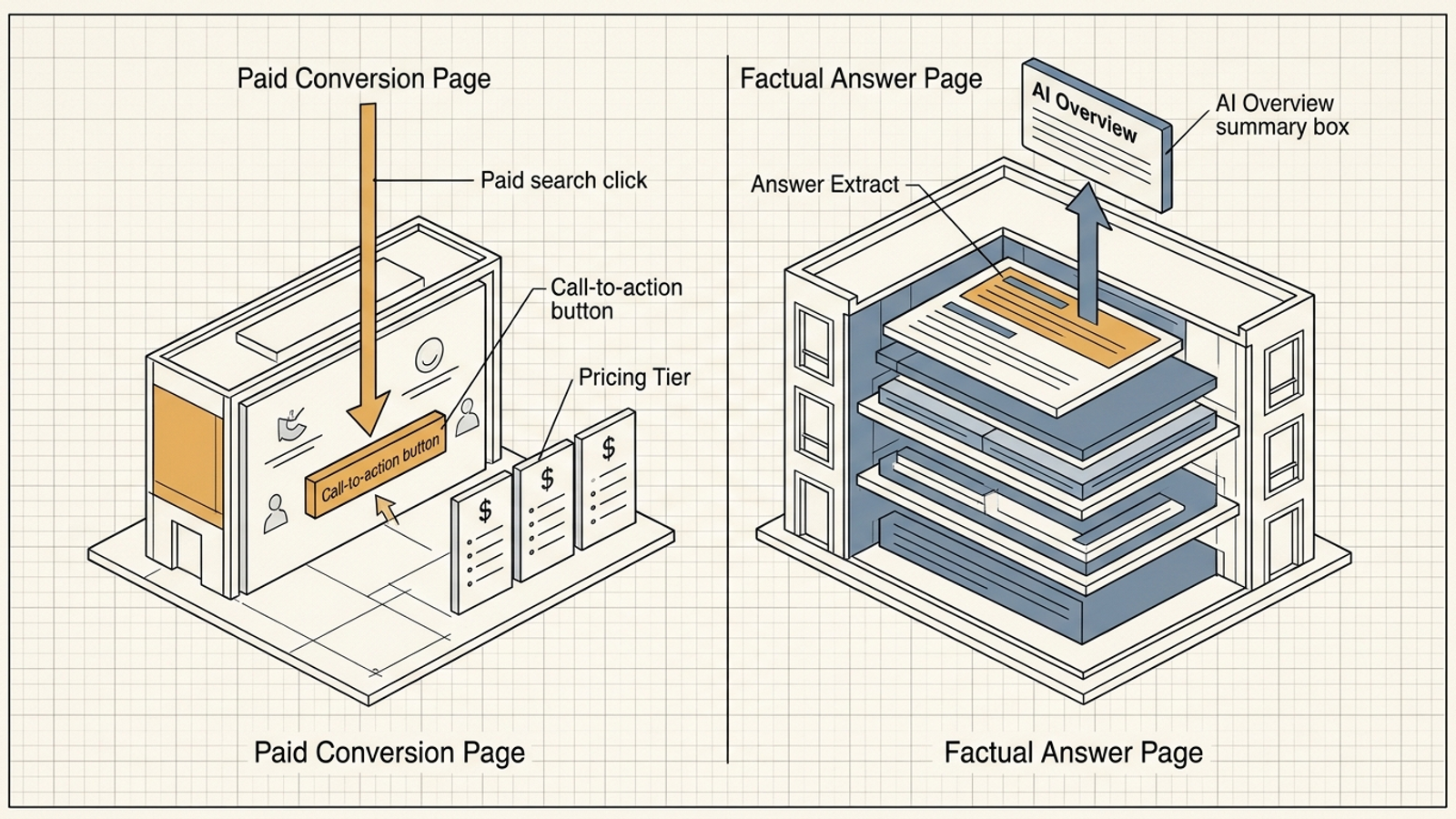
On the landing page, I would make three restrained changes rather than rebuild it around citations:
- Render core details in the initial HTML. If specifications, pricing thresholds, or compatibility requirements matter to the sale, do not make a client-side interaction the only way to read them.
- Use precise claims instead of corporate adjectives. Replace “rapid enterprise onboarding” with the actual onboarding measure you can substantiate. Do not invent a number just to look quotable.
- Keep the buying path obvious. Make the value proposition, intended buyer, and primary action easy to find. A citation will not repair a page that leaves a human visitor guessing what you sell.
Then build the answers beside that page: technical documentation, comparison tables, and dated changelogs where those formats suit the questions buyers ask. Each format has a reason to exist. Documentation can explain a specification; a table can make differences legible; a dated post can put a change in context. None needs to interrupt the paid visitor’s path to the offer. A detailed answer can supply the passage a retrieval system needs while the landing page stays focused on turning qualified visits into pipeline. At groas, that division is part of why we manage paid search and organic visibility together. Autonomous models handle continuous execution across bids and search visibility; a named strategist keeps the work pointed at closed-won revenue, not a prettier citation report.
I used to think the neatest funnel was the one with the fewest pages. It is neat right up until the sales page has to become the manual, the comparison chart, and the changelog. Let the landing page sell. Give the answer its own place to be found.