

 LinkedIn
Most agencies won’t tell you this: the fee in your quote may have been set before anyone looked inside your account. I used to quote that way. Pick a percentage, add a minimum, add a setup fee for onboarding, and call it strategy. That math roughly worked when more spend meant more manual work. At $20k a month in Google Ads spend, it deserves another look. These are the seven beliefs that keep the old prices alive.
Myth 1: Percent of spend means the agency wins when you win
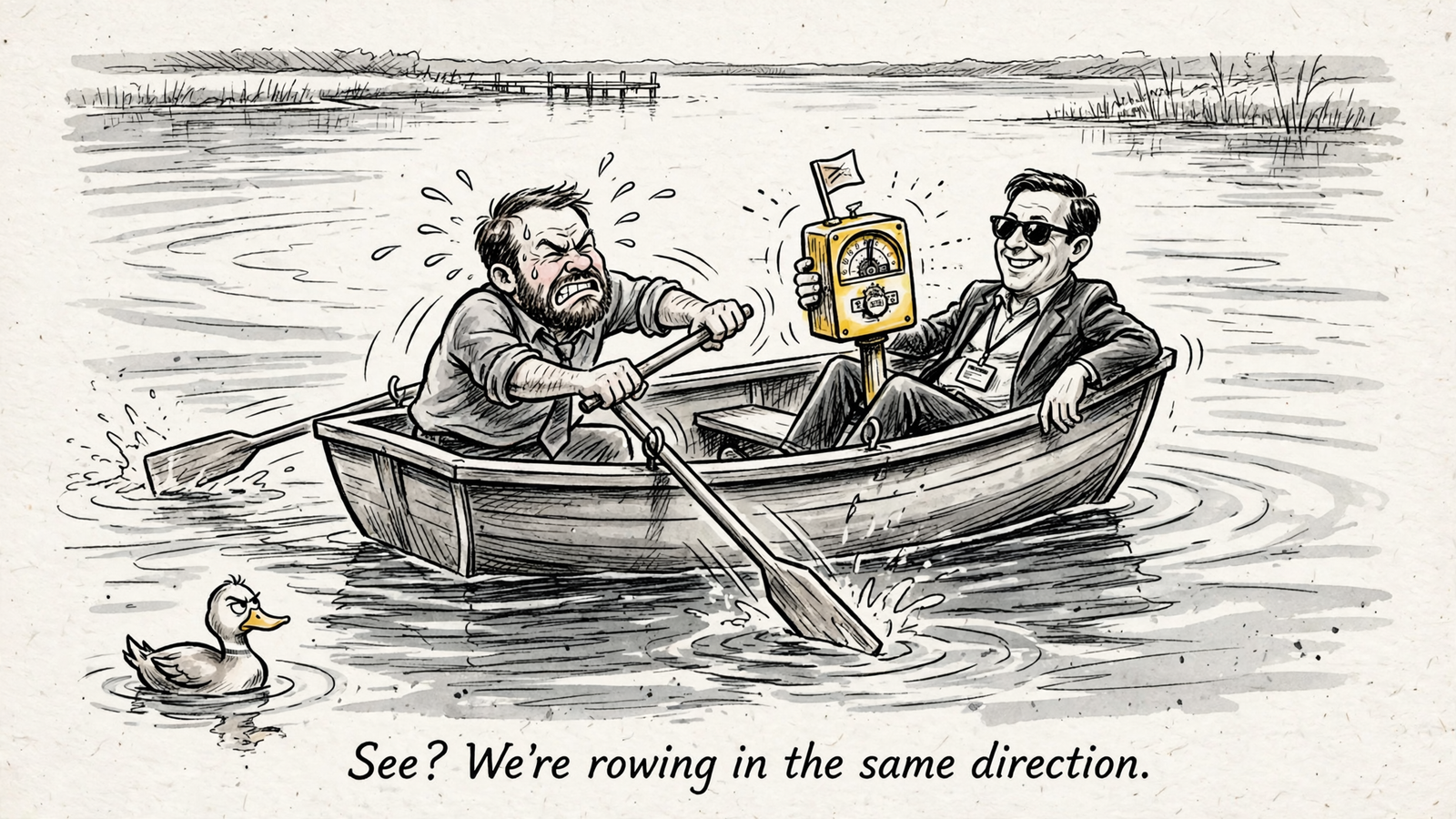
It sounds right in a pitch meeting. You spend more because you’re growing; the agency earns more because you grew. Everyone rows the same direction.
Except the fee rises whether performance improves or not. Pricing guides quote 10–20% of ad spend, commonly 15%, with around a $500 minimum, alongside flat retainers of $1,500 to $5,000 a month. At $20k in monthly spend, 15% is $3,000 a month for management alone, on top of the $20k going to Google. Double spend to $40k with the same CPA and the management fee doubles to $6,000. Nothing about that tells you the account became twice as hard to run. The invoice just followed its formula.
A larger budget can come with harder decisions. It doesn’t follow that every extra dollar creates the same fraction of extra management work. Ask the agency which tasks grow when spend grows, and which outcome it is paid to improve. If it cannot separate those answers, you’re being charged for your budget, not for what happens to it.
Tie the incentive to CPA, qualified pipeline or ROAS if those are the outcomes you care about. Percent of spend is tied to your credit card limit.
Myth 2: More spend takes more management hours
I believed this one because it feels like physics. Bigger budget, bigger workload. The part I got wrong was which work grows.
Even small accounts need an ongoing floor of 8 to 12 hours a month, plus 15 to 25 hours for onboarding. Tracking checks, search term review, budget pacing and asset testing are real work. That floor doesn’t double just because an account moves from $20k to $40k in spend. The extra auction volume is largely handled by automation; it doesn’t arrive as twice as many bids for a person to type.
The pricing math makes the mismatch plain: at 15%, $5k in spend produces a $750 fee and $10k produces a $1,500 fee, even if the ongoing task list looks much the same. More complexity may justify a higher price. A larger number in the spend column, by itself, does not explain one.
So make the pitch concrete. What new decisions, checks or tests appear when your spend doubles? If the answer is bids, pacing and query review, ask what the people do that the automated systems don’t. Then ask whether tracking, feed quality and landing pages are included or invoiced separately. Pay for the work and judgment the account needs, not a perfect percentage of its budget.
Myth 3: Result-based fees are always cheaper
I used to tell clients revenue share was the fair option. I was wrong. The pitch is appealing: pay when it works. Offers are quoted around 5–15% of attributed revenue; pay-per-lead arrangements run from $10 to $100, with $50 per qualified lead as one example.
Now put $20k in spend against $80k in tracked revenue. Even at 5%, the fee is $4,000 that month, versus the $3,000 percent-of-spend fee in Myth 1. If revenue rises to $120k at the same 5% rate, the fee becomes $6,000. That may be a price worth paying for genuinely incremental revenue. It isn’t automatically the cheap option.
Then comes the argument the pitch tends to skip. Does branded search count if the buyer was already looking for you? What about a repeat buyer, or a lead sales never worked? The fee formula cannot settle those questions. It makes them more expensive to leave unsettled. This is how pay-per-acquisition deals can change incentives instead of fixing them.
Before signing, get the definition into the contract: qualified by whom, attributed to what, within which window, and whether brand and existing customers count. Revenue share moves the incentive problem into attribution unless both sides agree on what earns the fee.
Myth 4: Setup fees pay for strategy
What the deck calls strategy, I call the checklist every account needs before it spends a dollar: keyword research, conversion tracking, campaign structure and first ads. That work is real. Guides put setup at $500 to $2,500, with ranges reaching $5,000 and $10k at the enterprise end. A shop that puts substantial senior setup work into the first month’s retainer may charge separately rather than wait to recover the cost. Fair enough.
The question is what the fee leaves behind. If you pay four figures and get a slide deck plus a structure Google can build for free, you bought onboarding theater. If you get tracking that fires, negatives that block waste and an account structure you keep when you leave, you bought work you can inspect.
Ask for the deliverables before you pay, then ask who owns them. Accounts, pages, tracking, audiences, creative and data should not become a surprise conversation at the exit. A setup fee should buy usable account work, not the privilege of becoming a client.
Myth 5: A 6-month minimum is needed for the algorithm to learn
This is the one I hear delivered with the straightest face. Sorry, the algorithm needs six months. Learning needs conversions, not calendar pages. The cited guidance points to around 30 conversions in 30 days, 50-plus for Target ROAS, and learning windows of one to two weeks. If clean tracking and enough conversions aren’t there, another page turning on the calendar won’t create them. If they are there, a six-month lock-in doesn’t make the system learn faster.
An agency may want time to test and improve an account. That’s a different argument, and it should be made openly. Ask what evidence it expects to gather during the term and what you can do if the work isn’t happening. Check the notice period, termination fee and whether tool contracts sit in your name or theirs. An exit penalty can reach $10,000 in the practitioner teardown cited here; it belongs in the pricing conversation, not the goodbye email.
Match the term to the work and the available conversion volume. No volume, no learning. No contract should pretend otherwise.
Myth 6: A cheap retainer means a cheap account
The $800 retainer looks disciplined beside a $3,000 percent-of-spend quote. Then the extras arrive: landing pages at $500 to $2,000 each, with three to five for a multi-service account; call tracking at $50 to $150, heatmaps at $50 to $100, dashboards at $50 to $200, and reporting fees at $200 to $500 a month. Another practitioner breakdown describes a $200 to $400 monthly tool stack marked up 30–50%, plus creative and landing assets at $1,000 to $5,000 each. Where a vendor splits the work that moves conversion rate into separate invoices, the retainer isn’t the whole price.
Here is the comparison at $20k a month in ad spend. The three listed management fees run from $1,499 to $4,000 a month under the assumptions shown. These are illustrations, not quotes from the same agency. Google’s $20k media charge sits outside every management figure.
| Model and assumption | Listed monthly management fee | One-off setup | Recurring costs or questions outside the listed fee | First-year listed management fees |
|---|---|---|---|---|
| 15% of $20k spend | $3,000 (15% is a commonly quoted rate) | $500–$2,500 is a quoted range | Ask whether another platform is billed separately | $36,000, plus any setup and extras |
| 5% of an illustrative $80k in monthly attributed revenue | $4,000 (5–15% is a quoted revenue-share range) | Check the contract; not assumed here | Agree on treatment of branded and repeat buyers | $48,000 if attributed revenue stays at $80k each month |
| Flat autonomous groas Search Ads | $1,499, regardless of spend | $0 setup fee | Landing page for every ad group included | $17,988 at the listed monthly fee |
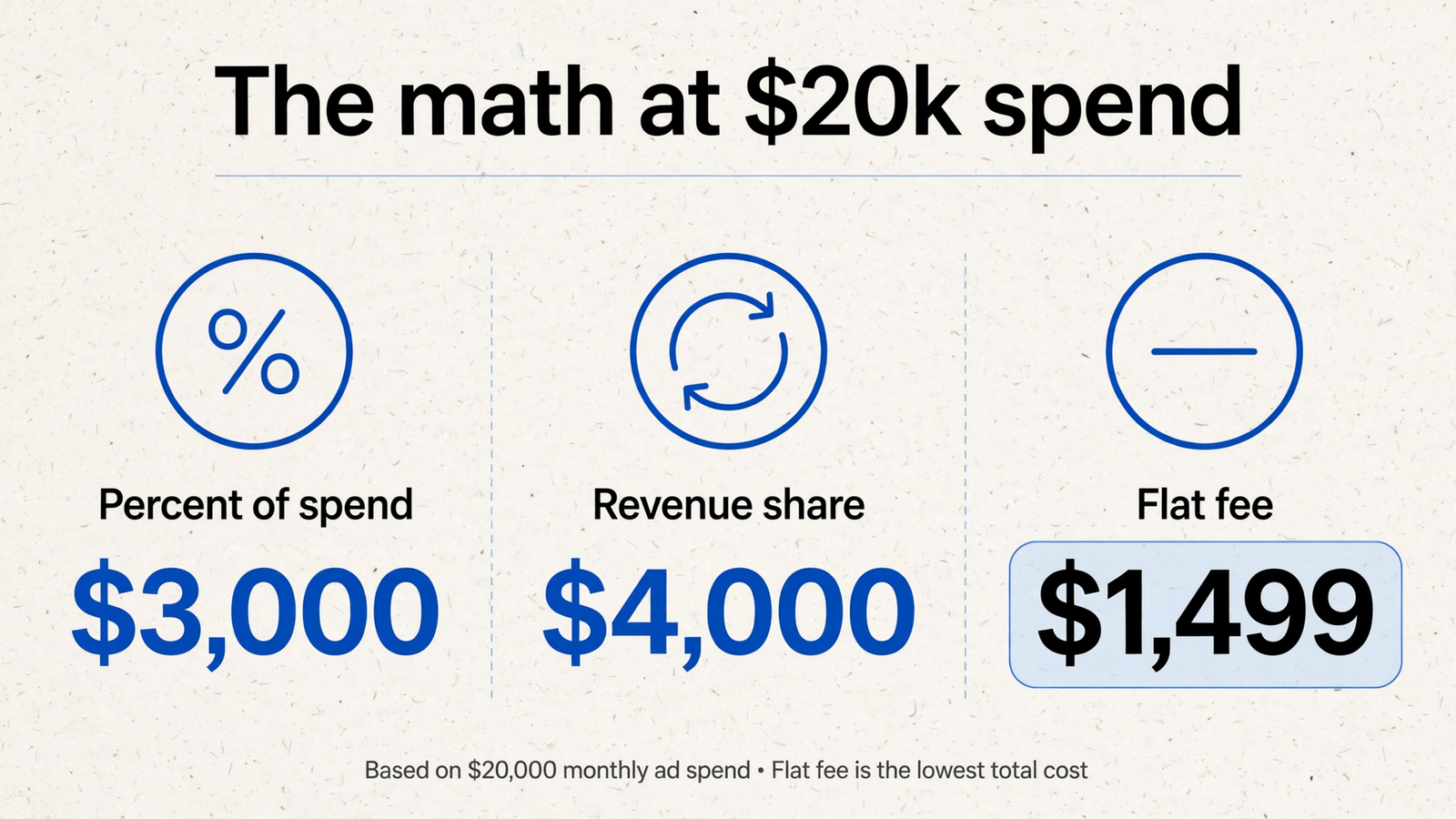
The table separates listed fees from costs you still need to ask about. The percent-of-spend total excludes setup and extras; the revenue-share total changes with attributed revenue. Pages and creative are not monthly management fees just because someone tucks them into a proposal. Tool subscriptions and reporting charges recur if the contract says they do. And an exit fee isn’t a monthly cost, but it can make leaving the most expensive month of the relationship.
This is where a flat fee matters. At the stated price, groas Search Ads does not take a larger management cut because you raise spend, and its listed offer includes setup and a landing page for every ad group. An agency can still make a case for its price. It has to make that case with work and outcomes, not with an $800 headline followed by a second invoice.
Before choosing, ask for the all-in number: management, tools, pages, creative, reporting, setup and the cost to leave. The pricing-model comparison and fuller cost breakdown give you two ways to run your own quote line by line. The cheapest-looking retainer is only cheap if the work you need is actually in it.
Myth 7: Monthly reports are proof of work
This is the hardest one to kill because the report looks like labor. Twenty pages, branded cover, CTR up, impressions up, Quality Score stable. I’ve sent those reports. The client feels looked after and the agency feels safe. Neither feeling tells you whether the fee earned its place.
The distinction matters when clicks cost money and conversions don’t follow automatically. Benchmark data from more than 16,000 campaigns puts average CPC at $5.26, up from $4.66, with conversion rates around 7.5–8.2% and average cost per lead at $70.11. In that dataset, 29% of accounts had zero conversions in 90 days. A rising CTR can look lovely on the cover while the account still has that problem. Negative-keyword work can matter far more than the chart it gets in the deck, if it gets one at all.
I want the change log instead. What did the agency block, fix or test? What happened afterward to CPA, qualified leads and closed revenue? A report should connect an action to an outcome, not use a stack of charts as a substitute for either. Ask for three actions and the result each was meant to change. If nobody can point to them, the document proves reporting happened. That’s all.
Pull your last three invoices and put them beside the account changes from those months. The cheapest mistake in this list is paying a setup fee for a deck you never use again. The expensive one is signing a percentage that keeps taxing your growth while a monthly report persuades you the invoice must be paying for something.