

 LinkedIn

Most agencies about to resell AI SEO are about to sell the wrong thing: a separate AEO package with a dashboard on top. I get why. Clients keep asking how to show up in ChatGPT, the SEO retainer already feels thin, and a tidy add-on looks like the fastest way to say yes without hiring anyone. But the client does not want a new acronym. They want to know why a prospect asked an engine who to hire and their name never came up. Getting cited is not a new service. It is the same content, technical and citation work as good SEO, aimed at buyer questions.
Myth 1: “AEO and GEO are separate services from SEO”
Agencies believe this because it is convenient to sell. A new acronym gets a new line item, a new $800 add-on, and nobody has to reopen the base SEO retainer. I used to think that way about every new Google feature. It felt like growth until clients asked why they were paying twice for work on the same pages.
The engines still need something useful to find, understand and cite. White-label SEO+AEO is sold as one campaign, not two, with plans from $355 to $2,219 a month bundling technical SEO, topic clusters, buyer-question content, digital PR and AI-visibility tracking. The provider’s own FAQ puts it plainly: AEO extends the SEO foundation. Mavlers makes the same case from the pricing side, recommending bundling by default because AEO without SEO ignores the fundamentals.
That does not mean every SEO retainer already does enough. A page written to catch a broad search term may still fail to answer the specific question a buyer puts to ChatGPT. The work may need a different emphasis: clearer answers, better-supported claims and mentions beyond the client’s own site. But those are changes to the work, not proof that you need a second service wrapped around the first.
If your partner sells AI search with no crawl fixes, no new pages and no mentions elsewhere, you are reselling tracking. Ask which deliverables actually differ between its SEO and AI search work. If the answer is a report, do not charge the client twice for the same pages.
Myth 2: “A visibility dashboard is the product”
This one survives because dashboards demo well. You type the client name, a graph shows 12% share of voice, and the prospect nods. I have sat through that demo. What the deck calls visibility coverage, I call a screenshot of work someone else still has to do.
Tracking tells you where you stand. It does not write the buying-guide page, fix the blocked product data or earn the third-party mention that gets quoted. That gap is why fulfillment-heavy white label starts at £2,500 per client per month for product-data fixes, buying-guide pages and third-party mentions with live links. A $299 tracking seat leaves that work on your desk. The cheap seat may be perfectly good at tracking; it is not a cheap way to have the pages and fixes done.
A useful dashboard makes the next action obvious. It shows which buyer questions matter, whether a relevant page exists, and whether that page is getting named. If the score moves but nobody can point to a shipped page or a live fix, you have learned very little about what the client is buying.
If you resell the score without the labor, you own the awkward renewal call. Ask the vendor which pages it shipped last month. If it cannot name them, it sold you a thermometer and called it heating.
Myth 3: “One prompt check tells us where the client stands”
I still see this in agency Slack screenshots. Someone asks ChatGPT “best CRM for plumbers in Austin” once, the client is not there, and panic ensues. I made the same mistake when AI answers first showed up. A few reruns made the problem obvious: I was treating one answer as a stable result.
A controlled test of 10,000 identical queries found ChatGPT gave materially different answers 34% of the time. Brand citations varied in 28%, while small phrasing changes alone caused 27% variation, with only 58% brand overlap across five phrasings. One missing mention is not a diagnosis. Nor is one lucky citation proof that the work is done.
One prompt is an anecdote. Thirty prompts tracked weekly is a baseline. Ask your partner how many prompts, engines and phrasings sit behind its score, and how often it reruns them. Keep the buyer questions consistent enough to spot movement, but include the different ways a buyer might ask them. If the answer is fewer than 20 prompts checked monthly, you are reselling noise. Do not turn a screenshot into a client recommendation.

Myth 4: “Getting cited is about tricks in the markup”
Vendors love markup because it is shippable. Add some schema, drop in an llms.txt file, invoice for GEO readiness. I bought into this early too, back when I thought FAQ schema would win featured snippets on its own. It did not then, and it does not now.
Google said it plainly in May 2026: you do not need new machine-readable files, AI text files, markup or Markdown. Ahrefs found 97% of llms.txt files got zero requests across 137,210 domains. A WashU study of 55,393 searches found credibility and source quality predicted citation, not schema. None of that makes technical work optional. It means a new file is a poor substitute for a page an engine can fetch and a buyer can use.
What gets quoted is boring in the best way. An analysis of 1.2 million AI answers and 18,012 verified citations found 44.2% of ChatGPT citations came from the first 30% of the page. Cited passages were about twice as likely to use definitive language and clear Q&A headings. If the answer is buried below a long introduction, tidy markup will not move it up the page.
Write the answer in the first three paragraphs. Say what it is, then give the buyer enough substance to trust it. Ask your partner what percentage of its GEO hours goes to markup versus pages and mentions. If markup is the plan, you are paying for paint with no house.
Myth 5: “Bot traffic in the logs means the client is visible”
This is the easiest myth to sell because the graph always goes up. AI crawlers fetch, the log fills with GPTBot and ChatGPT-User hits, and the monthly report gets a satisfying green arrow. I used to forward those spikes to clients too. The trouble is that a fetch records access, not a recommendation.
Consider a site with 12,755 live-answer fetches across 499 pages in one week, versus 148 training-crawler visits: an 86-to-1 ratio. It still held about 4% citation share in its category. The engines could reach the site. That did not mean they chose to name it in answers.
Raw user-agent hits are weaker still, since most fail verification when checked properly. Raw AI-bot hits are a weak metric until you separate verified fetches from spoofed noise. Then separate live-answer fetches from training crawls. They describe different activity, and neither gives you a citation count on its own.
Being fetched is being considered, not being chosen. Ask your partner how it splits those fetches and what share turn into citations. If it cannot answer, its visibility report is a crawl report wearing a costume.
Myth 6: “We need a GEO specialist on payroll to offer it”
Hiring feels like control. One job post, one clever title, and suddenly you offer AI search. I priced that hire back when I ran accounts myself. Say $75k base for someone who knows entities, crawling and content. Add benefits and management time, and you still have no writer, no developer hours and no digital PR relationships to get the client mentioned anywhere that matters.
The math only works if fulfillment is already covered. Agency AEO/GEO pricing runs $500 to $1,500 for a one-time audit, $1,300 to $2,000 a month as an add-on, $2,400 to $3,000 a month for foundations and $4,500 to $6,000 a month for growth. Mavlers puts white-label margin at 29% to 38% after a 40% to 60% markup. That margin survives if you resell work that ships. It dies if you resell a dashboard and do the pages, fixes and outreach yourself at midnight.
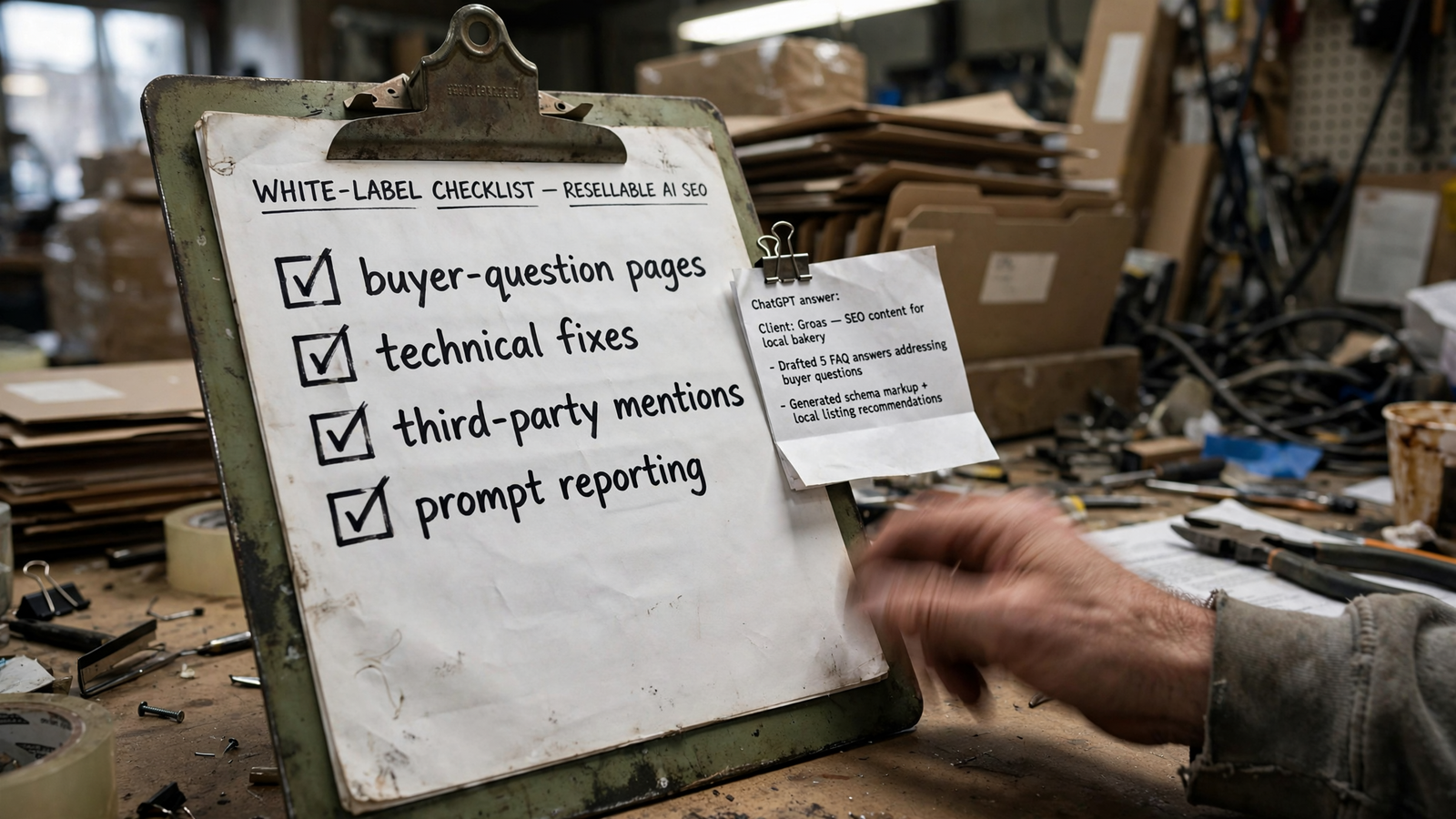
A package you can put your logo on needs four kinds of work:
- Buyer-question pages that give a plain-language answer near the top.
- Technical fixes shipped, not listed, so engines can fetch what they might quote.
- Third-party mentions on sites the engines already trust, with live links.
- Prompt-set reporting that reruns buyer questions weekly across engines and phrasings, tied to calls and forms.
That is what groas runs as SEO & AI Search: new pages and technical fixes every day, coverage across Google plus ChatGPT, Perplexity and Gemini, and authority work on the sites engines trust, live in under 24 hours with a dedicated manager for one flat fee. A separate tracking seat cannot fill those four roles. If one is missing, check whose team will supply it before you calculate your margin.
Before signing a white-label partner, run this five-question screen:
- Which deliverables differ between your SEO and AI search work?
- How many prompts, engines and phrasings sit behind your visibility score, and how often do you rerun them?
- What share of GEO hours goes to markup versus pages and mentions?
- How do you split live-answer fetches from training crawls, and what share become citations?
- Who writes the pages, ships the fixes and earns the mentions?
Score the answers on the 16-point vendor checklist for reselling AEO across clients. Do not hire to cover a tool gap. Hire after resold fulfillment pays for the hire. If the partner answers mostly with dashboards, you did not buy fulfillment.
Myth 7: “Clients will pay for AI visibility as a metric forever”
This is the myth I find hardest to kill, because I have sold it. A visibility score feels like progress in month one. By month three, the client asks the only question that matters: did anyone call? I used to tell clients visibility was leading work that would convert later. I was wrong to treat the score as an answer to that question. Visibility that never reaches a quote request is a hobby, not a channel.
The score still has a job. It can show whether the client is appearing for the buyer questions you targeted, and whether that changes as pages, fixes and mentions go live. But it belongs inside a report on the work and what followed, not on a slide by itself. Otherwise a good-looking graph can hide an empty pipeline until the renewal meeting.
Clients renew on enquiries, not on share of voice. Report the path from citation to lead: which buyer questions you targeted, which pages now answer them, where the client is named, and how many of those sessions turned into calls or forms. Before you put AI search on your services page, ask whether you could defend the renewal with pages shipped, fixes live, mentions earned and calls booked. If you cannot, do not sign the platform yet. Your clients asked how to get named in ChatGPT. Give them the work that gets them named, under your logo, and leave the dashboard in the appendix where it belongs.