

 LinkedIn

A Meta agency can price your ads down to the last creative and still have no idea what a customer is worth to you. I see proposals that spell out the fee, spend, and reporting cadence but never ask which jobs you want, which leads you reject, or who answers the phone. That is campaign activity priced as customer acquisition. If you run a service business and are comparing agencies, use these seven questions before you compare their promised cost per lead. A good provider will ask them of you before you have to ask.
1. Ask which jobs you actually want more of
I used to tell clients all leads were good leads. I was wrong. In home services, the job mix changes the economics: plumbing converts at 12–16% on a one-day cycle with a roughly $337 ticket, while HVAC and roofing close at 3–7% over 30–90 days on $5,000–$25,000 tickets. Same town, same budget, different sales cycle and different reason to spend. An agency that never asks about the work will chase the cheapest form fill, even when that means filling your calendar with calls you did not want while the install jobs go elsewhere.
First step: write down the two services you want more of and one job you would turn down even if the phone rang today. Give that list to each bidder. Ask how it changes the offer, targeting, and budget split in the proposal. If nothing changes, the agency is buying calendar filler, not planning around your margin.
Do not accept a blended cost-per-lead promise as a substitute. A lead for a job you cannot or will not take is not a cheaper route to a customer. It is a cost the report has hidden in the average. The provider needs your preferred job mix before it can make a useful forecast.

2. Ask where you can serve customers profitably
A radius looks tidy on a proposal map. It gets less tidy when a river, a highway, or a long drive sits between your tech and the job. I want an agency to ask for a zip-code list, not just a mile count, because the boundary that matters is where you can do the work without destroying the margin.
Meta lets you drop a pin with a radius down to about one mile, but you still need to build the area from zips you serve, set location to people living in the area, and exclude the rest. That is the difference between a circle on a slide and a guardrail on a campaign. Without the service boundary, a quote for lead volume or cost rests on people you may never be able to serve.
First step: send each agency your served zips and your exclusions. Ask it to show you how those boundaries will appear in the campaign plan before launch. If it proposes a broad radius instead, make it explain what happens to leads on the wrong side of the boundary. You should not pay for the agency to discover your service area by sending you unreachable enquiries.

3. Ask what makes a lead unqualified
If an agency counts every form fill as a win, it will optimize for form fills. Instant Forms come pre-filled and can submit in one tap. That makes them easy to complete, but easy is not the same as ready to buy. The system gets a signal from the action you count. Count only submissions, and you give it little reason to distinguish a serious enquiry from a stray tap.
Start with the form and the definition of junk. Add the Higher Intent review step and two or three multiple-choice qualifiers, such as service area, timeline, and problem type or budget. The lead count on the report may fall. In return, your team gets answers it can use to sort enquiries instead of guessing from a name and number.
First step: agree in writing, before the quote, which leads you will reject and how you will record the reason. The list might include wrong or switched-off numbers, people who say they did not fill out the form, out-of-area requests, price-only enquiries, and real people who are the wrong fit. Those are not one problem with one fix. An accidental submission points back to the form. An out-of-area request points to geography. A wrong-fit job points to the offer or the job mix.
Make the agency say which of those problems its plan can address and which your team must handle. A lead-volume promise without rejection reasons sells you the count, not the customer. That distinction should be settled before anyone puts a price on managing the campaign.
4. Ask how many additional customers you can handle
Every agency deck has a scale slide. Capacity deserves a slide first. Two techs, one diary, and long drives between jobs can turn a surge in enquiries into a scheduling problem rather than growth. More leads do not remove that constraint. They put it on the phone, in the calendar, and eventually in front of customers who expected a quicker appointment.
First step: tell each bidder how many additional booked jobs per week you can staff, and in which zips. Then name what breaks first if bookings rise beyond that number: phones, trucks, or install slots. You do not need a perfect forecast. You need a ceiling the agency cannot quietly ignore when it proposes more spend.
Ask what the provider would do as you approach that ceiling. A serious plan can pace testing and spend against the work you can take, rather than treating every extra lead as proof the campaign is healthy. If the recommendation is simply to buy more volume, ask where the extra jobs go. A proposal for 100 leads a month is not a growth plan until someone has asked what 100 leads would do to your operation.
Capacity is also why a cheap lead can be expensive in a less obvious way. Your staff still have to answer it, qualify it, and find room for it. Do not scale the enquiry count past the work you can deliver. Give the agency the ceiling before it gives you the forecast.
5. Ask what proportion of qualified enquiries become paying customers
This question kills the cheap-lead pitch. A close rate is not one number until you define its denominator. HVAC install averages around 43% and clears 52% with four or more options and financing offered every time; roofing runs 30–40% on qualified appointments, and remodeling sits at 20–30%. Those are appointment-to-job figures. The marketing view starts earlier: 7.8% lead-to-customer overall, with phone leads converting at 46%, Facebook Ads at 5.22%, and Google Ads at 7.33%.
Put an appointment-to-job rate beside a lead-to-customer rate without labeling them and a proposal can look much more confident than it should. The agency needs to know where your number starts and where it ends. Otherwise it cannot translate its quoted cost per lead into a credible cost per customer.
First step: take your recent qualified enquiries, booked appointments, and paying jobs to the quoting call. Ask each provider to show the calculation it will use, then ask which stage it can actually measure. Do the simple translation on paper: $15 instant-form leads that book at 10% cost $150 per booked job; $50 landing-page leads that book at 40% cost $125 per booked job. The higher cost per lead buys the cheaper booked job in that example.
I have watched owners celebrate cheap leads while paying more for the work that matters. Judge the proposal on cost per booked job and margin, not the number that looks nicest in a weekly email. Cheap leads that never book are the most expensive leads you can buy.

6. Ask what customer information can return to measurement
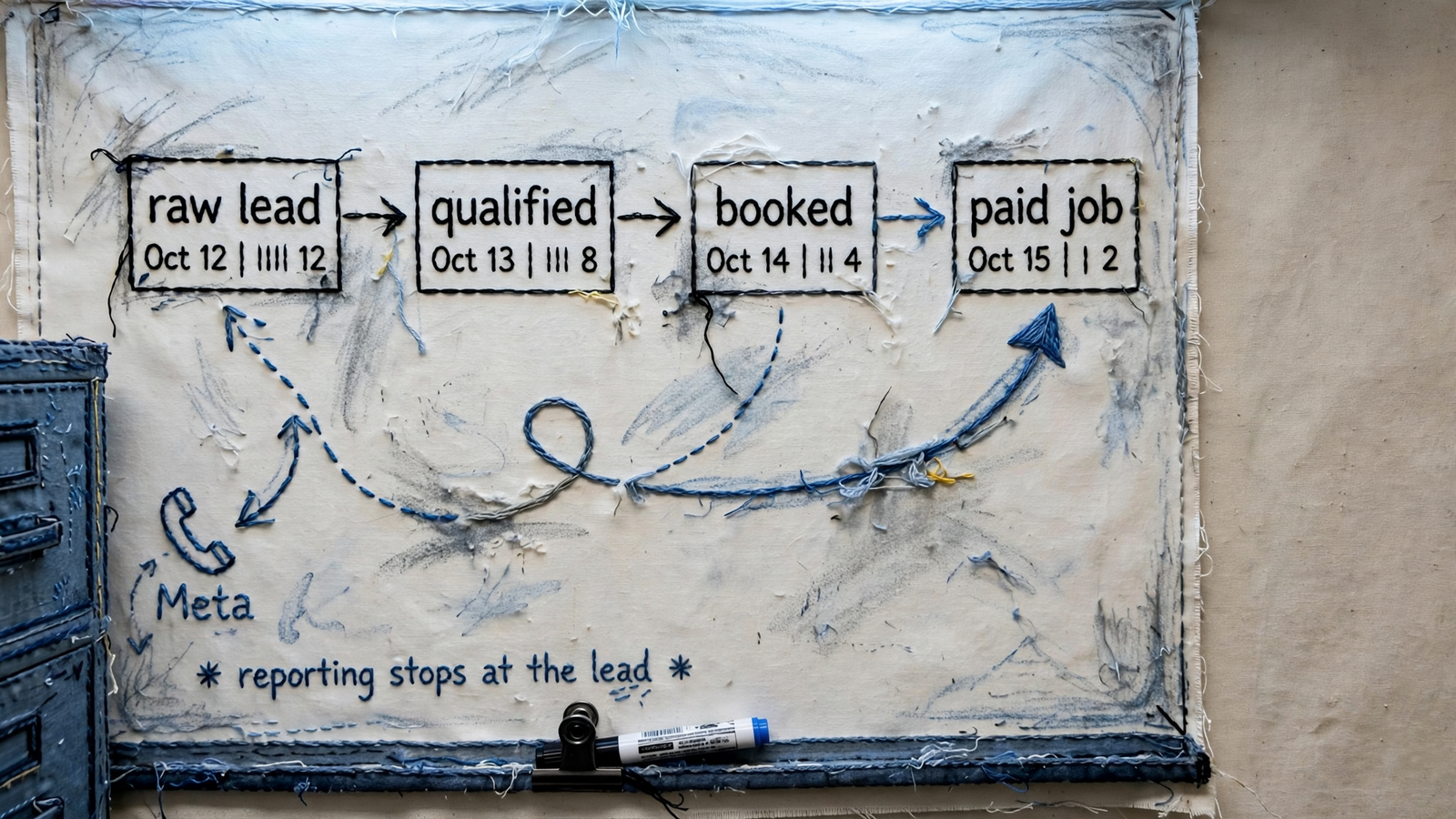
If Meta only receives raw form fills, it can learn to find more raw form fills. To give it a signal about booked work, you can send CRM stages back through the Conversions API for CRM and optimize toward the Conversion Leads goal with Instant Forms. That requires the agency to know more than how to launch an ad. It needs to know what your CRM records, who can share the outcome data, and who owns the numbers when a lead changes stage.
The fit is specific. This approach works best around 200 or more leads a month, with uploads at least daily, a target stage reached within 28 days, a stage rate between 1% and 40%, and every stage sent starting with the raw lead. A smaller operation should not be sold that setup as a magic switch. It still needs a reliable way to see which enquiries became appointments and jobs.
First step: ask each agency which lead stages it expects to receive, who records them, and what it will report if the data is unavailable. Do not let a bidder promise optimization for quality while leaving CRM access and consent for later. If a stage cannot be measured, nobody gets to claim it was improved.
Follow-up belongs in this conversation too: 79% of marketing leads never convert without nurture. When nobody can see what happened after the form, the agency may keep changing ads to fix a leak elsewhere. If you are comparing search and Meta providers together, apply the same discipline to these questions before hiring a fully managed Google Ads agency.
7. Ask who contacts new enquiries, and how quickly
This is where decent campaigns go to die. A lead can sit in an inbox for six hours while the prospect books the contractor who called first. In the MIT and InsideSales study of 15,000 leads, contact odds were about 100 times higher and qualification odds about 21 times higher at five minutes than at 30 minutes; Velocify found 391% higher conversion when the call came in the first minute. The figures make the mechanism hard to miss: the ad creates an opportunity, but a person still has to turn it into a conversation.
First step: ask every bidder to put four answers next to its lead forecast: who makes the first call, which number receives the enquiry, how soon that call happens, and what happens after hours. The working rule I give shops is a first attempt inside five minutes, six or more attempts over 48 hours across call, text, and email, forms piped into the CRM, and an instant auto-text. If your operation cannot support that rule, say so before an agency quotes a result that depends on it.

This is the question I would start with, even after ranking the seven by what a proposal needs to understand. It exposes the handoff the fastest. Put the promises in two columns before you sign:
- Agency-controlled work: the job mix, geo plan, qualification questions, offer, and reporting it can build and manage.
- Business-controlled work: answering and following up, staffing the jobs you accept, recording rejection reasons, and allowing outcome data back into measurement.
- Shared guardrail: no cost-per-customer promise without your close rate, and no claim about booked jobs without a way to see them.
That split stops the month-two blame game. It also gives you a fairer way to compare proposals than the advertised cost per lead. At groas, goals are agreed on the onboarding call, then Meta Ads run around the clock on audiences, budgets, and testing for a flat $1,499 a month, with actions logged and a human owner attached. No percentage of spend. No pretending the business side of the handoff does not exist.
Start with the phone. Meta can deliver an enquiry in seconds; only your process can make it a conversation. If an agency will not ask how you qualify, contact, and close leads, do not let it quote customer acquisition. It priced clicks. You need customers.