

 LinkedIn

A six-month Meta Ads contract does not give the algorithm six months of learning. It gives the agency six months of guaranteed fees. I used to tell clients that minimum terms were normal; now, when I see one tucked behind the creative samples and an almost reasonable fee, I look for the justification. It is usually a technical claim that does not hold up or a pricing problem dressed as one. Meta does not count the months left on your agreement. It counts events.
Myth 1: “Meta needs 90 days to learn your account”
People believe this one because it sounds patient and scientific. The rep says the algorithm is studying your customers, and studying takes time, so give it a quarter. But the useful question is not how long the agency wants to hold the account. It is how many of the events you are optimizing for the account can produce.
An ad set generally needs about 50 optimization events within seven days of its last significant edit to exit learning, and Meta’s own analysis put the penalty for missing that pace at about 28% higher cost per purchase. Say you spend $20k a month and drive 200 purchases a week into one consolidated ad set. You have enough volume to clear that bar within a week. Say you drive eight leads a week across four fragmented ad sets. You can still be in Learning Limited on day 89. The contract cannot manufacture the missing events.
The constraint is conversion volume per ad set, not calendar time. Ask on the sales call: How many optimization events per ad set per week will my budget support, and how will you consolidate to hit 50? If the answer comes back in months instead of events, you have your answer.
Myth 2: “If you leave, you lose your pixel and data”
This is the one that keeps owners up at night. It only holds if you set up ownership backwards.
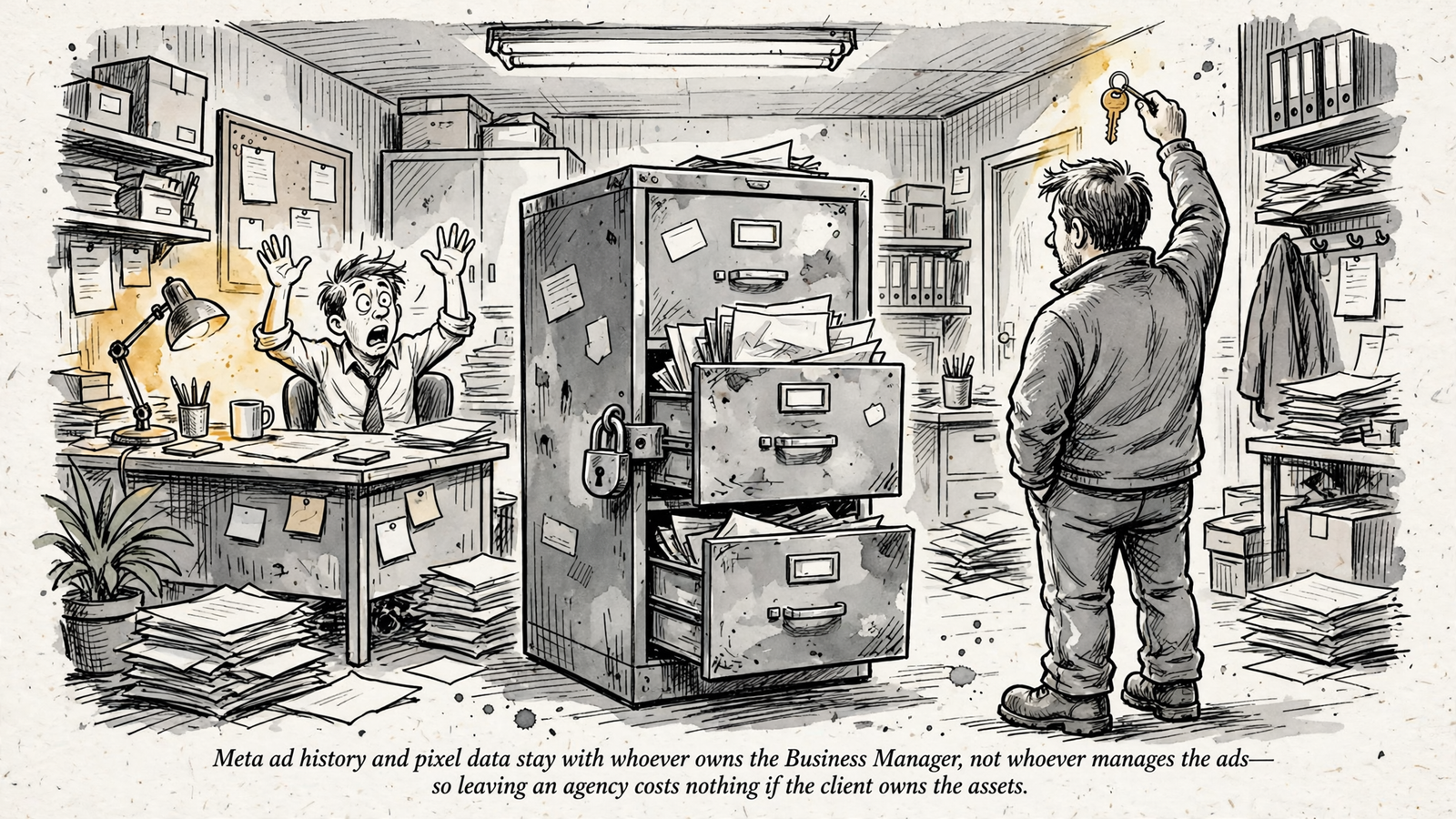
Done right, you create and own the Business Manager, ad account, pixel and Page, then grant the agency partner access. The agency never owns those assets. Revoking its access changes who can work in the account; it does not erase the account’s history. Done wrong, the agency builds the ad account and pixel inside its own Business Portfolio, and ownership sits with that portfolio. Meta even labels the distinction in the API as OWNER versus AGENCY. That is not fine print you want to discover during a breakup.
I have taken over accounts in both states. When the client owned the assets, campaign history stayed in the ad account after we removed the old agency. Audiences built from that pixel stayed usable. When the agency owned the assets, the pixel could not be transferred between portfolios. A new pixel meant a new ID and rebuilt website audiences. Those are two very different handovers, despite both being called “switching agencies.”
You do not lose data by leaving. You risk losing access to it by letting someone else own the container it lives in. Ask for this line in the contract before you sign: the client retains ownership of Business Manager, ad account, datasets and Page; the agency operates with partner access only. If they will not put that in writing, walk.
Myth 3: “Setup is expensive, so we spread it over six months”
This one is honest about money and dishonest about why. Building a Meta account is real work: audit, pixel and Conversions API check, catalog, campaign structure, first batch of creative. Pricing roundups put that onboarding work at $1,000 to $2,500 in most cases, with a wider range from $500 to $7,000, depending on the tracking mess and creative volume. I would rather see that work priced plainly than pretend it disappears into a retainer.
The work takes days to configure, not months to perform. What the deck calls amortized setup, I call an installment loan you cannot refinance. If setup costs $1,800 and the retainer is $2,500 a month, a six-month term commits you to $15,000 to protect $1,800 of early labor. The rest of those payments should have to earn their place through the work done each month.
Charge for setup as setup, then let the monthly work prove itself. Ask what the one-time build fee would be if you paid it outright, and what work stops after week two. If the answer is vague, the contract is doing the retention work that performance should do.
Myth 4: “Creative testing takes a full quarter to read”
I hear this one phrased as thoroughness: several rounds of testing, audiences maturing, winners emerging. The FAQ version says yes to a minimum term because finding winning creative and audiences takes several rounds of testing. That sounds plausible until you ask what is supposed to happen between those rounds.
Winning ads typically hold for two to six weeks before frequency climbs and CPA follows. Working accounts therefore need new concepts, not three months spent admiring one test. Meta Experiments guidance says to run an A/B test at least seven days, ideally 14, long enough for roughly 30 to 50 conversions per variant, and not past 30 days. A test still needs enough conversion volume to be readable. A longer contract does not supply that volume; it just makes waiting easier to sell.
Ask for the testing calendar: how many new concepts ship each week, what the kill rules are by spend and CPA, and what ships in week three if everything loses. If the answer is “we will know next quarter,” you have a retention plan, not a test plan.

Myth 5: “Short contracts can’t support real strategy”
The pitch here is that six months buys planning. One agency puts it plainly: after a 6-month minimum term, plans roll monthly because six months gives campaigns enough time to be tested fairly. It sounds responsible. But a term on a contract does not decide which creative gets killed on Tuesday.
Meta strategy is a weekly operating rhythm: which angle gets budget, which creative gets killed, which audience gets consolidated, what ships next. I have seen more useful strategy in a 30-minute call with live spend data than in a 20-slide Q1 roadmap. A long contract does not create planning discipline. It removes the pressure to show it. Shops that plan well under month-to-month terms write down kill rules, test calendars and budget caps in week one because they have to earn month two.
Ask for the next 30 days in writing: how many concepts, what budget per test, what CPA kills an ad. If strategy only exists inside a six-month agreement, it was never strategy.
Put the obligations in writing, not the lock-in
Monthly does not mean loose. The best monthly agreement I ever signed was stricter than most six-month contracts, just strict about the right things. It named who owned what, what shipped each week and how either side could leave without a fight. That is the trade you want: give up the lock, keep the obligations.
- Ownership: Business Manager, ad account, datasets, catalog and Page stay in your name. The agency works as a partner, not the owner.
- Output cadence: State the number of new concepts per week, who writes and edits them, and where they are logged.
- Money rules: Set a budget per test, a CPA or CPL kill line, and who can raise daily caps without a call.
- Measurement: Define a conversion, how it is tracked, and your access to spend, results and change history.
- Exit: Specify 14 or 30 days’ notice, handover of logins and creative, and no wind-down fee invented at the end.
If an agency will not promise weekly work in writing, a six-month term only guarantees you pay for the weeks it coasts.
Myth 6: “Every agency does minimum terms”
Everyone does it, so it must be standard. Buyer guides now list a long lock-in alongside agency-owned ad accounts and vanity reporting as a red flag. They describe reasonable notice as normal and being trapped for a year as not normal. That matches what I see quoting work. Plenty of competent freelancers and small teams work monthly with a 14- or 30-day out.
The firms pushing hardest on six or twelve months tend to be the ones with the heaviest sales process and the lightest weekly output. Volume of paperwork rises as frequency of changes falls. groas runs the other way on Meta Ads at $1,499 a month, month to month with no setup fee and cancel anytime. Its execution does not depend on someone remembering to review the account when the next reporting date comes around.
Standard does not mean necessary. It often means unexamined. Ask how many clients would stay if the term were 30 days. Then watch the face.
Five questions for the sales call
Take these in with you and let the answers pick the vendor:
- How many optimization events will my budget produce per ad set per week?
- Who owns the Business Manager and datasets on day one?
- What is the setup fee if I pay it separately?
- How many creatives ship weekly, and what kills them?
- What stays live if I leave after 30 days?
An operator answers in numbers and names. A salesperson answers in quarters.
Myth 7: “Switching agencies resets performance”
This is the one I find hardest to kill because it contains half a truth. Yes, I have watched performance dip the week after a handover. No, it was not the calendar punishing disloyalty.
When you change who holds the login but keep the assets in place, campaign history stays in the ad account after agency access is removed. Learning does not restart because a different human opened Ads Manager. Significant edits are the risk: a new pixel, a new ad account, or a consolidated structure blown apart on day one so the incoming team can say it rebuilt everything. Keep the same ad account, dataset and Page, and Meta keeps working from the same events. Start over with a fresh pixel because the old one lived in the old agency’s portfolio, and you face a cold start, since a dataset cannot be transferred between portfolios. One outcome follows from the changes made to the account. The other begins with paperwork.
The tell is how the incoming agency talks about week one. If the plan is to audit access, keep winners running, fix tracking first and test second, a handover need not become a relaunch. If the plan is to pause everything and introduce my proprietary structure, expect relearning that the change in management did not require. I have written up the ownership versions of this in who keeps your Meta ads when you quit, because the reset people fear is often an ownership trap set months earlier.
Ask the incoming team what stays live on day one, what gets edited and which edits reset learning. Anyone who cannot answer will put your performance at risk regardless of the term length. I still feel the tug when someone warns me that switching resets everything; I remember handovers where CPA spiked for ten days. Then I pull the change log: new owner, new structure, five significant edits before lunch. The algorithm did what it was told. Keep ownership, count events, charge setup as setup, and the six-month contract has nothing left to stand on.