

 LinkedIn

Spend $2,000 or $3,000 a month on Meta and you may get the worst advice in the room. You need $10k before ads work. You need a dozen audiences for control. You should trust the ROAS number in Ads Manager. I ran accounts like this for years, and most of that advice was built for bigger budgets and older Facebook targeting. On a modest budget, it can do more damage than doing nothing.
Myth 1: You need $10k a month before Meta works
People believe this because they tried $20 a day, split it four ways, got nothing and blamed the budget. Often, the split is the problem. Meta’s minimum budgets can be tiny: $1 a day for awareness, $5 for clicks, and $10 to $20 for conversions. But meeting a platform minimum is not the same as giving an ad set enough spend to learn. Four ad sets at $5 a day each do not become a useful test just because all four are running.
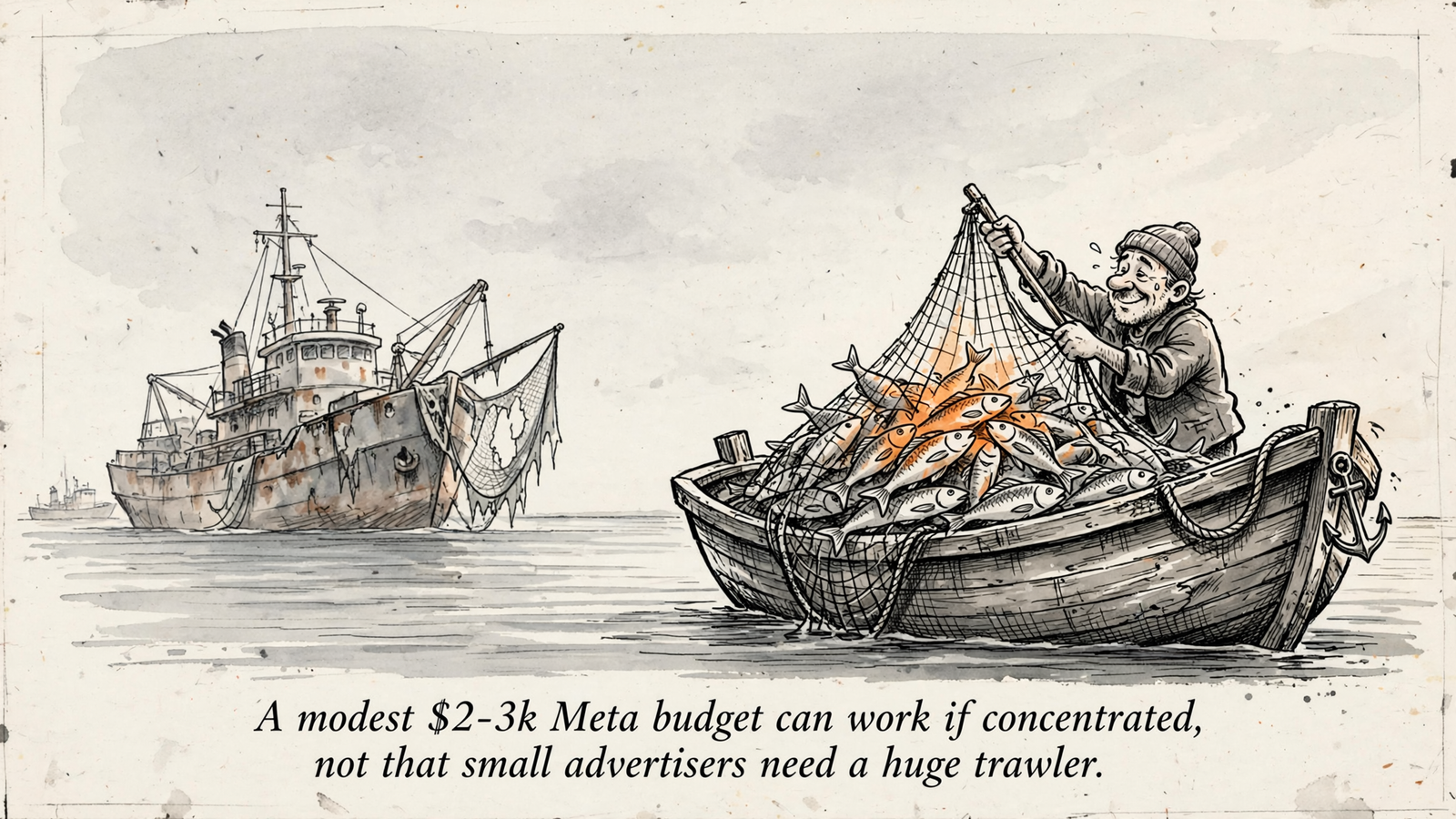
Here is the math I use to check whether a plan is plausible: take your expected CPA, multiply by 50, then divide by 7. That estimates the daily spend an ad set would need to generate 50 conversions in a week. At a $20 CPA, it is about $143 a day. If you spend $2,000 a month, or roughly $66 a day, you will not hit that pace by splitting the budget into four ad sets. You may not hit it with one, either. That is a reason to concentrate spend, not a reason to declare the account hopeless.
Start with one campaign, one ad set and one or two ads. Keep the audience broad enough to give Meta room to deliver. The floor operators often quote is about $30 a day to test, $50 a day to work and $100 a day to scale. Below those levels, you can still sell. You just cannot test four ideas at once and expect a clean answer.
Myth 2: More ad sets and audiences mean more control
I used to build accounts this way. Five ad sets for five interests, three more for lookalikes, each with its own $15 budget. It felt like control. What it bought was a collection of ad sets without enough conversion volume to settle. Meta’s learning-phase benchmark is roughly 50 optimization events in 7 days. Significant edits can send an ad set back into learning, too. Keep dividing $66 a day, and each slice has less evidence to work with.
The fix is boring: one campaign, one ad set to start, and broad targeting. If you use interests, treat them as suggestions rather than a carefully fenced-off set of buyers. Meta has removed detailed-targeting exclusions and made Advantage+ Audience the default for several campaign types. The old habit of stacking interests for precision buys less control than it appears to.
Fund the first ad set before you build the second. Use the CPA × 50 ÷ 7 calculation as a check on how much conversion volume each new split is likely to get, not as a promise that learning will finish on schedule.
Myth 3: The learning phase means you should never touch anything
Someone tells a small advertiser to wait seven days without touching an ad while Meta learns. The ad burns $400 with no sales, but switching it off would be interfering with the algorithm. I have made that mistake. It is expensive politeness.
Yes, significant edits can restart learning. No, that does not mean you sit on your hands while one creative takes 80% of spend and produces zero sales. Learning has a cost. So does protecting a bad ad from a decision you already have enough evidence to make.
Touch the account less often, but touch it decisively. Cut a clear loser. Make a budget change in one move instead of five nervous nudges. Add new creative to the existing structure rather than building another ad set around every new idea. My practical rule is 48 to 72 hours without tweaks, unless CPA is running at double the target with zero conversions. Then I cut. A small budget cannot afford constant resets or a week of ceremonial patience.
Myth 4: Meta’s reported ROAS is your real ROAS
Ads Manager told one ecommerce brand I worked on that ROAS was 2.0. The bank account told a different story. Meta’s number draws on modeled conversions, delayed reporting and cross-device attribution. After iOS privacy changes, the gap became harder to ignore. I have seen the pattern others report: 2x ROAS in Ads Manager while a tracker showed negative ROI, and once the reverse.
That does not make Ads Manager useless. It tells you how Meta is delivering and what it attributes to its ads. It does not settle whether the business made money. Use Meta for delivery signals; judge revenue in Shopify, GA4 or your CRM. If the numbers disagree by 20% or more, investigate tracking and attribution before you increase spend. The screenshot is a prompt to check the books, not a substitute for them.
Myth 5: Interest targeting is where the skill is
I built my early reputation on interest stacks. Yoga moms plus Lululemon plus Whole Foods, that kind of thing. I was wrong to be proud of it. Meta spent 2025 taking that game away: it consolidated interests and pulled detailed-targeting exclusions. In January 2026, ad sets still using removed interests stopped delivering. Advantage+ Audience became the default for Sales, Leads and App campaigns, and interests entered there function as suggestions rather than the hard boundaries I used to build around.
The work moved somewhere less romantic: broad targeting and a tighter creative brief. One home services client I ran spent $2,400 a month. Its interest-split version stalled at $48 per lead. With the same budget and offer, we ran broad targeting and two UGC-style videos aimed at homeowners in a 25-mile radius. The result was $31 per lead in three weeks. The change gave Meta more room to find converters while the videos made the offer recognizable to the people we wanted. Put the hour into the hook and the offer, not a 40-line interest stack the platform may treat as a hint.
Myth 6: One winning creative can run for months
Every small advertiser has a story about the ad that printed money in March and died in May. Repetition catches up with it. For cold audiences, 7-day frequency around 2 to 2.5 can signal fatigue, with direct-response performance often falling off after 3 to 4. On broad audiences under $10k a month, a good concept may last 6 to 12 weeks. Plan for two to four fresh variants a month rather than waiting for the winner to collapse.
Small budgets can hide the problem because frequency climbs slowly. The ad looks stable until cost per result starts to move. Watch both frequency and cost per result by creative, not just at account level. My cue to replace an ad is frequency past 2.5 alongside CPA roughly 30% above its best week. Neither number alone is a magic cutoff. Together, they are a better reason to test a replacement than to raise the budget and hope the old ad recovers.

Myth 7: Boosting posts is a cheap way to test
People believe this because the button is right there. A post does well organically, Meta offers to boost it for $25, and the resulting likes and site visits feel like evidence. Evidence of what? If you want to know what a qualified lead or purchase costs, engagement is a detour.
A boost promotes an existing post with fewer creative, targeting and optimization controls than an Ads Manager campaign. Ads Manager lets you choose Leads or Sales objectives, work with Pixel signals, build retargeting audiences and report on lead costs. That is a more useful setup when the question is whether an offer brings in customers.
Boost when you want eyeballs on an announcement. Build a campaign when you want to measure customers. If your test cannot tell you the cost per qualified lead, it was not the test you needed. It was a donation with a tidy little results screen.

Myth 8: An agency charging a percent of a small budget is the affordable option
On paper, it looks cheap. Fifteen percent of $2,000 is $300, which sounds better than a flat fee. But a low fee does not buy much time, and a percentage-of-spend model rewards the agency when your budget rises whether your ROAS improves or not. Meta management commonly runs flat fees of $500 to $5,000 a month, 10 to 25% of spend, or $25 to $150 an hour, on top of what you pay Meta.
I have inherited small accounts where the management showed in the structure: stale ad sets, one tired creative and a report that treated Meta’s attributed ROAS as money in the bank. That does not describe every agency. It does describe the risk in buying the cheapest-looking line item without asking who actually watches the account and what they change.
Do the comparison honestly. A flat fee such as groas Meta Ads at $1,499 a month costs far more upfront on a $2,000 ad budget. In return, the fee does not rise just because spend rises, and the service is built around continuous work on audiences, budgets and testing. That is the stronger alternative to paying a percentage for occasional attention, though the fee still has to make sense against your revenue. I break down the ownership decision in Who Should Run Your Meta Ads at $3k, $10k or $30k a Month. Compare the work and its incentives, not just the first invoice.
What a $2,000-to-$3,000 account should actually look like
Strip out the myths and the starting structure is simple. Put prospecting into one campaign and one ad set, use a broad audience, and rotate a small number of creatives. Optimize for the sale or qualified lead you want, not the click that looks good in a report. Check orders or qualified calls in your store or CRM rather than refreshing Ads Manager every hour.
Retargeting is an option, not a compulsory second campaign. If you have enough site visitors or customer-list volume to support it, keep it small: roughly 10 to 20% of spend. If you do not, that extra split only recreates the problem from Myth 1. Fewer moving parts, watched closely, judged on revenue. Here is the account I would start with:
- Prospecting: one campaign and one ad set; check the daily budget against expected CPA and the conversion volume it can realistically buy.
- Creative: two ads live to start, with a new variant about every two weeks. Review a loser when CPA runs roughly 30% above its better week.
- Retargeting, if volume supports it: site visitors from the past 30 days and a customer list, with frequency watched rather than ignored.
- Measurement: orders and qualified calls first, Ads Manager’s attribution second.
- Changes: one decisive adjustment at a time, then give it about 48 hours before another routine tweak.

Four questions before you pay someone to improve ROAS
If you hire help on $2,000 a month, ask these before you sign. The answers tell you whether the service manages money or manages reports. Anyone who cannot show the math in question two should not design your account structure.
- What number will you report against: Meta’s ROAS, or orders and qualified leads in my store or CRM?
- How many ad sets can my budget support at my expected CPA? Show me the CPA × 50 ÷ 7 calculation, and tell me what you will do if spend falls short of it.
- Who makes new creative, how many variants will you test, and what gets cut when?
- What did you change last week in an account my size, and why?
The myth I find hardest to kill is Myth 4. Clients still send me screenshots of 4.2 ROAS in Ads Manager while Shopify shows 1.9, and they want to believe the screenshot. I get it. It arrives daily, looks precise and flatters the work. But Meta counts modeled conversions and delayed attribution, and your landlord accepts neither. Judge the account on money collected. The number in Ads Manager is not your bank balance.