

 LinkedIn
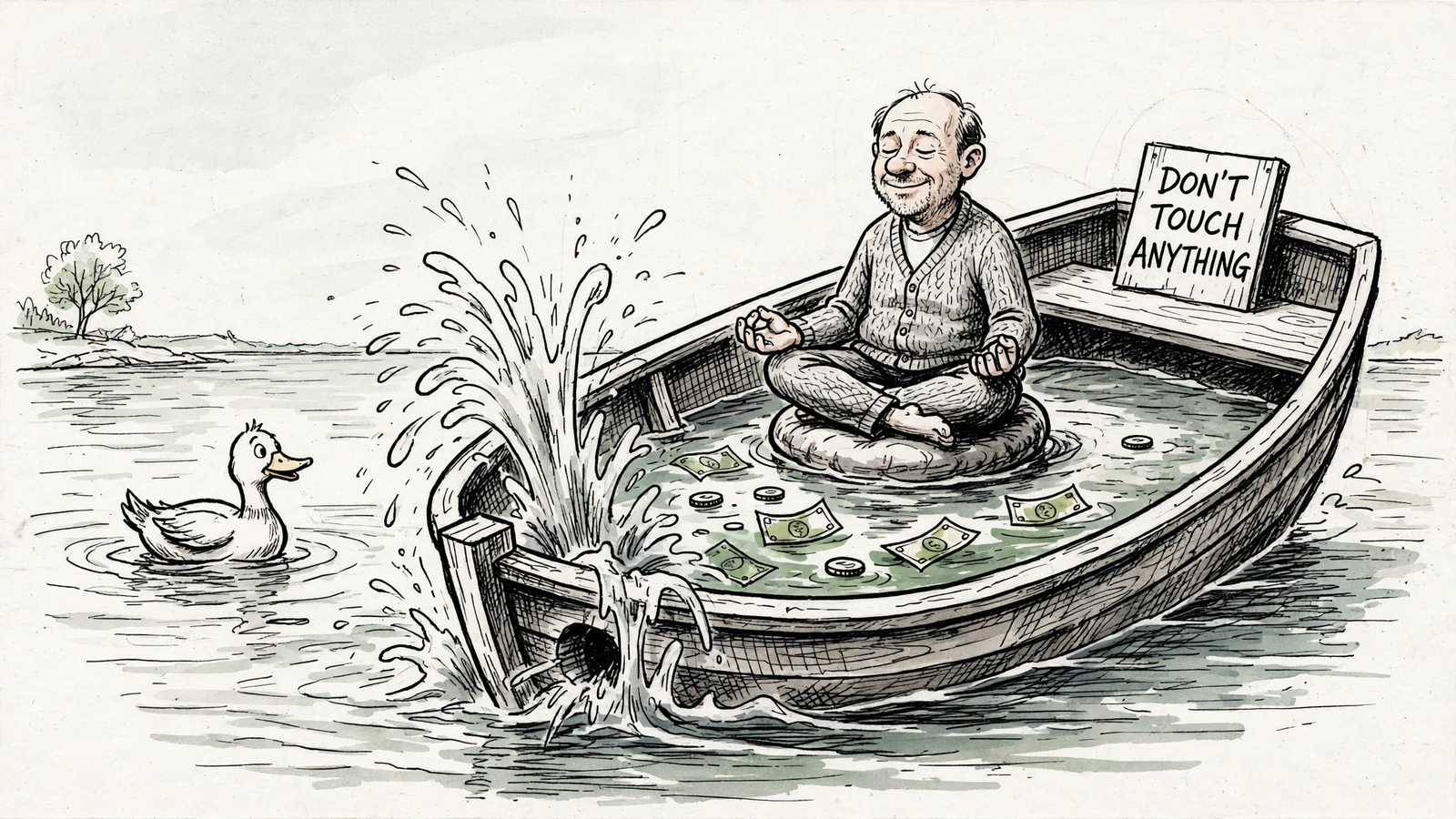
A new Google Ads campaign can waste money on irrelevant searches while its owner waits two weeks to “let it learn.” I used to recommend a softer version of that wait. I was wrong. Most launch schedules build folklore around one misread help page: Google tells you when to judge Smart Bidding, not to ignore a leaking campaign.
1. “The learning phase lasts exactly seven days”
I understand why this one sticks. Google puts a Learning badge in the status column, and a week later the badge goes away. Google says that status never lasts more than seven days. Ads keep serving normally while it shows. It looks like a countdown to a verdict.
The badge is not the verdict. Smart Bidding can keep calibrating after it disappears. Google says convergence typically takes one to two conversion cycles, depending on conversion volume, cycle length and how tightly the strategy is constrained. Its guidance for judging performance is two conversion cycles or two weeks, whichever is longer, with conversion delay accounted for.
Take a lead-gen account with a 21-day sales cycle and eight conversions a month. Day eight tells you very little about its eventual CPA. An ecommerce account with 200 conversions a week gives you more to work with. Same badge, different amount of evidence. Practitioners also discuss roughly 50 conversion events or three conversion cycles as a calibration yardstick; that is not a seven-day guarantee.
In week one, I check whether conversions are being counted and whether the traffic has a chance of producing them. I do not announce that the campaign has passed or failed because an icon disappeared. Count conversions and conversion cycles, not days since launch.
2. “Don’t touch anything for two weeks”
This is the launch instruction people print in capital letters. One framework says “DON’T TOUCH ANYTHING” for 7–14 days, warning that changes reset learning. I get the appeal. A nervous owner wants a rule; doing nothing sounds more disciplined than reacting to every expensive click.
But “anything” covers both strategic changes and basic repairs. Those are not the same job. Google identifies a limited set of Learning triggers: a new or reactivated strategy, composition changes such as campaigns or keywords added or removed, and large changes to goals or conversion actions. Its learning-status guidance says budget, target, creative and targeting-setting changes do not erase historical data or trigger that status. An edit is not a factory reset.
That does not make constant tinkering clever. I leave a sensible structure alone long enough to gather evidence. Splitting ad groups in week one can scatter already-thin data, whether or not a badge appears. I also resist moving a target three times because Tuesday’s CPA looks ugly. I made that mistake on a home services account years ago. Ten days of chasing a number did not produce ten days’ worth of insight.
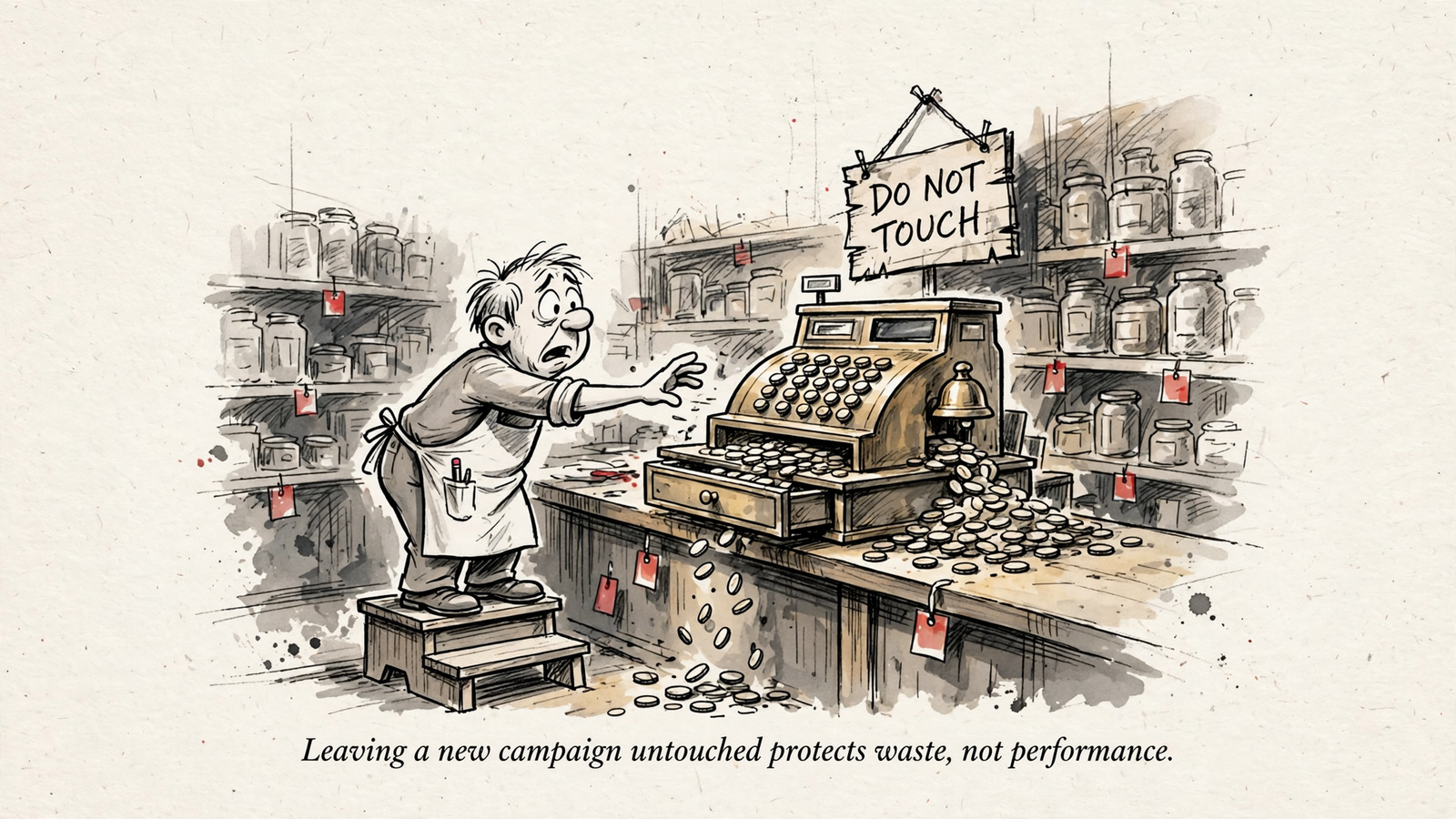
What I will touch immediately: broken conversion tracking, disapproved assets, an ad that sends people to the wrong page, and search terms that plainly cannot convert. I check the form by submitting it, not by admiring it in a browser tab. I compare spend with the traffic it bought. That is account management, not interference.
Leave sound structure and targets time to work; fix visible waste today. The hands-off rule confuses patience about performance with permission to ignore the account. For a longer version of that split, I wrote out the argument against the two-week hands-off rule. It is why I run launches through groas now: the system works on terms and bids around the clock while a strategist owns the structural calls. That beats my old 1am negative-keyword sessions on speed and sleep.
3. “Adding negative keywords hurts learning”
This myth is the hands-off rule with a particularly expensive exception. Some launch advice says to review search terms but wait to add negatives. So you spot an irrelevant query, recognise that it cannot become a customer, and pay for more of it because you have been told to protect Learning. Impressive commitment to the badge.
Google’s list of learning-status triggers does not tell you to leave irrelevant searches eligible while the campaign calibrates. Negative keywords block traffic you do not want to buy. They do not make a job seeker more likely to become a customer or a DIY searcher more likely to pay for the service they intend to do themselves.
In week one, I add exact negatives for clear mismatches: jobs, free, DIY, or locations the business does not serve, where those searches have no place in the campaign. I do not treat every unfamiliar query as junk. A borderline term can wait for 20 or 30 clicks of data; an obviously irrelevant one does not need a ceremony.
Block clear waste on day two or three. You are not starving the system of useful evidence when you stop buying searches that cannot serve the business.
4. “Week-one CTR tells you if the campaign works”
CTR is available early, which makes it tempting. The first few hundred impressions produce a number; the conversions may take longer. I used to like any metric that arrived before the client’s first anxious email. Availability is not the same thing as usefulness.
A click-through rate reflects the queries that triggered the ads, the position they appeared in and how closely the headline matched what someone typed. It does not tell you what happened after the click. A 9% CTR from freebie hunters and job seekers loses to a 2% CTR from buyers. Buying more of the first traffic because the percentage looks tidy only makes the mistake faster.
In week one, I read the search terms behind the CTR. I check that the landing page matches the promise in the ad and that conversion tracking counts the action the business cares about. If those pieces are broken, a beautiful CTR is decoration. Judge early traffic by its relevance and the integrity of the conversion signal, not by the easiest number on the screen.
5. “Start on a tiny budget and scale once it’s learned”
A tiny launch budget feels cautious. Say you spend $20 a day in a market where a click costs $60. At that rate, you can afford roughly one click every three days. You have capped your exposure, but you have also given the bidding system very little conversion data to learn from.
Calibration depends on conversions and conversion cycles, not on how many mornings have passed since launch. A practitioner baseline puts four to six weeks to clear learning at roughly $100 a day, with longer before bidding becomes reliably accurate. That is a benchmark, not a promise for any account. At $20 a day and $60 a click, the practical point needs no benchmark: there is not much to judge.
Google’s guidance is to give the system enough daily budget to optimise. A budget increase can take effect without triggering Learning status, so the badge is not a reason to keep a campaign underfunded. I would start with enough budget to buy roughly 10 to 15 clicks a day in the market, then control risk with relevant keywords, negatives and a tight geographic area. If that budget is not available, I would narrow what the campaign tries to cover rather than pretend the same broad launch will learn on scraps.
A small budget can limit loss. It cannot manufacture a pattern out of a handful of clicks. Fund a scope you can actually test.
6. “Switch to tCPA or tROAS on day one to save time”
I see the logic. If you know what a lead or sale is worth, why not give Google the target immediately? Because a target and the evidence needed to bid toward it are different things. With little conversion history, a tight goal can restrict delivery before the system has much to work from. Or the number can look reassuring while the traffic behind it is wrong.
There is no universal requirement to wait for a magic conversion count. As bidding guidance notes, Target CPA can start without conversion history; being allowed to select it does not mean a new campaign has enough data to make that choice useful. The 30- and 50-conversion figures people pass around are practical yardsticks, not proof that every account behaves the same way on conversion number 31.
My usual launch sequence is plain: start with Maximise Conversions, check that the campaign is attracting relevant searches and recording real conversions, then consider a target once there is enough history to judge it. Around 30 conversions in a month is the working threshold I use for that decision, not a switch Google physically locks until then.
In week one, I spend more attention on whether the conversion action is the right one than on setting an elegant tCPA. A precise target applied to a bad signal is still a bad instruction. Get the signal right before you constrain the bidding.
7. “If it says Limited in week two, the campaign is broken”
A Limited label can look like a diagnosis. Often, it is simply telling you that the budget is restricting delivery. Google’s budget guidance says the system needs enough room to optimise. That is a funding question before it is a verdict on the bidding strategy.
I still check what is limited and why. If impression share lost to budget is above 20% and conversions are scarce, I look at two choices: add budget or narrow the geography and keywords so the existing budget reaches a more focused set of searches. I do not increase spend merely to make a warning disappear. Strong search terms with a capped budget call for a different decision from irrelevant terms eating the same budget.
Budget-capped Target CPA and Target ROAS campaigns can also deliver closer to the target rather than quietly coasting beneath it. A loose target is not a substitute for watching spend. In week two, I check the search terms, conversion count and budget pressure together. A Limited label with relevant traffic may be a funding problem; with junk traffic, it is a cleanup problem. The label alone cannot tell you which.
8. “The landing page can wait until the ads prove themselves”
This is the myth I find hardest to kill. It sounds like sensible sequencing: get traffic, see what happens, improve the page later. I understand it. Ads feel easy to edit; a page can feel like a project. But the ad and the page are one paid journey, and the click is where the invoice starts.
Smart Bidding learns from the conversions it sees. If the form asks for a life story, the phone number hides in the footer or the page fails to deliver what the ad promised, you pay for clicks while feeding the system a poor conversion signal. Fixing the page in week five does not refund the first four weeks. Waiting has not isolated an ad test; it has mixed the ad with a weak destination and called the result evidence.
Google’s learning-period documentation tells you how long to wait before judging bidding performance. It does not tell you to postpone making the destination usable. Before launch, I want a focused page that matches the ad and makes its main action clear. In week one, I submit the form myself, check that the conversion registers and look at the searches sending people there. A focused page for an ad group can serve that job better than a generic homepage; “we’ll fix it after the ads prove themselves” is not a testing plan.
Fix the page before you pay to discover that it is broken. Then give sound structure and targets the two conversion cycles Google recommends for judgment, while you keep checking the plumbing every day. I keep a longer breakdown of what the learning phase does and does not mean for anyone still tempted to use the badge as a launch calendar.

If I could kill only one myth here, it would be this one. Nobody proudly defends paying for junk search terms. Plenty of smart owners defend sending paid clicks to a bad page because they think traffic has to come first. It does not. Build the page, guard the budget daily and judge performance on conversions over a sensible window. The badge will take care of itself.