

 LinkedIn

A PPC client asks why competitors appear in ChatGPT and Perplexity while they do not. You can answer with a white-label SEO and AI search partner, an in-house SEO hire, or a resold visibility tool. For a PPC agency with fewer than roughly 15 SEO clients, the hire that feels safest is usually the worst financial choice. The tool looks cheap until that client asks why ChatGPT still names someone else.
This is a head-to-head for agency owners managing $30k to $200k a month in media who want to add SEO and answer-engine work without wrecking margin. I’ll compare the three routes on fulfillment, AI search coverage, client risk, margin at 3, 10 and 25 clients, and speed to visible work. My verdict up front: buy fulfillment before you build a team. A good white-label partner wins for most shops at this stage; the hire becomes compelling when the client base can keep a team busy.
Meet the three contenders
White-label SEO and AI search partner: Another team does the work under your brand. Your client sees your reports, your Slack and your invoice. A partner that covers both classic SEO and AI search can handle pages, technical fixes and third-party mentions in one service. Wholesale white-label SEO runs $300 to $5,000+ per client per month, with standard packages at $500 to $1,500. Resellers commonly mark up the wholesale price. For agencies, groas lists SEO & AI Search at $1,499 a month per client location, covering Google plus ChatGPT, Perplexity, Gemini and more, with new pages and technical fixes every day.
In-house SEO hire: One specialist on payroll owns audits, content briefs, publishing and whatever developer time you can get. A cited salary benchmark is $78,760; with benefits representing roughly 30% of total employer cost, that puts the loaded cost near $112k a year before tools. Entry plans include Ahrefs Lite at $129 a month or Semrush Pro at $139.95 a month. Writers and developer time sit outside those prices.
Reselling an AI visibility tool: You license a dashboard such as Otterly, Profound, Peec, Scrunch or Goodie and sell AI search monitoring as an add-on. The quoted entry range runs from $29 a month for Otterly to $500 a month for Scrunch Agency Core, with prompt and project limits affecting what you pay. I used to think a tool plus a few hours of operator time could cover SEO. I was wrong. Measurement is not fulfillment.
Axis 1: Who publishes the page and fixes the site?
A PPC agency does not need another dashboard when a client asks for SEO. It needs pages published, technical faults fixed and mentions earned. The route that assigns those jobs to someone wins this axis.
A white-label partner takes on the work under your brand. groas, for example, includes new pages, daily technical fixes and authority-building on third-party sites in its service. An in-house hire can plan the same work, but one person ships only what their time and access to developers allow. I know the bottleneck: an audit can be finished long before a developer has a slot for the fixes, while the next content brief waits in another queue.
A visibility tool does not publish, fix or earn mentions. The leading platforms are measurement products, not fulfillment teams. They can show where a brand appears. Someone still has to change the site, write the content and follow through.
If nobody is assigned to do that work, do not sell SEO and AI search yet. The partner assigns it to a fulfillment team. The hire assigns it to one person. The tool assigns it back to you.
Axis 2: Does AI search coverage mean work or a chart?
Your client did not ask for another ranking report. They asked why ChatGPT names a competitor. Reporting an absence is different from doing the work that might change it.
A partner built for both SEO and AI search can cover Google, ChatGPT, Perplexity, Gemini and AI Overviews in one workflow. The work overlaps: a sound technical base, pages that answer specific questions, and mentions on relevant third-party sites. groas sells that combined service, so a PPC agency does not have to assemble a second fulfillment line to answer the client’s question.
An in-house specialist may cover both, too. The constraint is bandwidth. Classic SEO already involves audits, content, publishing and technical coordination. Add work aimed at answer engines, including tighter page structure and corroboration across sources, and a single hire has another queue to manage. One person can learn the work. That does not give them more hours to ship it.
The tool route is the tempting one because the dashboard puts ChatGPT, Perplexity and AI Overviews side by side. It can tell you whether a brand appeared in the prompts it tracked. It cannot publish the missing page or earn the mention. When the client asks, “Why does ChatGPT still not mention us?”, you have a chart and the same unfinished work.
Sell AI search coverage only when someone is paid to produce what that coverage depends on. A dashboard is useful for checking the work, not replacing it.
Axis 3: Whose reputation takes the hit?
White-label has a real risk: your name is on work you did not do. If the partner ships thin pages, inconsistent reports or questionable links, the client calls you. Known failure modes include quality variance, branding slips, a partner going dark and link shortcuts. You cannot delegate accountability along with fulfillment.
I would vet a partner the way I would vet a link builder:
- Run a paid pilot with one low-profile client.
- Put output and turnaround expectations in writing.
- Keep the right to audit link placements and published work.
An action log and a named strategist give you something to inspect and someone to hold accountable. A month-end PDF does not.
The hire has a different concentration risk. One person quits, gets sick or turns out to be weaker at technical SEO than the interview suggested, and several clients feel it at once. Tool resale puts you in an even thinner position: the client pays your markup for someone else’s dashboard, then asks you to explain a prompt sample or an answer that has not changed. They do not blame the software vendor. They blame you.
White-label risk is manageable if you insist on a pilot and audit rights. A single hire is harder to backstop, and a tool cannot take responsibility for work it never promised to do.
Axis 4: What does the margin actually look like?
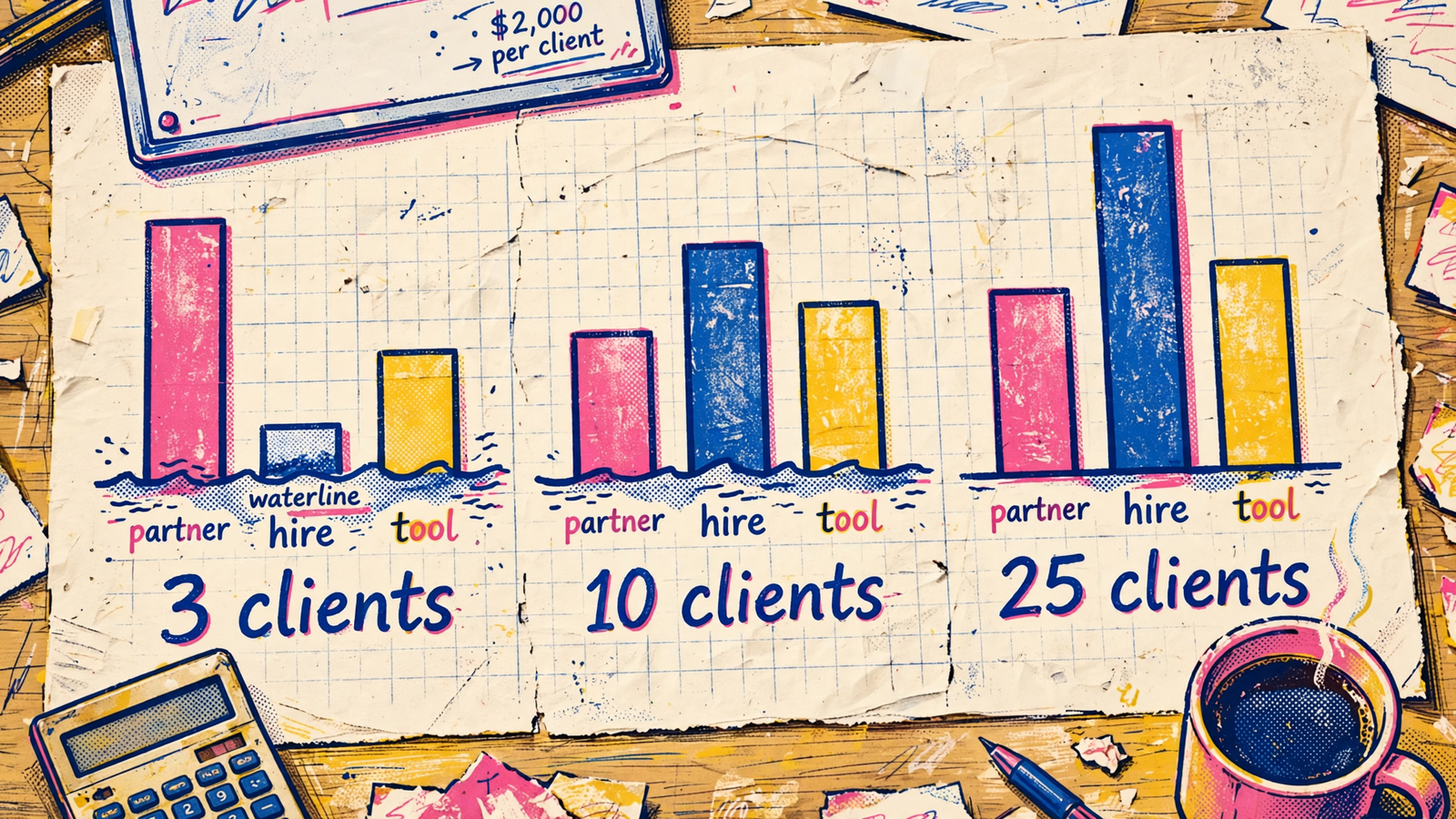
At an illustrative $2,000 per client per month for SEO plus AI search, the comparison starts with these recurring totals: the groas partner price is $1,499 per client, or $4,497 to $37,475 a month across 3 to 25 clients; one loaded hire is about $9,333 a month before tools and writers; and the cited tool entry prices range from $29 to $500 a month before fulfillment labor. Those totals are not interchangeable. One buys delivery, one buys an employee’s time, and one buys measurement.
Here are the line items. Listed prices are separate from one-off costs and the labor a price page does not cover.
| Route | Listed recurring cost and source | One-off costs and recurring work outside the price |
|---|---|---|
| White-label partner | groas: $1,499/month per client location, with no setup fee and month-to-month terms. The broader wholesale market spans $300 to $5,000+ per client, with standard packages at $500 to $1,500. | Pilot one client to check quality; allow roughly two hours of your account management per client per month. Confirm output expectations and link audit rights before signing. |
| In-house SEO hire | The cited salary benchmark is $78,760; with the stated benefits assumption, budget about $112k/year, or $9,333/month, loaded. Ahrefs Lite is $129/month; Semrush Pro is $139.95/month, with higher agency tiers. | Recruiting and ramp time are one-off costs. Writers, borrowed developer time, management and eventual turnover add recurring or replacement costs. The draft budget for writers is $300 to $800 per client per month. |
| Visibility tool resale | The quoted entry range is $29/month for Otterly to $500/month for Scrunch Agency Core; prompt caps and project limits can push upgrades. | You still need to write, publish and fix. Budget the draft’s estimate of five to eight hours of your time per client per month if you do that work yourself. The tool measures visibility; it does not change the site. |
At 3 clients, you bill $6,000. The partner costs $4,497, leaving about $1,500 before your account-management time. A single hire costs roughly $9,333 in loaded pay before tools or writers, so this route loses money at that volume. A tool seat can look cheap, but five to eight hours of your labor per client means 15 to 24 hours across the three. At the illustrative $100 an hour used here, that is $1,500 to $2,400 in labor before you count the subscription.
At 10 clients, you bill $20,000. The partner costs $14,990, leaving about $5,000 before your account-management time. One hire is unlikely to carry real SEO and AI search fulfillment for all 10 alone. If you add a second specialist or the draft’s estimated $4,000 to $6,000 a month in freelance content and developer help, the cost moves toward $14,000 to $16,000 before turnover. The apparent saving narrows quickly.
At 25 clients, you bill $50,000. The partner costs $37,475 and leaves about $12,500 before account management. Here the hire model has room to win: the draft’s estimate for two to three specialists plus tools is $25,000 to $30,000 a month. But you have to recruit, manage and retain that team, not just compare two lines on a spreadsheet. The break point near 15 steady retainers is a planning threshold, not a magic switch; the work each client needs matters.
The cheapest mistake in this section is paying too much for a tool seat. The most expensive is carrying a loaded salary on three clients while the work they bought still waits to ship.
Axis 5: How soon can the client see work?
PPC owners can mistake a fast tool demo for a fast service. A dashboard can appear today; a page still has to be published.
With groas, the service can go live within 24 hours of the onboarding call, and pages and technical fixes can start shipping in the first week. That is visible work, not a promise that a client will outrank anyone in week one.
An in-house hire has to be found, hired and ramped before they can audit, brief or coordinate fixes. Once they start, developer queues can slow the first changes further. A first visible output in roughly 60 to 90 days is a more useful planning assumption than treating the hire date as launch day.
A visibility tool is fastest at showing a measurement. Connect the domains and you can see prompt coverage quickly. Unless someone then makes changes, you have nothing new to show the client next month. In the 10-client agency comparison of AEO software and a white-label partner, that distinction is the decision: one route supplies a view of the problem; the other supplies people to work on it.
| Decision axis | White-label partner | In-house SEO hire | Visibility tool resale |
|---|---|---|---|
| Who does the work? | Partner publishes and fixes under your brand | One specialist, subject to capacity and developer access | Tool measures; your team does the work |
| AI search coverage | Included in the fulfillment workflow | Possible if the hire has the skills and time | Monitored, not fulfilled |
| Client risk | Your reputation is exposed, but you can pilot and audit | One person becomes a bottleneck | You own the gap between the chart and the answer |
| Margin at 3 / 10 / 25 clients | Predictable per-client cost; works at low volume | Weak at 3; more attractive at scale | Labor determines whether the apparent saving is real |
| First visible result | Published work can start in week one | Plan around hiring, ramp and delivery queues | Measurement appears quickly; changes require separate work |
Verdict: buy the work until you can keep a team busy
If you run a PPC shop with 3 to 12 clients asking for SEO and ChatGPT coverage, sign a vetted white-label partner first. Hire later. Do not sell the tool alone. The partner gives you a per-client cost and a team assigned to ship. The hire carries fixed payroll before enough retainers support it. The tool tells you what happened, then leaves you to explain why nothing changed.
I put the point to reconsider an in-house team near 15 steady SEO retainers. Above 20 to 25, the draft’s cost comparison favors a small team if you can keep it busy and keep it together. That is the build-or-buy call: buy execution until the client volume pays for heads.
Who should pick the losing routes anyway? Hire earlier if you already have 15-plus clients signed, or if a founder who genuinely does SEO will take on the work. Buy a visibility tool as an internal monitor alongside real fulfillment, not as the client deliverable. A prompt chart cannot publish a page. Sell what ships.