

 LinkedIn
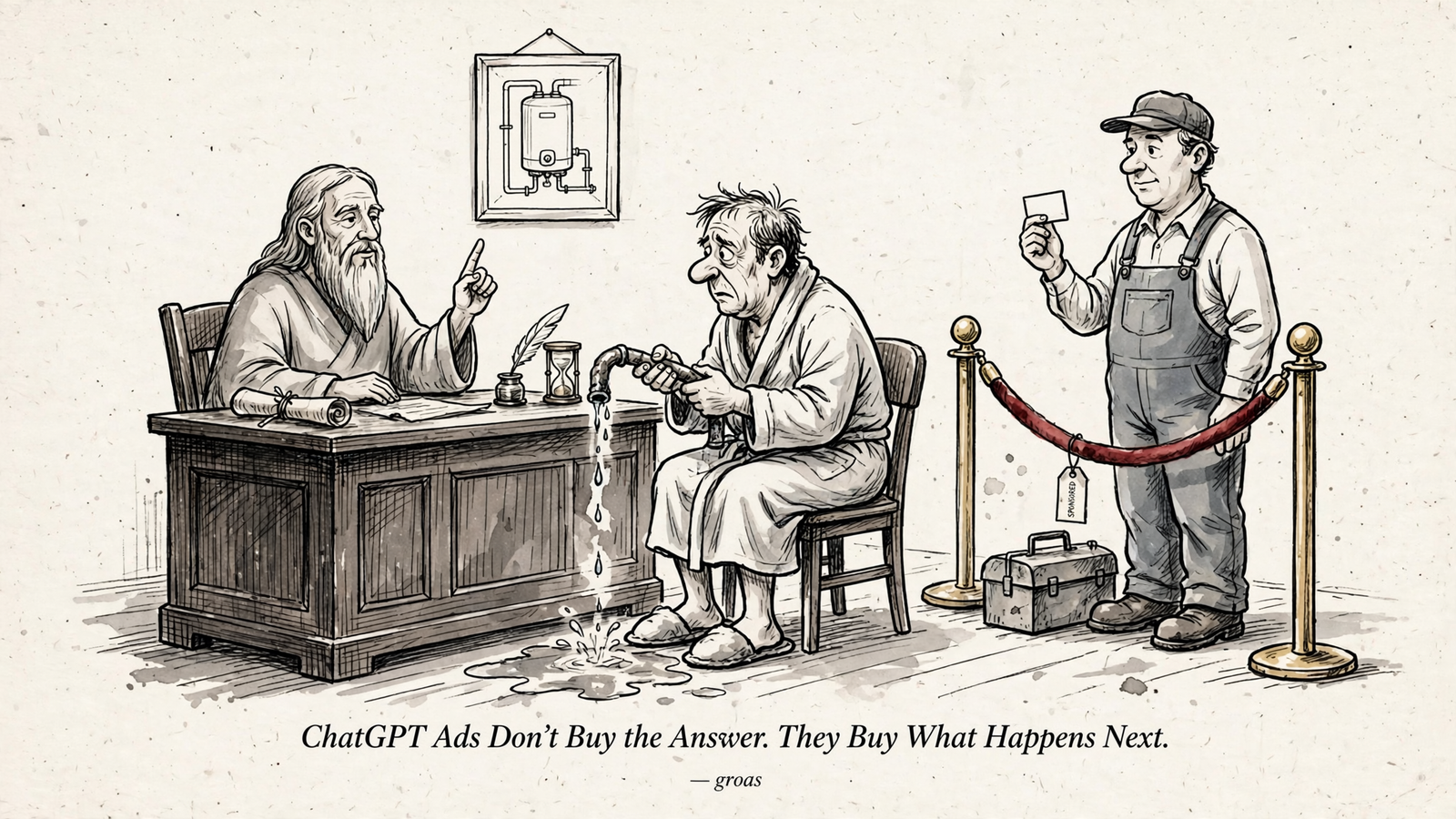
Your customer spends six messages working out whether to replace a leaking water heater. You cannot pay to put your company in ChatGPT’s answer, but you may be able to show a labeled ad just below it.
That is the fact everything else follows from: ChatGPT writes the answer on its own; a sponsored slot may appear afterward. The ad system is a dedicated setup separate from the model that writes the answer, and the unit stays labeled and visually separate from the response. You are not buying the diagnosis or the recommendation. You are buying a chance to offer the next step after the conversation has done some of the explaining.
I understand why advertisers picture something else. Google trained us to start with a keyword and compete for a position beside the result. Carry that picture into ChatGPT and you will make the wrong calls about targeting, creative, landing pages and measurement. Let’s follow the water heater customer and build the model from the placement up.
First, the answer and the ad take separate paths
The customer describes the tank’s age, rust-colored water, pilot light behavior and a repair quote. ChatGPT answers the question. Separately, an ad orchestrator reads the multi-turn conversation, turns parts of it into embeddings and queries, nominates candidates, then runs an auction to rank and price them. If the ad system is late, the answer still renders. The late ad does not show.
When an ad does show, it is a labeled sponsored slot below the response, with a short system-written explanation of its relevance kept apart from the advertiser’s headline, description and call to action. Winning the relevance-weighted second-price auction does not guarantee an impression: suitability and delivery-window checks can still block it, according to that same account of OpenAI’s stack.
That order matters. The model can explain repair versus replacement without waiting for a plumber’s bid. The plumber’s card can offer to book a visit afterward. Good timing, not a purchased answer.
The trust boundary is also an inventory boundary
I used to tell clients to think of position one as rented trust. Here there is no position one inside the answer to rent. Paying does not boost an organic citation, and your copy does not edit the model’s sentence. Your logo sits underneath it.
Not every conversation becomes available inventory, either. ChatGPT ads reach logged-in adults on Free and Go tiers; Plus, Pro, Business, Enterprise and Education remain ad-free. Our water heater conversation is only an ad opportunity if that person is on an eligible plan.
Perplexity made a different choice about the same trust problem: it phased out sponsored follow-up questions in late 2025 and confirmed in February 2026 that it was not pursuing ads because even labeled placements could make users doubt an answer’s independence. ChatGPT keeps ads separate; Perplexity removed them. Neither sells you the answer. Before you plan reach, establish which conversations can carry an ad at all.
Next, replace the keyword with the conversation
In Google, I might bid on emergency plumber near me or water heater replacement cost. Those words signal a topic, but they leave a lot unanswered. Is the person an owner or a renter? Is the tank leaking now? Have they already priced a repair?
The six-message chat can contain those details. ChatGPT targeting uses one- to two-sentence context hints describing buyer moments, matched semantically rather than by keyword overlap. For the water heater company, a useful hint would describe a homeowner weighing repair against replacement after finding signs of a failing tank. It is not a disguised bid on the phrase water heater replacement.
The distinction has an operational consequence: there are no keywords, negative matches or search-terms reports to work through. The hints are plain-language descriptions that guide matching rather than guarantee delivery. I first took them for keywords with better PR. They are closer to a brief about the moment your business can help. The system decides whether the conversation fits.
That sounds like richer intent, and sometimes it is. The same conversation can also carry an objection you did not choose: the person may already lean toward repair, or expect a price your company cannot offer. Your ad arrives after the chat has shaped the decision. Write for that moment, not for the first seven words of a search.
Then, count the controls you actually have
Once you stop looking for a keyword panel, the advertiser’s job becomes easier to describe. You control:
- The moment: context hints describing conversations where your offer is relevant.
- The eligible audience and place: geography and, if you have one, an uploaded list.
- The card: its headline, description, image and destination.
- The bid and budget: what you are willing to pay to compete for delivery.
Those controls are narrower than a Google Ads operator might expect. Setup guidance lists context hints, geography and uploaded lists, but no keywords, match types, negatives, demographics or in-market audiences. An uploaded list needs at least 25,000 matched users, and there is no pixel retargeting. Our water heater company cannot simply retarget everyone who visited its site. It can describe the replacement decision, choose serviceable locations and use a sufficiently large list if it has one.
The creative has to do a lot in a small space. The compact Sponsored card can include an advertiser name and logo drawn from the domain, a headline of roughly 24 to 50 characters, a description of roughly 48 to 100 characters, one square image and a landing page URL. Retailers have a separate feed-built product-card option. For the plumber, that space is better spent saying what happens after the click than announcing, with great ceremony, that water heaters exist.
Bidding uses a relevance-weighted second-price auction. One setup account gives a suggested CPC maximum of US$3–$5 and a default CPM maximum around US$60, with no spend floor in self-serve. No minimum does not mean cheap learning. Early reports range from CPMs near $25 to around $10 with roughly 0.5% CTR; one first-hand Australia test reported about 0.75–0.86% CTR at roughly A$6.50 CPC over a few weeks. Those are observations, not a price list for your account. Set a budget you can afford to learn from, and make the hint and card say plainly when you can help.
Your old optimization loop stops at the search-terms report
I spent years mining search terms at 1 a.m.: find the exact phrases burning money, add negatives, see what happens to CPA. There is no equivalent loop here. Advertisers cannot see which conversations or prompt clusters triggered their ads. They also get country-only location breakdowns even where US targeting is more granular.
You can still change the hint, card, destination and bid. You just cannot inspect the water heater thread that produced a click, identify an unwanted phrase and exclude it. Nor can you edit the answer, reorder it or buy a top paragraph. Reporting covers impressions, clicks, spend, CTR, CPC, CPM and pixel conversions, not a transcript of why you appeared.
There are other limits worth checking before a launch. Outside the US, geography is country-only; state, DMA and ZIP targeting are available inside the US. There is no language targeting or query-level breakdown, and the view-through window is fixed at one day. Conversions can take 24 to 48 hours to post. Landing pages must allow OAI-AdsBot or the ads fail review.
For our plumber, the practical shift is this: choose the service area as precisely as the available targeting permits, but do not expect reporting to tell you which local conversation pattern paid off. Optimize for a useful next click, not a position you cannot buy or a query you cannot see.
Make the landing page pick up where the chat stopped
On Google, a landing page often starts the explanation. The person typed a short query; the page fills in the rest. In our ChatGPT example, the customer may already have read about tank versus tankless, lifespan, repair costs and replacement costs. Send that person to a page headed What Is a Water Heater? and you make them start over.
A better destination picks up mid-thought. It helps the visitor find the replacement options, local cost information, installation availability, warranty and booking step that matter to this decision. It does not make them hunt through a general plumbing homepage for the one thing they came to do. A clear call button and fast-loading page still matter; so does allowing OAI-AdsBot.
This is where Google Ads habits can mislead marketers chasing AI visibility. A keyword landing page tries to match a phrase. A conversation landing page has to meet a conclusion. If the customer has decided the tank probably needs replacing, the page should help them check the options and book the work. If it cannot do that, rewrite it before buying clicks.
Measure the job, not the novelty of the placement
OpenAI reports a $1B annualized run rate in under 200 days and more than 100,000 advertisers. It does not disclose CPA, ROAS, conversion-rate or retention benchmarks. Revenue scale tells you the placement attracted advertisers; it does not tell you whether it will acquire customers profitably for your business.
Your measurement has to carry that burden. Platform reporting gives you impressions, clicks, spend and pixel conversions, among other basics, but conversions arrive with a delay. You cannot inspect the triggering conversations, and the fixed one-day view-through window will not describe every longer purchase journey. Early advertiser accounts also include mixed results, including short dwell times and low-quality leads. A click from a detailed chat is not automatically a good lead.
For the water heater company, I would start with the conversion path: did the visitor request a visit, did that request become a job, and did the revenue justify the spend? Look at downstream revenue by session cohort, not CTR alone. Give a test 6 to 8 weeks before calling it. Standard Google Ads metrics do not translate neatly to AI-platform visibility; pretending they do will make a thin report look more decisive than it is.
Decide whether the next click is worth testing
A good early candidate sells something people research in chat, can serve the locations it targets, has clean conversion tracking and can fund a 6- to 8-week test without demanding week-two ROAS. A relevant product feed helps a retailer. Daily minimums such as USD 25 operate as a seven-day average with room for daily spikes of up to twice that amount, so plan the week’s budget rather than treating every day as identical.
Wait if you cannot track conversions, if your buyers chiefly use ad-free Business or Enterprise plans, or if country-only targeting outside the US is too broad for your service area. Finance and health advertisers outside the US also face prohibited categories. None of that becomes less important because the placement is new. If you cannot connect the click to a useful outcome, fix that before you test.
Now run two unfamiliar businesses through the model. First, a direct-to-consumer $900 mattress that ships nationally. A customer spends five messages comparing back pain, firmness and trial periods. The answer handles the education. A context hint describes that comparison moment; a labeled card offers the next step; the landing page shows firmness options, trial terms and delivery information. The business can serve the customer, and the page can continue the decision. That is a plausible test.
Second, a plumber serving one ZIP code. The burst-pipe conversation may signal urgent intent, and US ZIP targeting can narrow where the ad serves. But country-only location reporting and the absence of conversation-level detail make it harder to judge what that narrow test achieved. Google can catch an emergency plumber near me search with familiar local controls. ChatGPT may catch a longer research thread. They are different jobs, not interchangeable dashboards.
That is why I would put both under one search strategy and decide where the next dollar earns its place. If you want the execution handled rather than learning another console, groas Search Ads across Google, Bing and ChatGPT is built for that: one flat fee and one strategist, not a percentage of spend that rewards the priciest click. The work still needs doing. Someone has to write the hint, build the page that finishes the chat and judge revenue despite delayed, limited reporting.
Back to the leaking water heater. The chat weighs the diagnosis, cost and repair-versus-replace trade. The ad does not touch that answer. It waits below it and offers a way to act. Ask anyone selling you ChatGPT ads what they control. If they promise placement inside the answer, walk away. If they cannot explain how they will judge the job without a search-terms report, walk away faster. Buy the moment after the answer, then measure whether it became a job.