

 LinkedIn

Your Meta agency can spend the next month moving budget between prospecting and retargeting campaigns, or it can give one campaign enough purchase data to learn. If you run an ecommerce store, that structure choice matters more than the agency’s reporting deck: consolidated Advantage+ Sales on one side, a hand-built prospecting and retargeting split on the other.
I have run both. I used to tell clients the manual build was the careful choice. I was wrong for most stores. When an account has enough purchases to feed it, I would choose consolidation and measure its new-customer results separately. Manual still wins for three kinds of stores, and I will name them. But when an agency defaults to segmentation for everyone, I want to know what that extra complexity buys the store, not how many hours it gives the agency to bill.
The contenders: one learning pool or several controlled budgets
Contender A is Advantage+ Sales, what Meta used to call Advantage+ Shopping. The old Shopping type is no longer a separate campaign you create. Since February 2025, it has lived inside the standard Sales objective; the API also blocks creating or editing the legacy type as a separate campaign. A Sales campaign counts as Advantage+ when three settings work together: one campaign budget, Advantage+ audience using suggestions rather than hard limits, and Advantage+ placements without exclusions. Separate ad-set budgets, locked interest targets, or placement bans change the build, whatever the agency calls it.
Contender B is the hand-built structure I grew up on: cold prospecting in one campaign, warm retargeting in another, sometimes existing customers in a third. Each has its own budget and audience. You can decide who sees what and how much each pool may spend. That control feels responsible. It also splits purchases across smaller learning pools and creates a recurring job moving money between them.
Control is worth paying for when it changes who gets the dollar. Otherwise, it is a more elaborate way to make the same decision.
Signal volume: count purchases before you count campaigns
Advantage+ puts a campaign budget and broad audience suggestions behind one pool of purchase events. Four small ad sets have four smaller pools to learn from. That is the mechanism behind the performance argument, not a mystical property of an Advantage+ label.
The reported learning floor dropped to 25 conversions per week in April 2026, with 50 per week described as dependable and 100-plus as reliable. Reported CPA differences are larger above $10k a month, around 38%, than under $2k, around 14%. More pooled purchases can support steadier bidding; splitting the same purchases makes each pool work with less information.
Say you spend $20k a month and get 200 purchases. That is roughly 50 a week in one pool. Divide them among prospecting, retargeting, existing customers, and a test campaign, and each gets roughly 10 to 15 a week. You have not created more evidence by creating more ad sets. You have distributed the evidence you had.
The small-store exception matters. If you get 80 purchases a month, consolidation cannot manufacture the volume you lack. Practitioner guidance puts stable Advantage+ optimization around 300 purchases in 30 days and 50-plus weekly conversions, and suggests starting with manual campaigns and broad audience suggestions below that level. My takeaway: work out purchases per ad set per week before an agency sells you a structure. If each proposed pool gets 12, ask why there are so many pools.

New-customer ROAS: the cheapest purchase may be the wrong one
One budget gives Meta room to find conversions. It does not, by itself, tell Meta how much a new customer is worth to you. The old existing-customer budget cap did not carry over to Advantage+ Sales. If you need to keep spend away from existing buyers, you can exclude a customer list or put those buyers in a separately limited ad set. Those are different choices: exclusion removes listed customers from the consolidated campaign; a separate budget limits what you spend reaching them.
Without a guardrail, a campaign looking for cheap conversions can find people who already know the checkout. Then blended ROAS looks healthy while acquisition gets worse. One Black Friday comparison put Advantage+ at 3.14x ROAS against 2.70x for manual. Useful result. Not the whole answer to who bought.
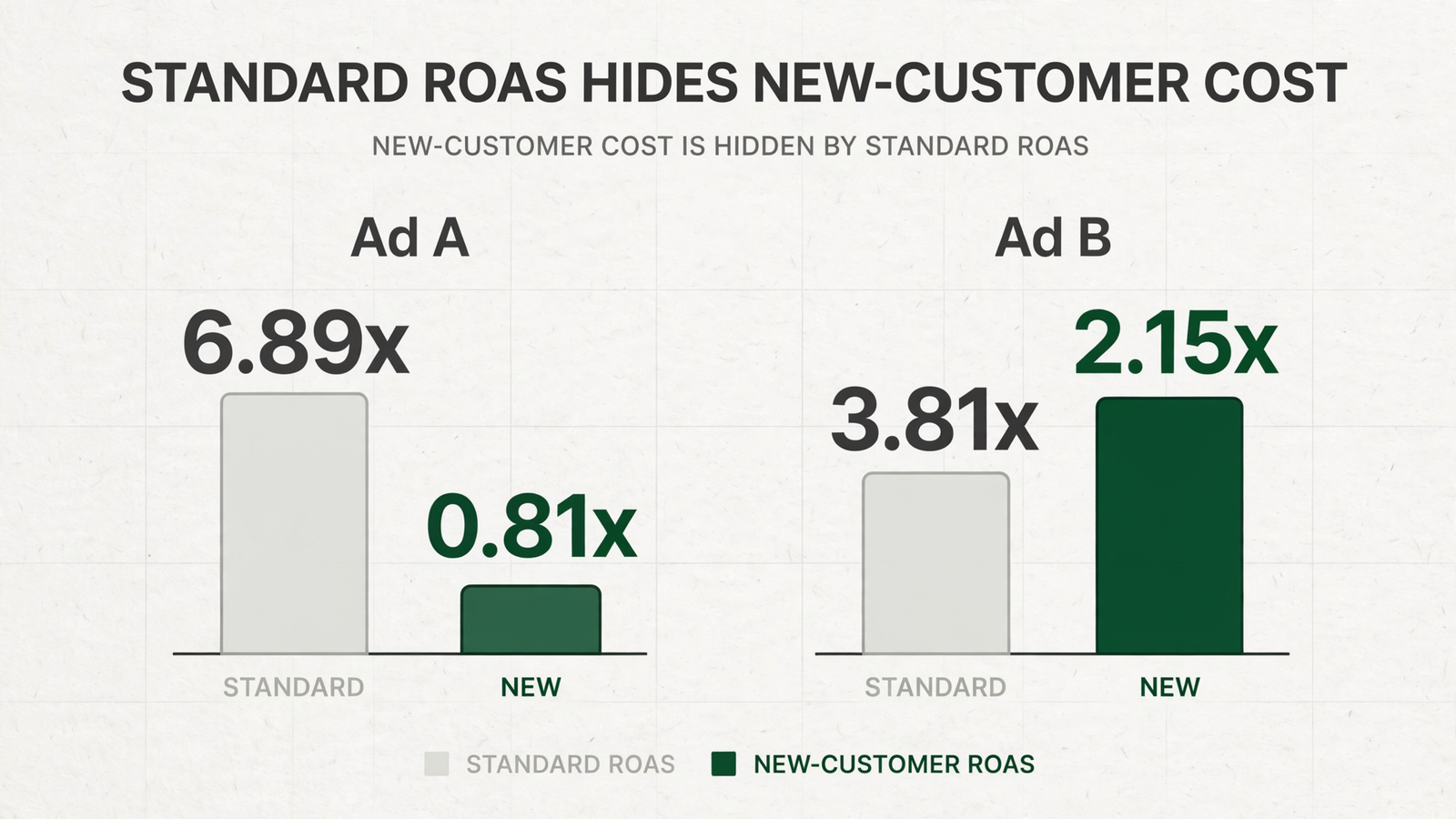
The distinction shows up sharply in one ad comparison: an ad reported 6.89x standard ROAS but 0.81x incremental ROAS on new customers, while another reported 3.81x standard and 2.15x incremental. A wider analysis of 55,661 campaigns found Advantage+ new-customer CAC rising from $257 in May 2024 to $528 in May 2025 as existing buyers were re-converted. Blended ROAS can reward repeat purchases even when your acquisition economics deteriorate.
The manual build gives you a defined retargeting pool and a budget you can hold to a limit. Meta’s guidance keeps retargeting that must stay inside a defined pool in manual campaigns; it also identifies restricted categories, strict placement rules, and fixed-budget tests as manual cases. That is a real advantage when the boundary itself matters.
It is not a measurement cure. Whether you consolidate or segment, break out delivery to new, engaged, and existing customers. Judge acquisition decisions using incremental ROAS for the new audience alongside your usual 7-day click and 1-day view reporting for volume. If you want to compare structures, keep a separately budgeted manual retargeting line as a holdout. Do not call the higher blended number the winner until you have checked the buyer mix.
Creative speed: broad targeting makes the ad do more work
Consolidation takes work away from audience construction and puts it into creative. Advantage+ can test up to 150 creative combinations and reallocate budget dynamically. The practical brief is 8 to 15 distinct concepts per ad set, not near-identical crops of one product shot. When targeting broadens, the ad has to give different buyers a reason to care.
A segmented build lets an agency report four audiences launched. A consolidated build invites the less comfortable question: did anyone make twelve different hooks, or did they make twelve sizes of the same image? I would rather see the concepts. Budget shuffling cannot rescue a month of weak ads, whichever campaign type you choose.

Management work: pay for decisions, not motion
A manual build creates weekly chores that can look like expertise: move $200 from prospecting to retargeting, pause an ad set with too little volume to judge, restart learning, repeat. Sometimes those moves protect a genuine boundary. When they do not, they are work generated by the structure itself.
A consolidated campaign needs management too. Someone must keep customer exclusions current, inspect the new-customer read, and ship creative before a winner wears out. That is judgment and production, not a standing appointment to shuffle budgets. Guidance describing a leaner build as one or two hubs with six to eight ad sets at most gets at the difference: fewer moving parts leave less routine motion to sell.
That matters when agency pricing commonly runs 15% to 25% of spend, often with $2,000 minimums, plus setup fees and lock-ins. I am not saying every segmented build exists to pad an invoice. I am saying a busy account makes an hours-based fee easier to explain. Ask which recurring tasks change acquisition cost and which exist because the agency built more campaigns.
The head-to-head scorecard
Put an agency on the spot with your purchase count and customer mix. This is the grid it should be able to discuss without opening a sales deck:
| Decision | Advantage+ Sales: consolidated | Manual: segmented | My pick |
|---|---|---|---|
| Purchase signal | Pools events; 50 a week is described as dependable | Divides events among learning pools | Consolidated when volume supports it |
| New-customer control | Needs exclusions or a separately limited customer ad set | Holds retargeting inside a defined pool and budget | Manual when that boundary is essential |
| Creative testing | Can test up to 150 combinations | More of the operating work goes to audience and budget splits | Consolidated if the agency ships distinct concepts |
| Management work | Fewer routine budget moves; guardrails and creative still need owners | More decisions between campaigns, whether useful or not | Consolidated unless the splits protect economics |
My default is consolidated. The new-customer row is the reason that default comes with measurement and a customer guardrail, not a license to celebrate whatever blended ROAS appears in the report.
Three stores where I would choose manual
I consolidate by default, but I would argue for a manual build in these three cases:
- A tiny catalog with low purchase volume. At 80 purchases a month, one pool still has limited data and four pools have even less. I would start with one or two manual campaigns, leave Advantage+ audience on as suggestions, and let interest and lookalike pools help do the finding work. That fits the 300-purchase, 30-day practitioner threshold better than pretending a campaign label will create signal.
- A store with heavy repeat buying. Subscriptions, consumables, pet food: if existing customers account for a large share of purchases, the missing old cap becomes a serious operating choice. You can exclude those customers or fence them within a spending limit. If repeat buyers account for 40% of revenue and you need a fixed acquisition-versus-retention budget, I would rather build that fence manually than hope blended ROAS reveals the problem.
- Product lines with different margins. A hero SKU at 65% margin and a clearance line at 18% should not automatically share one budget. A pooled campaign can favor the easier sale without respecting the margin difference. Separate budgets let you decide which line deserves spend. That is control worth having.
Manual is a scalpel for buyer and margin boundaries, not a ceremony every store has to pay for.
Verdict: consolidate by default, segment on purpose
For a store spending $10k a month or more, with enough weekly purchases, a normal buyer mix, and products that can reasonably share a budget, I would hire the company that proposes one or two Advantage+ Sales hubs. I would expect it to show the purchase math, set a clear policy for existing customers, report new-customer performance separately, and produce 8 to 15 genuinely distinct creative concepts per cycle. Spend alone does not clear a 50-purchase weekly threshold; the conversion count has to do that work.
That is how I approach Meta Ads at groas: a flat $1,499 a month, no cut of spend, with audiences and budgets worked around the clock. The point is to put the effort into creative and guardrails rather than budget shuffling that justifies a percentage fee. Pick a manual build instead if your store is low-volume, heavily repeat-driven, or split across materially different margins. Make the agency say which exception applies.

Three sales-call questions that expose the real plan
Ask these in order. Listen for your numbers, not adjectives.
- How will you keep existing customers from inflating acquisition ROAS? A real answer distinguishes excluding a customer list from setting a separate budget for existing buyers. If the agency proposes a cap, ask where that cap lives. If it proposes neither, ask how it will judge new-customer results.
- How many purchases per ad set per week will this structure produce? Make them do the math on your spend and purchase history. If each pool gets 12 a week, ask what the split achieves that is worth slower learning.
- Who makes the next ten ads, and how many are distinct concepts? Four audiences and two resized images are not a creative plan. Walk away from that pitch.
For the store that can feed it, consolidation with creative output is my winner. For the three exceptions, buy the manual boundary you actually need. Segmentation without a reason scales invoices.