

 LinkedIn

Your business is missing from Google AI Overviews and ChatGPT answers, and a competitor keeps showing up instead. If you are choosing between self-serve AEO software, an agency retainer and flat-fee done-for-you execution, I would ask one question before looking at the price: who ships the change that could get your page cited?
Software that automates AI visibility reporting replaces the agency’s monthly deck, not the agency’s work. It can tell you that you went missing on 14 prompts. It will not rewrite the page, fix the schema or earn the mention that helps an answer cite you. On the axis that matters most, the cheapest invoice can become the most expensive per citation won.
Three invoices, one job that still needs doing
Say you spend $20k a month on ads, or your business lives off 40 service calls a month. Customers start telling you ChatGPT recommended your competitor. You look for help and find three invoices that sound like the same promise: a tool that tracks prompts, an agency that plans and executes a program, and a flat-fee service that takes the work off your desk.
They buy different things. Otterly Lite at $29 a month covers 15 prompts; Peec Starter near $95 covers about 50; broader software tiers start around $399 a month. Many businesses pay $1,500 to $5,000 a month for an SEO retainer, with an agency average around $3,209. Managed AEO programs range from $1,000 to $3,000 a month at entry to $3,000 to $8,000 for growth.
I used to tell clients a tool was enough if they had a smart in-house person. I was wrong about how often that person had time to make the edits. A prompt count is not a work plan. Before comparing prices, name the person who will open the CMS.
Meet the contenders: a tracker, a team and an execution owner
Self-serve AEO software shows you the miss
You connect your domain, choose buyer prompts and check whether ChatGPT, Perplexity, Gemini and Google AI Overviews name you. Setup can be quick: under 30 minutes on Peec versus two to three hours per brand on Profound. The same comparison puts time to insight at about 1.1 hours on Peec Pro and 2.4 hours on Profound Growth.
That speed buys awareness. I like these tools for what they are; I stopped pretending they do the fix. Nobody at the software company edits your page, ships schema or fixes your robots.txt. For a closer look at capabilities that help move a citation rather than merely count it, read tools that help you get featured in Google AI Overviews. If nobody owns the edit queue, the subscription buys you a more precise way to watch yourself lose.
An agency retainer buys scheduled work
An agency can supply technical fixes, content, link earning and measurement. At a small-business tier around $1,500 to $3,000 a month, a typical package includes 2 to 4 posts and 3 to 8 links. Most contracts run 6 to 12 months minimum, including the slower months.
The distinction is what makes it onto your site. I have seen a sound strategy arrive in month one, then watch the edits wait for dev time and the links wait for approval. The deck arrives on schedule. The pages do not. Ask for the monthly work log before you buy the monthly meeting.
Flat-fee done-for-you owns the edit queue
On the groas model I write about, the service creates new pages and handles technical fixes, tracks visibility across ChatGPT, Perplexity, Gemini, Claude and Google AI Overviews, and provides a weekly report showing where you were named, what moved and why. Actions are logged with their reasoning, a human strategist owns direction and accountability, and the fee does not rise as a percentage of ad spend.
That is a different purchase from a login or a recurring strategy call. If shipping is your bottleneck, stop buying sharper charts of the bottleneck.
Axis 1: Count the hours behind the monthly price
Software looks cheap until you price the labor it assumes you have. Entry monitoring starts around $29 a month for Otterly Lite and $50 for HubSpot AEO. The industry average sits near $337 a month, while enterprise tiers run $500 to $2,000 plus. That fee buys tracked prompts, not hours spent improving pages. Expand your prompt list and the bill can climb. Your rewrite queue does not shrink.
A traditional retainer generally runs $1,500 to $5,000 a month. You pay for a slice of a team, including in months when little ships. Managed execution costs more than monitoring because someone has to investigate the miss and then handle content, schema, technical issues, entity work and authority. At $500 a month for managed GEO, almost no budget remains for research, editing, implementation and authority work.
Consider a $189 tracker that flags 100 prompts. You still have to decide which misses matter, research the answer, rewrite the page, implement changes and pursue corroborating mentions. If you already pay people to do that work, fine. If you have no spare writer or developer hours, price the work required, not the subscription. The small invoice may be the expensive choice.

Axis 2: Find out who edits the page
Software tells you what happened. A managed program should work out why and what to change, including technical fixes, content, schema, entity work and authority. When ChatGPT skips your pricing page, a tracker can show the miss. It cannot tell your CMS what to publish.
Someone must check whether the page can be fetched cleanly, whether its answer is easy to quote, and whether it has the support an answer engine might look for elsewhere. Then someone has to tighten the copy, ship the schema, clear a crawl block or earn a relevant mention. Not every miss needs every fix. That is why judgment matters as much as throughput.
Agencies know this. Real retainer work includes technical fixes, content creation and optimization, link earning and measurement, not just a chart. Their weak point is often the queue: your ticket waits behind other clients, your developer’s backlog and your approval chain. Done-for-you execution is built for owners who do not want to manage that chain themselves. Ask who touches the site, how often, and where you can see the finished edit.

Axis 3: Demand a report you can audit
Software gives you a clean chart and little accountability for action. You might see share of voice move from 12% to 14% and spot the prompts you missed. The tool has not performed the work that would explain the movement.
An agency report is useful when it connects a monthly work log to outcomes. It is fluff when it is a rankings chart with no pages, fixes or links shipped. I ask one question on sales calls: show me last month’s log for a client like me. If the answer is a slide with arrows, you are buying the deck.
What I want is a record I can check: page X rewritten on Tuesday for a named prompt; schema shipped on Thursday; an old post pruned on Friday. Then show me whether citations changed. That is the point of groas’s SEO & AI Search reporting: actions and reasons alongside where the business was named and what moved that week. The in-house version of this comparison is in AEO agency vs in-house monitoring vs done-for-you. If you cannot audit the edit, you did not buy execution.
Axis 4: Start the citation clock when work ships
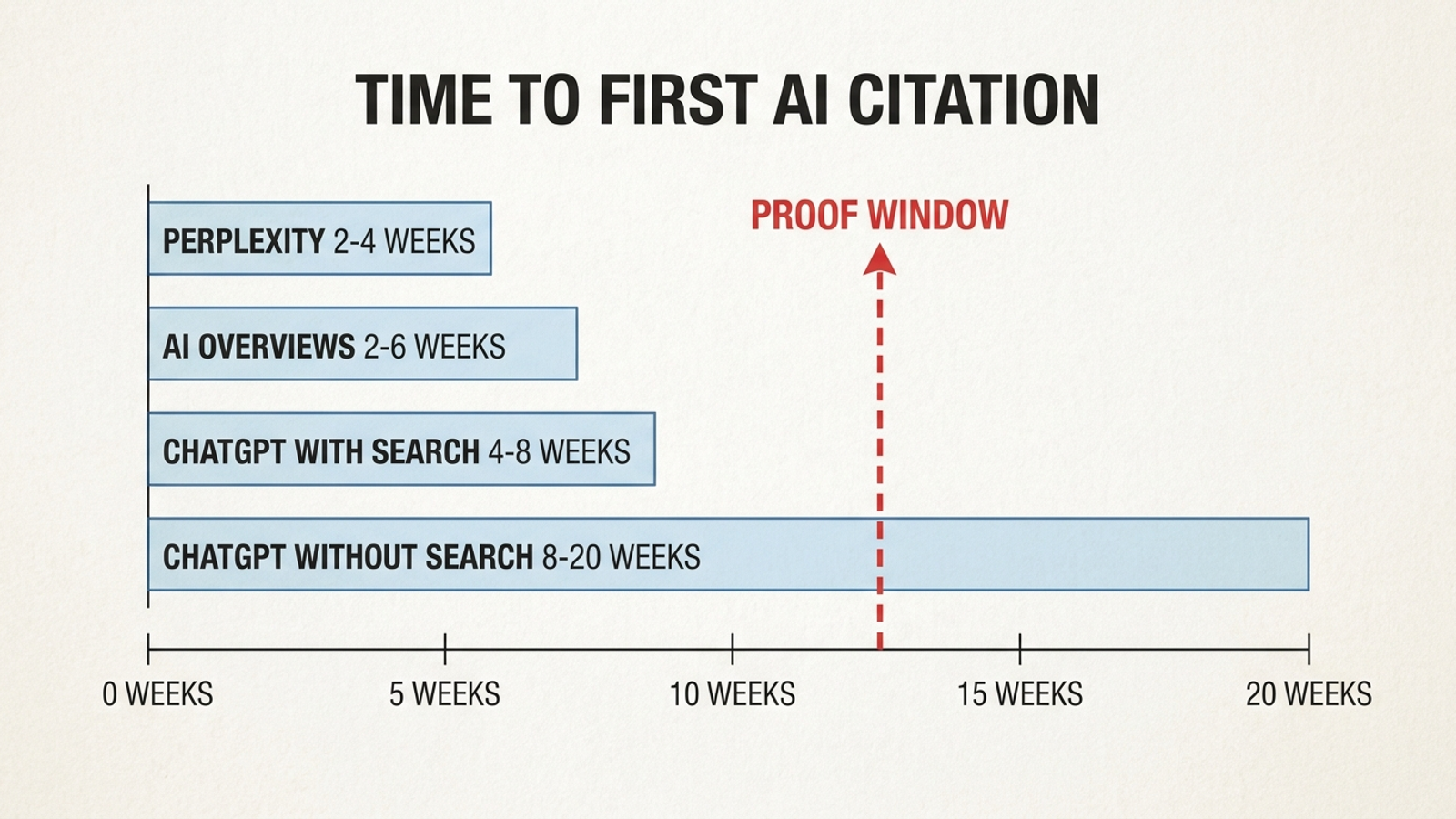
Software can show you a gap the day you install it. Closing that gap takes longer, and the answer engine sets some of the pace. As rough guides, Perplexity can pick up structural fixes in 2 to 4 weeks. Google AI Overviews can take 2 to 6 weeks if you already rank in the top 10, and 6 to 18 months if you do not. ChatGPT with search may need 4 to 8 weeks once you sit in Bing’s top 30; ChatGPT without search and Claude can wait for a model cycle of 8 to 20 weeks. Many paid engagements need 90 days to demonstrate ROI on live-retrieval engines.
None of those ranges promises a citation. They do make one point plain: you cannot wait for a change that has not shipped. A tracker watches the gap. An agency can act when its tickets clear the queue. Done-for-you can begin publishing and technical work without waiting for a monthly sprint call, though the engine still decides what it cites and when.
Ask each vendor what ships in week one. A forecast for month three is not an answer.
Axis 5: Check what remains when you leave
Software is easy to stop paying for because it has not changed your site. You may have reports or exports to keep, but pages you never rewrote stay as they were. Low commitment is useful only if somebody acts on what you learn. Three months of a $189 tracker costs $567 before you count your own stalled hours.
Retainers are harder to leave. Most require 6 to 12 months and charge through slower periods. The posts that shipped, links that stuck and technical fixes that were implemented can remain. The agency’s cadence and the context behind its decisions may not.
Flat-fee done-for-you has a different exit: groas is month to month, has no percentage-of-spend meter, and the work it publishes lives on your domain and in your CMS. Whatever you choose, ask what will ship in the first 30 days and who owns it on day 31. Do not sign for duration in place of delivery.
Put the three choices side by side
The useful comparison is not the lowest monthly number. It is what your payment gets onto the site and how easily you can verify it.
| Decision | Self-serve software | Agency retainer | Flat-fee done-for-you |
|---|---|---|---|
| Monthly price | $29 to $399+; average near $337 | Typically $1,500 to $5,000; average around $3,209 | Flat fee; no percentage-of-spend markup |
| Who makes edits | You and your team | Agency team, subject to the work queue | Execution team ships the work |
| What you can audit | Prompt and visibility charts | Work log, if the agency supplies one | Action log and citation movement |
| When work begins | When your team acts on the findings | When tickets clear | Publishing and technical work can begin without a monthly sprint call |
| Commitment and residue | Monitoring can stop; your site changes only if you made edits | Often 6 to 12 months; implemented work remains | Month to month; published work remains on your site |
The winner for a lean business, and who should pick the others
Software wins when you already employ the fixers. If you have a writer with four free hours a week and a developer who ships tickets that same week, a $29 to $189 tracker can be a bargain. Monitor the prompts, assign the rewrites and use the tool to check what changed. If those people do not exist, skip it. I have watched owners pay for charts while the edit queue sat empty.
An agency retainer wins when a messy site needs sustained coordination. Think multiple locations, a regulated category, migration debt or content that contradicts itself across 400 pages. A good strategist can earn a $3,000 to $7,000 tier by sequencing technical work, deciding what not to do and keeping link quality away from junk. What the deck calls synergy, I call people doing their jobs without stepping on each other. On a complex account, that coordination is worth paying for.
Done-for-you wins for the lean owner who needs work shipped. One location, one offer, no in-house writer and no developer on call: you do not need another dashboard to interpret. You need pages improved, technical blocks cleared and relevant mentions pursued, with a log you can check in five minutes. That is the buyer groas built its flat-fee execution for.
So if you run a lean business without a writer or developer ready to act, I would choose done-for-you over a tracker or a traditional retainer. A team that can ship its own fixes should buy software. A complex site that needs careful sequencing should hire the agency. That is not a tie; those are different owners with different bottlenecks.
Before you sign, ask each vendor for a recent edit log and the citations they tracked afterward. Look for pages, dates and prompts, not a slide about momentum. Then see what execution actually ships. The chart never got anyone cited. The edit gave the page a chance.