

 LinkedIn

A search term is burning through your budget at 2 a.m. Does your Google Ads tool pause it, or leave you a recommendation to approve in the morning? Who presses the button is the real split between AI tools, and smart operators disagree because both delay and unchecked automation can cost money. I have been the human mining negatives at 1 a.m. and the human who opened an approval queue three weeks too late. I will argue each side at full strength before giving my verdict: autonomy inside hard guardrails.
The case for approving every change
If you want the approval-first argument at full strength, listen to anyone who has cleaned up after an automated change. I have been that person. A client swaps a landing page URL without telling you, or an auto-apply setting quietly adds broad-match keywords, and suddenly you are paying for traffic you never asked for. One ecommerce audit found that cutting auto-apply and reviewing recommendations by hand cut wasted spend by 25% in the first month. That number sticks with you.
The fear is specific, not theoretical. Quality Score runs from 1 to 10 across expected CTR, ad relevance, and landing page experience, and it affects what you pay per click. Change the URL, add a redirect, slow the page, or mismatch the message, and you can damage the score. Policy adds another risk: trademark use in ad copy can lead to disapproval, while circumventing-system violations can lead to permanent suspension. An approver looks at that list and says nothing touching the ad, page, or targeting ships without a signature. I used to tell clients exactly that. I was wrong about how far to take it, but the concern is sound.
A fixed budget can still buy the wrong traffic
Here is the mechanism approvers worry about. Google says auto-applying recommendations will not raise your budget, but it can change bid targets, add broad-match keywords, and enable targeting or Display expansion. Your daily cap stays put; what it buys changes. That is how a $20k/month account can drift for two weeks before someone notices a search terms report full of close variants that never close.
The approval-first operator wants to inspect those changes before the spend begins. It is not a fear of technology. It is a refusal to treat a budget cap as a substitute for judgment about where the budget goes.
Someone has to answer for the change
There is also a trust argument, and it is stronger than operators admit. When spend jumps or an ad gets flagged, nobody wants to hear that a model did it. They want a name and a reason. The old advice still holds for a reason: keep auto-apply boxes unchecked so changes do not arrive overnight, and distinguish routine recommendations from urgent billing or disapproval notices. An approver would rather be slow and answerable than fast and shrugging.
The strongest version of this case is not that humans never make mistakes. I certainly did. It is that a consequential change deserves an accountable decision before it reaches the account, not an explanation after the bill arrives. If you cannot name who authorized a risky move, you will struggle to defend it in the meeting where it matters.
The case for letting it run
Now give autonomy its best case, because it wins on arithmetic. A search term does not stop spending while its recommendation waits in a queue. A person has to spot the problem, judge the suggestion, click, and check the result. Multiply that sequence across bids, keywords, ads, and accounts. The work does not become more strategic because you put an approval button in front of it.
Not every recommendation deserves to be executed, either. Google Ads recommendations began as an internal sales tool for reps with a human filter; now they surface automatically in accounts. What the deck calls Optimization Score, I call a compliance meter: dismissing a recommendation can lift the score just as applying it can. The autonomous argument is not “apply everything Google suggests.” It is let a system act on your goals and constraints rather than wait for you to process a stack of cards.
That distinction matters. Autonomous tools decide and execute with approval optional; rules tools execute rules you wrote; one-click tools recommend and wait for your click. Call all three “AI” if you like. Only one removes the approval step from routine decisions.
Search moves faster than a review cycle
A competitor launches, a term spikes, or a feed breaks, and the account needs a response that night. I did the 1 a.m. negative-keyword mining for years. I know what it cost: sleep, followed by the occasional morning when I missed something anyway. An autonomous engine can pause a bleeding term at 2:13 a.m. and log the action. An approval-first system can identify the same problem and still let it spend until someone finds time.
That is the autonomy case in one line: hours versus the next review cycle. The advantage does not come from a model having better taste than a good operator. It comes from acting on a routine decision while that decision still matters.
The queue gets longer as account loads grow
Do the capacity math the way an agency owner has to. Veteran agency advice says one manager should oversee no more than five substantial accounts, while 30-plus accounts per manager leaves little room for real attention. At five substantial accounts, careful review has a chance. At 15, imagine you are spending $20k/month and receiving 45 minutes a week of hands-on attention. At 40, you are likely getting a glance.
An approval queue assumes someone will bring fresh judgment to each item. In practice, the manager means to review on Friday, Friday becomes next Tuesday, and the search term that has spent 3x CPA for 11 days keeps spending. Autonomy moves much of that judgment to the goals and guardrails set up front, then executes repeatable decisions inside them. Every recommendation you do not have time to judge is a decision you have already delegated to inertia.

Where each side breaks down
Approval fails the way most review processes fail: slowly, then all at once. The manager opens a queue of 40 suggestions, approves the three that look safe, ignores the rest, and calls it control. I have done that review. After the tenth similar card, you stop reading and start clicking. A signature is not evidence of attention. The queue can give you liability without giving you enough time to prevent a bad outcome.
Autonomy fails in the opposite direction, and that failure is real. Give a system permission to act without limits and it may broaden matching, widen targeting, or raise bid targets inside the same budget. A fixed cap does not make those moves wise. Change history records before-and-after values and who made a change; in one test account, a third of weekly changes were automated. If you cannot separate human moves from machine moves in a readable log, you cannot tell whether the system is cutting waste or churning settings.
This is where the debate turns for me. The useful question is not “approve everything or approve nothing?” It is which changes are cheap to reverse, and which leave a mark even after you reverse them?
My verdict: autonomy inside hard guardrails
I take the autonomy side for an advertiser with enough search activity that routine decisions pile up between reviews. The single consideration that decides it is reversibility. Pause a bleeding term, cut a bid on a location that never closes, or add a narrowly scoped negative: each can be undone quickly, and each can run inside a spend cap. Holding that work for approval adds delay while the meter runs.
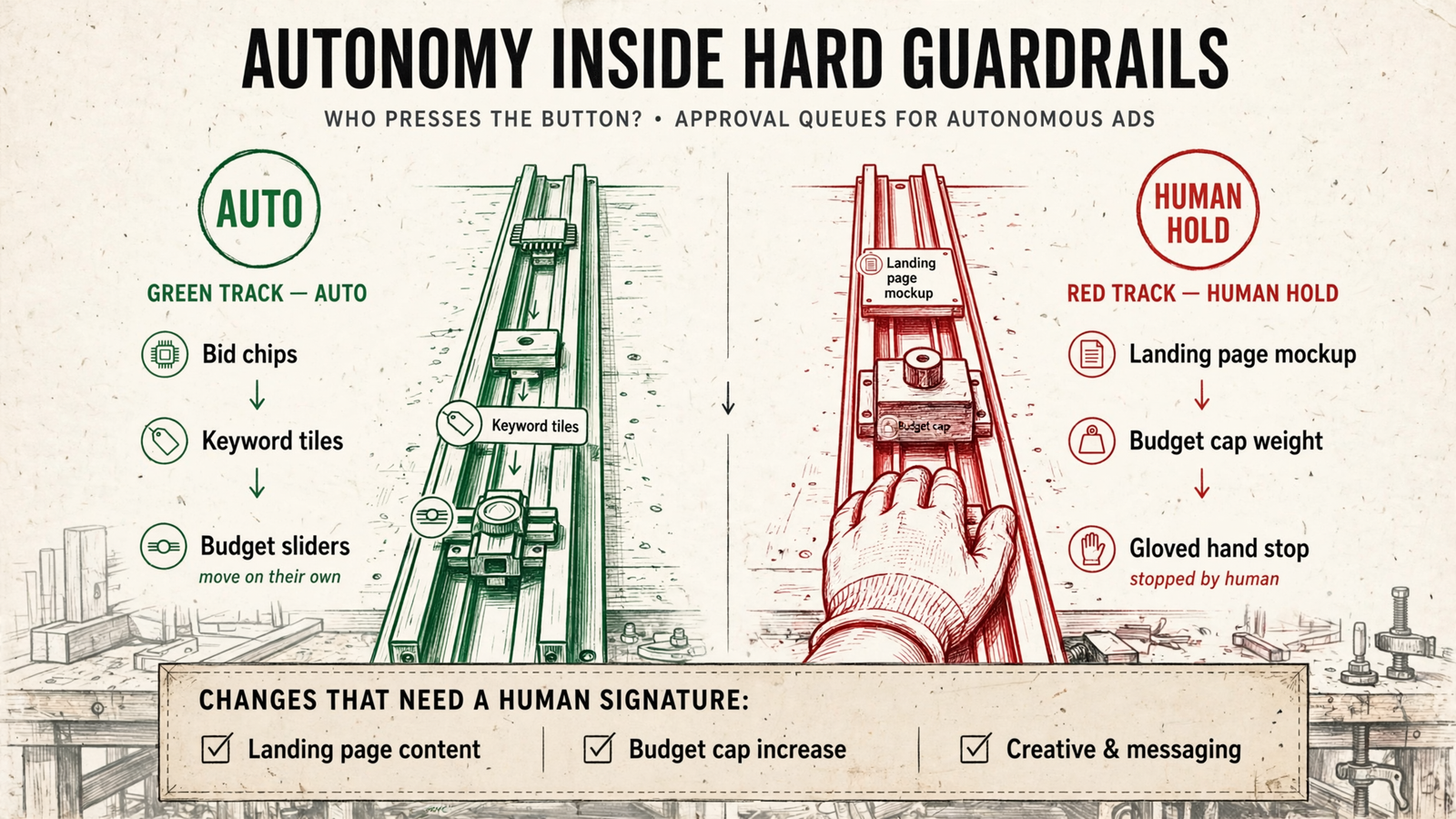
That does not mean every change gets the same permission. A new landing page, a budget-cap increase, or a claim in ad copy can leave a longer trail. It needs a person who can judge the business and policy consequences before it goes live. My rule is simple: if a change is reversible in one click and capped in spend, it should not wait for me. Everything else goes on a short hold list. That split is what I mean by supervised autonomy.
Let the reversible grind run
Give the engine bounded permission to handle routine work:
- Add narrowly scoped search-term negatives and exact-match versions of proven queries.
- Adjust bid targets inside your CPA or ROAS band.
- Pause a keyword that has spent 2x target with zero conversions.
- Shift budget between campaigns without raising the capped daily total.
The mechanism is straightforward. These moves can be reversed, and the guardrails limit what they can spend. Cutting waste sooner gives CPA a better chance to recover than leaving an obvious problem until Friday. I used to batch this sort of work for Fridays. For terms I already knew were dead, that was three more days of spend. If you can reverse the move before lunch and it cannot breach the cap, do not leave it in a queue.
Keep a short human hold list
Reserve approval for changes with consequences that are harder to pull back:
- A landing page or domain change.
- A net-new campaign or budget-cap increase.
- Ad copy involving claims, trademarks, or regulated language.
- Targeting expansion into Display, broad match at scale, or new geographies.
You can click “undo” on some of these later. You cannot necessarily undo the spend, the policy issue, or what the brand has already said in public. That is the difference between a tool that only recommends and one that runs the account end to end: execution is welcome until a mistake outlives the click. The hold list should fit on an index card. If it needs a second page, you have rebuilt the queue.
Make the log your accountability layer
Autonomy without a log is auto-apply with better marketing. The approval camp is right about this: if you cannot see what changed, the before-and-after values, and who made the call, you cannot trust the system or defend it to a client. I read change history before I read performance because it shows whether an engine is cutting waste or merely moving settings around.
groas builds around that discipline. It logs bid, budget, keyword, and page moves with the reasoning in plain language, while a named strategist owns the result. You set goals and caps; the engine works inside them around the clock; the weekly report shows what moved and why. Control becomes an auditable record, not a pile of pending clicks. That is the accountability I want before I let a system run.
Ask a vendor who presses the button
Before you sign, ask three blunt questions:
- At 2 a.m., who acts: me or the system?
- What ships without approval, and what is blocked until I sign?
- Where can I see each action and its reason, and who answers when it is wrong?
A diagnostic tool that only audits performance fails the first question by design. It flags a problem and leaves the fix to you. A percentage-of-spend manager has another problem: more spend and more review hours can serve the invoice rather than your CPA. I want flat-fee execution with guardrails I set, approval reserved for pages, budgets, claims, and expansion, and one strategist who owns the number.
For an account with routine search decisions arriving faster than a person can review them, that is the side I take. Let the engine make the cheap-to-reverse moves. Put a human signature on the ones that can leave a mark. If a vendor cannot show you that split in writing, you are buying a queue, not an engine.