

 LinkedIn

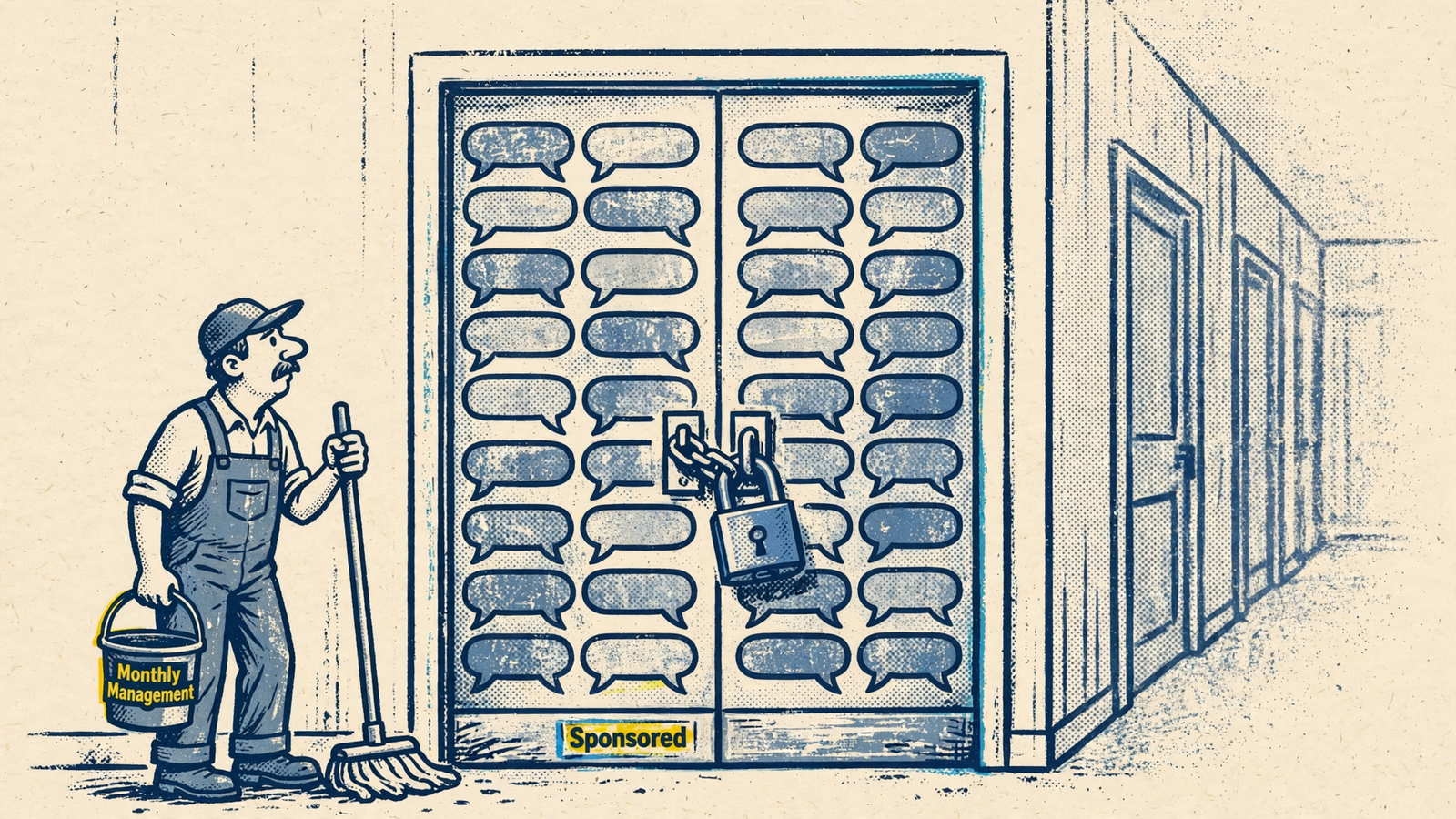
Do not hire anyone to manage your ChatGPT ads until they prove your account can run them. A failed launch may feel like proof you need a monthly retainer. It is not. A stuck setup is not a management problem, and paying a retainer will not turn it into one.
I spent most of the last decade fixing Google Ads accounts that someone else had already charged to “set up.” An owner could not get a campaign live, assumed they needed ongoing management, and signed a monthly fee for a job that did not exist yet. With ChatGPT ads, access, eligibility and tracking have to be settled before there is anything to optimize. I used to tell clients management would sort it out. I was wrong. Management works only when someone can show you the buying route from your account to a live campaign.
Your failed launch tells you one thing: something blocked you. It does not tell you what. In ChatGPT ads, the possible work falls into two different buckets:
- Access and eligibility: Is your billing entity in a listed country? Is your category allowed? Can your account open the buying interface at ads.openai.com?
- Implementation and optimization: Which context hints, landing pages, budgets and tracking events will you use? What will you change once results come in?
Agencies sell the second bucket. If you are still stuck in the first, ask them to solve that problem before you buy the second. A proposal about creative, bids and reporting cannot answer an eligibility question. It only tells you what the agency would do if the account could buy ads. That conditional matters when the fee is not conditional.
Self-serve buying has a $25/day campaign minimum, and eligibility follows where your billing legal entity is registered, not where you want to reach. Category matters too. Retail, household goods, local services, travel and digital products are openly allowed, while financial services, healthcare and legal outside the US are generally prohibited or subject to US-only manual approval. If your primary business sits in a restricted category, the whole account can be ineligible. No amount of weekly optimization calls fixes that. It just bills you while you wait.
I watched this confusion waste money in Google Ads for years. An owner got tangled in billing, policy or tracking while building a first campaign, decided the platform was too complex, and signed a $2,000 retainer for management of an account that could not serve an impression. The useful question came first: Can this account, with this business, buy this inventory right now? Skip it and you are not buying execution. You are funding an investigation with a management price tag.
Make the agency show the route to a live ad
Any agency that wants your monthly fee should answer three questions with your account on screen, not with a slide deck:
- Where exactly do we buy?
- Is this business eligible to buy there right now?
- What format can actually serve?
If they cannot answer those, you are talking to a researcher who wants a manager’s retainer. Do not let a tour of another advertiser’s account stand in for the answer. It may show that the agency knows the interface. It does not show that your billing entity and category can use it.
Start with the buying screen. Self-serve buying lives at ads.openai.com, but rollout has been uneven: after a US pilot in February 2026, self-serve opened in May, then expanded through August and September, with 89 countries total and more than 100,000 advertisers reported on October 21, 2026. An agency talking about ChatGPT ads in general may be describing inventory your billing entity cannot touch. Have them log into your advertiser account through an invitation and show you the screen that loads for you.
I draw the account-ownership line hard. The business creates the advertiser at ads.openai.com because country, currency and timezone are permanent. It then invites the agency under Settings > Users as Admin, Member or Viewer. There is no Google-Ads-style manager view, just switching between accounts. OpenAI tells agencies not to create client accounts, which one beta breakdown notes keeps ownership and compliance with the client. A pitch that starts with “hand over your login so we can check access” asks for the wrong thing. Invite access, never a password.
Then make them show the format that can serve. Live inventory is narrow: ads show to logged-in adults on Free and Go plans (and to logged-out users in some markets), below the answer with a Sponsored label. Plus, Pro, Business, Enterprise and Edu are ad-free. Ads do not serve near personal health, mental health or politics. If your intended audience is on an ad-free plan or your query set leans into those excluded topics, a confident proposal does not create inventory.
The buying mechanism is not Google Ads with a different logo. There are no keywords or negative lists for targeting. Ad groups use up to 2,000 plain-language context hints, such as “runner comparing cushioned shoes for long distances,” plus landing-page relevance. The auction is relevance-weighted second-price, with a reported entry around $3–$5 max CPC and roughly $25–$45 CPM. Do not let anyone sell a roadmap as inventory, either. Sponsored Agents, ads during image generation and 4–6 image units are in limited alpha, not generally available. Live today are chat cards and product-feed carousels. Demonstrated means they can show a running format in your category and country. Proposed means a deck slide. Price those differently.
A buying screen is not a measurement plan
Getting into the account does not mean you can measure what happens next. I have seen owners celebrate a live campaign that reported zero conversions for two weeks, then blame the agency for poor optimization. The campaign was serving. Measurement was never built. In ChatGPT ads, conversion tracking is a separate build, not automatic. You need the OpenAI Pixel in <head> plus a server-side Conversions API event with a shared event_id to deduplicate them; the first event wins. Then you must link that event to the campaign, or the campaign reports zero.
That build decides what you can optimize toward. Reporting lags 24–48 hours and is aggregate-only, with no chat transcripts. You also need UTMs to separate ChatGPT traffic in GA4. Platform-reported conversions and downstream business outcomes are two different numbers. A manager who optimizes the first without connecting it to the second can lower cost per click while your pipeline stays flat.
This is another place where the invoice can get ahead of the work. If nobody has chosen the event, installed the tracking and linked it to the campaign, a weekly performance meeting has little to work with. You cannot diagnose an optimization failure from a zero that may mean the event never reached the campaign. First establish what the number measures. Then argue about whether the ads are doing their job.
Before you pay for optimization, demand a tracking map: which event fires where, how it deduplicates, and which CRM stage it ties to. If that map does not exist, you are ready for implementation, not management.
Buy the work your account is ready for
Once access is confirmed, you can shop for management: hands-on setup followed by weekly execution. Build discipline matters because some choices lock. Campaign objective (Views, Clicks or Conversions), billing method including oCPC versus oCPM, product-feed mode and conversion event cannot be changed after creation; you clone to switch. Daily budget is a 7-day average that can spend twice as much in a day. Changing Brand or Legal name restarts verification and pauses ads. A manager who chooses the wrong objective on day one does not tweak it on day three. They rebuild it. That is why I judge a ChatGPT ads manager on build discipline first, bid tweaks second.

If access is not confirmed, do not sign for management. Commission a bounded investigation with an end date and a yes-or-no answer: can this business, in this account, serve this format to this buyer, and what exactly blocks it? Advertised offers vary, from €990 a month for paid management to $750 a month with $1,500 recommended spend to $1,499 for white-glove service inside your account. Those are management prices. They assume there is something to manage.
An investigation should name the country check, category check, live format and tracking gap. It should finish in days, not billing cycles. Ask what happens if the answer is no. If the agency cannot tell you, it was selling a retainer and hoping you would not notice. A useful answer may be that access works but tracking does not. Fine: scope the tracking build. It may be that the account cannot buy the intended inventory. Also fine: stop pricing monthly optimization as though it can. Either answer is worth more than a calendar full of status calls.
Ask groas to pass the same test
I hold groas to this standard too. If you talk to us about ChatGPT ads, do not accept confidence about the channel. Ask for account-specific proof: with my billing entity, category and site, what can run right now, in which interface, and in what format? Then ask when the work starts.
Search Ads at groas covers Google Ads, Bing Ads and ChatGPT Ads for $1,499 a month: one service, one flat fee. You can run all three or only the channels you want. That makes sense only if someone shows you which channels are actually buyable for you today. If ChatGPT inventory is unavailable to your account, paying to have it managed is paying for air. Run the same 21 checks you would run on any AI ads agency, and make availability check number one.
That $1,499 is a management fee. Media spend is separate, you set the budget, and nothing increases without your approval. You get bids, keywords and budgets worked around the clock, plus a landing page for every ad group, with no cut of ad spend, no setup fees and month-to-month cancellation. Billing starts when work starts, after you share access and agree on goals during the onboarding call; groas goes live in your accounts within 24 hours of that call. For ChatGPT ads specifically, expect invited access rather than a password, a named owner for the result, and an action log with reasoning you can read. The scope has to match what the account can do. If a provider cannot tell you that plainly, it is selling hope about a new channel. We sell execution inside guardrails you set.
Pay for an executable scope, not confidence
Here is the rule. If no one can show you the buying route from your account to a live ChatGPT campaign, you do not have a management need. You have an unanswered access question. Pay for that answer as a bounded job, or get it free in an audit. Do not dress it up as a $1,499 retainer.
Ignore the distinction and the outcome is predictable: month one goes to discovering what an eligibility check would have found; month two goes to rebuilding tracking that was never scoped; month three goes to arguing about who owns the delay. I have cleaned up that invoice too many times. Make them prove your account can run ads. Then pay them to run them. Anything else is a retainer in search of a job.