

 LinkedIn

A polished AEO pitch deck cannot tell you whether your buyers will ever see your company in an AI answer. Neither can a wall of five-star reviews. I wrote Directive Consulting vs groas: Which SEO and AI Search Service Ships More for the Money? to lay out how I think those options stack up. This is the second look: almost every agency now claims to do AEO, and you should be able to test that claim before signing a retainer. Include us in the test.
The question is narrow on purpose: which partner can show credible work against our buyer questions at a cost we can carry? This protocol is for B2B teams below enterprise scale, say 10 to 200 people, with a founder or one marketing lead making the call. Over two weeks, you will baseline your AI citations, give each shortlisted agency the same question, and compare its proposed output, fee and exit terms. If a trial follows, you will measure what actually ships and whether citations move. Do not confuse those two stages. A sample can reveal how an agency thinks; only shipped work and a repeat measurement can show what changed.
Setup: record the answers before anyone touches the account
Pull 20 to 30 questions buyers actually ask. Sales call transcripts beat keyword tools here. Include the five questions reps hear on every demo, comparison and pricing questions from lost deals, and informational queries Search Console already shows you ranking on page two for. Cut any question that would never lead to a demo. Keep a mix of discovery, comparison, suitability and constraint prompts. These are the questions an actual buyer might put to ChatGPT or Perplexity instead of Google.
Choose 20 prompts from that pool for the repeat test. Write each one down exactly as you will ask it later; changing the wording makes the before-and-after comparison harder to read. Run them in fresh sessions across ChatGPT with web search on, Perplexity, Gemini and Claude, and log each answer by hand. Record mentions separately from citations and recommendations, along with position, sentiment and who appears instead of you. Save screenshots and cited URLs. Note your organic rank and inbound enquiries for the same topics.
Keep the original answers, not just a coverage percentage. Coverage is prompts mentioning your brand divided by prompts tested, but a passing mention is not the same as a cited page a buyer can open. This sheet is your baseline. Without it, you risk paying for a report that calls any movement a win, including movement that began before the work did.
Step 1: Get the price and the exit terms in writing
Email every shortlisted agency the same request. Ask for:
- The monthly retainer and any setup fee.
- A paid-media minimum if SEO is bundled with paid work.
- The contract length and notice period.
- The work included each month, stated as deliverables rather than service labels.
- What happens to pages, accounts, data and working files when you leave.
For Directive, do not substitute third-party estimates for a quote. An independent 2026 pricing review reports a $5,000 minimum retainer listed on G2, a $5,000-per-month month-to-month startup package, a newer $6,500 figure for that package, and broader engagements at $10,000 to $49,000. Those are public indicators, not the price you have been offered. Its Clutch profile lists 50 to 249 staff, 55% midmarket and 35% enterprise clients, with the most common project size at $10,000 to $49,999. A larger bench may be useful. It also needs to be paid for.
Put the written quote beside a flat-fee line you can check: groas lists SEO & AI Search at $1,499 a month, month to month, with no setup fee and cancellation anytime. Say you hold $20k a month in ad spend. The groas fee does not rise with that spend; Directive’s quote depends on its proposed scope and terms. Against the reported $5,000 starting point, $1,499 is less than a third of the monthly fee. Write down the actual quote and the cost of leaving, not just the headline price. If an agency will not put output and exit terms beside its fee, discount the pitch hard or walk away.
Step 2: Make every AEO pitch answer the same questions
Send every agency the identical email so you compare answers, not sales styles:
- How would you earn citations for our buyer questions, and what would ship in week one?
- Who does the daily work, and how often is our account touched?
- Can we see a client report with the tracked prompt list visible?
Directive describes three lines on its GEO page: GEO for AI answers, AEO through schema and semantic signals, and AI-Enhanced Content Strategy with dashboards for citations, impressions and engagement. Those labels tell you what it sells. The reply should tell you what its people would do with your baseline. A useful answer names the pages, schema types and internal links it would work on. A weak one promises AI-ready content and points you toward a dashboard.
Score specificity and cadence separately. Directive’s 2026 AEO checklist names comparison tables, Q&A headings, author bios, freshness, FAQ and HowTo schema, crawlability, and tools for tracking URL citations and prompt gaps. That is a concrete methods list. It is not yet your shipping schedule. Ask for expected pages per month, fixes per month and the process for earning third-party mentions. Ask what the report will show when a prompt still cites a competitor. Buy the work log you can inspect, not the dashboard you can admire.
Step 3: Request one work sample against your baseline
Pick one buyer question where you are not cited today. Ask each agency for the same one-page brief or draft outline intended to address it. No full article and no free strategy deck. Request the heading structure, three facts the page would cite, the schema it would add, and the existing pages that would link to it. Give each agency the same question and the same relevant context. Otherwise you are grading who guessed your business best, not who proposed the better work.
Directive’s public proof point is the Case Status build: from zero LLM presence to a dominant position across 39+ tracked prompts in nine months, with organic sessions up 19% quarter over quarter. The described work included a dedicated LLM page and Q&A restructuring. The page does not give you monthly counts for pages, fixes or mentions. Your sample request cannot prove an agency will reproduce that result. It can show whether the agency can turn one of your unanswered questions into a plausible piece of work.
Score the sample on three lines:
- Specificity: Does it answer the exact buyer question, or drift into generic thought leadership?
- Sourcing: Does it identify verifiable facts, product limits, pricing bands or integration details an answer engine could use without guessing?
- Fit: Is the proposed page structured to be fetched and quoted, with a direct answer, clear headings and a plan for third-party corroboration where your own blog alone may not carry the citation?
I used to grade samples on polish. I was wrong. A plain brief that names the mechanism, the page to ship and the links that support it beats a beautiful deck that never gets past the title slide. One concrete brief against your baseline tells you more than ten case studies against someone else’s.
Step 4: Read reviews for fit, then ask for deliverables
Ignore the star average until you know what the reviewer bought. An independent review reports 4.8 out of 5 across 56 Clutch reviews, with praise for communication and strategic support, versus 3.7 out of 5 across 12 G2 reviews, including complaints about overpromising and accountability. Both pools are small. The gap is a reason to investigate, not a verdict on what will happen in your account.
Filter for company size, ramp time and who actually staffed the work. A team praising quarterly planning may have bought something different from the pages you need live in your first 30 days. On reference calls, ask three questions and then stop talking:
- What shipped in month one, in numbers?
- How long did it take to see citation or pipeline movement you could tie to that work?
- What happened when you pushed back on scope?
Our longer operator’s-eye review of Directive Consulting gives you more questions to take into that call. Do not let any review, including ours, answer them for you. Reviews form questions; deliverables make the decision.
Scorecard: separate promises from work you can open
At the end of two weeks, score every agency on the same four axes. Put numbers and links in the cells, not adjectives. Where no trial has run, label monthly output as a commitment, not an accomplishment. Cost per shipped asset becomes a real measure only when assets exist. Until then, calculate what the proposed fee would buy if the promised output arrives, and mark that figure provisional.
| Deciding axis | What good looks like | What fails the test |
|---|---|---|
| Entry cost | Written monthly fee, setup fee, term and notice period | A verbal range that widens after the call |
| Output per dollar | Monthly commitments for pages, fixes and earned mentions; shipped counts during a trial | A methods checklist with no counts, or promised work reported as live |
| AEO proof | Tracked prompt list, citation rate and cited URLs you can open | One flattering answer screenshot with no prompt list |
| Exit | Clear ownership of pages, accounts, data and working files | A strategy deck you keep but working files you cannot access |
For context on the proposed fees, one market table puts First Page Sage at roughly $8K to $20K a month on 6- to 12-month terms, Omniscient from about $10K, and Siege at $8K to $10K. These are comparison points, not quotes for your scope. They make a reported $5,000 starting retainer look less expensive than some alternatives. They do not make it cheap for a team that needs pages shipped now.
When a trial produces work, divide its fee by the assets actually shipped and keep the categories visible: pages live, technical fixes completed and third-party mentions earned. Do not collapse an internal-link fix and a cited third-party page into one magic productivity number. Re-run the prompts as well. The point is to connect cost, work and citation movement, not to crown whoever fills the largest cell.
Reading the result: choose the work, not the logo
Directive may make a persuasive case if you have several stakeholders, a long sales cycle, and paid, SEO and content work that must be coordinated. One California audit puts Directive at $5K to $20K or more per month with a typical 3- to 6-month minimum. Put the actual proposal on your sheet and ask whether that coordination is the bottleneck you are paying to remove. For a mid-size team with unanswered buyer questions and a limited budget, do not pay for a bench merely because the bench exists. Make it beat the flat-fee alternative on the work you need.
If your backlog is 40 buyer questions with no pages live to answer them, the flatter, faster shipping model has the clearer case. groas lists SEO and AI Search at $1,499 a month and describes new pages and technical fixes every day, month to month with no setup fee. More relevant, fetchable pages give your buyer questions more chances to surface in cited answers. That is a mechanism, not a promised citation count. Inspect the work log each week, then run your original prompts again. For this team, groas is the better alternative unless a higher-priced proposal shows work worth the difference.
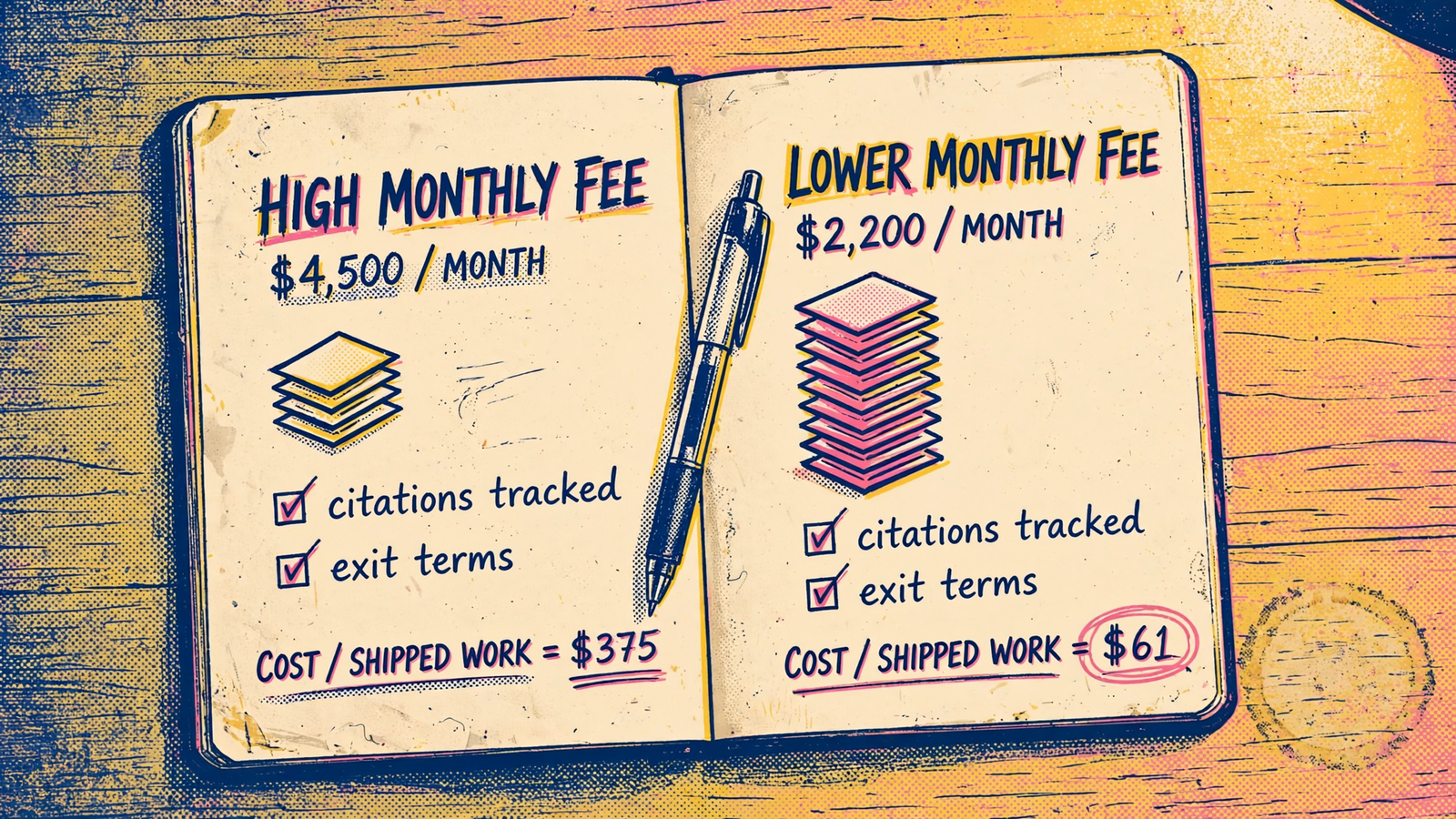
The sheet may also tell you to hire neither yet. If competitors appear on 18 of your 20 prompts and you have no pages that answer them, do not pretend a two-week selection test will fix the underlying gap. Start with indexation, internal links and a clear answer to each priority buyer question. If you cannot carry a $5,000 floor for three to six months, do not sign it hoping the budget appears later. Park the enterprise shortlist, ship the ten pages mapped to your highest-intent prompts, and re-test. A pause costs less than a retainer you cannot sustain.
If you start a trial, re-run the exact baseline at day 30: the same 20 prompts, the same four tools and fresh sessions. Count mentions and citations separately. Open every cited URL and compare it with the work log: pages live, fixes completed, mentions earned. If coverage moves on the questions you shipped for and the log gives you a plausible reason, keep going. If the report celebrates impressions while your buyer questions still cite someone else, that is a result too. Keep the pages and the data. Change the partner, or change the work.