

 LinkedIn

Most agencies will rewrite your Context Hints the week ROAS looks soft. That may be the one thing that was working. I have watched the same routine in Google Ads for ten years: one bad number, four simultaneous changes, no record of what was true before.
You get a cleaner-looking ad group and zero idea what broke. Here is the discipline I want instead: trace the chain from conversation to click to qualified sale before changing any link in it. Separate matching, delivery, measurement and commercial performance. Then change one thing. If an agency will not work that way, I would not let it manage this channel.
What is live before anyone changes it?
The first job is not optimization. It is writing down the account as it stands: the ad as shown, the Context Hints as defined in OpenAI Ads Manager, the destination page, the offer on that page and exactly what counts as a conversion. Add the current bid, budget and spend cap. A screenshot and a dated change log are less glamorous than an optimization deck. They are also useful when the numbers move.
Context Hints are plain-language descriptions of conversations, situations and buyers set at ad-group level. They guide matching; they are not exact-match keywords, and they do not guarantee delivery in specific conversations. That distinction matters because matching does not read your hints in isolation. A relevance-weighted, second-price auction scores Context Hints, ad title, ad copy and landing page against the live conversation. The cited starting practice is 5 to 15 hints per ad group describing the same buyer in the same situation, with a $3 to $5 starting CPC bid.
If someone rewrites the hints while the page promises something else, the test has already lost its control. The same goes for changing the landing page and copy together. You may get a different result, but you will not know which input caused it. Record the four matching inputs before you edit one.
Before an agency promises a fix, make it confirm what it can see and change. Ask for account access, live controls and reporting limits. Conversion reporting is aggregate-only with a 24 to 48 hour lag: no user-level export, conversation text, demographics or order-ID matching. The Conversions column is click-based; a separate 1-day view-through window is excluded from CPA. If an agency promises to inspect individual ChatGPT journeys, ask it to show you the report. It is probably describing Google.
I also check creative enhancements. OpenAI is set to turn them on by default for new and existing self-serve campaigns from October 30, 2026. The system can rewrite headlines and descriptions, resize images, translate copy and swap the destination URL to another page on your site without per-version approval. Ads Manager has an on/off toggle, and campaign settings can override the account default. Record the setting that actually applies to your campaign. You cannot diagnose a match confidently if the ad or destination may change underneath your test.
Does the ad answer the same question as the landing page?
Read the ad as a ChatGPT user would see it. Then open the destination page cold. Does it promise the same outcome, for the same person, in the same terms? If the hints describe emergency plumbing repair and the headline offers general home services, the inputs disagree. If the copy promises pricing but the page asks for a demo before showing anything, the click has a different problem: the page does not deliver what the ad offered.
I check this before arguing about hint volume because the auction scores the page alongside the hints and copy. Early field data gives the concern some weight. A Seer Interactive analysis of around 55,000 ChatGPT responses found 38% fully on-topic, 58% category-adjacent and 4% unrelated. In a separate Barn2 test, $477 bought 19,154 impressions and 370 clicks but produced zero conversions over six weeks. Those results do not tell you which input failed in your account. They do tell you why a vague page is a poor thing to leave untouched while you cycle through new hints.
Should the page repeat your Context Hints word for word?
Some testers suggest mirroring Context Hint phrasing on the landing page. I can see the logic: the auction scores the page as well as the hints. But OpenAI’s definition says only that hints guide matching. It does not give a weighting for page wording, a match threshold or a guarantee tied to repeating a phrase. Treat word-for-word mirroring as a test, not a platform rule.
The useful standard is simpler. Can a visitor see the answer the ad led them to expect? If not, document the mismatch and fix the page while holding the other inputs steady. If the page already answers the question, leave it alone and investigate the next link. Rewriting 30 hints against a generic page is not a substitute for that check.
Is delivery broken, or is the ad reaching the wrong people?
Delivery is not relevance. You need a dated log to tell them apart: note bursts, dead stretches, spend and every change with a timestamp. One small-business field test spent $500 in just over an hour at around $3.50 CPC. OpenAI reported about 140 clicks, only around 13% were verifiable in site analytics, and the test produced zero leads. The tester also saw a dashboard lag of about 24 hours and five partial charges. Rewrite hints during a reporting lag like that and you may be responding to yesterday’s account.
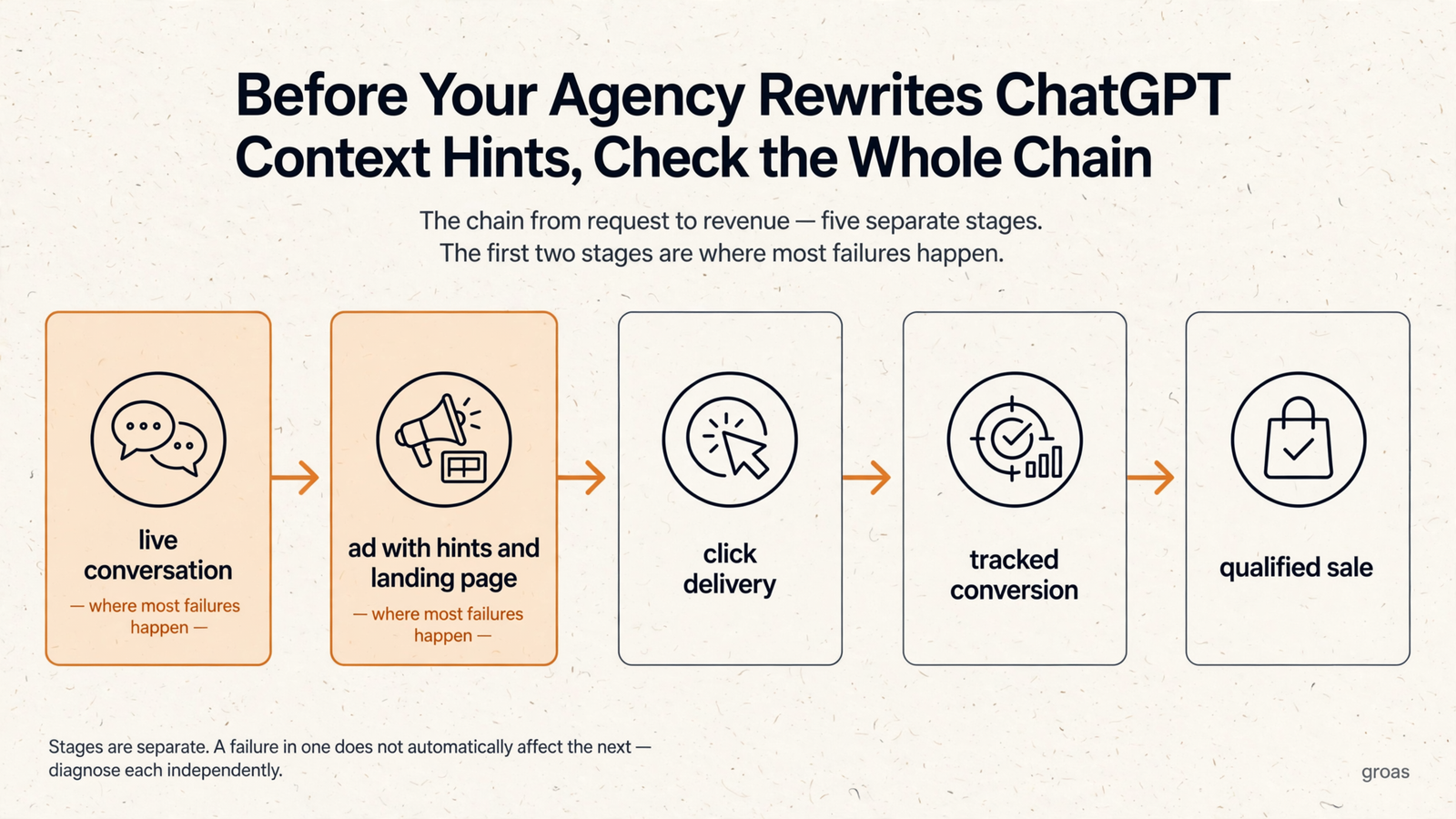
The buying model matters here. The conversion objective is optimized CPC, not true CPA buying: you pay for clicks from users likely to act, not for conversions. Reporting includes impressions, clicks, CTR and spend, with early examples around $25 CPMs falling toward $10 and 0.5 to 0.6% CTRs. Those numbers can help you describe delivery. They cannot, on their own, explain whether the offer worked.
There is also an audience limit no hint rewrite can fix. Ads show only to Free and Go tiers; Plus, Pro, Business and Enterprise users do not see them. For a B2B advertiser, that belongs in the diagnosis before anyone declares the copy a failure. Log a structural limit as a structural limit. Do not charge the client for another round of wording changes to solve it.
Can you trust the conversion number yet?
A click in the platform and a qualified lead in your CRM are different events. With aggregate reporting, a 24 to 48 hour lag and no order-ID matching, you cannot settle the difference by pulling up one user’s path. You can still compare what the platform counted with what your business recorded. Do it on a fixed weekly rhythm, not by refreshing yesterday’s dashboard until it agrees with you.
That means keeping the conversion definition in view. Was the agency measuring the action the business actually needs, or an earlier event that happens to be easier to count? Then compare weekly campaign totals with Shopify or GA4 and the qualified pipeline in your CRM. Keep the click-based Conversions column separate from the 1-day view-through window when you discuss CPA. If the numbers disagree, write down the disagreement before changing the campaign.
Measurement trouble is not proof of hidden revenue. Nor is it proof that matching failed. It is a reason to pause the diagnosis at this step. An agency that skips straight from a soft ROAS figure to new hints has not established whether the figure is telling the truth.
What should you change first?
Only after those checks do I pick a test. If the ad and page plainly disagree, fix that mismatch. If they agree but delivery is thin, do not disguise the delivery problem with copy changes. If tracking does not reconcile, fix the measurement question before judging a new offer. The point is not to move slowly for its own sake. It is to make the next result interpretable.
When matching looks plausible but signups stay thin, freeze everything except the input you are testing. Keep the offer and destination page stable for a copy test, or keep the copy stable for a page change. I used to tell clients to move fast and test boldly. I was wrong on small samples. On a channel where one six-week test produced zero conversions from 370 clicks, changing hints, copy and page in the same week tells you almost nothing.
Write down competing explanations before you declare a winner: loose matching, thin delivery to Free-tier users, broken tracking or an offer that does not fit the conversation. Advertiser reports are mixed: some describe cheaper clicks for local services, while others describe low-quality leads and glitches, including a five-second average time on site. A few signups cannot separate those stories. Your change history at least tells you what you tested.
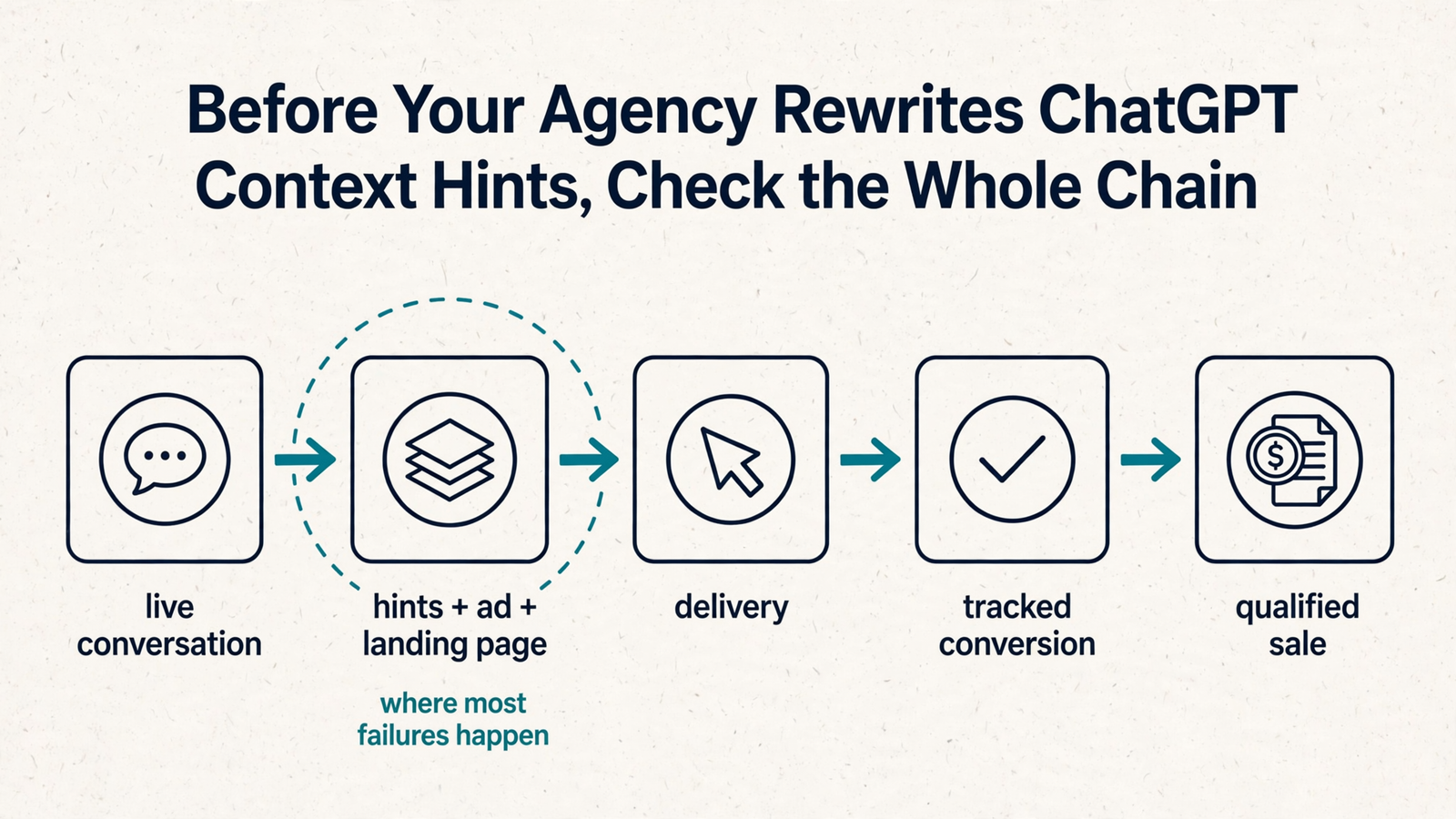
No log, no learning. That is the rule I hold agencies to. Put the hypothesis, the single change and the next weekly read in the same record. If the result is inconclusive, say so rather than polishing it into a win.
When does weak ROAS mean the test should stop?
Poor ROAS on ChatGPT does not automatically mean the channel assists sales you cannot see. Reconcile platform counts with business outcomes first. In a working paper covering about 1,898 sites, US paid ChatGPT visits generated $0.89 per session versus $2.45 for Google Search, with conversion rates of 0.37% versus 1.17%. Of 87 advertisers using both, 97% earned less per ChatGPT visit. The authors estimated that a $0.26 CPC would be needed to match Google ROAS, versus a disclosed $1.72 CPC. That gap is a reason to measure carefully, not an invoiceable theory of invisible influence.
I treat claims about a consideration effect the way I treat view-through claims in Google: show me the independent orders. Reconcile weekly campaign totals against Shopify or GA4, not daily totals, because of the aggregate lag and separate view-through window. Barn2 offers a useful contrast: paid visitors averaged 37 seconds on site versus 443 seconds for organic ChatGPT referrals, which drove five sales while paid drove none. The organic result does not rescue the paid result.
Allow for lag, but set a kill date before spending. I wait for a full week of business outcomes before judging a change, then read again on the same weekly schedule. If two to three weekly reads show platform clicks but no qualified pipeline in the CRM, I stop the test. Set the conditions in writing: a daily spend cap, a total test budget and the CPA or cost per qualified lead that ends the test. A consultant extends an inconclusive test. An operator knows when to pause it.
What should an agency show you every week?
Demand four records and one name:
- A hypothesis log: what the agency believed, what it changed and what would prove it wrong.
- A dated change history, including changes to hints, ad copy, destination page and enhancements.
- Spend guardrails showing the current cap and total test budget.
- A weekly reconciliation of platform results with business outcomes.
- A named owner who decides whether to pause, continue or scale.
That is the minimum I expect from a fully managed Google Ads service. ChatGPT needs the same discipline with less reporting visibility. Before signing, ask what the agency will change first and what it will leave alone; what evidence would prove its diagnosis wrong; and who approves a budget increase. If the answer is a deck and a monthly call, you hired advice. Not management.
Where does groas fit?
I run this work inside groas as daily management, not advice. Search Ads covers Google Ads, Bing Ads and ChatGPT Ads together for one flat $1,499 a month, whatever you spend, with no setup fee and month-to-month cancellation. The model puts bids, keywords and budgets under around-the-clock management, with a landing page for every ad group so its promise matches the hints and copy, tracking checked against real orders, and approval before any budget increase.
Run groas through the same filter I use for any provider in the seven questions to ask before hiring a fully managed agency. Verify platform eligibility. Confirm who holds account access and controls the enhancements toggle. Walk away from guaranteed ROAS. No one can guarantee an auction they do not control. The better operating model is the one that can show its work and stop spending when the work is not paying off.
What should you do today?
Start with a record, not a rewrite. Set the spend guardrails, then hold hint, copy, page and budget changes steady for one full reporting week. Put the live chain in one document: ad text, every Context Hint, destination URL, offer, conversion definition, enhancements setting and spend cap. Use the complete Google Ads account audit checklist as a starting point, but read this account in order: matching, delivery, measurement, then commercial outcome.
- Screenshot the ad, save the 5 to 15 focused hints, and record the landing page URL and offer wording.
- Confirm account access, the creative-enhancements setting and the Free and Go audience limit in writing.
- Set a daily cap, a total test budget and the cost per qualified lead that kills the test.
- Reconcile weekly platform totals with Shopify or GA4 and CRM pipeline, not daily dashboard clicks.
If the page does not answer the same question as the ad, fix the page and leave everything else alone until the next weekly read. That will teach you more than another month of Context Hint rewrites.