

 LinkedIn

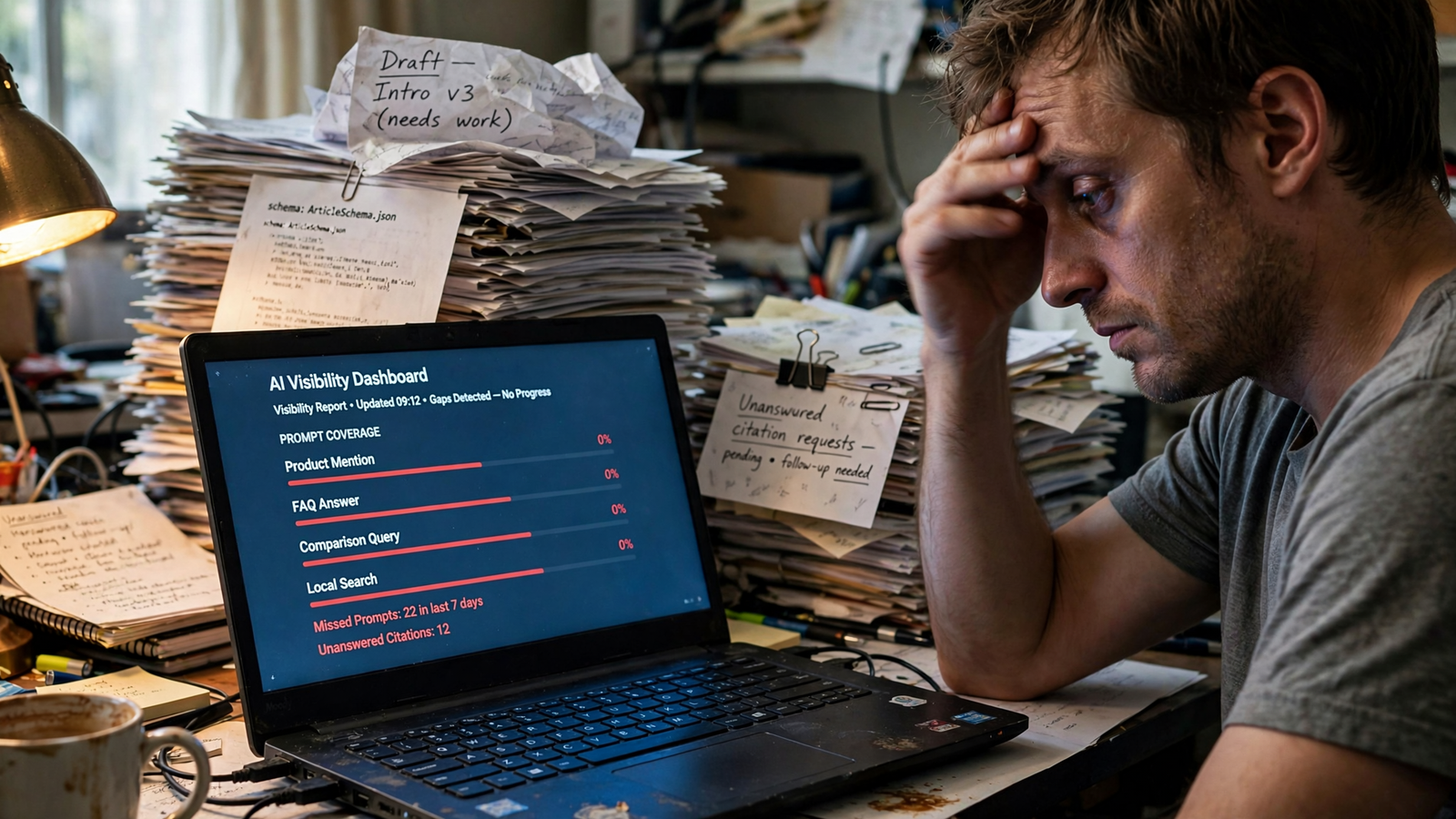
A $99 dashboard can show that AI answers keep naming your competitors. Should you buy it, or pay someone to change those answers? Smart people disagree because the software camp sees tracking as a cheap job a small business can own, while the service camp sees a report that has never earned a citation on its own.
Both sides think the other is selling half the job. Software advocates say service contracts dress up basic prompt tracking as strategy. Service advocates say tools hand you a to-do list and leave you to do the work. I used to tell clients to buy the tool and check it weekly. I was wrong about what happens after week two.
Position 1: buy the software and keep control
The software camp has a compelling opening number. Self-serve tracking starts around $29 a month for a lean plan like Astiva Lite or Otterly on annual billing and rises to a few hundred dollars for multi-engine coverage. Full-service programs start with audits near $3,000 and can run to $9,000 to $15,000 or more a month. If your immediate question is Where do we appear?, paying an agency fee to find out looks hard to justify.
Its stronger argument is control. Pick 25 to 50 buyer prompts, add three to five competitors, and scan weekly across ChatGPT, Gemini, Perplexity and AI Overviews. The software shows which prompts mention your brand and how often. A team with publishing access can work on a gap in the same sprint instead of waiting two to four weeks for an agency ticket to move. For that team, quick access matters more than another layer of service. A comparison of self-serve tools identifies eight that let teams start scanning without a demo call or enterprise onboarding, including Trakkr at $79 for seven-plus models and Peec from $89 for starter coverage.
The useful output is not a mysterious score out of 100. It is a mention rate with a numerator and denominator: 50 mentions in 200 answers is 25%. One worked example puts a brand at 22 mentions in 100 high-intent prompts, or 22% visibility across ChatGPT, Perplexity and AI Overviews. A practical scoreboard tracks:
- Mention rate: answers naming your brand divided by answers scanned.
- Share of voice against the competitors you chose.
- Clickable citations to your site versus bare mentions or citations to someone else.
- Buyer prompts that produce a mention versus prompts where you are missing.
- The split by engine, rather than one blended result.
Those measures give an in-house team something it can use, not just admire. They also keep the team away from vanity scores whose workings are harder to inspect (scoreboard breakdown).
Software advocates are right about another thing: one scan is not a verdict. In a test of 600 volunteers running 12 prompts each, ChatGPT and Google produced the same brand list twice less than one time in 100, and the same order about one time in 1,000. That is why a serious team keeps its buyer prompts and competitor set consistent, reruns them weekly, and uses multiple runs per prompt (test details). Against a $3,000 audit, a $79 or $99 plan that lets you repeat the measurement yourself is a persuasive buy. If your team can act on what it finds, keep the ruler in-house.
Position 2: hire for the work the dashboard cannot do
The service camp does not need to dispute that math. It disputes what you are buying. Software measures the gap; execution closes it. A tracker can flag missing citations and weak share of voice. Someone still has to audit the site, clean up entity information, add schema, publish content that answers buyer questions, and pursue outside mentions. That division helps explain the pricing: software runs from free to roughly $650-plus a month, while agency execution runs $1,500 to $30,000-plus a month. You are not paying that difference for a prettier chart.
Most GEO software flags and suggests; it does not execute. It can tell you that you are absent from Perplexity or missing schema. It cannot earn the citation or publish the page for you. A 2026 Semrush survey of 481 marketers found that only 8% were actively running digital PR, even though most said they wanted AI visibility (survey breakdown). The service advocate’s point is blunt: monitored and featured are different outcomes. The first means you know what the answers say. The second takes someone who can change what the models have to work with.
The reports tend to point to the same work: refresh pages that have slipped, answer buyer questions directly, add useful lists and FAQs, and fix technical blocks. Pages updated in the past 12 months are twice as likely to retain citations, while 60% of commercial queries cite content refreshed in the last six months. URLs cited in ChatGPT average 17 times more list sections than URLs that are not, and proper schema lifts citation odds by about 13%. A tracker may surface those opportunities. A writer and someone with site access still have to make the edits.
That work is more specific than do more content. Take the page that answers a buyer question. Cut its windup, put a direct answer near the top, add a comparison list or FAQ where it helps, and mark the page up so machines can parse it. I have written about tools that help you get featured in Google AI Overviews versus tools that only monitor citations. The test is whether the work gets shipped, not whether the absence gets charted.
Then comes the job nobody budgets for: a page cannot be cited by a system that never fetches it. AI Overviews draw mostly from pages already ranking 1 to 10, so improving a strong page can matter more than building a new one for a query that does not trigger an Overview (how Overviews pick sources). Say you spend $20k a month on ads and your top commercial page sits at position 14. The tracker can show the gap. Someone must fix the internal links, page speed, or title that promises one thing and delivers another, then work to earn a credible outside citation. That is the service camp’s best case: pay for finished work, not another account of unfinished work.
The scoreboard both sides should accept
Neither argument works if the measurement is sloppy. Lock 25 to 50 buyer prompts tied to questions that could make you money. Add three to five competitors. Rerun the set weekly, with multiple runs per prompt. Record mention rate, share of voice, citations versus bare mentions, and results by engine. Keep the prompts fixed so a change in the report can mean something.
Free platform data does not replace that cross-engine scan. Google Search Console’s generative AI report shows impressions by page, country, date and device, but no query or clicks. Bing Webmaster shows citations and sample grounding queries without placement or rank. ChatGPT traffic can arrive tagged utm_source=chatgpt.com for grouping in GA4 (what free data covers). If you need to see your presence across ChatGPT, Gemini and AI Overviews, you still need to run the prompts.
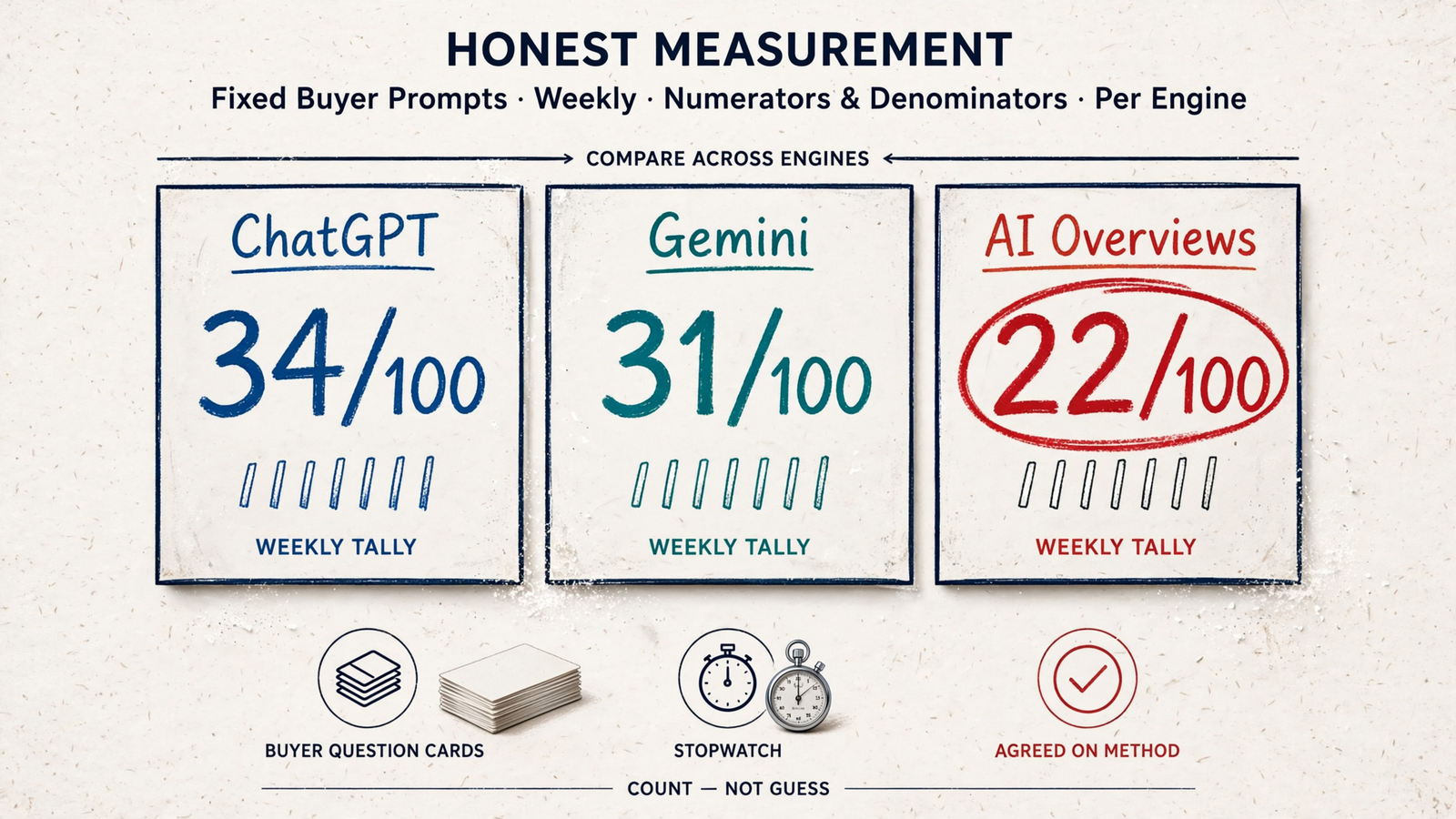
The engine split is easy to skip and costly to ignore. In one live scan, Ahrefs ranked first on ChatGPT but sixth on Gemini. Semrush ranked first on Perplexity, AI Overviews and Copilot, yet had no semrush.com pages cited. A blended score hides both stories. Report 22 mentions in 100 answers as 22%, show where those answers came from, and compare the result week over week. Counting that way is a job software does cheaply. Deciding what to publish next is not.
My verdict: own the ruler, hire for the fixes
I take the service camp’s side on the outcome and the software camp’s side on measurement. Own the ruler; hire for the fixes you cannot ship. A citation depends on a page being available, understandable and worth quoting. None of that changes inside a dashboard. I have written before about whether AEO software earns citations or identifies gaps that need manual work. A tool can tell you which buyer prompt you lost and which competitor appeared instead. Someone must rewrite the page, add the schema or pursue the outside mention.
The price gap makes the distinction useful. A scan can cost $29 to $399 a month, depending on engines and prompt volume. Done-for-you execution that includes schema and three to five pages a month starts near $1,497 a month, while full programs run to $10,000-plus. Content and off-site mentions need more than 60 to 90 days for a fair judgment, so a lean pilot with a tool and an optional audit makes more sense than committing to a retainer before you know the gaps (pilot advice). If you spend $20k a month on search, paying $99 to learn that you are missing 38 of 50 buyer prompts is cheap intelligence. The return depends on what you do with it.
The single consideration that decides it for me is time to a shipped fix. A team with CMS access can close a content gap in the same sprint. A small business without a writer, developer or clear approval owner can watch the same report stay red for months. That is when paying for execution makes more sense than buying a more elaborate view of the problem.
Who should buy the tool, hire the service, or use both
Buy the tool and stop there if one person can publish every week. They need CMS access, time for rewrites, and a willingness to rerun the prompts and act on the missing rows. As I have argued before, the cost of running AI search visibility in-house is in the shipping, not the subscription. If nobody can publish, the tracker documents the gap for $99 a month.
Hire execution if reports already sit unread, your top pages have not been touched in a year, or schema and outside mentions never happen because nobody owns them. Use both when search pays your bills: keep the inexpensive scan for honest counting across engines, and pay for done-for-you execution that refreshes pages, fixes technical blocks and works to earn citations while you run the business. The measurement should tell the crew where to work, not become the work.
My rule after arguing both sides: start with the $29 to $399 scan, lock your buyer prompts, and fix what you can in 30 days. If mentions have not moved by day 90, stop buying more reports. Buy finished pages, fixes and citation work instead. groas is built for that second job, with autonomous execution and a human strategist accountable for the direction. The dashboard tells you where you stand. Someone still has to move you.