

 LinkedIn
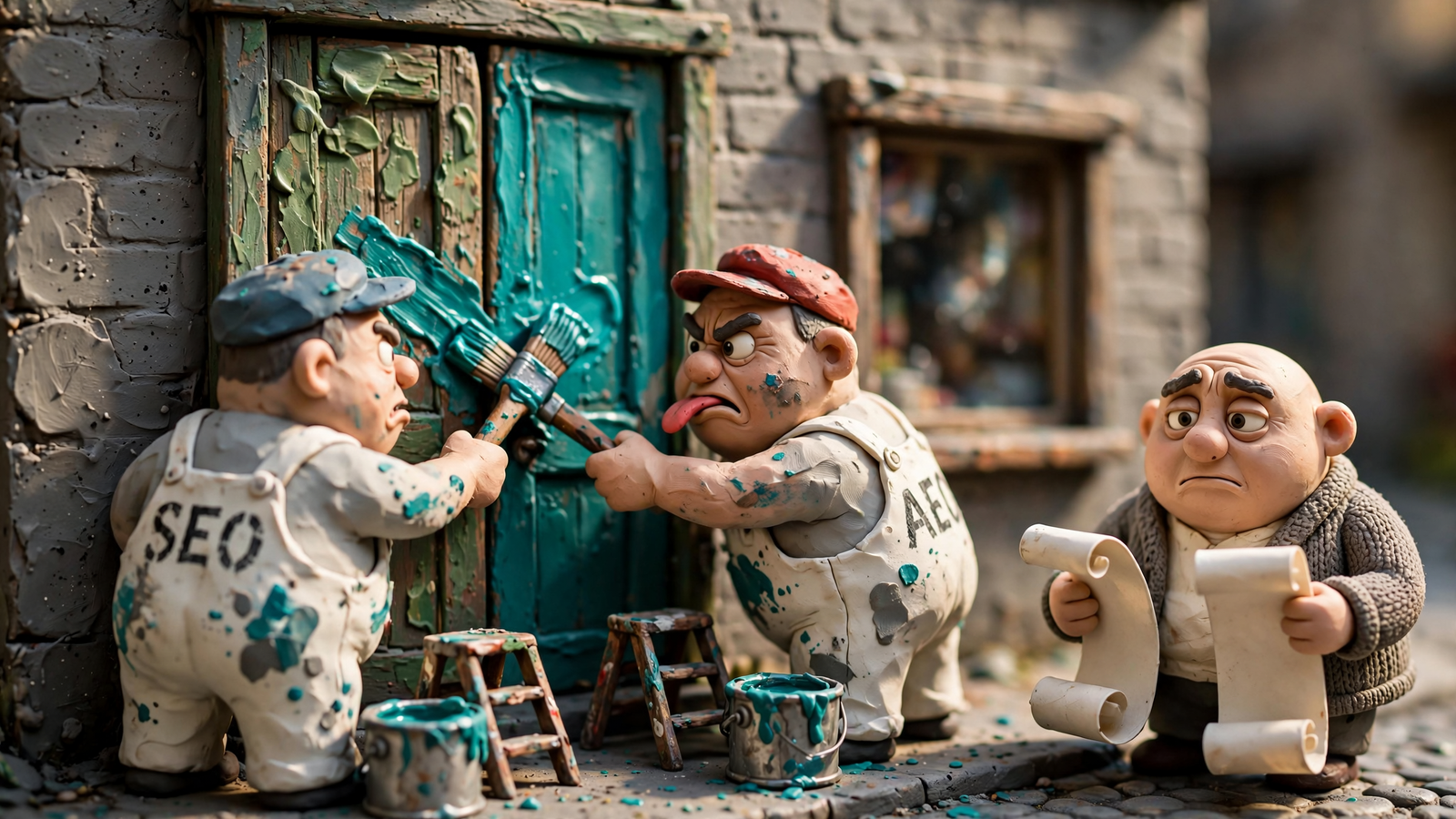
By December 31, 2027, you will not be able to buy AEO as a standalone retainer from any vendor worth hiring. It will sit inside SEO, delivered by the people who fix your crawl, your pages, and your authority, for one fee. I am writing the date down so you can hold me to it.
If you are choosing between an SEO agency, an AEO specialist, or both, that distinction matters now. I spent years selling the old version of search work by the hour and by the spreadsheet. The split you see in proposals today is a pricing artefact, not a lasting discipline boundary. Same pages, overlapping work, two invoices.
Why these predictions have deadlines
Prediction posts without dates are sales decks. I used to tell clients things like “build authority and the citations will follow.” I was wrong about how useful that advice was. No one could check it. A deadline and a fail condition make me explain the mechanism before I announce the outcome, which is the only order I trust.
Each prediction below has a December 31, 2027 deadline. My base case starts with Google’s May 2025 AI search guidance: AEO and GEO are industry-invented terms, and optimizing for generative AI search is still SEO. Retrieval draws on the existing index and familiar ranking signals. If that remains the foundation, a separate AEO retainer has a hard time explaining what separate job it does.
Keep score with me. If three of these five miss, stop listening to me on AI search. If they land, you may avoid signing two long contracts for work that belongs under one owner.
Prediction 1: AEO disappears as a separate line item
Citation retrieval sits on top of the index Google already built for organic search. Query fan-out affects which passages get pulled, but the practical work remains familiar: make pages crawlable, write clear passages that answer a question, connect those pages with useful internal links, and build authority from sites the engines trust. I have never seen a citation won by llms.txt or AI-specific chunking alone. Google has said those tricks do not move retrieval the way standard ranking signals do.
That overlap creates the commercial pressure. A page rewrite that makes a service page clearer for search does not become a second piece of work because someone also wants an AI citation from it. The same team can plan it, ship it, and check what happened. Once buyers see that, a second delivery line becomes difficult to defend.
The pricing gap makes the duplicate work expensive. Serious AEO agencies currently charge $3,000 to $15,000 a month, with enterprise programs over $20,000. Traditional SEO sits at $2,000 to $7,500 a month. The same pricing survey notes that bundling the work under one vendor can reduce total cost because content and technical fixes serve both channels. If you pay $5,000 for SEO and another $5,000 for AEO in 2026, ask which page rewrites appear on both invoices.
Here is the test: by December 31, 2027, if the top 20 vendors on a credible best-agencies-for-AEO list still sell AEO-only retainers above $3,000 a month and disclose separate AEO delivery teams, my collapse call missed. A label on a proposal does not count as a new discipline. A durable, separately staffed service would.
Prediction 2: Paid AI placements expand without buying citations
Google does not sell the answer itself. It sells labeled space next to it, filled from existing Search, Shopping, and Performance Max campaigns. Those campaigns became automatically eligible for AI Mode inventory through the existing auction, with no separate charge or AI-surface targeting switch. Advertisers do not have to build a new campaign to enter that inventory. As AI Mode reaches more queries, the same campaign setup has more places to show an ad.
That distinction matters when someone promises you “AI answer ads” as though they have found a new lever. On Google, there is no separate AI Overview placement fee in this setup; clicks run through the existing auction. Your bill can change as impressions and clicks change, but buying that labeled space is not the same thing as earning a place in the answer.
The rollout is already moving. On October 28, 2026, Google pushed AI Mode ads into 10 new countries and multiturn ads in the US, with Brazil, Mexico, and the UK planned for Q4 2026. ChatGPT has a different buying path: US self-serve ads became available with no minimum commitment, a $25 daily campaign budget, and a suggested starting bid of $3 to $5 CPC, after a $60 CPM pilot with a $200,000 minimum. Do not confuse those buying models. The common point is that an ad does not shape the answer itself.
Paid gets you labeled presence. It does not buy you the citation. By December 31, 2027, I expect more paid placement beside AI answers while that boundary holds. My prediction fails if Google lets advertisers pay to alter or guarantee an organic citation inside the summary. If citations go up for auction, I missed badly.
Prediction 3: Enquiry attribution replaces the blended mention score
A brand mention score has an appealing shape: run a set of prompts, count appearances, put a percentage in a report. The trouble is that answers do not sit still long enough for one run on one day to carry that much weight. In an analysis of 815,000 prompt-page pairs, only 2.3% of citations stayed consistent after three identical ChatGPT runs. Separate tracking of 82,619 prompts over 17 weeks found Google AI Mode replaced 56% of cited sources weekly, while ChatGPT replaced 74%.
When sources change between runs, a monthly score can move because of the sample rather than the work. Blend several engines together and you hide a second problem: they can tell sharply different stories about the same brand. One athletic brand scored 78% on ChatGPT problem prompts but 34% on Perplexity. ChatGPT pulled from its blog; Perplexity pulled from reviews and comparison sites. A single blended number would make that gap easier to miss, not easier to fix.
That does not mean prompt tracking is useless. It means the method has to match the question. Three to five runs per prompt per platform each week, separate engine scores, persona-specific prompts, and full conversation journeys give a more useful picture of where a brand appears. Then connect that picture to the business question: are enquiries coming in through calls, forms, or booked jobs?
A mention is a diagnostic; an enquiry is the result worth reporting. I predict buyers will stop accepting a blended, single-run monthly percentage as the main deliverable. My call fails if, by December 31, 2027, leading AEO reporting tools still sell that score as their default plan and buyers keep renewing it at current rates. If vanity survives contact with finance, I got this wrong.
Prediction 4: The two-vendor setup becomes one invoice
Say you spend $4,000 a month on SEO and another $4,500 on an AEO specialist. I have seen that split. Both vendors audit the same crawl. Both rewrite the same service pages. Both claim credit when a citation appears. You can call those two strategies, but the work lands on one website.
The price can climb further as the specialist adds engines: the same AEO pricing survey says each added engine increases the retainer by about 20 to 40%. So the buyer pays twice for overlapping page work, then pays an uplift to extend the second vendor’s reporting or delivery. Finance does not need a lecture on query fan-out to ask why two teams own the same pages.
One owner is not a promise that every search surface behaves identically. The ChatGPT and Perplexity split above is a good reason to report by engine. It is not, by itself, a reason to hire a second firm to edit the same page. The owner should be able to explain what changed, where it appeared, and whether enquiries followed. The second invoice has to prove it funds distinct work.
By December 31, 2027, I expect procurement to pick one owner rather than renew two full retainers for that overlap. Prove me wrong by showing businesses with separate SEO and AEO vendors renewing both at full rate for a second year at the same volume as single-vendor buyers. If dual retainers stick, consolidation did not happen.
Prediction 5: Pure-play AEO shops pivot to SEO or software
A standalone AEO shop can sell an audit, prompt tracking, and page tweaks, then bill again next month to check the same prompts. That works while buyers treat AI visibility as a separate mystery. It gets harder when they recognize the underlying delivery as pages, technical fixes, and authority work they already expect from SEO.
The margin pressure follows from that recognition. A vendor that ships the underlying work can defend a retainer by pointing to what changed on the site. A shop whose main output is another view of the same prompts has to explain why the buyer needs a separate fulfillment team. I have watched similar labels vanish into the main retainer with mobile SEO and speed optimization. The work stayed. The extra category did not.
My bet is that specialists choose one of two paths: broaden into full SEO delivery or become software providers that help another team measure the work. If an AEO specialist cannot show you pages shipped, fixes deployed, and enquiries tracked, you are buying a report, not a result.
This is falsifiable. If, by December 31, 2027, at least five pure-play AEO vendors still have no SEO fulfillment and no software product, yet grow revenue year over year on standalone AEO retainers, my pivot prediction missed. A few surviving labels would not settle it. Growing businesses built on the separate service would.
What I would put in a contract now
If I am right, the contract you sign now should still make sense when AEO sits inside SEO. I would ask for three terms in writing:
- Month-to-month service with no setup fee. Do not take a six-month lock just to receive a report.
- One owner for Google and AI search. The scope should include pages shipped and technical fixes deployed, not two vendors auditing the same site.
- Enquiry reporting by engine. Ask how the vendor connects answers to calls, forms, and booked jobs, and how many runs sit behind its visibility reports.
Ask for that before you ask about price. A cheap second invoice is still a second invoice if both vendors are billing for the same page.
This is why I point buyers with the two-vendor problem toward a single done-for-you setup. groas runs SEO and AI search as one service for a flat $1,499 a month, with new pages and technical fixes every day and visibility across ChatGPT, Perplexity, and Gemini. It is month to month with no setup fee. One account manager owns the result, changes come with the reasoning in plain language, and paid search runs on the same context so ads and organic do not fight each other.
Say you spend $20,000 a month on ads and $8,000 on two retainers. Consolidating the organic side to one invoice does more than remove a fee: it removes the argument over which vendor caused a citation and who should act when an enquiry does not follow. If my predictions miss, you still need pages, fixes, and enquiry tracking. If they land, you have signed a contract built for the work rather than its latest label.
The December 2027 scorecard
I will revisit these five calls in public, pass or fail:
- AEO stops being a separate line item. I lose if leading vendors still sell separately staffed AEO-only retainers above $3,000 a month.
- Paid AI placements expand; citations stay organic. I lose if Google lets advertisers buy or guarantee a citation inside the summary.
- Enquiry reporting displaces blended mention scores. I lose if single-run monthly scores remain the default and buyers renew them at current rates.
- Two-vendor setups consolidate. I lose if businesses keep renewing both full retainers at the same volume as single-vendor buyers.
- Pure-play AEO shops pivot. I lose if five grow on standalone retainers without adding SEO fulfillment or a software product.
If I am right, the cheapest insurance is a contract that already looks like 2027: one owner, month to month, pages and fixes shipped, enquiries tracked. Read this alongside my notes on how growing ad placements affect organic citations. Then ask every vendor bidding for your business to put its own dates in writing. The one who refuses to be checked is telling you how confident it is.