

 LinkedIn

By December 31, 2027, per-prompt AEO pricing will be dead. Serious white-label platforms will not charge an agency extra because a client tracks 400 buyer prompts instead of 100, or because the agency adds engine number five and six. Sign a contract this quarter that prices AI visibility that way, and you will be packaging a commodity within 18 months.
Look at the deals on offer. Rank Monster charges $399 a month per client workspace for 200 prompts across six engines. Profound Agency Growth runs $99 a month plus $399 per client workspace for 100 prompts and three engines. Otterly Standard gives you 100 prompts for $189, while Premium stretches to 400 for $489. I read those sheets the way I used to read PPC tooling sheets: you are paying for counting, not for fixing.
I spent most of a decade building match type structures by hand and mining negative keywords at 1am. Then scripts ate some of that work. Smart Bidding took more. Agencies still billing a percentage of spend for routine bid tweaks lost the argument. AEO tooling is following the same path, only faster: monitoring first, then automation, then flat-priced execution. Here are five predictions, each with a date and a test that would prove me wrong.
The pricing trap agencies are buying today
Prompt caps, per-seat fees, and monitoring sold as a service. That is the package. Semrush sells its AI Visibility Toolkit at $99 a month for 25 prompts and one domain, with per-user licensing on top. Semrush One starts around $199 a month for 50 daily prompts and $299 for 100 prompts. Add a second domain for client two and a third for client three, and you can watch the math break. One agency AEO comparison puts the problem plainly: per-domain and per-prompt models get expensive fast at 15, 30, or 50 clients when tools built for in-house teams acquire extra agency workspaces.
Wholesale white-label AEO runs $800 to $3,500 per client per month depending on scope; a 20-client book commonly bills $24k to $50k monthly for $8k to $20k net margin. I do not hate that margin. I hate the idea of building it on counting mentions across engines and sending a PDF. A G2 survey of 1,076 B2B buyers in March 2026 found 51% start research in an AI chatbot more often than Google, up from 29% in early 2025. Only 11% of domains cited by ChatGPT are also cited by Perplexity, so measuring one engine will not tell the whole story. When broad measurement becomes necessary, charging by the prompt becomes harder to defend.
2010–2016: PPC structure justified the hours
Exact and phrase match behaved differently, broad match could burn a budget, and negative keyword lists were a moat. An agency could justify 15% of spend because somebody had to work through search term reports, split ad groups by intent, and rewrite ads for Quality Score. Manual throughput made complexity expensive. The retainer followed the hours.
That bargain held while people had to do the matching work. Once the engine could take on more of it, the hours were no longer proof of value. A labor-based fee needs labor the client cannot easily replace.
2016–2019: Scripts made speed less billable
Scripts and rule engines took on hourly bid adjustments, budget pacing alerts, broken URL checks, and query mining that dumped possible negatives into a sheet. I used to tell clients scripts made us faster. I was wrong about what that meant for the fee: they made everyone faster. Speed stopped being a distinction.
Judgment about targets, tracking, and creative still mattered. Routine account maintenance became table stakes. Practitioners could spend less time pushing buttons, but agencies could no longer sell the button-pushing as a specialist service.
2020–2021: Smart Bidding weakened the bid-management pitch
Smart Bidding pushed the same change further. Auction-time signals and cross-advertiser learning let the engine set bids at a granularity a human could not match through manual tweaks. Google reports that more than 80% of advertisers now use at least one form of Smart Bidding, up from around 50% in 2021, on $306B in global search spend in 2024.
The practical consequence was blunt: if the engine sets the bid, you cannot charge 15% for setting the bid. Agencies had to earn the fee through tracking integrity, pipeline-linked targets, and creative. Selling routine bid management became a weaker pitch.
2026: AEO is still selling the measurement layer
Today’s AEO price sheets look like that earlier PPC transition: a necessary activity is packaged as if performing it were the outcome. Prompt tracking matters. Without it, you cannot see which answers mention a client, which engines differ, or where a competitor appears instead. But a visibility chart does not publish a page or repair a technical block.
The record is thinner on how fast AEO execution will become standard. The direction is clearer. The fee will move toward the work that changes the answer, not the check that records it. That is the line behind the next five predictions.
Prediction 1: Tracked-prompt caps disappear from serious AEO pricing by 2027
A prompt check is an API call plus parsing. As vendors standardize checks and cache work across clients, I expect the marginal cost to fall. Charging $489 for 400 prompts is easier to defend while measurement is novel. It gets harder when a client needs 500 to 1,000 prompts across six engines to see where buyers actually start.
The pricing pressure is visible already: flat plans with unlimited workspaces sit beside capped plans that charge more for higher prompt allowances. Those are not the same thing as uncapped, flat per-domain execution. They do show agencies being offered different ways to buy measurement. A cap that rises every time the agency learns more about buyer intent punishes the agency for doing the work.
What would prove me wrong: On December 31, 2027, the three best-selling white-label AEO platforms still use tracked prompts as their primary pricing meter and retain overage fees. I will check pricing pages and agency contracts, not a vendor’s blog claim.
This quarter, refuse a renewal that makes tracked prompts the meter. Pay for domains and shipped work, not for counting.
Prediction 2: Monitoring-only tools add execution or get bundled away
I can do the audit math a client will eventually do. Prompt monitoring across five models runs about $125 a month in software, and an entity and schema cleanup is a one-time $800 job. A tool that stops at insight forces the agency to stack subscriptions, people, or processes before anything gets fixed. A chart does not change an AI answer. A published page, a repaired technical block, or a new citation might.
That is why a retainer built on monitoring gets awkward the first time a client asks what shipped last month. If the platform cannot write the page, fix the schema, or build the citation, the agency still needs a separate way to do the valuable work. A login is not a deliverable.
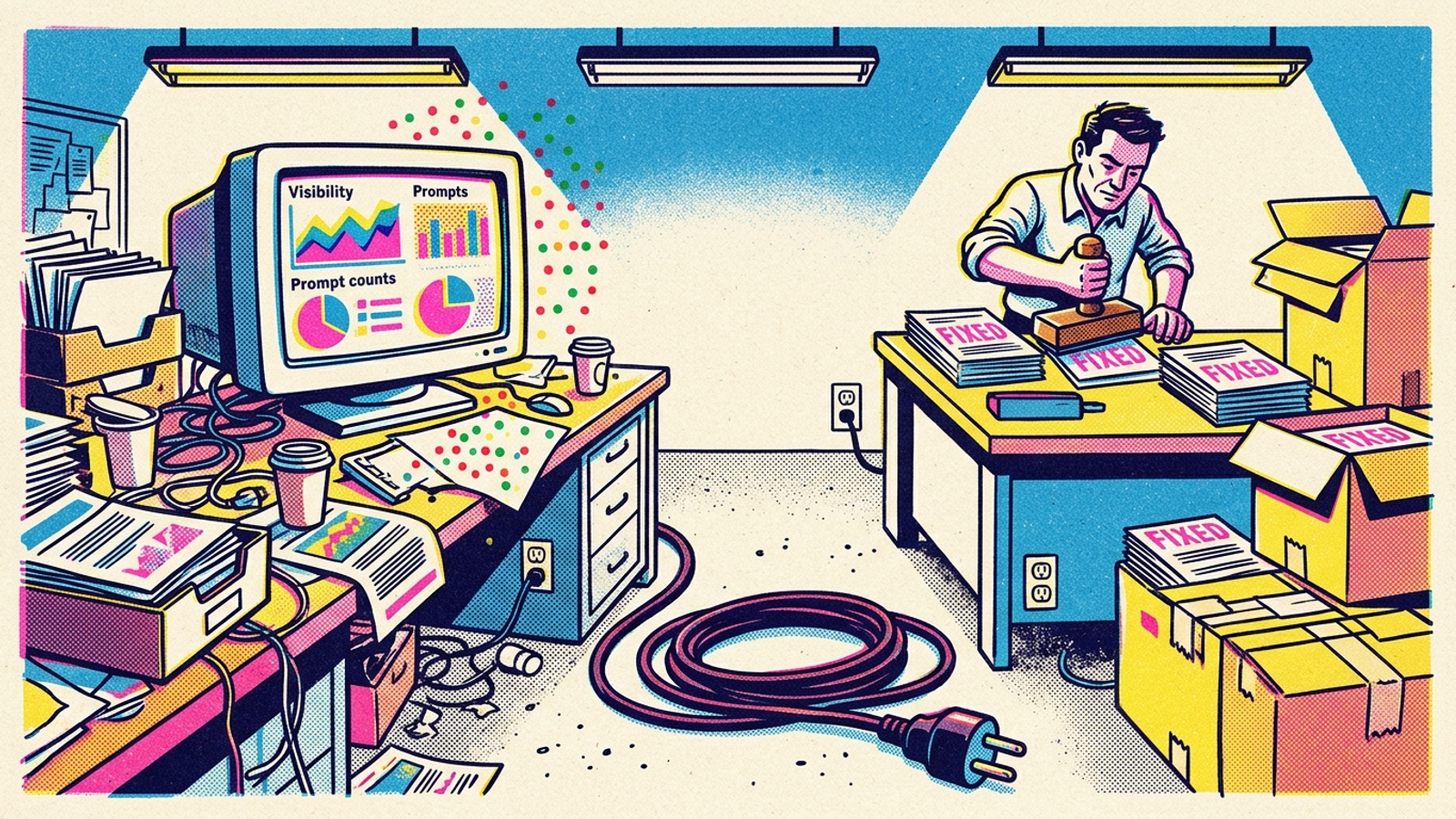
What would prove me wrong: By mid-2027, a pure tracker still commands more than $300 per domain without adding writing, technical fixes, or citation building, and agencies renew it at scale. I expect trackers instead to ship execution or become a tab inside a broader suite.
Before you white-label a dashboard, ask where the fix gets made. If the answer is an export to CSV, walk away. That gap is why I point agencies toward execution-led setups like groas for agencies, where bids, content, technical fixes, and citations run around the clock with actions logged. Monitoring tells you that you lost prompt 212. Execution gives you a way to win it back.
Prediction 3: Flat per-domain pricing becomes the agency default
The meter that survives will be the domain, not the prompt or the seat. Agencies sell outcomes per brand, manage a book of clients, and report per domain. A prompt meter disrupts that math when a client expands the questions it tracks. A seat meter does the same when a strategist invites a teammate into a report.
Existing plans show the pressure, though they have not settled on the same answer. Otterly includes unlimited workspaces at its flat plan price, while Profound charges $99 plus $399 per client workspace. Rank Monster discounts workspaces toward $249 in packs, with the base fee waived at scale. Those models produce different margin forecasts as an agency grows. The winning agency plan will let you price client 31 without dreading the invoice.
If you want a comparison at agency scale, read the AEO software comparison at client number ten and look at what each pricing model does across 10 domains.
What would prove me wrong: At the end of 2027, leading white-label sellers still bill per seat or per prompt on their default agency plans, and flat per-domain pricing remains a custom enterprise add-on.
Negotiate a fixed price for each added domain now, with no prompt overages. That clause protects your margin if prompt counts triple.
Prediction 4: Client retainers shift from visibility reports to shipped fixes
Agencies pivoting to AI search are already commanding 20–30% higher retainers than traditional SEO. That premium will last only if the retainer buys work, not a more expensive report. Once a client takes AI-assisted research seriously, a weekly PDF showing share of voice starts looking like an invoice for observation.
The proposal has to change with the work. Instead of leading with “track 300 prompts,” lead with the deliverables the agency can ship and verify: “publish four citation-ready pages, repair schema on 40 URLs, earn six citations.” Those are examples of how to write the line item, not a promise that every client needs those quantities. A client can question a visibility score; a client can inspect what shipped.
What would prove me wrong: In Q4 2027, the median white-label AEO retainer still lists prompt counts and visibility scores as its top two deliverables, while content and technical fixes remain add-ons. I expect the order to reverse. For the pricing argument behind that shift, read From White-Label SEO to AEO: The Agency Retainer’s Next Pricing Shift.
Rewrite your proposal this month around shipped units per domain. Keep monitoring in the scope, but do not make it the headline.
Prediction 5: Edge-layer deployment replaces developer tickets for technical AEO
Technical AEO can die in a ticket queue. Traditional technical SEO changes may require site-code access and a development cycle. Edge SEO can make changes at the delivery layer with serverless functions on platforms such as Cloudflare Workers, allowing some fixes to deploy in minutes rather than weeks. That work can include titles and meta tags, bulk redirects, structured data, robots.txt overrides, and hreflang changes without waiting for a backend release.
The mechanism is access. Many agency clients cannot hand over CMS and backend deployment rights whenever a fix is ready, but they can approve a CDN worker. If the agency can make an approved technical change there, it no longer has to wait for the next development sprint. The agency that ships schema in an afternoon beats the agency waiting six weeks for sprint planning. Direct CMS edits still have a place for content; they need not be the only route for technical fixes.
What would prove me wrong: By the end of 2027, most white-label platforms still require backend or CMS code changes for redirects, canonicals, and schema, with no edge option. I do not expect clients to accept that delay once an alternative is available.
Ask how technical fixes are deployed before you buy the platform. “We create a developer ticket” is an answer, just not a strong one.
What to put in a contract you sign this quarter
If these predictions hold, a contract signed now should already account for the pricing model I expect in 2027. I would not sign an annual deal metered on prompts or seats. I would run the 22-check pre-signing list for 10 client domains and require four terms in writing:
- Month-to-month service, with no lock-in.
- Flat per-domain pricing, with each new domain at a fixed add-on price.
- Zero prompt caps and zero overage fees.
- An action log under your brand for every content piece, technical fix, and citation, with counts you can forward to the client.
Sign that version and you can keep your margin if prompt counts triple and the engines you track change. Sign the other version and you may have to explain why the invoice grew while the answers still cite the competitor.
Check back on December 31, 2027. If caps are gone, trackers ship fixes, and per-domain pricing is standard, reprice your retainers around shipped work and keep the 20–30% premium. If I am wrong, I will write the retraction with the same numbers.