

 LinkedIn

Move your next $1,000 from Google Shopping to ChatGPT ads, the pitch goes, because shoppers now ask AI what to buy. If you run a small online store, I would resist that pitch: Google Shopping still wins the first dollar for most stores. ChatGPT ads have a narrower job. They reach the shopper asking what should I buy? before that shopper knows the product name.
I managed small-store Google accounts for years, so I get the temptation. Shopping can feel expensive and flat. ChatGPT feels new and cheap to test. But novelty does not pay for inventory. Shopping puts an image and a price in front of someone searching for a product; ChatGPT puts a sponsored suggestion beside an answer for someone still weighing options. Catalogue type and margin decide which moment is worth your money.
The contenders: a price tag and a suggestion
Google Shopping is the price tag. Its ad shows the product before the click: image, price, store name and rating. It accounts for around 80% of ecommerce Google Ads spend. Google matches your product feed, including title, GTIN, image, availability and price, to a shopper’s query. When I ran small catalogues, the feed was the campaign. A vague title buried a product; a rewrite could lift impressions 147% by matching what shoppers typed.
ChatGPT ads are the suggestion. They appear as a single labelled sponsored card below the answer, not inside it, and OpenAI says ads do not influence the answer itself. There is no keyword bidding. You supply plain-language context hints, such as cushioned everyday running shoes for beginners training for their first 5K, and a landing page. The system matches the ad to conversation context. Distribution is still narrow and lumpy: in one published test, two ad groups received half of 97,131 impressions while the smallest received 857. If you expect an even spread, you will spend the test wondering what broke.
1. Intent: has the shopper picked a product yet?
A Shopping query might be women’s trail running shoes size 8. Price, image and store are visible before the click, so clicking is already a choice among products. A ChatGPT conversation might begin with what are the best running shoes for flat feet? The shopper is still deciding what kind of shoe to consider. That is the intent split practitioners describe: Shopping catches product searches; ChatGPT sits in the research conversation.
For a small store, that difference sets your tolerance for ambiguity. With Shopping, you might pay for someone who sees your $89 price beside alternatives and still clicks. With ChatGPT, you pay for someone who clicks a sponsored card shown only to logged-in adults on Free and Go plans. The answer may help them frame the decision, but your page still has to sell the category and then your brand.
If you need orders this week, buy the click that already has a product decision inside it. ChatGPT’s earlier moment matters most when your product needs an explanation before anyone searches for it by name.
2. Matching: feed precision versus use-case clarity
Shopping matches on your product data, not your theory of the customer. Supply the title, price, GTIN, image and availability; Google decides which queries fit. A sloppy title can miss those queries entirely. Practitioners cite 2% to 4% CTR, 1% to 3% conversion rates and CPCs around $0.80 to $2.50 when feeds are clean. Those are not promises for your shop. They show why feed quality is worth fixing before you blame the channel.
I used to call feed work boring admin. I was wrong. The feed is the targeting. A title with brand, product type and a useful attribute gives Google more to match. Correct GTINs, live prices and availability, and an image that matches the landing page keep the offer coherent after the click. A poor feed can make the same budget buy worse-matched, more expensive traffic. That is a painful way to discover a price mismatch.
ChatGPT asks for a different input. You write hints in plain English, and OpenAI is explicit that hints are not exact-match instructions and do not guarantee delivery. Its auction is relevance-weighted second-price on CPM or CPC. You cannot negative-match a bad conversation the way I used to mine search terms for Shopping. You rewrite the hint, tighten the landing page and see where delivery goes next. Think beginner running shoes for a first 5K, not a string of keyword variants.
Shopify stores also have an organic route through Shopify Catalog and Agentic Storefronts, which auto-syncs titles and images without a manual feed, alongside paid product ads through the ChatGPT Ads app launched September 16, 2026. Keep those routes separate in your head: organic Shopping Cards appeared in only 2.2% of answers in July 2026 and are selected independently of ads. Organic visibility is not a test of paid performance.
Shopping rewards precise product data. ChatGPT rewards a clear use case and a page that answers it. Neither rewards dumping a vague product description into a new interface and calling it a strategy.
3. Measurement: which result can you trust?
Shopping tracking is boring. Good. Purchase and value data flow into Google Ads and GA4, and Smart Bidding can work toward revenue you can reconcile. ChatGPT measurement takes more care. OpenAI recommends Pixel plus Conversions API with a shared event ID for deduplication and provides an event quality score. Reporting is aggregate, with no user-level export; click-through and one-day view-through results are reported separately.
There is also a simple bookkeeping trap. Organic ChatGPT traffic can arrive as utm_source=chatgpt.com. Use distinct UTMs on paid links or you may mix free and paid traffic in Shopify. Spend reporting can lag 7 to 8 hours; conversions can lag 24 to 48 hours. React to every refresh and you will mistake reporting delay for performance.
Early comparisons give another reason to keep your expectations sober. Published figures put chatbot CTR around 0.9% against 6.4% for Google Search. Tru Commerce reports about 1.3% CTR since July 2026, a $4.41 median CPC in one 15-campaign sample, and same-advertiser conversion rates of 0.21% to 0.9% against 3.71% to 6.64% on Google. Google Search is not identical to Shopping, and those samples are not your forecast. They do make it reckless to assume a research click will perform like a product click.
Judge Shopping on attributable purchase value. Give ChatGPT a longer window and distinguish direct orders from assisted signal. Do not let a delayed dashboard settle a budget argument overnight.

4. Test cost: what does $1,000 actually buy?
At the $25-per-day ChatGPT campaign minimum in the US, two weeks cost $350. At a $3 to $5 starting max CPC, that buys roughly 70 to 115 clicks. At a 1% conversion rate, expect about one order. To see 10 conversions at that rate, you would need roughly 1,000 clicks, or $3,000 to $5,000. That is why the two-week minimum can mislead a small store: it is long enough to run, not necessarily long enough to judge sales.
The stated floor is $25 per campaign per day, averaged over seven days, with spend able to reach twice that in a day. A $1,000 ChatGPT test buys a look, not a reliable verdict. A $300 allocation buys an even shorter audition. Treat it accordingly: learn which hints get delivery and clicks, then decide whether a larger test deserves funding.
Shopping is kinder to a small budget because its intent is denser. Practitioners cite $500 to $1,500 per month to start, $1,000 to $2,000 test budgets, and $15 to $25 per day to exit learning over three to four weeks. The first 30 days can still lose money; a clean feed may take until days 60 to 90 to become cash-positive. I would not sell any owner a guaranteed return on day 14.
On Shopping, $1,000 can start ranking products by the value of the queries they attract. On ChatGPT, it may only show which hints earn attention. Those are different outcomes for the same cheque.
5. Weekly work: maintenance versus judgment
Shopping needs unglamorous upkeep. Check disapprovals, prices that disagree with landing pages, image rejections and variant splits that broke titles. Then review search terms and cut junk. On a clean catalogue under 200 SKUs, I used to spend two to three hours a week keeping it honest. Skip that work and prices drift, bestsellers go out of stock, and bidding learns from noise. Before moving money elsewhere, I would work through these Google Ads ecommerce strategies.
ChatGPT needs less feed maintenance and more judgment. With Shopify auto-sync, you are not babysitting an organic product feed; with paid ads, you are checking whether hints earn impressions, whether those impressions earn clicks, and whether the landing page earns carts. Reporting may refresh every 15 minutes, but that does not erase the spend lag. A freelancer or percentage-of-spend agency that charges you to react to stale numbers is selling motion as management.
I would keep the channels under one owner. groas puts Google, Bing and ChatGPT Search Ads in one service, with bids, budgets and landing pages worked around the clock. The point is not to make every click look equally valuable. It is to judge research traffic and purchase traffic against the same revenue goal.
Shopping punishes neglect. ChatGPT punishes impatience. Know which problem your operator is being paid to solve.
| Decision axis | Google Shopping | ChatGPT ads |
|---|---|---|
| Shopper intent | Product search with price visible | Earlier research and comparison |
| Matching and inputs | Feed data matched to queries | Use-case hints matched to conversation context |
| Measurement | Purchase value you can reconcile | Aggregate reporting with conversion lag |
| What $1,000 buys | An initial read on products and queries | An early read on hint delivery and clicks |
| Weekly work | Feed hygiene and search-term review | Hint, page and delayed-result review |
The verdict by store type
Commodity products with price competition: pick Shopping. Phone cases, supplements and pet treats put you beside stores selling similar products. The visible price, image and rating do useful work before the click. Feed precision gives you something concrete to improve; a ChatGPT sponsored card does not replace that comparison. I would put the full $1,000 into Shopping and its feed before testing elsewhere. ChatGPT gets zero until Shopping’s conversion rate holds above 1.5% for two weeks.
Considered purchases: give ChatGPT a small audition, not the lead role. Think skincare for sensitive skin, running shoes for flat feet or strollers for small cars. These shoppers ask questions before they search a product name. I would put $700 on Shopping and $300 on ChatGPT, with two or three hints tied to real research questions. Send each to a buying-guide page with one clear pick, not the homepage. At the stated daily minimum, $300 is a short test, so do not pronounce it a sales winner or loser from its order count. Watch assisted revenue and total marketing efficiency ratio, or MER, over 30 to 60 days. Fund the experiment incrementally from your weakest channel rather than cutting the Shopping activity that works, as practitioners recommend.
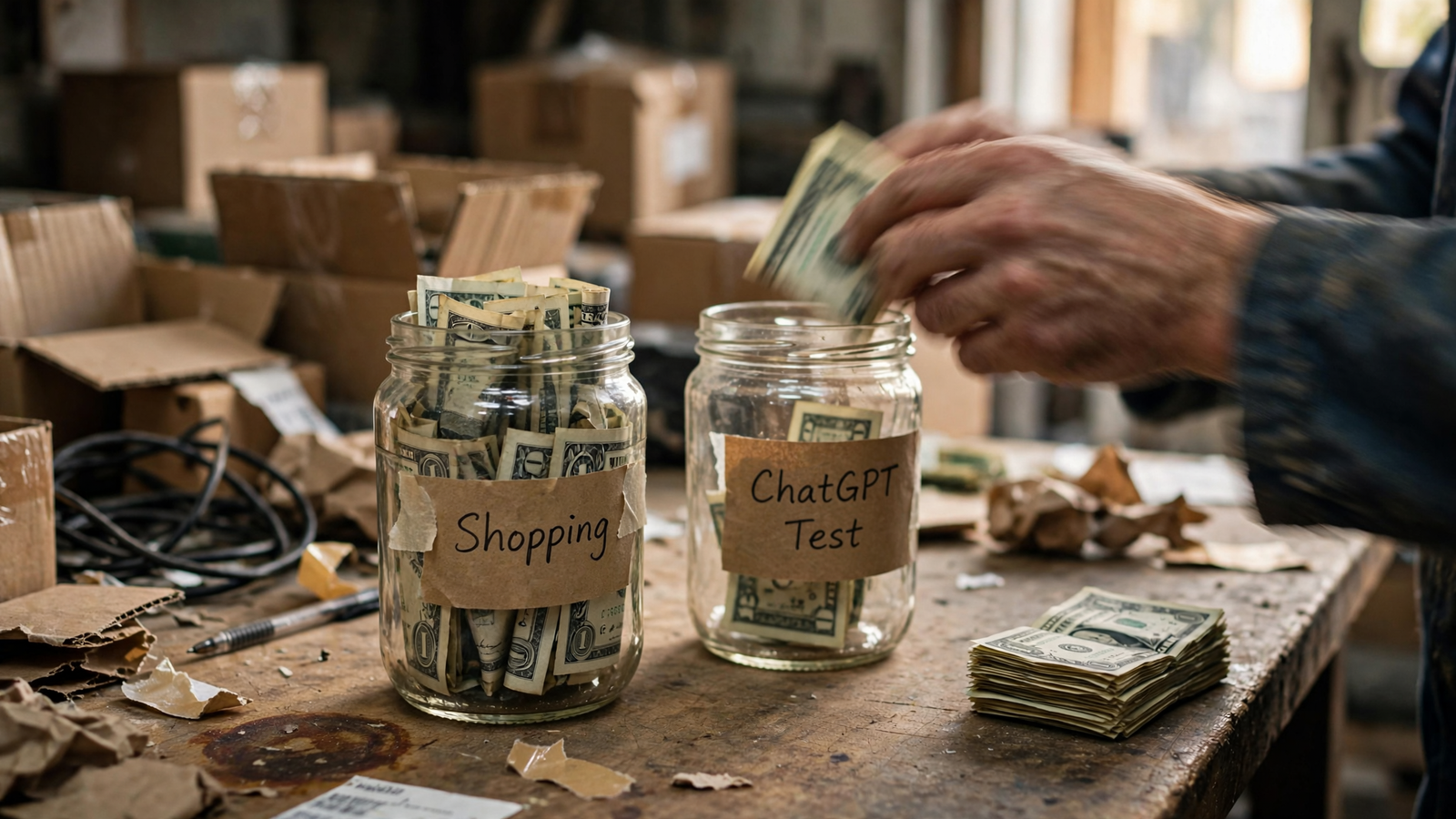
New brands with no name searches: Shopping first; ChatGPT only if margin allows. Shopping can feel painful for 30 days while Google learns which queries fit your products, but those queries give you a way to improve the feed. ChatGPT can introduce your product to people who never typed your name. Then the maths intrudes: $4 to $5 clicks converting under 1% need a $400-plus average order value or strong repeat purchasing to survive. If your margin cannot carry that, fix the Shopping feed and landing pages first. If it can, cap ChatGPT at 20% as a discovery bet and watch new-customer rate rather than dashboard ROAS. Anyone promising guaranteed ChatGPT scale is selling a story; start with these questions about unsupported results claims.
Where I would put the first $1,000
For most small stores, my call is $800 to $1,000 on Shopping. Fix titles, split variants, align prices and availability, and capture product searches you can already serve. Watch ChatGPT organic visibility without mistaking it for paid results. If you reserve up to $200 for a future paid experiment, do not pretend it meets the two-week ChatGPT test cost.
The exception is a considered-purchase store with $100-plus baskets and a page that answers which one should I buy? in one screen. That store can run the $700/$300 split as an audition, then decide whether a properly funded test merits a geographic holdout and a look at total store MER. The winner for most stores is still Shopping. ChatGPT is for the narrower store with the margin, page and patience to buy the question before the product search.
I would hire the same way. Do not hire a standalone Best ChatGPT Ads Agency for an ecommerce store. You risk a second dashboard, a second fee and hints optimised for clicks while Shopping is optimised for revenue. What the deck calls synergy, I call two people doing the same job. Put both channels with one operator who lives on purchase value. That is why groas bundles Google, Bing and ChatGPT in one Search Ads service for a flat fee rather than selling ChatGPT as a separate retainer.
The first $1,000 goes where the price is already visible. The next $1,000 can chase the question.