

 LinkedIn

A buyer asks ChatGPT for the best payroll software for a 20-person contracting firm. Your guide ranks second on Google for almost that exact question, but the answer cites five other pages.
The mismatch starts before the citations appear. When ChatGPT uses search, it can rewrite a buyer’s question into narrower background searches and cite pages that answer those instead. Google describes AI Overviews and AI Mode as systems that may issue multiple related searches across subtopics and data sources. OpenAI says ChatGPT typically rewrites a query into one or more targeted queries for search partners. One prompt goes in; several searches can come out. Anyone who has watched broad match turn one keyword into forty search terms already knows the shape of this problem.
One buyer question becomes several jobs
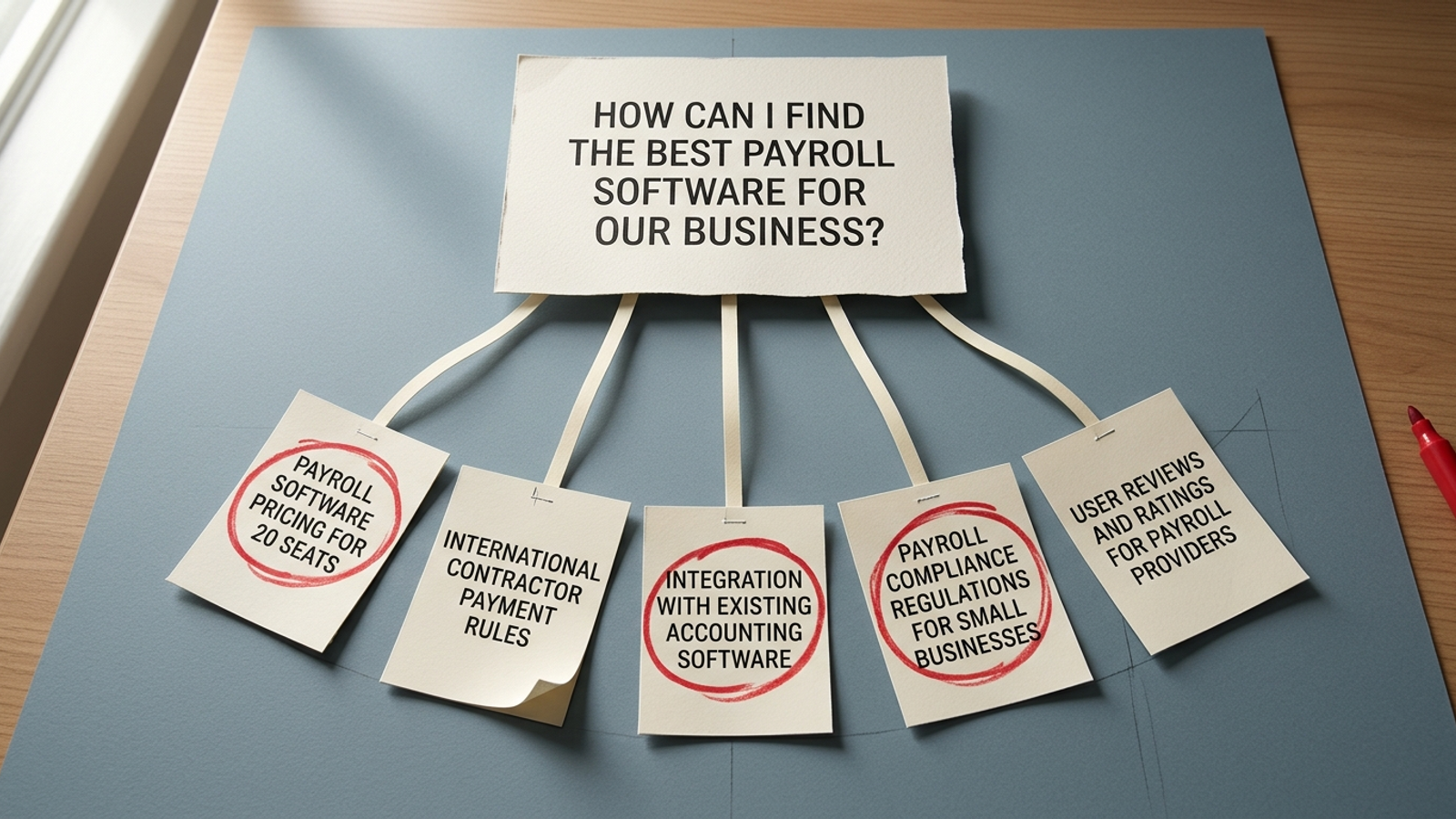
Take the payroll prompt. A useful answer has to deal with firm size, contractor pay rules, pricing at 20 seats, implementation effort and comparisons with named rivals. The buyer packed all of that into one sentence. The assistant may unpack it before deciding what to say or cite.
The number of searches varies. Gemini 3 averages 10.7 background queries per prompt, ranging from 3 to 28, while other measurements put ChatGPT around 2.1, Perplexity around 1.4 and Grok around 6.8. Deep Research modes can run into the hundreds for one report. Fan-out is a mechanism, not a fixed number of searches.
Not every prompt searches at all. In one DataForSEO sample of 100,000 ChatGPT prompts, about 47.5% triggered fan-out searches; the rest were answered from model knowledge. When searches do happen, the queries can be longer and more specific than the buyer’s wording: roughly 12 words rather than six in recent measurements, while the count per prompt held near 2.3 to 2.8.
That distinction matters if you are diagnosing a missing citation. First ask whether the assistant searched. Then ask what narrower answers it needed. Checking only where your page ranks for the sentence the buyer typed skips the work in between.
Step 1: The assistant rewrites the prompt
The rewrite comes before retrieval. The assistant can drop polite filler, keep the entities that matter and turn implied constraints into more targeted queries. In the payroll example, “best” is not much of a search plan. Pricing for 20 people, contractor rules and switching effort are. The buyer’s question is the brief; the rewrites are the work order.
The work order can change as the assistant reads. OpenAI’s help material on how search works describes sequential as well as parallel searches: after an initial search such as CCR8 immunotherapy drug development 2025, the system may follow with CHS-114 conference 2025. With Memory on, saved details can also enter a rewrite, turning vegan in SF into good vegan restaurants San Francisco. The later search depends on what the earlier one established.
What broad match gets right about this
I used to describe broad match as Google guessing what you meant. That was too simple. Add payroll software contractors, and the search terms could spread from contractor payroll tax rules to Gusto vs Rippling pricing. You watched which terms held CPA rather than treating the keyword you entered as the whole market.
Fan-out makes a similar expansion for a different purpose. Broad match expands a keyword to find clicks that convert. An assistant expands a prompt to find facts it can use in an answer. The shared lesson is to look past the head term and cover the searches behind it.
The analogy breaks at control. In Google Ads, I could inspect a search terms report and negate the junk. In AI answers, I cannot count on seeing the exact background strings. I would not build a page for every guessed wording even if I could. The useful target is the buyer’s recurring sub-question, not a transcript of one assistant run.
Step 2: Retrieval decides which answers are available
Once the rewrites exist, the assistant needs material to answer them. That material may come from a prebuilt index, a search API at answer time or a live page fetch. The route matters: a passage cannot earn a citation if the retrieval path never reaches it.
Retrieval can also work below the page level. Many RAG pipelines split pages into 256- to 1,024-token chunks, retrieve the top 3 to 10 using vector and keyword scoring, re-rank them, then generate an answer. A clean paragraph about contractor pay at a particular firm size may therefore be more useful than a whole guide that mentions contractors in six scattered places. Make the answer reachable before you make it elegant.
That starts with the unglamorous check: can the relevant system fetch the page at all? I send clients to Before You Write for ChatGPT, Check Whether AI Can Read Your Site before asking them to rewrite content. If retrieval fails, a better opening paragraph will not rescue the citation.
Why ChatGPT and Perplexity can cite different pages
Try the same payroll prompt in ChatGPT and Perplexity and the source lists may differ. Their retrieval paths differ, so a page available and useful along one path need not win along the other. Perplexity commonly shows 3 to 5 citations per answer and favors extractable formats, including FAQs, numbered steps, comparison tables and short definitions. The same source cites a practitioner study claiming 46.7% of Perplexity citations came from Reddit, in contrast with Wikipedia’s prominence on ChatGPT.
I would not turn that contrast into a rule that says “write for Reddit” or “write for Wikipedia.” The payroll buyer still needs an answer to the same underlying questions. What changes is how an assistant finds a usable passage. Do not optimize only for the prompt; check the retrieval path behind it.
Step 3: Passage selection rewards a complete answer
Retrieval produces candidates. Selection decides which chunks are useful enough to shape the response. This is where a comprehensive payroll guide can lose despite covering every topic somewhere: the model needs an answer to a narrow question now, not proof that a writer spent 4,000 words near the subject.
Picture a guide with pricing in one section, seat counts in another and contractor add-ons tucked into a comparison near the bottom. It may contain everything the buyer needs. It does not offer one clean answer to “what would this cost for a 20-person contracting firm?” A focused passage can put the relevant size, price and limitation together. The unit competing for selection is the passage, not the page.
What makes a payroll passage quotable
A useful passage answers one sub-question without forcing the assistant to assemble its conclusion from distant sections. Put the seat count beside the price. Put both product names beside the comparison. Put a definition beside its constraint. A 40- to 60-word paragraph can do that, but the word count is not magic; completeness is the point.
That is also why chasing exact background strings is a poor plan. Only about 27% of fan-out strings repeat across runs of the same prompt, and 66% appear just once. A new page for every wording could miss the next rewrite while drifting toward what Google calls scaled content abuse. About 90% of those unstable strings fall into four or fewer topic clusters. Cover the stable question, not the fleeting phrasing.
For the payroll example, that means a real answer about pricing at the buyer’s size, not six near-duplicate pages rearranging “20-person contracting firm.” If the pricing cannot be stated without conditions, state the conditions in the same passage. Do not make the assistant hunt for the sentence that changes the answer.
Step 4: Selection and citation are different wins
The passages that shape an answer are not always the passages named beside it. An assistant can combine agreeing chunks into one sentence and cite the source with the cleanest extractable support. That makes two questions worth asking: did your page contribute useful information, and did it earn the visible link? Being used and being named are different wins.
This distinction helps explain a frustrating result. Your guide may discuss contractor pay correctly, while another page states the relevant answer in one self-contained paragraph and gets the bracketed citation. Repeating the head phrase in your title does not settle that contest. Improve the passage the assistant would need to quote.
Citation lists can also change between runs as the searches and selected passages change. Perplexity may show three to five sources; ChatGPT may show more or fewer depending on the search. Deep Research can draw on many more. Anyone promising you a permanent citation position for a head prompt is selling a rank tracker for a process that does not stop at the head prompt. Track which sub-questions you answer well instead.
Why a Google ranking can still miss the citation
A head-term ranking tells you your page matches the question the buyer typed. It does not tell you whether the page matches the searches an assistant ran. In a 10,000-keyword study, pages ranking for the main query and at least one fan-out were 161% more likely to be cited in AI Overviews than pages ranking only for the main query. Pages ranking only for fan-outs were cited 29.2% of the time, versus 19.6% for head-term-only pages.
The mechanism is less mysterious than the dashboard makes it look. The assistant asks a narrower question; a narrower passage answers it; that passage has a chance to be cited. Your second-place payroll guide can still miss if its sections never resolve the pricing or contractor-rule questions cleanly. You can own the prompt and lose the searches behind it.
One big guide or several focused pages?
The answer is not automatically “publish five pages.” A 4,000-word guide that mixes pricing, compliance, integrations and onboarding without giving each a complete answer is hard to extract from. Five focused pages that each answer a real buyer question can be easier to use. But a single strong page can also contain distinct, self-contained sections.
About 84% of fan-out queries share at least one top-20 URL with the original query, according to the same fan-out study. That is a reason to connect the head topic to its subtopics, not to abandon the main page. Build a pillar and cluster pages where the questions warrant them; give every important sub-question a passage that stands on its own. If you are spending, say, $20k a month on payroll software terms, stop asking only whether the pillar ranks. Ask what a buyer would still need answered after reading it.
A content gap is an unanswered sub-question
For AI answers, the gap is not necessarily a keyword missing from your spreadsheet. It may be a buyer question your page raises but never settles. In the payroll example, map the likely questions to passages you can point to:
- Price at the buyer’s size: What does it cost for 20 seats, including contractor add-ons?
- Rules and risk: How does it handle contractor classification, tax forms and pay runs?
- Named comparison: How does it differ from the two rivals buyers keep mentioning?
- Effort to switch: How long does implementation take, and what changes during it?
- Next step: What should a firm this size do first?
This is a content review, not an invitation to make up answers. If the page cannot answer one of those questions, mark the gap. If it answers one across three sections, bring the necessary pieces together. The method in Your AI Citation Gap Is a Missing Answer, Not a Missing Keyword traces each sub-question to a passage an engine can retrieve and cite.
groas is built around that view: it tracks the prompts, answers and citations where a brand appears or goes missing, so a team can examine the sub-query behind the loss instead of guessing from the head term alone. If a sub-query has no answerable passage, fix the answer before chasing the citation.
Test the model on a different buyer
Now take “best CRM for a 10-person law firm.” The head prompt is familiar. The work beneath it is more specific: price per matter, ethics and conflict rules, Clio versus PracticePanther for a small firm, migration time from spreadsheets, and an intake checklist.
I would start by writing those sub-questions down, then finding the passage that answers each one. If there is no passage, that is the work. If one exists but requires the reader to stitch together a price from one section and its conditions from another, tighten it. Only then decide whether those answers belong as sections on a pillar page or on focused cluster pages.
Run the model forward: one buyer prompt becomes narrower searches; retrieval finds candidate passages; selection chooses usable answers; citation names some of their sources. You cannot control every rewrite or guarantee the bracket beside the answer. You can make sure the important sub-questions do not arrive at an empty page. Anyone who has run broad match knows why that beats staring at the head term.