

 LinkedIn

An ecommerce store hiring a Meta agency has two pitches to choose from: the creative studio promising new ads every week, and the classic media buyer promising tighter control. For most stores chasing ROAS, I would hire the shop that ships more tested creative. Advantage+ has taken over much of the targeting and bidding work that once justified a buyer’s retainer. The buyer still has a job, but it is not renaming ad sets until the numbers improve.
I spent years as the second guy. I built structures by hand, pruned audiences at 1am and wrote bid rules I was proud of. Those skills still matter when an account is broken. They are a weaker pitch when the account works and the same five ads have been running for months. A comparison of Advantage+ Shopping and manual setups reports 4.52x versus 3.70x ROAS; it also cites attribution work putting creative at around 56% of auction outcomes. Those figures are not a promise for your store. They do help explain why I now ask about ad output before I ask about bid rules.
The two pitches: new ads or tighter control
The creative studio promises a shipping calendar
The creative studio sells output you can count. On the first call, it talks hooks, angles, UGC makers and editing turnaround. The promise is volume with a testing loop: six to eight new hook concepts a month, cut into static, video and UGC variants; losers dropped, winners scaled. That is not an imaginary package. One ecommerce-focused agency offer pairs 6–8 monthly hooks with catalogue, Pixel and CAPI work.
Ask what happens in week three. A studio should be able to show when ads go live, who makes them and how it decides what to make next. If an agency cannot tell you how many new ads ship each month, it is not selling a creative engine.
The media buyer promises a cleaner account
The buyer sells control: campaign structure, prospecting and retargeting budgets, bid caps, exclusions and catalogue segmentation. The promise is fewer wasted impressions and a faster response when CPA drifts. I used to sell exactly this. I kept a spreadsheet of audience splits I swore was the reason ROAS held.
Then Advantage+ took much of the targeting, budget allocation, creative combination and placement work off my desk. The same Advantage+ overview describes testing up to 150 creative combinations at once. I could still improve a bad setup. I could not justify treating every manual adjustment as the source of growth while I was still renaming ad sets. If the pitch is all structure screenshots and no dates for new ads, you may be buying old work at a current price.
Why Advantage+ changed the contest
The buyer has fewer levers worth pulling
Five years ago, manual interest stacks, lookalike layering, placement checklists and morning bid tweaks could fill a buyer’s day. Advantage+ now handles much of that allocation and placement work. The benchmarks cited here put Advantage+ Shopping at 4.52x ROAS against 3.70x for manual setups, about 22% higher, alongside 9% lower CPA. I would not use a benchmark to forecast your account. I would use it to challenge an agency whose entire plan is twenty ad sets and weekly bid shuffles.
Automation does not clean your product feed or repair a purchase event that fires twice. It also cannot invent the next useful customer angle. That leaves three things worth pressing an agency on: product data, conversion signals and a steady supply of creative. If it spends thirty minutes on structure and five on ads, its priorities have not caught up.
The ad does more of the sorting
Broad targeting changes what a creative test is for. The image, the opening seconds of video and the hook give Meta different material to show different people. The system described in the same Advantage+ account can handle far more variants than the older setup; the practical launch baseline it gives is 20 to 50 variants to mix and place.
That does not mean forty weak ads beat five strong ones. It means five ads give the system fewer distinct messages to test. Spend the same budget behind a product demonstration, a customer objection and a UGC-style account, and you have given it different ways to find a buyer. Spend it behind five cuts of the same hero shot and you mostly have five filenames. Your creative now does much of the audience-finding work.
Axis 1: How many useful ads go live?
Say you spend $20k a month. A fashion ecommerce benchmark puts median Meta ROAS at 2.18x, the top quarter at 4.4x and the top tenth at 6.0x. The same source reports that brands testing 21 or more creatives a month beat brands testing fewer than 10. I would not assign that whole gap to creative; stores differ in more ways than their ad folders. But a buyer cannot test a new angle that nobody made.
The Motion 2026 study discussed here covers $1.29 billion in spend and 578,000 creatives. Its top-quartile shippers make two to three times as many ads as average at every spend tier: at $50k to $200k a month, the example is 16.0 versus 6.7 new ads a week. Only about 5% become winners. At that rate, 40 ads give you roughly two winners; five may give you none. Its rule of thumb is one new ad for every $3k of monthly spend. For a $20k account, that is about six or seven fresh ads at minimum.
So ask both contenders for last month’s net-new ads, with launch dates. Then ask what was genuinely new: a hook, format or argument, not the same video with a different end card. The creative analysis cited here reports UGC-style work ahead of polished work by about 27% on CTR and 19% on conversion, and describes conversion falling as people repeatedly see the same creative. That is a reason to test, not an order to make every ad look alike. If the same polished hero video has carried your account since spring, a tidier budget split will not make it fresh. Buy a testing cadence, not a promise to “iterate.”

Axis 2: Can the agency keep the catalogue usable?
Say you run a 400-SKU store and your bestseller goes out of stock on weekends. A buyer-led agency might propose an Advantage+ sales campaign for prospecting, a retargeting slice and product sets separated by margin or hero products. That discipline counts. If the feed is messy, it may be the most valuable work anyone does in the first month.
The failure I see is control for its own sake: twelve campaigns on $18 a day each, with budgets too fragmented to learn much. A creative-led shop may run fewer campaigns and broader product sets, then refresh catalogue-ad overlays and hooks instead of building another ad set. Neither model gets a pass on stock, margins or feed quality. But once those basics work, the buyer has to explain why another split will do more than a new message. Consolidation with fresh creative beats fragmentation with stale creative.
Axis 3: Who owns Pixel and CAPI?
Creative cannot rescue bad conversion signals. With ad blockers and iOS limits, the tracking setup discussed here puts pixel-only capture around 60–70% of conversions, against 85–95% with the Conversions API added. It also describes recovered conversions and CPA improvements after setup, with Event Match Quality improving when event_id deduplication is correct. Those are reported outcomes, not a timetable I would promise your store.
I have seen buyer-led agencies do this work well and creative shops skip it. Ask who checks the events, who handles deduplication and who notices when purchase data stops matching orders. “Your developer” is not an ownership plan unless the agency is working with that developer and checking the result. Fix Pixel and CAPI before you declare a creative test a winner or loser.
Axis 4: Which ROAS number reaches the report?
Meta-reported ROAS is not profit, and it is not a complete picture of sales. Missed conversions can make the platform number look low; duplicate events can make it look high. A buyer-led agency may send the Ads Manager figure without much explanation. A stronger creative shop should be willing to reconcile its work against store sales rather than choose the largest number available. One combined creative-and-buying offer describes using deduplicated Pixel plus CAPI alongside other measurement tools.
Ask to see Meta-attributed revenue and Shopify-recorded revenue for the same period, on one page, with the difference explained. They are not two interchangeable ROAS figures: store sales do not, by themselves, prove what Meta caused. But the comparison gives you a useful place to start questioning what the report claims. If an agency shows only the bigger figure and calls the matter settled, keep asking.
Axis 5: Does the fee rise when output does not?
Say your spend grows from $20k to $60k a month. A Meta agency pricing guide lists retainers of 15–25% of spend, often with $2,000–$5,000 minimums. At 18%, the $20k store pays $3,600; at 15%, the $60k store pays $9,000. The guide also describes setup fees and separate charges for design or UGC acquisition. The arithmetic is simple: spend rises, so the management fee rises. New creative may still be another line item.
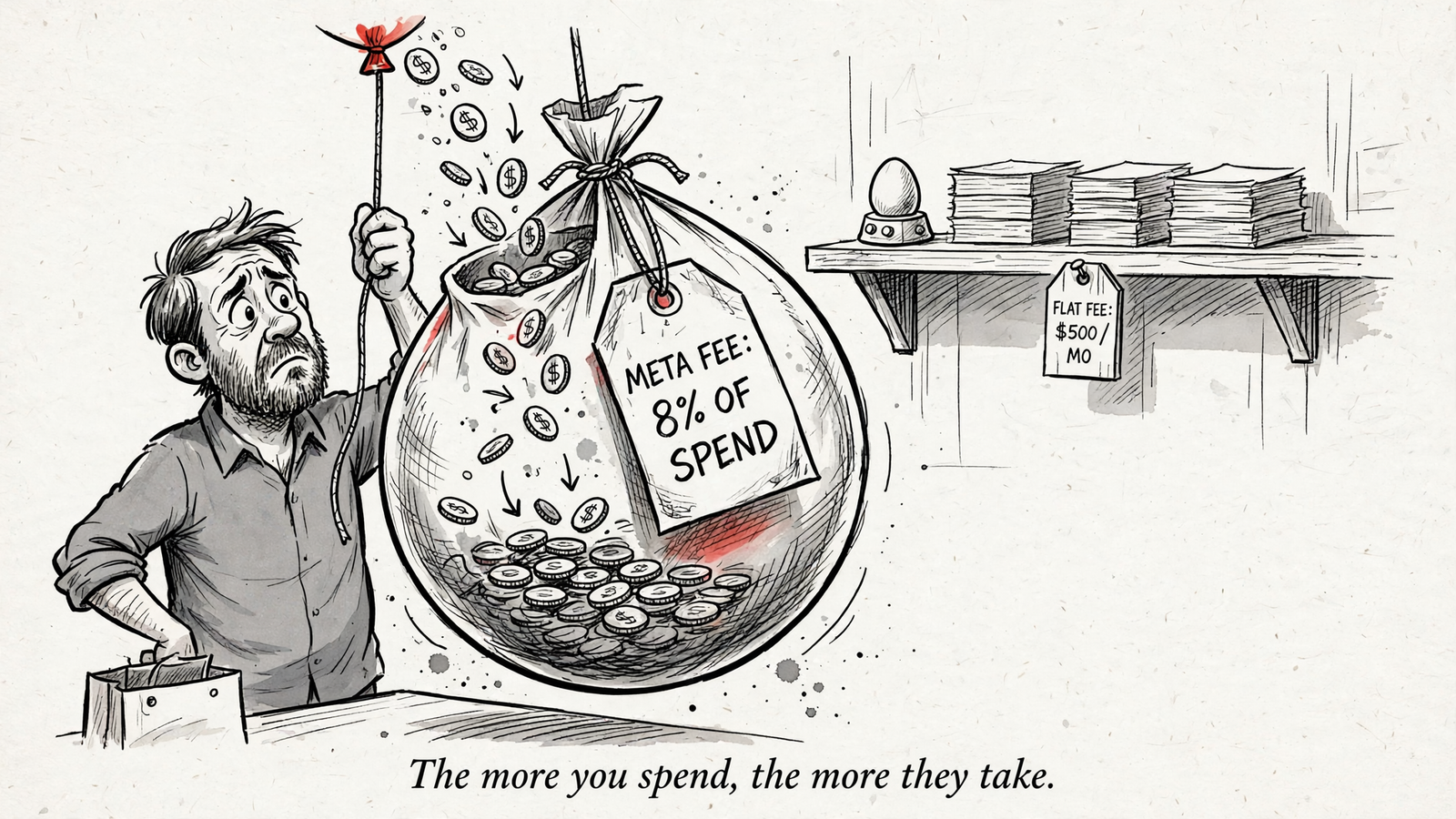
I prefer one flat number that includes the ad work. groas lists Meta Ads at $1,499 a month, with audiences, budgets and ads worked around the clock and new ads tested as winners are scaled. No cut of spend, no setup fee, month to month. That does not entitle any agency to promise you a particular number of winning ads. It does make the bill easier to judge against the work shipped.
At $20k in spend, $1,499 is well below the $3,600 percentage-fee example. At $60k, the gap against $9,000 is larger. You still need to ask how much creative goes live and who owns tracking. If the fee rises with spend but the testing cadence stays put, the agency is scaling its revenue faster than your output.
The scorecard: five decisions, not one pitch deck
| Decision | Creative-first agency | Buying-first agency | Edge |
|---|---|---|---|
| New creative | Scheduled hooks, variants and launch dates | Often a smaller creative cadence alongside account work | Creative-first, if the ads actually ship |
| Catalogue and Advantage+ | Simpler setup with refreshed catalogue creative | More attention to feed, product sets and controls | Buyer when the feed is broken; otherwise creative-first |
| Pixel and CAPI | Must show it owns setup and deduplication | Often a clearer fit for repair work | Buyer when tracking needs fixing |
| ROAS reporting | Stronger if it reconciles platform claims with store sales | Weak if it stops at an Ads Manager screenshot | Whoever explains the gap |
| Fees at scale | Stronger when creative is included at a flat fee | Percentage fees can rise without more ads | Flat, creative-included model |
That is not a clean 4–1 score. Tracking can hand the buyer a real win, and reporting belongs to whichever agency does the work. My choice rests on the account’s condition: once feed and events work, the recurring bottleneck is usually new creative, not another layer of buying control.
Verdict: hire the shop that ships
For an ecommerce store with a working feed and trustworthy purchase events, I pick the creative-first agency. Advantage+ can handle much of the allocation; it cannot give itself a new hook. A shop that ships and tests new ads gives it more distinct material to work with. A shop that spends the month shuffling bids may leave it with one old video and a cleaner ad set name. Buy output, not oversight.
When I would choose creative-first
If you spend $10k or more, your catalogue is stable and your last 30 days show fewer than 10 new ads launched, I would start with creative output. That describes most Shopify stores I have audited. Get ship dates in writing. Make sure creative is included in the fee, and make sure someone still owns buying and tracking underneath it. That is the combination I want from groas Meta Ads: audiences, budgets and ads worked around the clock, new ads tested and winners scaled for a flat $1,499 a month rather than a percentage of spend.
The exception: start with a buyer when the foundation is broken
Pick the buyer first if your catalogue feed rejects half your SKUs, your Pixel fires twice on every purchase, you have no CAPI, or product margins need tighter guardrails. Forty new videos can scale a leak faster. Bad signals give Advantage+ poor information; bad product data gives it the wrong products to sell.
In that store, I would hire buying discipline for 30 days to repair the feed, events, deduplication and guardrails, then move back to a creative-first retainer. This is a job for a buyer, not a reason to pay indefinitely for manual control after the repair is done.
Three questions for either agency’s first call
Ask these verbatim. Write down the numbers.
- How many net-new ads went live per client last month? Ask for dates and counts, not a process deck. Under 10 at $20k in spend would make me question the testing plan.
- Who owns Pixel, CAPI and deduplication? Ask for current Event Match Quality, then ask to see Meta-attributed revenue beside Shopify-recorded sales for the same period, with the difference explained.
- What do I pay if spend doubles from $20k to $40k, and is creative included? If the fee doubles while output stays flat, what additional work are you buying?
If you want the model I argued for, groas runs Meta for a flat $1,499 a month, with new ads tested in the same fee and no cut of spend. Bring those three answers from any competing pitch and compare them line by line. For a sound account short on fresh ads, I will take the shop that ships over the shop that shuffles.