

 LinkedIn

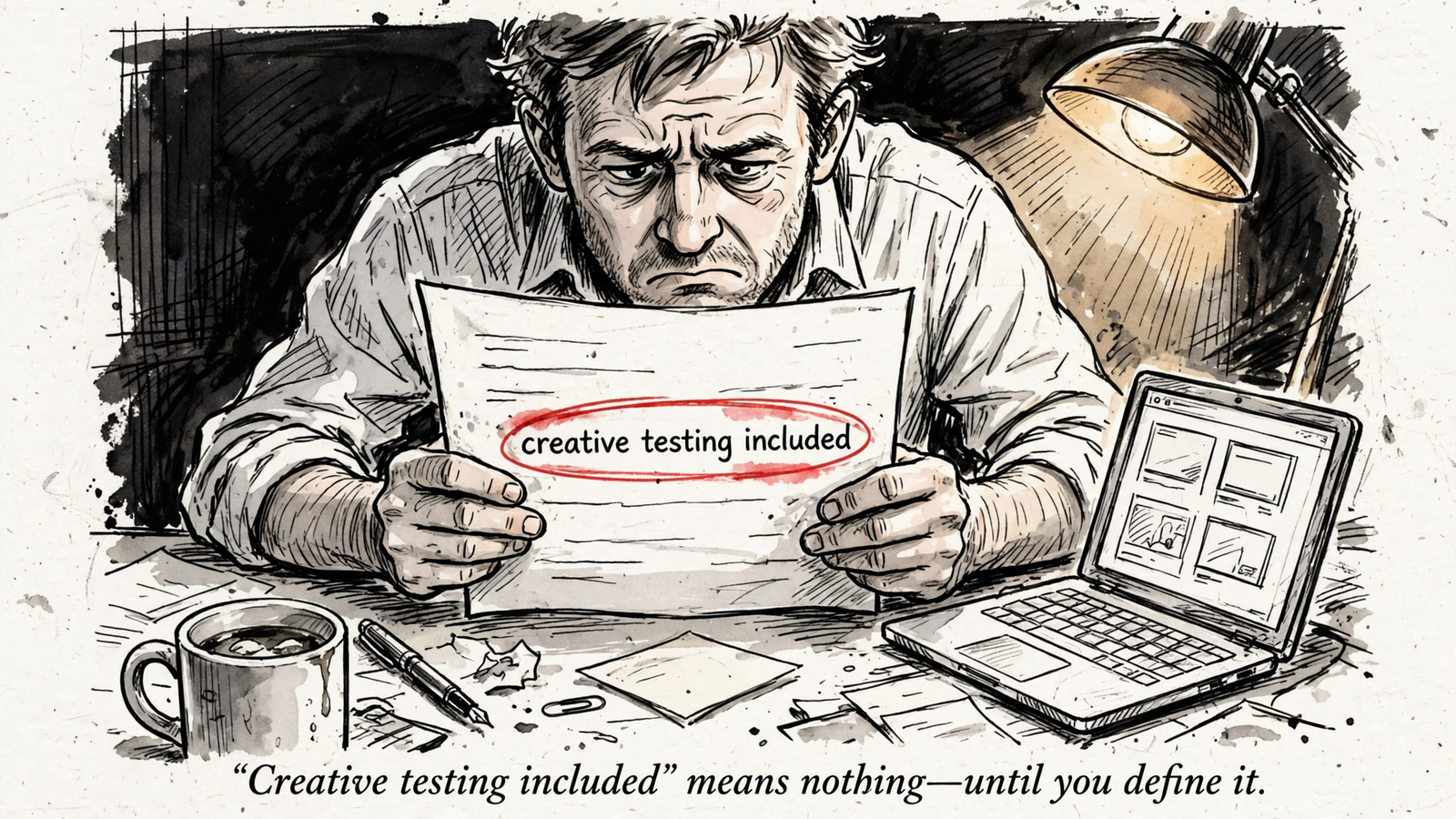
Most agencies won’t tell you this before you sign: “creative testing included” can mean four new ads a month, or one good ad duplicated twice and called a test. I’ve sat through the call where a marketer tries to explain that line to the founder holding the budget. The words tend to fall apart.
This is the translation sheet for that call. Until someone defines a concept, a variation, a test and a decision, “creative testing included” is not a scope of work. It is a sentence. Here is what to ask each finalist to put behind it before you ask anyone to approve the fee.
Included
Included means the work covered by the quoted fee, without a separate charge or change order.
The exclusions matter as much as the promise. A usable Meta management scope covers the eight buckets you would otherwise have to assign elsewhere: strategy, creative production, campaign builds, optimization, pixel and Conversions API work, landing-page support, reporting with attribution, and policy compliance. A provider may not do all eight. Fine. But the proposal should say so, rather than let “full service” do the work of a contract.
Ask who writes the brief, who shoots or designs, who launches, how often budgets move, and what landing-page work is covered. I used to tell clients “we handle everything” when I meant “we handle the ad account.” I was wrong to phrase it that way. Write the exclusions down before they become change orders.
Concept
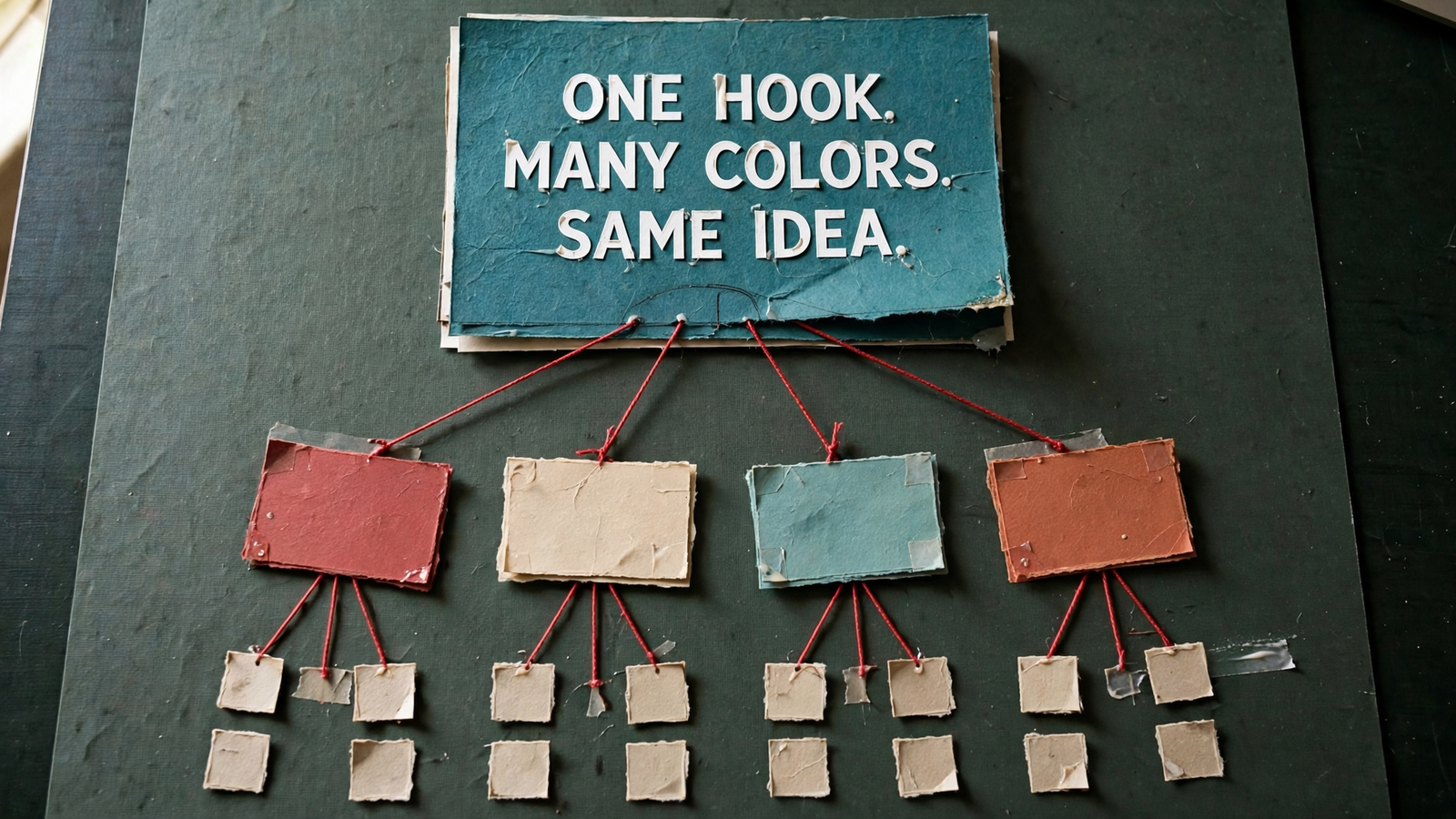
A concept is a distinct selling idea: a different reason, angle or audience hook for buying the same thing.
It is not every file in a creative folder. One script arguing that a product saves time remains one concept when four people read it and the editor exports it in three aspect ratios. Those versions may help delivery across placements. They do not tell you whether saving time beats a different reason to buy.
I’ve seen reports call that folder “12 new creatives tested.” Count the ideas before you count the exports. Ask for a monthly number of net-new concepts, not just a monthly number of assets.
Variation
A variation changes one element of an existing idea without necessarily changing the idea itself.
A new crop, background color, opening shot or voiceover can be a variation. It can be worth making: a tired execution may need a new opening, and different placements need different files. But if the same promise survives every edit, the provider has not explored a second selling argument.
This is where “creative volume” gets slippery. Ask the provider to count concepts, variations and file exports separately. If the proposal commits only to “assets,” find out whether resizing an image consumes one of the promised slots. That answer belongs in writing, not in an awkward conversation at the end of the month.
Creative production
Creative production is the work of making and preparing the ads that can be launched.
It includes the steps a proposal may scatter across departments: briefing, writing, shooting or designing, editing, approving, naming and sizing files for placement. An agency that “handles creative” might do all of that, or it might wait for your designer to deliver finished files. The difference decides whether new ideas ship or sit in a queue.
Name the owner of each handoff. Who writes the brief and script? Who makes the asset? Who approves it, and within how many days? Who builds the ad after approval? Ask how many net-new concepts ship each month, then ask how many executions and formats come with each one. An impressive asset count is less impressive if nobody owns the launch.
Creative testing
Creative testing is putting a defined creative question in front of an audience and deciding what the result means.
Production ends with launchable files. Testing needs a hypothesis, delivery, a comparison and a decision. “Does a price-first hook beat a problem-first hook for cold traffic?” is a question. Leaving five ads running and reporting whichever Meta spent most on is not, by itself, an answer. What the deck calls “always testing,” I sometimes call leaving the lights on.
Get the question and decision rule before the spend. The provider should say what will be compared, how it will judge the result, and whether the next move is to keep, change or stop the idea. Testing without production authority waits for your designer. Production without a test plan builds a larger folder. Neither is the program the proposal implies.
A/B test
An A/B test is a controlled comparison designed to isolate the effect of one change.
On Meta, Experiments can split people into non-overlapping groups for a comparison. Four ads competing inside one ad set are a different arrangement. Meta may give one more delivery, so the ad with the most spend has not necessarily beaten the others under equal conditions.
A provider does not need to run every creative decision as a formal A/B test. It does need to call the comparison what it is. Ask which variable changes, how the audiences and delivery will be handled, how much evidence the team wants before deciding, and what happens to the loser. If the answers arrive only after a “winner” is announced, the method is being written backward.
Ongoing optimization
Ongoing optimization is the account work between tests: adjusting delivery, budgets, audiences, tracking and underperforming ads.
It is not a synonym for creative testing. An account can need both a fresh idea and a budget change on the same Tuesday. The question is who notices, who acts, and whether the action stays within agreed spending authority. That is where continuous management has an advantage over a monthly review followed by a polished explanation of what happened weeks ago.
Ask who owns execution between meetings. A shared record can show the date, change, reason, hypothesis and outcome. Do not confuse a high change count with good management; needless edits are still needless. You want to see decisions made when they mattered, with enough context to judge them later.
Creative fatigue
Creative fatigue is the loss of performance that can follow repeated exposure to the same ad.
A rising CPA does not prove an audience is tired of the creative. Meta’s Creative Fatigue and Creative Limited labels can flag elevated costs, but a label does not identify the cause. A tracking break, a new competitor or another account change may be in the picture. Replacing an ad without checking turns diagnosis into a content calendar.
Ask for the reason before the replacement. What happened to frequency and reach? Is the ad still reaching new people? Did anything else change that week? Those questions matter because the remedy depends on the cause. A working idea may need a new execution. A broken measurement setup will not be fixed by a new opening shot.
Refresh
A refresh is a new execution of a concept the team still believes in.
Keep the promise, change the hook, face or first few seconds. That is different from retiring the idea and trying another reason to buy. Both can be sensible; neither should be hidden under the single line “new creative launched.”
Make the provider say what survives the edit. If the original angle still converts for new people but its execution looks tired, a refresh has a purpose. If the team cannot say what evidence supports keeping the angle, it may just be producing more versions of the same guess. Count the refresh as work. Do not count it as a net-new concept.
Winner
A winner is the best-performing option in a particular comparison, under the conditions in which it ran.
“Best in this account so far” is useful information. It is not proof that more budget will hold CPA steady. The hook beat what it faced, for that audience, at that spend, during that period. I’ve watched an ad work at $40 a day, survive at $120 and fail at $400. More money meant reaching people beyond the group that made the first result look good.
Ask what the ad won against and what happens next. If the agency cannot name the comparison or the metric, “winner” is a label on a screenshot. If it can, the result gives the team a concept to develop, not a license to spend without guardrails.
Scaling
Scaling means increasing spend on a working ad or concept while watching whether the economics still hold.
A manager may raise a winner’s budget gradually or duplicate it into a new campaign, then make more executions around the concept. Neither move guarantees that the next audience will behave like the first. The contract should set the manager’s authority: how far daily spend can move without approval, what performance change prompts a pause, and who makes the call.
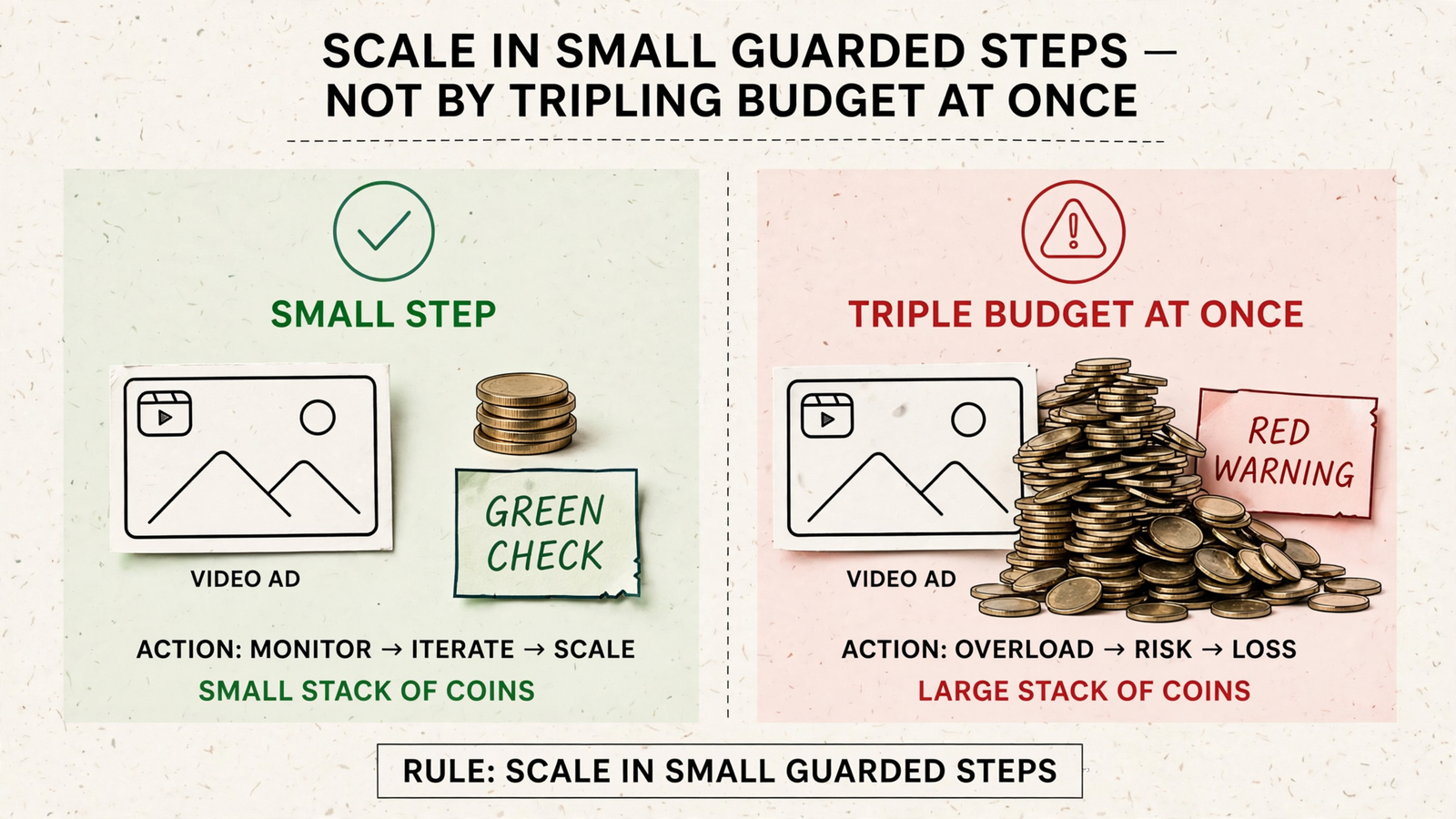
A scale rule is a spending rule. Write it down before the first promising result, while everyone is still capable of discussing it calmly. If the provider triples a budget on Friday and writes “scaling winner” on Monday, the wording does not make the extra spend a controlled decision.
Attribution window
An attribution window is the period after an ad interaction during which a platform may credit itself with a conversion.
Meta can report click, view and engage-through attribution; another platform may use a different window. The same order may appear in more than one platform report. Add those credited sales together and you can count one purchase twice without anyone typing a false number.
Put the window beside every reported result. Ask which click and view settings the team uses, which conversion event it reports, and whether the comparison uses the same dates and definitions. “Meta ROAS” and a finance team’s revenue figure may answer different questions. Before arguing over which is right, find out what each number includes.
Conversion lag
Conversion lag is the time between an ad interaction and the conversion you care about.
Say you sell a $2,400 service with a 19-day sales cycle. Clicks can land this week while the revenue appears weeks later. A report that treats the first week as a final verdict may punish an ad before those buyers have made a decision; a later report may take credit without explaining when the interest began.
Compare periods that account for the buying cycle. Ask when the team considers a result mature enough to act on and which source it uses for revenue. I approve nothing where an agency presents Meta ROAS, finance reads Shopify or Salesforce, and nobody writes down why the numbers differ. That is not a disagreement about performance yet. It is a disagreement about the ruler.
Performance report
A performance report tells you what happened to spend and results over a stated period.
At minimum, it should make the spend, revenue, CPA or ROAS, and week-over-week changes readable to someone who did not build the campaign. Put the attribution window, conversion event and revenue source near the front. Otherwise a clean chart can conceal a messy comparison.
A report is not a record of work. A monthly PDF may describe a quiet account beautifully. Ask who receives reporting, how often, and what the provider will explain when results move. Then ask for the separate document that shows the actions behind those results. You need both to tell the difference between management and maintenance.
Action log
An action log records what the manager changed, when, why, and what happened afterward.
It should show launches, pauses, edits and budget moves, with enough context to make the decision legible. The shared-sheet version is plain: date, change, reason, hypothesis, outcome. It does not need to look impressive. It needs to exist, and the person paying the fee needs to be able to read it.
When I ran accounts, that record made the difference between saying I managed something and showing how I managed it. Ask to see how the log will be shared before you sign. If the provider promises constant work but cannot show what moved and why, the report alone cannot settle the question.
Creative testing included
Creative testing included should mean that the provider’s creative output, test method, decisions and responsibilities are defined inside the quoted scope.
Here is the approval email I would send. Fill in the names and blanks from the proposal, not from what somebody said on a call:
- [Provider] writes, designs and edits [X] net-new concepts per month, with the agreed executions and placement formats listed separately.
- [Provider] launches each concept against a written question and states how it will decide whether to keep, change or stop it.
- [Provider] manages the account between tests and can move daily spend up or down by [Y]% without another approval.
- We approve or reject new creative within [Z] days; [provider] owns the build and launch after that.
- [Provider] sends a performance report and an action log showing the results, changes and reasons at the agreed frequency.
Those sentences make the fee discussable. They also expose a proposal that promises production but not launches, or reports but not the work behind them. If a finalist cannot fill in X, Y and Z, you are not ready to ask a colleague to approve the contract.
For comparison, groas lists a flat $1,499 monthly Meta price, with Facebook and Instagram builds, audiences, budgets and ads managed continuously, new ads tested, winners scaled, a dedicated manager and weekly reporting. No percentage-of-spend fee, no setup fee, month to month. That is a clearer starting point than paying an agency a larger variable fee for periodic attention. I would still put the concept count, approval timing, spending authority and action log into the five sentences before signing. A clear operating model does not excuse a vague agreement.
Send the glossary with the proposal, not instead of it. Ask each finalist to complete the five sentences in its own words and numbers. Then take those answers to the person approving the fee. If “creative testing included” is still doing all the work at the signature line, do not sign it. Make them define it first.