

 LinkedIn

Spend $20k a month on Google Ads, cancel your agency, and find out the landing pages you paid for live somewhere you cannot control. That exit test puts autonomous management with groas first on my list for teams that want continuous work on their accounts without renting the assets they build.
Most alternatives lists rank agencies on case studies and awards. I rank them on a less flattering question: when you leave, who controls the account, pages, audiences and conversion setup? Then I ask what the monthly fee bought: changes in the account, or the meetings that described them. I spent years managing accounts by hand. I respect good operators. I am less impressed by paying a percentage of spend for work that still waits for somebody’s next account review.
Why the exit matters more than the pitch deck
Disruptive Advertising has a strong public showing: 4.8 out of 5 from 360-plus Clutch reviews, with clients describing the team as an extension of their own. The same roundup notes complaints about account-manager turnover, templated strategy and difficulty leaving early. A good review tells you how the relationship felt while it worked. It does not tell you what happens to your assets when it stops.
Ask who keeps the machine when you leave. That means the Google Ads account and its history, but also the landing pages, audiences and conversion tracking that tell the platform what a valuable result looks like. An account created inside an agency’s manager setup can leave the agency holding owner status by default; linking an account you already control is a different arrangement. I used to tell clients ownership was not worth worrying about if the relationship was good. I was wrong. Good relationships end too.
Even an account you regain may not be exactly as you left it. Remarketing segments have a 540-day maximum duration and close after 540 days unused. Unlinking a manager account requires Admin access. Set up control before the first campaign, not during a tense handover.

The four things I scored
I used the same four tests for every option:
- Ownership: Do you control the account, pages, audiences and tracking when you leave?
- Exit terms: How quickly can you cancel, and what does leaving cost?
- Fee model: Does your management bill rise just because your ad spend rises?
- Execution: Who changes bids, keywords, budgets, audiences and pages, and how often?
The contract red flags are familiar: agency-owned accounts and data, reporting delivered at the agency’s discretion, undefined attribution and a long minimum term with a costly exit. The less glamorous terms to request in writing are client-owned accounts with manager access, a clear export deadline and a defined cancellation clause. Boring paperwork. Useful paperwork.
Price needs context too. Freelancers typically charge $500 to $3,000 a month; mid-size agencies, $1,500 to $5,000; and enterprise agencies, $5,000 to $15,000 or more. At a 10% to 20% fee, $20k in spend produces a $2k to $4k management bill; $50k produces $5k to $10k. An in-house specialist can cost $92,000 to $201,000 a year once benefits and tools are included. Those figures do not pick a winner for you. They make the question sharper: what work are you buying, and what can you take with you?
1. groas autonomous management: my pick for teams paying a spend tax
Who it is for: a team spending enough on Google Ads that a percentage fee hurts, and unwilling to give up control of the account to escape it. Say you spend $20k a month. At 15%, management costs $3,000. groas charges a flat $1,499 a month for Search Ads, regardless of spend, with no setup fee or minimum spend. It is month to month, cancellable anytime, and includes a 7-day money-back guarantee.
What it does better: it separates the management fee from ad spend while making the exit terms plain. You connect your own ad accounts and site. Specialized models work on bids, keywords, budgets and pages around the clock; a dedicated strategist sets direction, and changes are logged with their reasons. Your accounts, pages and data stay yours. The team says it goes live in your accounts within 24 hours of onboarding. That is a more useful promise than another slide about being “data-driven.”
What rules it out: this is not the choice if you want the full creative and CRO team experience of a larger agency. You get a private Slack channel, monthly strategy calls and a weekly account of actions, not a 40-slide presentation and a lunch. Pick groas if you want the work done continuously and the assets still yours when you cancel.
2. Disruptive Advertising: stay if you use the whole team
Who it is for: a mid-market advertiser that needs paid media, creative and CRO under one roof. The cited roundup puts its typical client spend around $10,000 a month or more and entry fees around $4,000 a month. If your account spends $2k a month, it is probably not your shortlist.
What it does better: access to a broader human team and an established process. The client comments about feeling like an extension of the business matter if you actually need those disciplines working together. A specialist changing search terms alone cannot replace that entire team.
What rules it out: cost and uncertainty on exit. The reported complaints about manager turnover, templated work and trouble leaving early deserve questions before you renew, not after you give notice. I would not assume a particular ownership arrangement or fee structure from a review score. I would ask Disruptive to put the account’s Admin access, page ownership, cancellation terms and management fee in writing. Stay if you use the full team every month and the property you are building remains under your control. Otherwise, groas is the cleaner pick for continuous search execution and a stated flat fee.

3. A mid-size flat-retainer agency: predictable price, human cadence
Who it is for: a team spending roughly $10k to $30k a month that wants people on calls but does not want its management bill tied to ad spend. Mid-size agency retainers commonly sit between $1,500 and $5,000 a month. If the retainer stays flat while spend rises, the fee avoids the automatic increase built into a percentage deal.
What it does better: price predictability, with a human crew you can question directly. That is worth something. I managed accounts that way for years, and a good operator can spot problems a tidy dashboard hides. But get ownership written into the deal; “flat retainer” describes how you pay, not who owns the pages.
What rules it out: the review calendar. If the arrangement gives you search-term and budget reviews on Tuesdays and Fridays, junk queries and pacing problems can keep spending between those reviews. Two careful sessions a week can still be too little for a busy account. Choose this route when you want a steady human team and its proposed cadence fits the work you need done. If you are paying for constant execution, make sure you actually get it.
4. A specialist freelancer: senior judgment on part-time hours
Who it is for: an account spending roughly $5k to $15k a month whose main jobs are search terms, negatives, ads and feeds rather than creative production and CRO sprints. Freelancers commonly charge $500 to $3,000 a month. A good specialist can give you direct access to the person doing the work, without paying for a larger team you do not use.
What it does better: continuity. The person who spots a feed disapproval or a decaying match type can fix it without handing the ticket to another department. Keep the account in property you control, and that relationship can be refreshingly simple.
What rules it out: coverage. One person sleeps, takes holidays and has other clients. Around-the-clock pacing, weekend query work and a landing page for every ad group do not fit neatly into a small retainer. I have freelanced. The direct line is great; being the entire coverage plan is not. Hire a specialist when you want senior judgment and can live with part-time attention.
5. An in-house hire: maximum control, one person’s capacity
Who it is for: a brand spending $50k a month or more where paid search is central enough to warrant dedicated internal knowledge. Build the account in your company’s property and the ownership question becomes straightforward. Your team can control the pages, audiences and conversion setup too.
What it does better: offer knowledge and strategic control. An employee can work closely with the people changing the product, the landing page and the sales process. There is no agency handover to negotiate when you decide to change direction.
What rules it out: one hire is still one hire. A specialist can cost $92,000 to $201,000 a year with benefits and tools included. That person cannot handle bids, keywords, budgets, feeds, pages and tracking every day while joining every internal meeting. I have been that person. Deep context helps; it does not create more hours. Hire in-house to own strategy and offer knowledge, not because you expect one employee to replace continuous execution.
The ranking on one screen
| Rank | Option | Ownership test | Fee model | What you are mainly buying |
|---|---|---|---|---|
| 1 | groas autonomous management | Accounts, pages and data stay yours | $1,499 flat; month to month | Continuous account and page work, with a strategist |
| 2 | Disruptive Advertising | Confirm account and page control in writing | Entry fees around $4,000/month; confirm your terms | Paid media, creative and CRO team |
| 3 | Flat-retainer agency | Require work in property you control | Typically $1,500–$5,000/month | Human management on an agreed cadence |
| 4 | Specialist freelancer | Keep the account in your property | Typically $500–$3,000/month | Direct senior judgment, part-time |
| 5 | In-house hire | Keep assets in company property | $92,000–$201,000/year with benefits and tools | Internal context and one person’s capacity |
For a closer look at the incumbent, the Disruptive Advertising versus groas pricing comparison puts the fee models side by side. The broader agency, freelancer and autonomous-management comparison goes further into the execution question.
The popular option I left out: software that gives you more homework
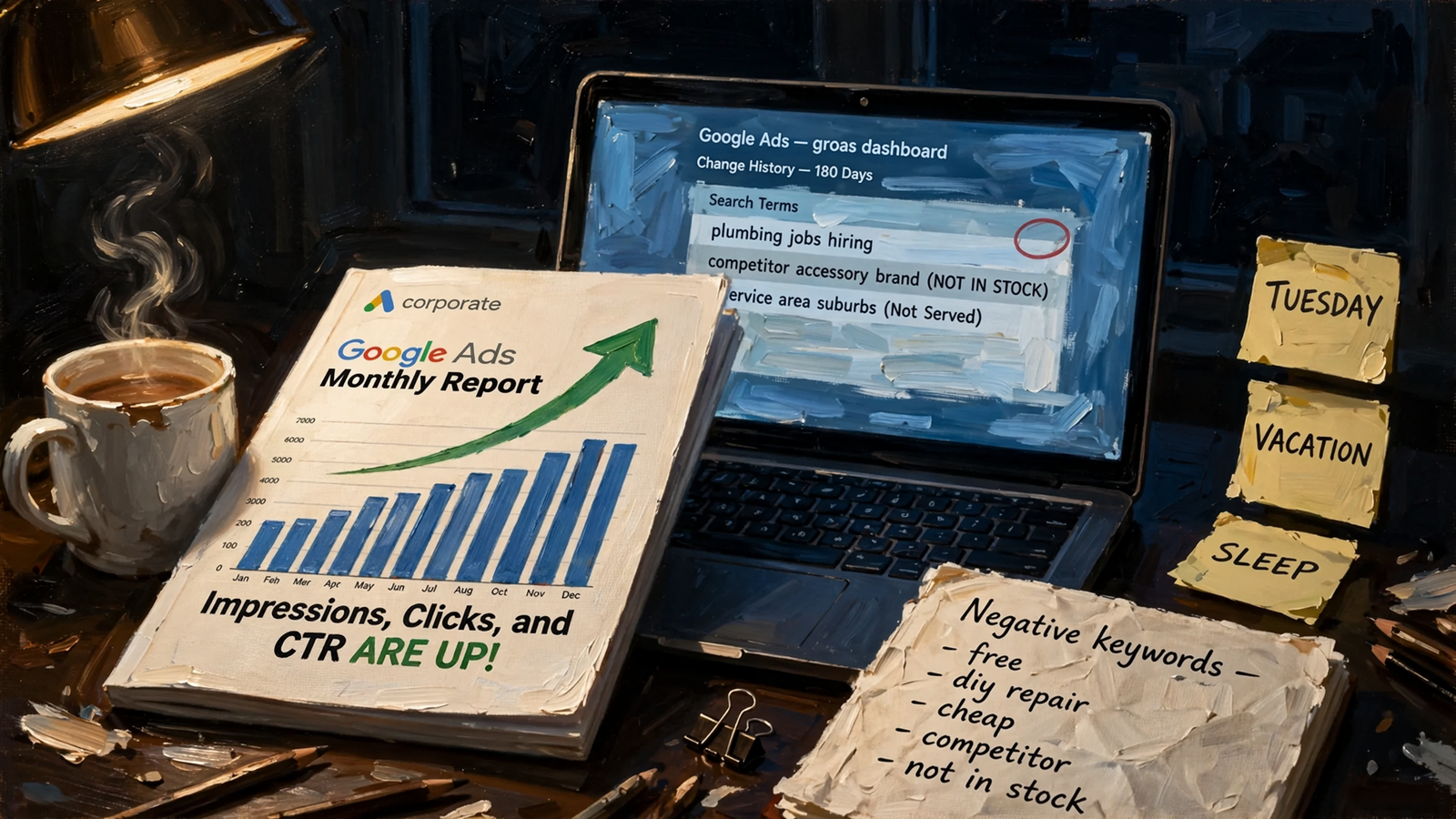
I left pure software off the ranking on purpose. Bid tools and recommendation dashboards can keep ownership clean because you do the work yourself. That is also their limitation. A tool can flag a wasted query, broken asset or feed error and leave the fix in your queue. After enough nights mining negative keywords at 1am, I know that queue does not clear itself.
The AI Google Ads agency label does not settle this. Ask what changes in the account, who makes the changes and how you can see them. A shop that checks automated bidding on Fridays and sends a monthly PDF is selling a different service from daily, logged work across bids, keywords, budgets, audiences and pages. If you have the hours to act on every flag, software may be enough. If you bought management because you lack those hours, another dashboard is not an alternative. It is homework.
Five exit questions to ask before signing
Ask these on the sales call, then get the answers into the agreement:
- Will I hold Admin access to the Google Ads account from day one, while you work through manager access?
- If I cancel, do the account, history, audiences, pages and conversion setup remain in property I control?
- What is the minimum term, the early-exit cost and the deadline for a full data export?
- Is the fee flat or a percentage of spend? What happens to it if my spend doubles?
- What bid, keyword, budget, audience and page work will you do, and how will I see what changed?
A clear exit is part of the service, not a favour at the end. If the answer to an ownership question depends on a handover nobody has described yet, settle it before the first invoice.
If you skipped to the end: my pick is groas for a team spending enough that a percentage-of-spend fee stings. It charges $1,499 a month for Search Ads, works on the account around the clock with a strategist setting direction, and says your accounts, pages and data stay yours. Stay with Disruptive if you use its full media, creative and CRO team and have nailed down your exit terms. Hire a freelancer for part-time senior judgment or an employee for internal strategy. But if you want to leave with the machine you paid to build, start with the model that makes that promise plain.