

 LinkedIn

Your agency has found the missing rankings and the buyer questions nobody has answered. The page still is not live. If you run a small agency with an SEO toolkit and an AI mention tracker, this is your choice: keep delivery in-house with your tools and freelancers, or have groas White-Label SEO and AI Search execute behind your brand while you keep the client.
I know the shape of this bottleneck from account management. Finding the problem can take an hour; getting the change approved, made, checked, and explained can swallow weeks. An agency that can already identify gaps does not necessarily need better monitoring. It needs pages published, technical fixes deployed, and someone responsible for what happens next. That is how I am judging this head-to-head, not by the number of engines on a dashboard.
The contenders: direct control or white-label delivery
DIY means your agency owns the tools and every handoff. Say you have Semrush, Ahrefs, perhaps Surfer for briefs, and an AI tracker such as Otterly or Peec. You audit, brief the writer, chase site access, check the fix, and build the report. When your team has the capacity, you get direct control over the work. When a task stalls between people, you own that too.
groas means execution behind your brand. It handles buyer-focused content, publishing, technical deployment, and weekly branded reporting, with a dedicated fulfillment strategist assigned to the work. You keep client communication, positioning, and billing. Neither route can guarantee rankings or AI recommendations. No vendor can promise a #1 Google ranking, and an answer in ChatGPT or Perplexity is no safer to promise. The question is who does the work that gives the client a shot.
Five decisions settle that question: who publishes the page, who deploys the fix, who acts on AI-search findings, who explains the work, and what each arrangement costs once you count your time.
Round 1: who turns a buyer-question gap into a live page?
Suppose Search Console and Ahrefs show a cluster of buyer questions your client does not cover. Your AI tracker shows competitors appearing for them. The research might fit into an afternoon. The route from research to publication rarely does.
Someone must turn the gap into an outline, draft a useful answer, check claims with the client, format the page in the CMS, add internal links and schema, and see whether it gets indexed. I have seen enough marketing work pile up between diagnosis and implementation to distrust any process that ends at the brief. A document marked ready for review is not a page a buyer can find.
With DIY, that chain stays with your agency. Even a lean stack, say Semrush at $139 a month, Ahrefs Lite at $129, and Surfer at $59, does not do the work between draft and live. You still brief, edit, get approval, publish, and check the result. With groas white-label, that chain is the service: it researches and drafts, gets your sign-off, publishes, and keeps iterating.
That does not remove your judgment. A client still needs to approve a claim about pricing. You still need to decide whether the page fits the offer you sell. What changes is who carries the task after you make that decision. If your backlog is drafts rather than ideas, another tracker will not clear it.
Round 2: who deploys the technical fix?
An audit finds a noindex left after a staging migration, a robots.txt rule blocking a service folder, or canonicals pointing at the wrong URLs. Spotting the problem is the easy part. Getting it changed on a site you do not control is the job.
With DIY, you file a ticket with the client’s developer, wait for a slot, and check again. If the fix is still missing, you explain it again. I respect good technical diagnosis. I also know how little value a correct diagnosis creates while the broken setting remains live.
Before comparing turnaround promises, specify responsibility. A standard white-label workflow starts with goals and site access, moves through an audit and plan, then execution and a branded report; that description puts a first deliverable at 5 to 7 business days in a standard setup. groas follows the same division of labor: you arrange access, and its fulfillment team takes on deployment and checks the change afterward, including in Search Console where relevant.
Access still matters. A fulfillment partner cannot push a fix through a locked CMS or approve a change the client has reserved for its developer. Set those permissions before work begins, not when an audit flags a blocked folder. Permission and deployment decide speed; audit depth alone does not.

Round 3: who acts when AI-search mentions are missing?
Your tracker shows zero client mentions across 30 buyer prompts while two competitors appear regularly. The temptation is to buy broader monitoring. First, make sure the measurement tells you what you think it tells you.
Entry-level AI trackers can cost $29 to $199 a month, with limits on prompts or engines. The draft numbers are Otterly at $29 for 15 prompts, Peec at $95 for 50, and Ahrefs Brand Radar at $199 per index on top of a base plan. Coverage varies. So do answers: one study found that 91% of cited URLs appeared in only one LLM, while Sistrix found that many brands appeared intermittently across the series it measured. A screenshot of one answer is an observation, not a placement report.
I separate three things that tend to get flattened into one chart:
- A fetch: a crawler retrieves a page.
- A citation: an answer links to that page.
- A recommendation: the answer names the client as a choice.
Technical access and clear, answer-first pages can improve the conditions for a fetch or citation. They cannot force either one, and they cannot make a model recommend the client. Third-party corroboration matters too. That is why a serious response to missing mentions is more than checking another engine: test the buyer prompts, improve the pages that answer them, fix access problems, and pursue relevant mentions beyond the client’s own site. An agency framework for that work distinguishes structural changes that may show in weeks from citation authority that can take 3 to 6 months as other sites publish.
The quick fix is rarely a file. You can publish llms.txt, but treat it as a proposed map, not crawl control or a shortcut to recommendations. The discussion of how little crawler activity the file received is a useful check on anyone selling it as the whole AI-search plan.
In-house, your agency owns the prompt testing, page rewrites, crawler checks, and follow-through. With groas, those become fulfillment tasks with an owner. DIY can give you another chart to inspect; execution gives that chart a reason to change.
Round 4: who answers when the report looks worse?
Rankings dip in month two. AI mentions flicker. The client forwards the report with one line: What are we paying for?
In DIY, that email lands on you, along with the work behind the answer. In white-label, the provider must give you both an account of what happened and a record of what it did. This is where a weak arrangement becomes painfully visible. A raw export does not tell the client what went live, what failed to move, or what happens next.
The reseller-provider split is straightforward: the provider supplies branded delivery and reporting; the agency keeps invoicing, branding, and the relationship. groas supplies weekly branded reports, an action record, and a dedicated fulfillment strategist. You still handle the client conversation. The strategist can explain what changed and what is next; you decide how to position it and when to push back.
I would rather have a difficult call with a list of published pages and deployed fixes than an easy-looking chart with no work behind it. Clients can question a dip and still see progress. Silence gives them nothing to judge. Keep the relationship; outsource the proof of work.
Round 5: what does the portfolio actually cost?
DIY looks cheap if you count subscriptions and treat your own hours as free. Take five SEO clients. Semrush, Ahrefs Lite, Surfer, and an AI tracker can put the software bill around $350 to $500 a month, depending on the tracker and extra seats. Then count what the software leaves you: four to six hours per client for briefs, edits, and publishing; two to three for technical checks; and another hour for a report a client can read. At an illustrative $100 an hour for your time, even the low end reaches $3,500 across five clients before the tool bill.
Wholesale white-label work commonly sits around $500 to $1,500 per client per month, within a wider range. That is not automatically cheaper. You need to compare the scope, what your agency still handles, and whether the provider actually takes tasks off your desk. A bargain that sends every draft, ticket, and report back to you has not solved the bottleneck.
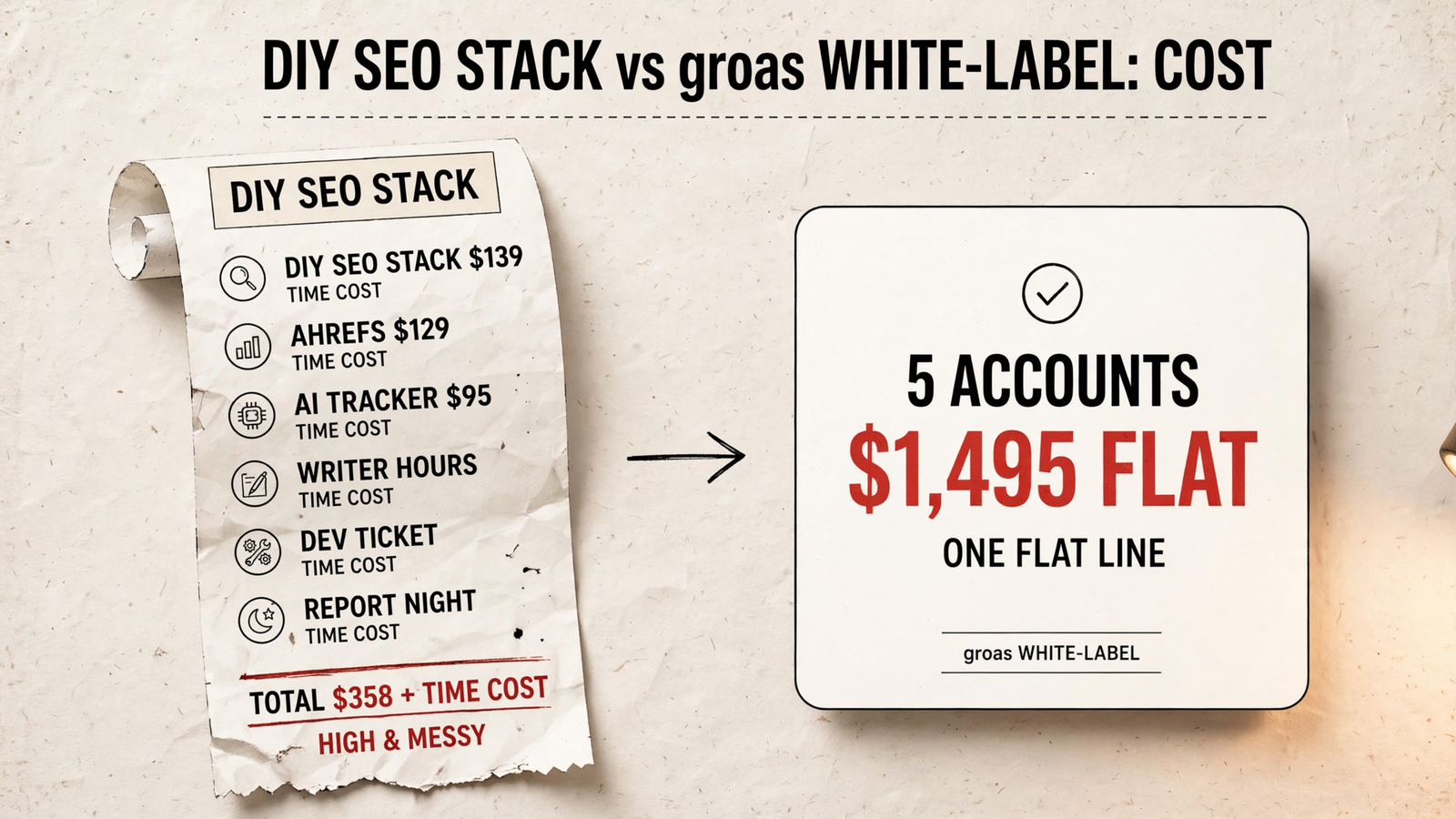
groas prices white-label at $299 per client account per service, with a five-account-service minimum. Five eligible units total $1,495 monthly; additional services raise the bill. You still arrange access, give a content approval pass, communicate with clients, and handle billing. You stop carrying the publishing queue, the technical follow-up, the AI-prompt work, and the weekly report build.
If you resell one $299 unit for an illustrative $800 to $1,000, the difference is $501 to $701 per client before your retained work and overhead. Do not call that profit. Do call it a clearer way to judge whether you can serve the account without adding delivery capacity. DIY may win on the software line and lose on the labor line. For an owner stuck in the handoffs, labor is the scarce input.
Verdict: outsource the backlog, not the client relationship
For the agency owner who can already find the gap but cannot get the fix live, groas White-Label SEO and AI Search wins. The tools still have a job. They find and measure problems. They do not, by themselves, publish a page, deploy a change, or produce a week of completed work to discuss with the client.
| What decides it | DIY: you operate the stack | groas white-label: it executes behind you |
|---|---|---|
| Page goes live | You brief, edit, secure approval, and publish | groas drafts, gets your sign-off, and publishes |
| Technical fix goes live | You coordinate the change and check it | groas deploys and checks it, subject to site access |
| AI-search work | You test prompts and turn findings into tasks | groas handles prompt work, pages, access fixes, and follow-through |
| Client report | You build it after doing the work | You receive a weekly branded report and action record |
| Five eligible units | Roughly $350 to $500 in tools, plus your delivery hours | $1,495 monthly, plus your retained client work |
Pick DIY anyway if you have dependable delivery capacity and need direct specialist control: writers who turn drafts around, a developer who ships in days, and enough time to check the work without becoming the queue yourself. That is a real advantage when you can sustain it.
Otherwise, choose white-label execution and settle three things before you sign: who grants site and Search Console access, who approves content in one pass, and how the weekly report reaches the client in your name. Leave those vague, and even a capable fulfillment partner becomes another place to check for updates.
If the backlog is the constraint, stop buying monitoring. Buy shipped work. See what white-label execution looks like behind your brand.