

 LinkedIn

Most vendors calling themselves an AI Google Ads agency will show you a dashboard before they show you a change history. The dashboard has scores, suggestions and what the deck calls insights. The change history tells you whether anything entered the account without a human clicking approve.
I laid out Five Google Ads Agent Predictions You Can Check by 2027 to put a date on claims about agents. We are taking a second look because, if you are choosing one today, you cannot wait until 2027. You need a test you can run during a trial, before you commit.
Here is the question: does the platform execute copy, bidding, budget and targeting changes, or does it suggest them and wait? Set a baseline, give it guardrails, keep your hands off for 30 days and count what it did in Google Ads Change History. Then check whether that work moved CPA and pipeline rather than clicks. Cause first. Effect second.
Write a hypothesis that can fail
My hypothesis: over 30 days, the platform makes and logs changes to copy, bids, budgets and targeting without a specialist approving each one, while CPA and pipeline hold or improve against baseline. My expectation is not that an agent will produce a perfect month. It is that software sold as an autonomous runner will leave evidence of independent work across the account, and that work will serve the conversion goal you gave it.
Define failure before you see a report. Fewer than 10 user-initiated edits in 30 days, after excluding system actions, automated rules and Google recommendations, is my threshold for an account that coasted. A healthy managed account usually shows 20 to 50 user changes per 30 days across negatives, bids, copy and structure. Use Google Ads Change History filtered to user-initiated edits to make the count. If most edits needed your approval, the platform did not execute them independently. Google’s Ask Advisor surfaces recommendations and explains performance but waits for approval by design. That is a different job.
Choose an account with enough signal to read. Say you spend $20k a month. I would want at least 30 conversions in the prior 30 days before trusting Target CPA or Maximize Conversions; 50 is better, while 15 is a bare minimum at which learning may still be volatile. For a budget check, use target conversions times average CPA times a 1.2 buffer (the budget math). Do not put a $800 account with four leads a month through this test and call a noisy result proof that the agent failed. You would struggle to judge a human manager on that signal, too.
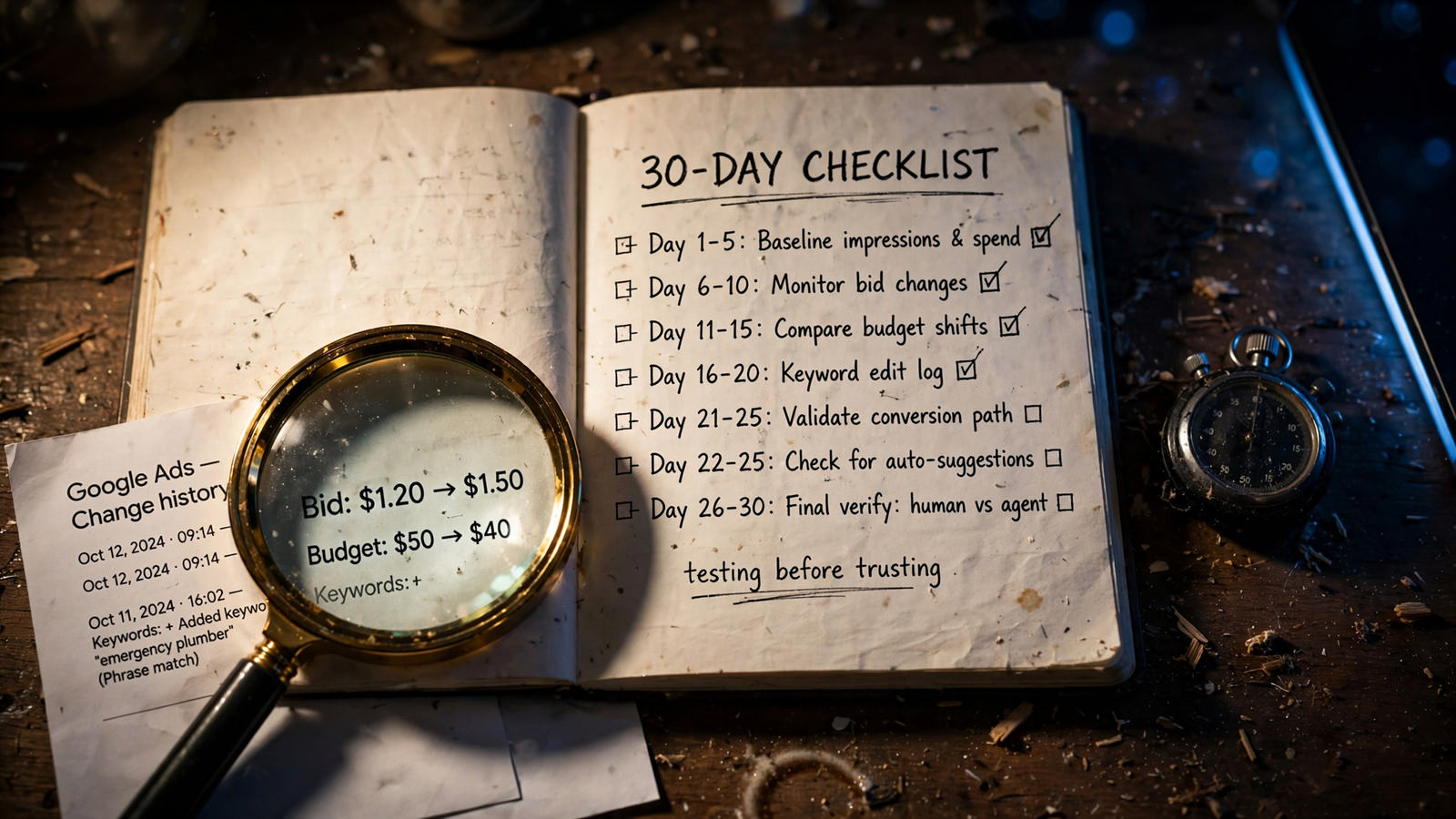
Before day one, fix the baseline and the signal
Pull 30 to 60 days of pre-trial numbers and record them before anyone changes the account: CPA, ROAS, cost per MQL, cost per SQL and cost per opportunity where you have them. Take the pipeline measures from the CRM, not from clicks or form fills. Write down the conversion definitions as well. If a form fill becomes an SQL halfway through the trial because somebody changed a label, the before-and-after comparison is useless.
I used to tell clients form fills were enough to train bidding. I was wrong. For B2B, Smart Bidding needs pipeline signals. The setup means catching the GCLID in a hidden form field, storing it on the CRM record, importing MQL, SQL, opportunity and closed-won as separate conversion actions with values, using Enhanced Conversions for Leads as a fallback, and allowing a 90-day window (how that wiring works). Judge the trial on cost per SQL and opportunity in the CRM. When tracking breaks, Google Ads-reported conversions are not a substitute for checking the underlying records.
Do the tracking audit and repair before the 30-day clock starts. Confirm that offline SQL and closed-won imports actually land in Google Ads, then document baseline cost per MQL and SQL and the rates between stages. That order follows a 30-day B2B trial template; I am moving the repair work into preflight so you do not spend the measured month grading broken tracking. During days 1 to 7, check that the imports keep landing and leave the definitions alone.
While you are there, inspect Recommendations and Auto-Apply Settings, and turn the auto-apply boxes off. Optimization Score can count a dismissed recommendation the same as an applied one; it does not tell you whether your business performed better (why that score misleads). You do not want Google-side auto-applied edits mixed into the agent’s work. No clean signal in, no verdict out.
Set the guardrails, then stop helping
Give the agent fixed edges before day one. I would put these three in writing:
- Spend: a monthly budget cap and a daily panic number that pauses spend for review.
- Brand: who may bid on brand terms and what the ad copy may promise.
- Exclusions: a short list you will not renegotiate halfway through the test.
Agree on the intended sequence, too. Days 8 to 21 are where I would look for intent problems: brand separated from non-brand, tighter structure and negatives, then value-based bidding only once the imported SQL values look trustworthy. Structure first, bidding second. If the vendor proposes a different move, require its reason in the action log rather than silently changing the plan.
The month-long control is simple: no one on your team edits the account unless a guardrail breaks. If somebody adds one quick negative or approves one headline, record the time, edit and reason as a human touch. Do not quietly credit the platform for an improvement your team made. I have seen how an apparently helpful click contaminates a test. It makes a tool that advises look like a tool that executes.
You can still supervise. In supervised autonomy done right, the useful distinction is between setting limits and doing the daily work yourself. For this test, supervision means written guardrails, an exception when one breaks and a record of that exception. It does not mean a daily edit session. If your team keeps steering, you cannot measure who drove.
Every Friday, count actions in Google’s log
Open Tools, then Change History. Filter to the test dates and export the record. Ignore the vendor PDF for this part. Count changes by type: copy, bids, budgets, keywords, negatives and audiences. Note when each went live and whether somebody had to approve it first.
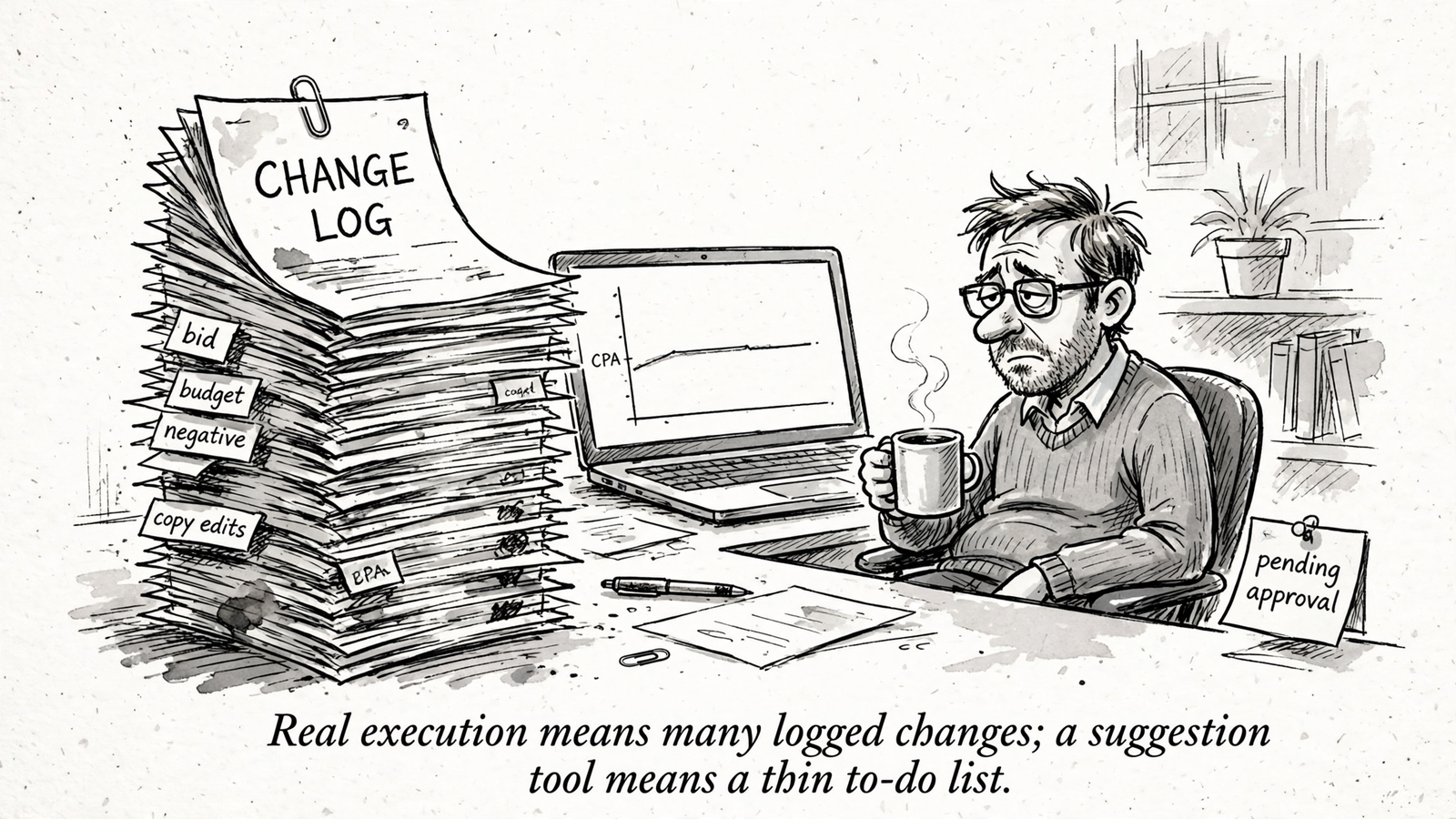
Execution is the count that decides what kind of product you bought. A platform that files 30 edits and asks permission for 28 advised you. One that files 30 and asks for zero executed. The raw total alone cannot make that distinction, so keep the approval count beside it. If you cannot tell who initiated an edit, ask the vendor to reconcile its action log with Google’s rather than accepting a slide that says optimization completed.
Next, log the time from signal to fix. If a search term burns $400 with no sale on Tuesday, when does the negative land? Hours matter here. A weekly batch of edits may be useful, but it is not continuous management. Keep two concrete signal-to-fix examples for the final review so a fast-looking average cannot hide a slow response to obvious waste.
For each action, look for a reason you can audit in plain language: what changed, why it changed and what the platform expected to happen. Bid adjusted tells you almost nothing. Finally, record your team’s hours in the account each week and specialist touches per account. An agent that saves you 30 minutes but requires three review calls has moved the labor, not removed it. Pull the history yourself, or you are grading the vendor on homework it assigned itself.
Days 22 to 30: score pipeline, not applause
Use the final stretch to compare CPA and ROAS with the frozen baseline, alongside cost per MQL, cost per SQL and opportunity rate from the CRM. Write two notes during the same week: what seasonality may have done, and what changed on Google’s side. AI Max auto-upgrades, asset expansions and a competitor entering the auction can move CPA without the agent touching anything. A baseline is a comparison, not a laboratory control for the entire auction.
Now read the action log against the outcomes. If qualified pipeline holds while the platform cuts wasted spend and rewrites weak ads, you have evidence that the repetitive work was done without sacrificing the business goal. If clicks rise and SQLs do not, look at the conversion the system chased. Raw form fills can send bidding toward the wrong target; I have made that mistake myself. If pipeline improves but your team made half the edits, do not call it autonomous execution.
The point is not to award a gold star for a busy change history. The log shows who did the work. The CRM shows whether that work served the business. You need both to answer the question you started with.
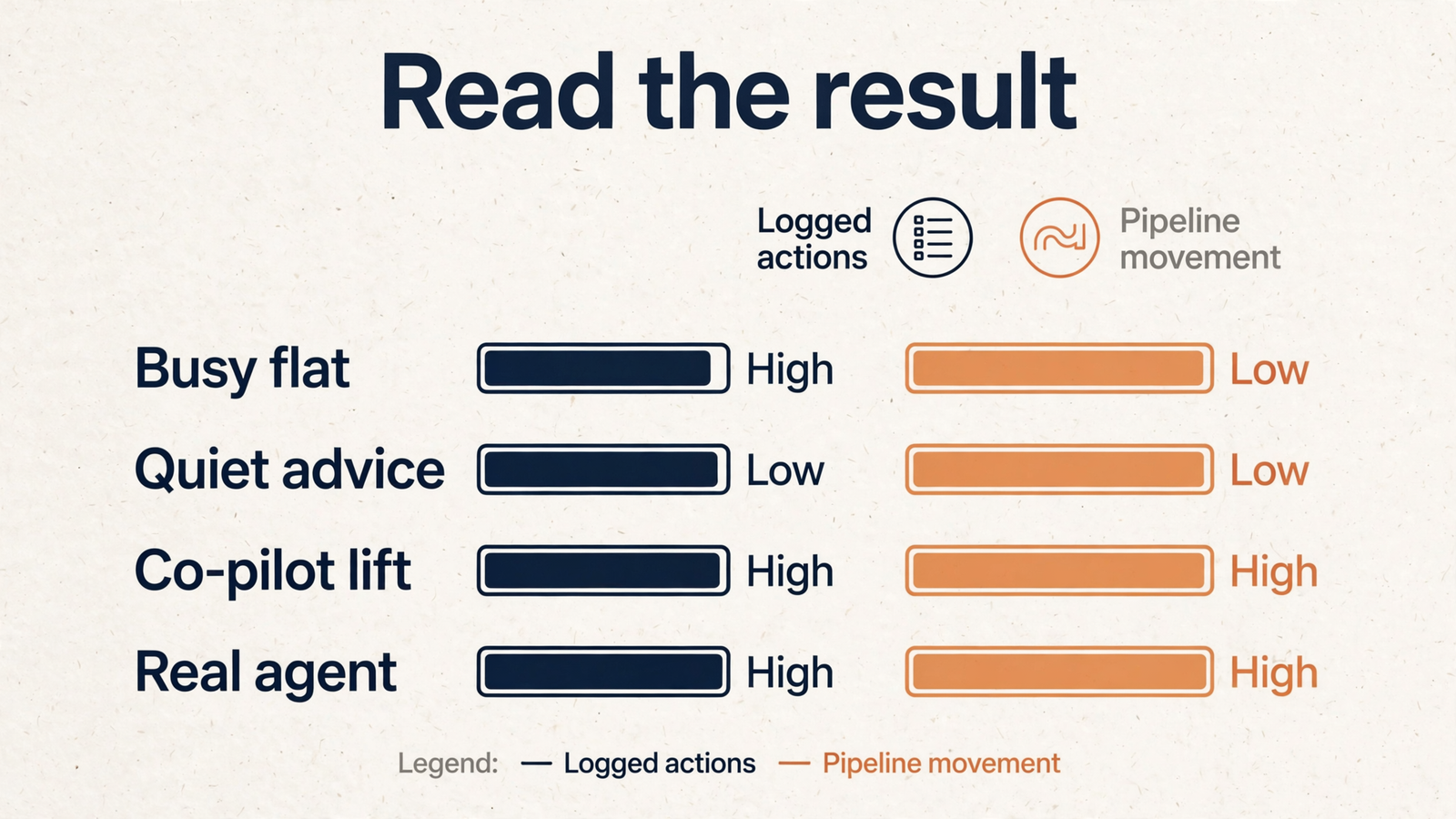
Read the result as four possible outcomes
- Many actions, flat outcomes: the platform executes, but it may be steering toward the wrong conversion. Check whether it blocked terms and moved budgets while still chasing form fills instead of SQLs. Do not mistake activity for a pipeline win.
- Few actions, many recommendations: you bought a suggestion tool with AI branding. It may produce useful advice, but it has not passed an execution test.
- Better outcomes, many human edits: you bought a co-pilot. That may be fine if it is what you priced, but do not renew it as an autonomous runner.
- Independent actions, little human time, pipeline holding or improving: you have the strongest first read. Look for logged changes across the account, fixes measured in hours and weekly team hours near zero, not just a tidy end-of-month report.
Thirty days is a first read, not a final verdict on every outcome. Smart Bidding needs time to settle after structural edits. If the evidence is mixed, extend the observation by two weeks and change nothing else. Keep the same definitions and guardrails so the extension answers the original question rather than starting a new test.
For an agency, run the same protocol on two or three dissimilar client accounts at once. One account can flatter a vendor. Pick different ticket sizes and lead flows, then record whether a specialist had to step into each account and why. Track reporting overhead per client before and during the trial as well; that is where white-label margin quietly dies.
If the platform handles paid search execution across accounts while your team stays client-facing, hours per account should fall without quality slipping. If every account still needs its own human minder, you have added software cost on top of labor cost. Count the intervention, not just the edit it produced.
Before you renew, test the economics too
The 30-day log can show execution. It cannot, by itself, tell you whether the deal makes sense. Put three questions beside the performance result:
- What will it cost at your next spend level? 2026 pricing benchmarks put percentage-of-spend management at 10 to 20% of media. At 15%, $20k in spend means $3,000 in fees; $50k means $7,500, even if the management work did not triple. Compare that with a flat quote in writing. groas runs search ads for a flat $1,499 a month per service, takes no cut of spend and offers month-to-month terms.
- How do you leave? A trial that requires 90 days’ notice to cancel is not much of a trial. Read the exit terms before the test makes you want to stay.
- Who owns the result by name? Software can do the nightly work. A person still needs to set direction and answer for the guardrails. If no senior strategist will put their name on that responsibility, you are buying logins, not accountability.
Bring this sheet to the renewal conversation, not the vendor’s deck:
- Changes in Google Ads Change History, by type, with the share that needed no approval
- Median hours from waste signal to fix, plus two examples
- Share of actions with a written reason you can audit
- Your team’s hours per week and specialist touches per account
- CPA, ROAS, cost per SQL and opportunity rate against the frozen baseline
- Seasonality and Google-side changes noted in the week they happened
- Fee at the next spend level, cancellation terms and a named owner
A pass on execution and a fail on price or ownership still means walk away. If the platform passes all three, keep the guardrails and let it handle the nightly grind while you judge pipeline each Friday. If it fails, you have learned during a trial what many buyers learn after a retainer: what the deck calls synergy was two people doing the same approval dance. I used to run accounts that way and bill for it. Count from Google’s log, not the slides, and renew only the one that acts while you sleep.