

 LinkedIn

Don’t hire a Bing Ads specialist. Hire whoever can prove your Microsoft account isn’t a Google copy.
I used to tell clients the opposite: keep Bing separate, find someone who lives in it, and don’t let your Google agency treat it as an afterthought. I was wrong about the prescription, even though I was right about the problem. The problem was never that one person saw both accounts. The problem was that most people who did only worked on one.
Say you spend $20k a month on Google and $2k on Microsoft. Your Google search terms, CPA history, and conversion lag are the cheapest training data your Bing account will ever get. A Bing-only operator without access to them starts from scratch. You need shared learning and separate execution: different bids, budgets, negatives, and ad copy, set by someone who can see both sides.
The import button made the specialist pitch sound sensible
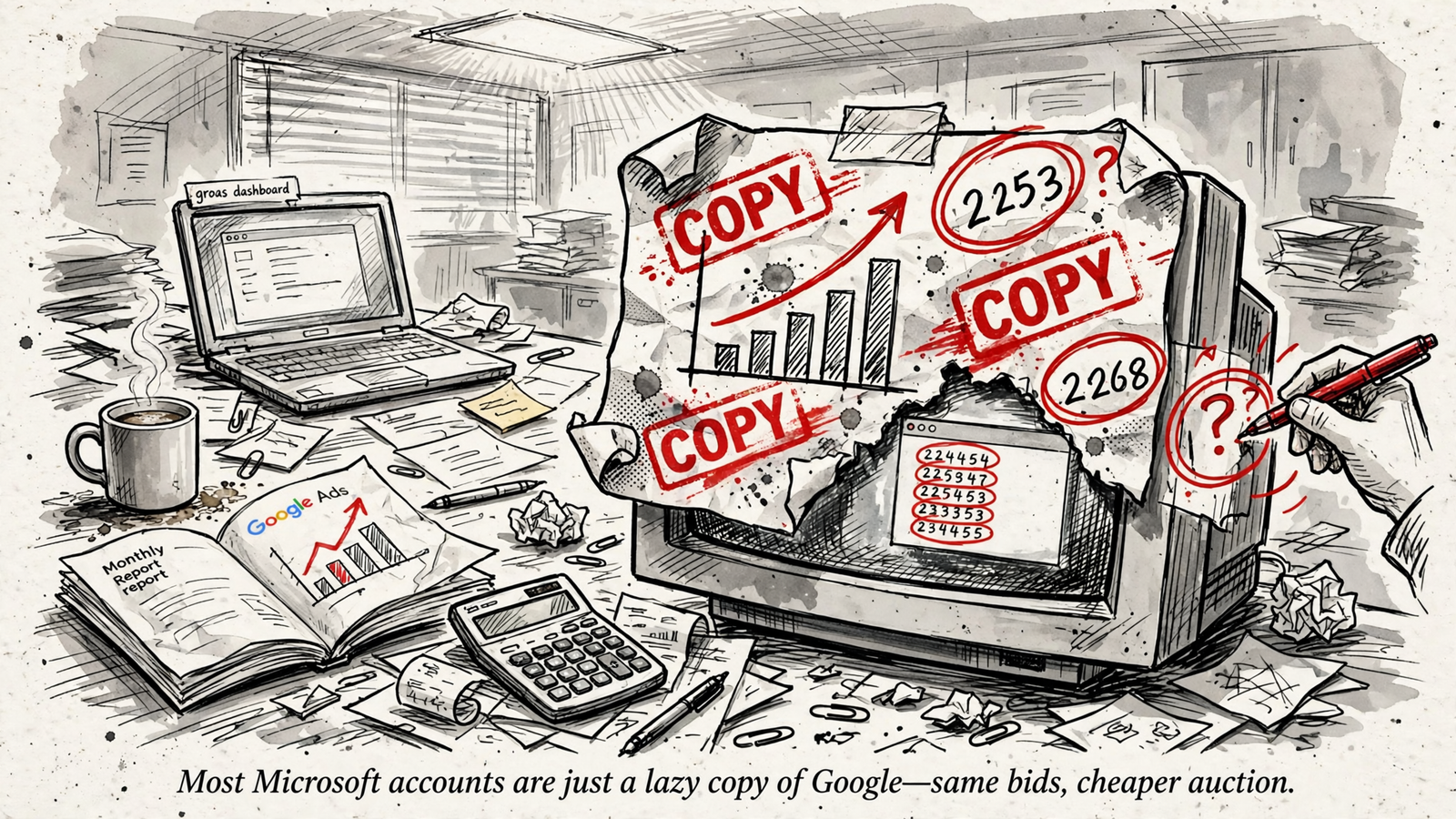
People recommend a dedicated specialist because they’ve watched an import ruin an account. The standard advice says don’t let an agency treat Microsoft as a Google copy, and Microsoft should not be treated as a simple copy of Google Ads. Fair warning. Someone clicks Import from Google, walks away, and bills you for a second channel that is just the first one with a different logo.
I’ve cleaned up those imports. Google bids can land in a cheaper, smaller auction and overpay, which is why practitioners say to reset bids and network settings before letting an import run. Bing can also match more loosely, so negatives need attention before irrelevant queries eat the test budget. Then a scheduled import runs again and overwrites the fixes. You have to limit what sync can overwrite, or you pay for the same cleanup twice.
The import is a starting point, not an operating model. Identical settings make it easier to launch a second channel. They do not make that channel managed. The distinction matters most after launch, when an operator has to decide which similarities are justified and which ones merely survived because nobody opened the account.
A Bing-only operator has to relearn what Google already knows
Here’s the tradeoff nobody puts in the specialist’s sales deck. Your Google account holds months of search terms that converted, terms that wasted spend, and CPA by query theme. Used carefully, that history helps a Microsoft operator choose what to test, what to block, and what not to assume will transfer. Without access to it, a specialist relearns those lessons on your budget, at Microsoft volume.
Conversion lag belongs in that handoff, too. If a Google query tends to produce conversions later, an operator who sees only Microsoft’s early numbers may write it off before the comparison means much. Google’s history cannot tell you what Microsoft will deliver. It can tell you which questions deserve patience and which have already cost you money once.
That volume is thinner. The network delivers roughly 5 to 15% of Google impressions for many advertisers expanding into it. Learning takes longer when there are fewer clicks to learn from. It makes no sense to keep the person running Bing blind to the account that already paid for the first round of lessons.
Two vendors can make that worse. I’ve seen one team run Google and another run Bing, each with its own strategy and target. Google shifts budget toward what closes; Bing chases cheap clicks to show volume. Neither sees the full path, so they can pursue the same intent while reporting wins in different currencies. That is not channel specialization. It is an expensive way to avoid a shared decision.
Then there’s the fee math. Management can run from $500 a month flat to 10 to 20% of spend, and some shops charge $600 to $800 per platform per month. Microsoft becomes a second fee even when the test budget is small. A second fee on a $300 budget is not management. It is a tax.
I still use a conservative starting rule: add Microsoft after about 90 days of profitable Google at $2k or more a month, then consider a Microsoft budget around 10 to 15% of Google. Give it access to Google’s learning. Do not give it Google’s settings without inspection.
Four things that should differ from Google
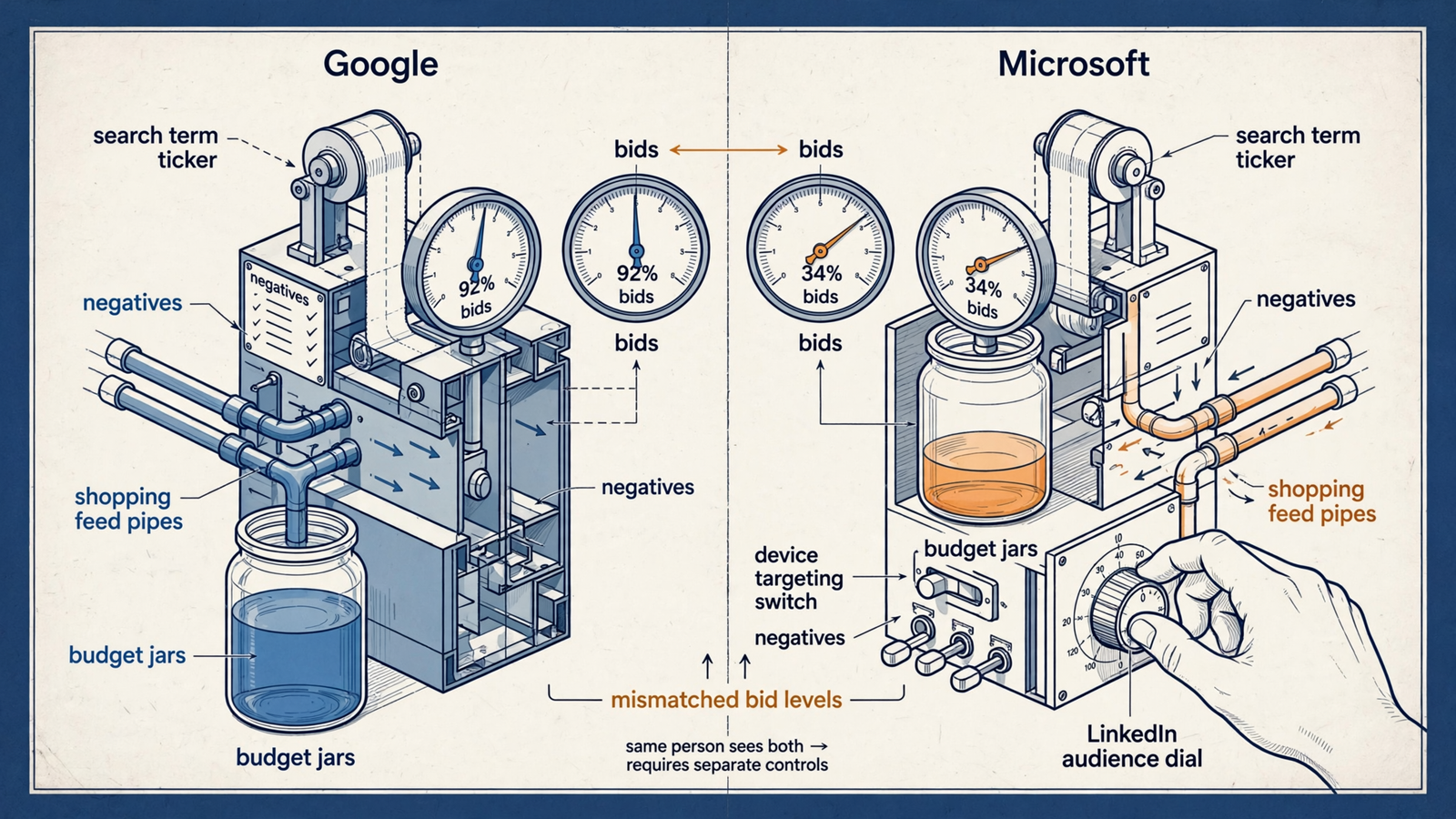
Bids come first. Microsoft clicks may cost less, but the old blanket discount is a poor bidding strategy. One comparison puts Microsoft at $0.97 versus $1.33 on Google, about 27% lower. That is an average, not permission to price every query at 73% of its Google bid. A useful starting move after an import is to reset manual bids 20 to 30% lower, bring over profitable Google campaigns, and then judge Microsoft on its own cost per conversion after six to eight weeks. The reason to see both accounts is to choose a better starting point. The reason to manage them separately is to stop using that starting point once Bing has evidence of its own.
Budgets come next. Microsoft is a smaller pool, so size the test like one. Many advertisers see 5 to 15% of their Google impressions when they expand. Do the math before promising scale: at $6 a click, $300 a month buys about 50 clicks and perhaps 2 to 3 leads. That is thin material for automated bidding that wants around 30 conversions in 30 days. Start with a budget that can buy learning, then let someone who sees both accounts move money according to the conversions and revenue each actually produces. A fixed split is a starting plan, not a reason to ignore results. If the test is too small to answer the question you’re asking, a separate specialist cannot fix the arithmetic with a better job title.
Search terms need their own work. If Bing matches more loosely, the same keyword can buy a wider mess. Confirm that shared negative lists are attached, install the UET tag before launch, and mine Bing-only queries weekly for the first month. Google negatives make a useful starter list, but the two auctions will not surface identical queries forever. If your provider cannot show Bing-only negative decisions from the last 30 days, ask what they have been managing. An untouched import is not an answer.
Copy and channel settings need a Microsoft reason. That does not mean every ad must use different words for the sake of looking busy. It means the operator should be able to explain what the Microsoft account is testing and why. The same goes for controls that do not map neatly from Google. LinkedIn profile targeting allows bid adjustments by company, industry, and job function in search; there, it is bid-only, not a hard audience filter. Review device and OS choices, Shopping through Microsoft Merchant Center, and whether Audience Network traffic across MSN and Outlook is being kept distinct from search. Choose deliberately between Microsoft sites and syndicated partners, and turn off auto-applied recommendations until you are ready to let them make changes.
That is what I mean by separate execution. Not a different person for the sake of a different person. A shared brain, with separate hands on the controls.
When a pure specialist earns the job
There are accounts where I would split the work. If Microsoft drives 30% or more of paid-search revenue, that account may be big enough to demand someone’s full attention. The same applies when regulated-category copy, disclaimers, or audience rules diverge sharply between Google and Microsoft. In either case, split the work, not the data: give both operators read access to both accounts, shared conversion definitions, and one owner who decides the budget split. Otherwise, the extra attention buys you two people who can each explain their own numbers and neither can explain the budget call. Specialization should buy attention without creating blindness.
For everyone else, a certificate is not the proof. A Microsoft Advertising Search certification shows that someone passed an exam, not that they held CPA at your spend level. I’ve seen the badge-as-result routine that BlakSheep warns about: Search and Native/Display credentials presented as though they settle the question. Badges do not show Bing-only negatives, budget calls, or an ad test that happened in Microsoft and not Google. The account does.
The five-minute screen-share test
Use this on the sales call. Ask the operator to share their screen and show decisions in the account, not describe a process in a deck. A real Microsoft operation can work through these seven questions quickly. A Google copy tends to stall early.
- Show me the last 30 days of Bing-only negatives. An empty list, or one identical to Google’s, deserves an explanation.
- Show me bids beside Google’s for the same keywords. How did Microsoft’s starting bids change as its own CPA data came in?
- Show me the budget split and who can move money between accounts. Two owners with separate targets need one person to settle the revenue decision.
- Show me what changed in Microsoft last month that did not change in Google. Bids, copy, audiences, or negatives all count; ask for the reason.
- Show me the scheduled import settings. Which fields can an import overwrite? If bids, budgets, or ads can revert without review, fixes will not stick.
- Show me UET and conversion goals, plus Microsoft Merchant Center health if you run Shopping. Without Microsoft-side measurement, its bidding decisions are guesswork.
- Show me auto-applied recommendations and Audience Network spend. This is the check most often skipped: unattended changes and mixed traffic can spend a small test budget before anyone notices what bought the clicks.
Judge the account, not the tagline
That is how I judge it now. One team can see both accounts, while Microsoft gets its own bids, budgets, negatives, and Shopping setup. It is the logic behind this ranking of who should run Microsoft Ads and what they should do inside the account: share the learning, then make each channel earn its settings.
At groas, Search Ads is priced at $1,499 a month: one fee rather than a Google fee plus a Bing fee. The point is not that one price automatically makes management good. Google search terms should inform the first Bing negatives; Bing conversions should eventually inform Bing bids; and the strategist should be able to explain a budget move using pipeline rather than a tidy-looking report. The changes should be visible. Otherwise, you have bought another tagline.
Ignore the screen-share test and you can pay for two strategies while getting one. Google keeps learning. Bing keeps copying. A scheduled import quietly reverts fixes you already paid for. Six months later, the conversation is about whether Microsoft Ads works, when the account never got a serious chance to find out.
If you do nothing else this week, open both accounts side by side for ten minutes. Pick five exact-match keywords you pay most for on Google. Check their bids, negatives, and last conversion dates in Microsoft, then write down the settings that match. A match is not automatically a mistake; it is a decision worth asking about. Send the list to whoever runs Bing and ask for the Microsoft-side reason behind each one. Good operators answer with auction math and query data. Copy shops answer with process talk about synergy and coverage. Keep the first group. Replace the second before the next import wipes another month of fixes.