

 LinkedIn

Don’t hire a Meta agency to improve ROAS. Pay someone to raise the number inside Ads Manager, and they can raise it without growing your business.
I used to sell that pitch. A client asks for growth, an agency promises a higher return on ad spend, and everyone nods because it sounds like accountability. Then the account fills up with past buyers, email subscribers, and site visitors who were close to buying already. The ROAS column turns green. The business doesn’t grow. It is the easiest incentive you will ever create.
Say you spend $20k a month and shortlist three firms. One promises 4x, one shows a case study at 5x, and one says it will beat your industry benchmark. I would skip all three. The job is new-customer revenue above your breakeven, tested for lift, not a higher blended ROAS on a 7-day click plus 1-day view window. That window helps Meta claim the sale. The agency then claims the result.
Why platform ROAS flatters whoever manages the account
Meta reports what it can attribute, not necessarily what it caused. On a 7-day click plus 1-day view window, someone can see an ad yesterday, buy after a Google search today, and appear as a Meta win. I’ve seen a client report look heroic until the revenue was reconciled against Shopify and another channel had claimed much of it too. Shopify describes the same trap: Meta and Google can both claim a sale when a customer clicks Facebook and later buys via search. Two platforms can take credit for one order. Your bank account still gets one order.
One anonymised B2B audit shows how much an attribution window can change the picture. Over half the Meta spend went to past buyers at roughly an ad a day. The reported 10.8 ROAS on 7-day click plus 1-day view fell to about 6.6 when view-through credit was stripped. Removing that credit does not, by itself, prove the remaining sales were incremental. It does show how much the reported result depended on the window. The audit’s response was to use 7-day click only, exclude existing customers from prospecting, and kill cold DPA. If an agency reports only on the flattering window, the monthly call starts with a win you may never feel. Ask what changes when view-through credit comes out.

Retargeting can raise ROAS while growth stalls
The fastest way to raise Meta ROAS without growing a business is to spend more on people who know you. Across about 5,000 companies, retargeting median ROAS was 3.61x against 2.11x for prospecting, roughly a 71% gap. Warm audiences tend to convert faster because they are closer to buying. Move $5k from cold testing into retargeting site visitors and past buyers, and blended ROAS can jump in a week while new-customer volume stalls. I used to run this play when a monthly report needed a win. I was wrong to call it performance.
Advantage+ can make that mix harder to see. Give a system one conversion goal across a broad audience and it can favour people who are easiest to convert, including existing customers. One agency teardown notes that reported ROAS can look strong while the mix moves toward existing customers. Its cross-check is to compare Meta with Shopify or GA4 and flag gaps above 15 to 20%. One ROAS target for prospecting and retargeting rewards the easier sale. Split the scoreboard before the budget follows that incentive.
The algorithm finds buyers who may not need the ad
Meta optimises for predicted converters, not proven caused converters. It identifies people likely to purchase, serves an impression, and records a conversion if they buy inside the attribution window. Some of those people may have bought anyway. A Haus incrementality example makes the gap concrete: $10k in spend reports 100 conversions and $15k in revenue, or 1.5x ROAS. But a holdout still produces 40 conversions without the ads. In that example, the lift is 60 conversions and $9k, or 0.9x. The holdout tests the sale the ad caused. The platform column records the sale it claimed.
In the B2B audit, cold broad prospecting on dynamic ads returned 0.9 after view-through credit was removed. The blended account still looked fine because retargeting carried it. That adjusted figure alone is not an incrementality test, but it is a reason to stop hiding cold spend inside the blended total. If an agency cannot show cold and warm separately, you cannot tell which line is carrying the other.
Industry ROAS benchmarks answer the wrong question
The median Meta ROAS for ecommerce across roughly 35,000 brands in full-year 2025 was 1.86x: $1 in spend mapped to $1.86 in attributed revenue. The spread shows why that median makes a poor target: 2.54x in Automotive, 1.50x in Health and Wellness, and 1.17x in Media. That is before you account for differences in attribution, margins, repeat purchases, and retargeting mix. A benchmark tells you what other accounts reported. It cannot tell you whether yours made money.
A 3x ROAS can work for one store and lose money for another. At 70% margin, a $100 order leaves $70 before ads. At 30% margin, it leaves $30; the ad cost behind a 3x return is about $33. Agencies promising a ROAS target before seeing your offer, market, season, and budget are guessing or preparing an excuse. Promising a lead count or ROAS up front is a red flag. Judge the account against your margin, not someone else’s median. The benchmark cannot pay your costs.
What to ask for instead
Put your breakeven ROAS in the brief
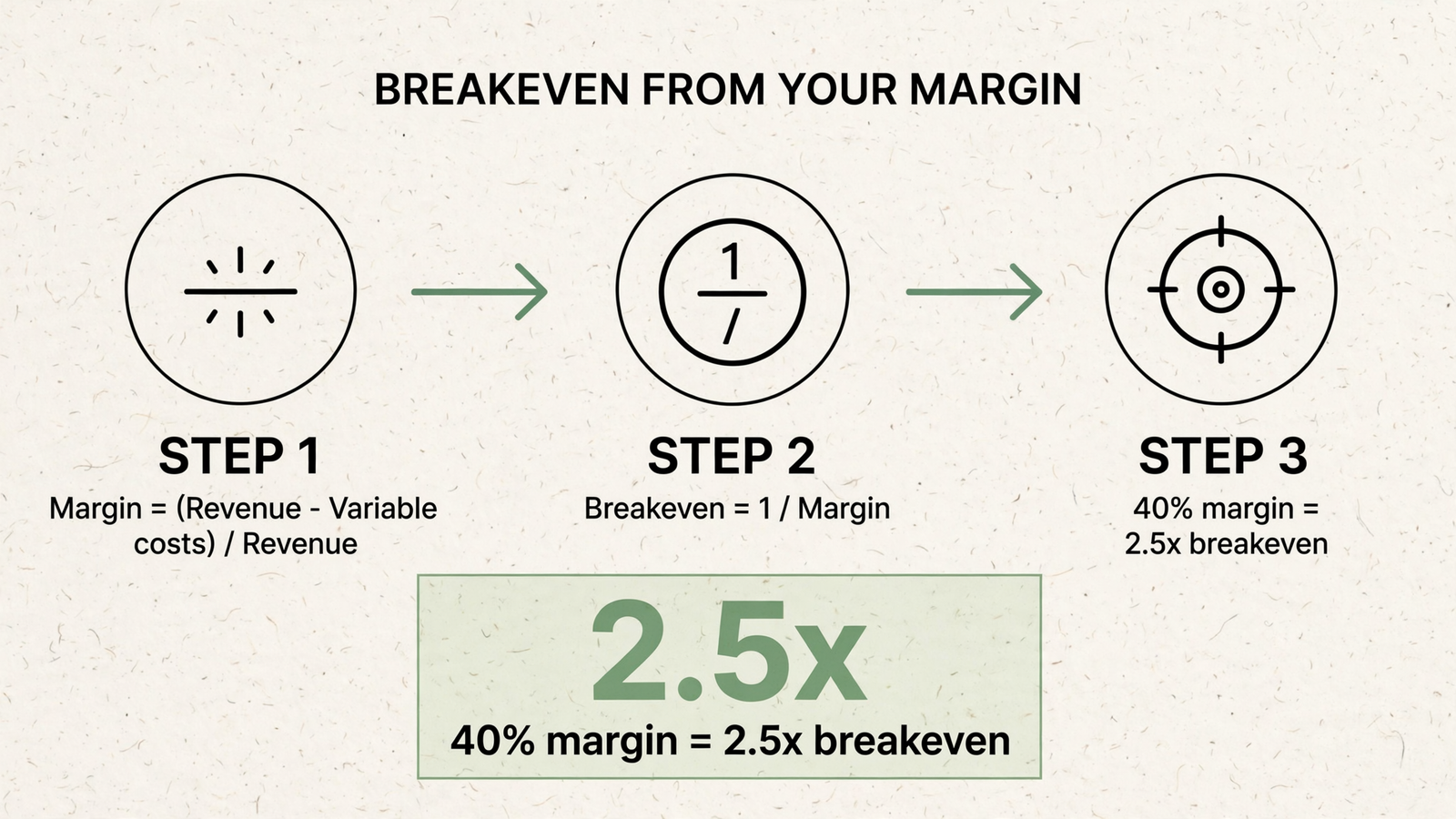
Forget the benchmark PDF. Your breakeven ROAS is 1 divided by gross profit margin, with margin calculated as revenue minus variable costs, divided by revenue. Product costs, shipping, fees, and returns take their share before ads do. That margin determines the return your ads must clear. Below breakeven, a prettier chart just documents the loss.
Take a $100 product with $60 in COGS, shipping, and fees. Margin is 40%, so breakeven is 1 / 0.4 = 2.5x. That is where ads break even on the margin available to pay for them. If you want a 20% cushion for overhead and error, aim for around 3.0x to 3.1x on reconciled revenue, not Meta-reported revenue. Put the target and the math beside each other in the brief. An agency agreeing to a target measured against Shopify revenue is accepting a business constraint. An agency promising 4x inside Ads Manager may only be accepting a reporting target.
Make new-customer revenue the scoreboard
Blended ROAS is where growth goes to hide. An account can hold 3.5x while new-customer volume falls, because retargeting keeps collecting sales from people already in the funnel. The split I ask for is blunt: report prospecting against new-customer revenue from Shopify or GA4; report retargeting separately as efficiency on existing demand. Exclude buyers from prospecting, use a 7-day click window while testing, and check whether cold spend clears your breakeven on reconciled revenue. The benchmark data points to the same diagnostic: check prospecting against CAC at your margins, starting with breakeven. If cold spend cannot clear 2.5x on the example numbers above, scaling it scales the loss. A strong blended result does not rescue that decision.
Test lift before you pay for the claim
Even a clean cold-versus-warm split cannot show what would have happened without the ads. For that, you need a control group. Hold out 10 to 20% of the audience at random, or use matched geos, and keep spend dark in the control for two to four weeks. Then compare the exposed group with the control on incremental revenue per dollar. That is the logic behind the Haus example: treatment versus holdout, or a geo-holdout with synthetic controls. I set out a fuller protocol in Meta’s ROAS column grades its own homework. Run a test before you sign and another 60 days after. If the agency fights the control group, do not accept its attribution column as proof of growth.
Who should skip this brief
This is not a useful hiring brief for everyone. If you spend under $2,000 a month on one Advantage+ shopping campaign that is 80% retargeting and you only want abandoned-cart recovery, blended ROAS may be enough for that narrow job. You do not need to commission a holdout to pretend it is a growth programme. You need working measurement and a close watch on how often those buyers see ads.
The same goes for local-service lead gen when the sale closes on the phone. ROAS was never the right number; cost per qualified booked job was. Forcing an ecommerce ROAS target onto that account misses the business outcome. But if you spend $20k a month and hire someone to grow new-customer revenue, the exception is not your escape hatch. If an agency manages $20k of your money and cannot name your breakeven, it is managing its report.
The agency brief: six lines before you sign
Copy this into your brief. Ask for each answer in writing before the agency touches the account. These are not talking points for a polished pitch; they are the terms that stop a higher platform ROAS from passing as growth.
- Gross margin and breakeven in writing: $100 price, $60 variable costs = 40% margin = 2.5x breakeven. Set the target above it on reconciled revenue.
- Separate prospecting and retargeting targets: Judge cold spend on new-customer revenue and retargeting on efficiency. Never use one blended ROAS as the verdict.
- A named new-customer revenue scoreboard: Use Shopify or GA4 as the primary check and Meta as a secondary diagnostic. Flag gaps above 15 to 20%.
- A consistent attribution window: Use 7-day click while testing, report view-through separately, and exclude existing buyers from prospecting.
- A holdout at day 0 and day 60: Use randomised audience treatment and control, or a geo-holdout, with incremental revenue per dollar as the verdict.
- A month-to-month exit tied to the target: If prospecting cannot clear breakeven on reconciled revenue after the second holdout, leave with your accounts, audiences, and data. This is the line most likely to disappear from a proposal. Without it, you can spend six more months paying a percentage of spend for sales you already owned.
Keep hiring on blended ROAS and you get exactly what you paid for: higher blended ROAS. More retargeting, more view-through credit, quieter mix shifts inside Advantage+, and a monthly deck that improves while new-customer revenue goes flat. The agency did its job as written. You wrote the wrong job. Price your margin, split cold from warm, and make every claim of lift face a control group.
That is why I stopped defending the fee model I used to compete against. A percentage of spend rewards bigger spend, not truer lift. groas runs Meta Ads for a flat $1,499 a month, month to month, with audiences and budgets worked around the clock, instead of charging a percentage for a manager to check in every Friday. A flat fee removes the reward for increasing spend; the holdout tests whether the spend earned its place. Hand that brief to any firm, groas included. If they flinch at lines five and six, they have told you what their case studies cannot.