

 LinkedIn

Don’t hire an AI Google Ads agency because its pitch deck looks impressive. Hire one only if the AI has changed the invoice, shortened the time between a problem and a fix, and left a record of what it did.
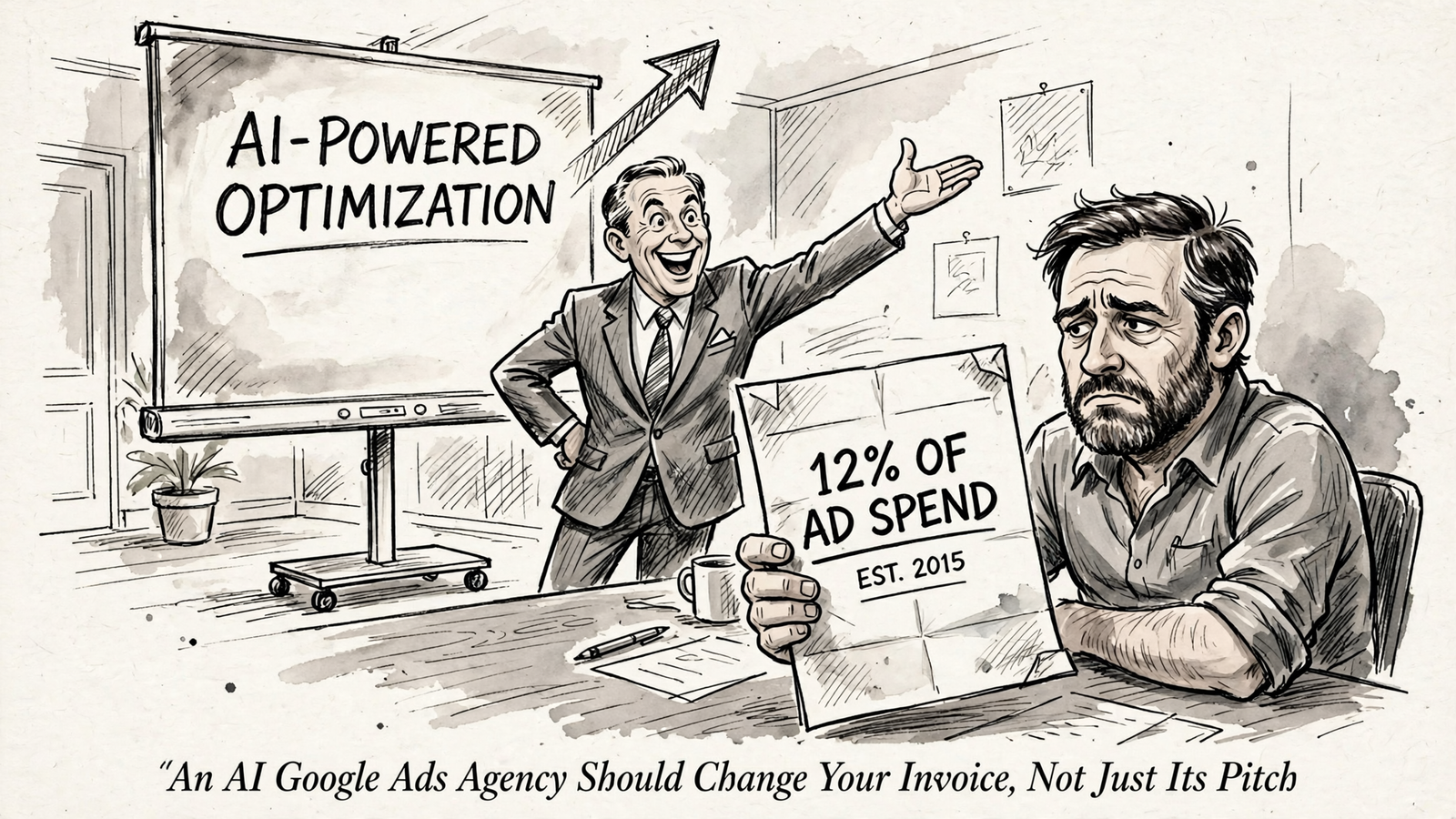
I’ve sat through the familiar version of that pitch. Slide two says AI-powered optimization. Slide nine says 12% of ad spend, billed monthly, minimum fee applies. Between them, the AI never appears again: no count of its changes, no log of its decisions, no explanation of why the shop charges what it did in 2019. The deck calls this a technology partnership. I call it the same invoice with a new noun printed on it.
If software genuinely executes the bid adjustments, negative keywords, budget shifts, and ad tests a junior strategist used to handle, three things should move: the price, the reaction time, and the paper trail. When none of them moves, the automation is a slide. You’re paying 2015 labor rates for work that no longer takes 2015 hours.
The people searching for an AI agency are rarely first-time advertisers. In one r/PPC thread, a local wildlife-removal business described letting Google’s reps set up its account, burning about $3,000 in ad spend, and looking for an AI agent because it couldn’t afford another loss. That buyer doesn’t need another impressive presentation. It needs a way to audit what it is buying.
The pitch sells AI. The demo often sells a to-do list.
The phrase AI-powered covers so much ground it barely means anything. A Shopify app called Agency AI sells an ‘AI Strategist’ that ‘runs your Meta and Google Ads like an agency’ for $59 a month, with a revealing qualifier in its own copy: every change waits for your approval. That is not execution. That is a to-do list a robot drew up, with the reviewing work handed back to you.
At the other end, a site calling itself Google AI Ads offers ‘100% of your Google Ads account managed’ by a ‘dedicated AI agent’ for $399 a month or $1,799 one-time. Its page offers no named strategist, change log, or guardrails language, and its name sits close enough to the platform’s that buyers ask whether Google runs it. Those offers look different, but neither description gives me what I want to see: a clear account of who executes changes and who answers for them.
Between those poles sit the shops with sales decks, case-study PDFs, and a Google Premier Partner badge on the homepage. Ask what the AI does and you get a demo. Watch closely. The screen recommends pausing a keyword, adding a negative, or adjusting a bid. The recommendations may be sensible. Recommendations are still not execution. Optmyzr draws that line openly in its documentation: its AI ‘does not currently apply changes to live campaigns,’ and suggestions wait for ‘you review and apply before anything changes in Google Ads.’ If a respected tool vendor says so plainly, an agency blurring the distinction in a pitch deck owes you an explanation.
I learned to distrust the case-study slide early. It says CTR up 40%, conversions up 34%, ROAS improved. It may never say what those conversions cost or what counted as one. A veterinary practice in r/googleads ran into that gap: its agency reported roughly 75 conversions a month at a $32.89 CPA, but when the owner checked, only three to ten were booked appointments. The rest were form fills that never became paying customers. The report looked healthy. The appointment book did not.
Most agency-vetting advice asks whether you own the account, can see a search terms report, or can speak to a client for whom the work failed. Ask those questions. But they test what a shop is willing to discuss, not whether its AI does the work. Stop evaluating the talk. Evaluate the motion.
If the machine does the work, why does the fee rise with spend?
Start with the invoice, where the old economics hide. Percentage-of-spend pricing made sense when a larger account meant more human hours: more budget, more ad groups, more evenings inside the account. The fee rose with the work. Then bid management moved into the platform. Google’s agentic capabilities for Google Ads now recommend and apply strategies inside an account, and Smart Bidding works whether or not anyone is logged in. The mechanical workload shrank. Many fee structures did not.
Go from $10,000 a month in spend to $20,000 and a 15% fee rises from $1,500 to $3,000, ‘even though managing the larger account is mostly the same weekly routine’ (Ahmed Imran PPC). The work does not double. The invoice does.
The incentive follows the arithmetic. COSEOM puts it this way in its pricing guide: ‘a percentage-of-spend agency that recommends cutting your budget is acting against its own invoice, and few do it twice’ (COSEOM). Sagapixel says agencies ‘want you to increase your ad spend so that their revenue goes up,’ while publishing a rate of 15 to 22% capped at $4,000 a month (Digital Marketing Remote). In an r/PPC pricing thread, an agency-side commenter said big-budget clients go on percentage ‘because we make way more money this way,’ while some flat-fee side-hustle clients pay 60% of their budget in fees (r/PPC). This doesn’t require bad intent. The invoice already points in one direction.
And the hours you buy do not guarantee attention when it matters. One PPC manager on r/PPC described becoming solely responsible for 25-plus client accounts after an acquisition. A single $60,000-a-month account overspent by $104,000 before anyone noticed, and the agency credited the client’s $9,000-a-month invoice for eleven months to make it right (r/PPC). Spread one manager that thin and budget drift can wait for the next review. A system watching the account continuously does not need a meeting to spot a budget that doubled overnight.
That is the cost question: if the AI removed the hours, what are you still paying those hours for?
Demand three proofs before you sign
The label is marketing. These are the checks I would run, in order. Don’t accept a dashboard tour in place of an answer.
-
The invoice: what changes when your spend changes? Ask for your fee at $20,000 a month in spend and again at $40,000. Then ask what additional work justifies the difference. A flat fee is consistent with automated execution because watching a larger account does not necessarily require proportionately more labor. A percentage that rises with every budget increase needs a better explanation than ‘that’s our model.’ For context, percentage-of-spend fees run 10 to 20% with a minimum fee. At 15% on $20,000, you pay $3,000 a month. At $100,000 in spend, management fees can run $10,000 to $25,000. If the vendor says its AI removed the work but cannot explain what your higher fee buys, the AI is a slide.
-
The change log: what actually happened last week? Ask how many actions the account received, who or what made each one, and where the reasoning is written down. Google’s Change history records changes for the past two years, including ‘when you paused your campaign, who added a keyword, and the amounts of your previous budgets.’ The native record can show what changed; the vendor should be able to explain why. Ask to walk through the record beside impressions, clicks, conversions, and cost. A shop claiming autonomous execution should be able to show more than a monthly batch of recommendations waiting for a person to apply them.
-
The reaction time: what happened the day something broke? Request a real incident, not a hypothetical workflow. Who noticed? How many hours passed before the account changed? What happened to spend in the gap? A landing page starts throwing errors on a Tuesday. In a review-cycle account, action waits until someone sees the problem; you pay for the delay. Turning off Google’s auto-apply recommendations stops future changes but ‘does not undo changes already made to your campaigns’ (freak.marketing). The money spent in the gap is gone, and cleanup is separate work. One advertiser on r/Google_Ads followed a Google strategist’s push toward automated campaigns and AI features until ‘spend doubled and at points tripled, without any noticeable improvement in results’ (r/Google_Ads). Advice that increases your spend without accountable execution is not management.
Some accounts should skip the managed service
Not every account needs a managed growth engine. If you run one campaign in one city and the account is fundamentally healthy, the cheapest honest fix may be to do it yourself. Let Google’s platform automation handle bidding. Write three decent ads, check the search terms report on Fridays, and keep the fee.
If you need brand creative, video production, or packaging work, hire a brand studio. That job never belonged to a search account manager, and a bidding engine does not do it now. What I would not do is buy a cheap human agency at that size and assume the problem is solved. The veterinary practice paid $300 a month on a $2,500 budget and got three to ten booked appointments from a report claiming 75 conversions. Low spend does not buy you lower standards. It buys you less margin for error.
Match the fix to your spend, not the vendor’s pitch
Under $5,000 a month: Skip the managed service. Run Google’s Smart Bidding, write your own ads or hire a freelancer per project, and check the search terms report every Friday. At this budget, a management fee eats into the margin you need for testing. If you want help, buy a one-time setup audit and a monthly review call. Ask what the person changed, even at this size.
$5,000 to $50,000 a month: This is where I would look for managed autonomous execution rather than a review schedule. You need the account worked continuously, a named person who answers for the outcome, and a fee that stops rising merely because your budget does. That is the model groas runs: one flat fee per service, whatever you spend on ads, with changes logged and their reasoning written down in plain language. At $20,000 a month in spend, a 15% agency fee is $3,000. A flat fee stays flat when you scale to $30,000 or $40,000. If you want the pricing mechanism in more depth, read the case against percentage pricing. If you are deciding how involved to be day to day, the done-with-you versus done-for-you breakdown covers that choice.
Above $50,000 a month: The fee gap gets harder to ignore. A 10% fee on $50,000 is $5,000 a month, though the weekly routine has not grown in proportion to spend. Bring execution in-house with your own operators and an execution engine behind them, or use a flat-fee managed model and hold its strategist accountable to pipeline and closed-won revenue rather than CTR. If you are an agency carrying multiple clients at this scale, white-label autonomous execution at $299 per client per service makes delivery cost a fixed line instead of a headcount decision.
Buy the log, not the label
Check case studies. Ask for references. Verify account ownership. Then ask the questions that reveal whether the work has changed since 2015. A vendor can add AI to its homepage for nothing. Showing you the invoice, the change log, and the time it took to fix a broken account requires more.
Ignore those proofs and the first quarter may look fine. The reports arrive. The dashboards glow. Then a landing page breaks on a Tuesday and you discover the AI is a dashboard reviewed by someone with twenty-four other accounts. You pay for the gap. You spend more time untangling changes nobody explained. Then you fire the shop and start looking for the next tool at 1am, already out the money you needed it to protect. The label does not protect you. The evidence does.