

 LinkedIn
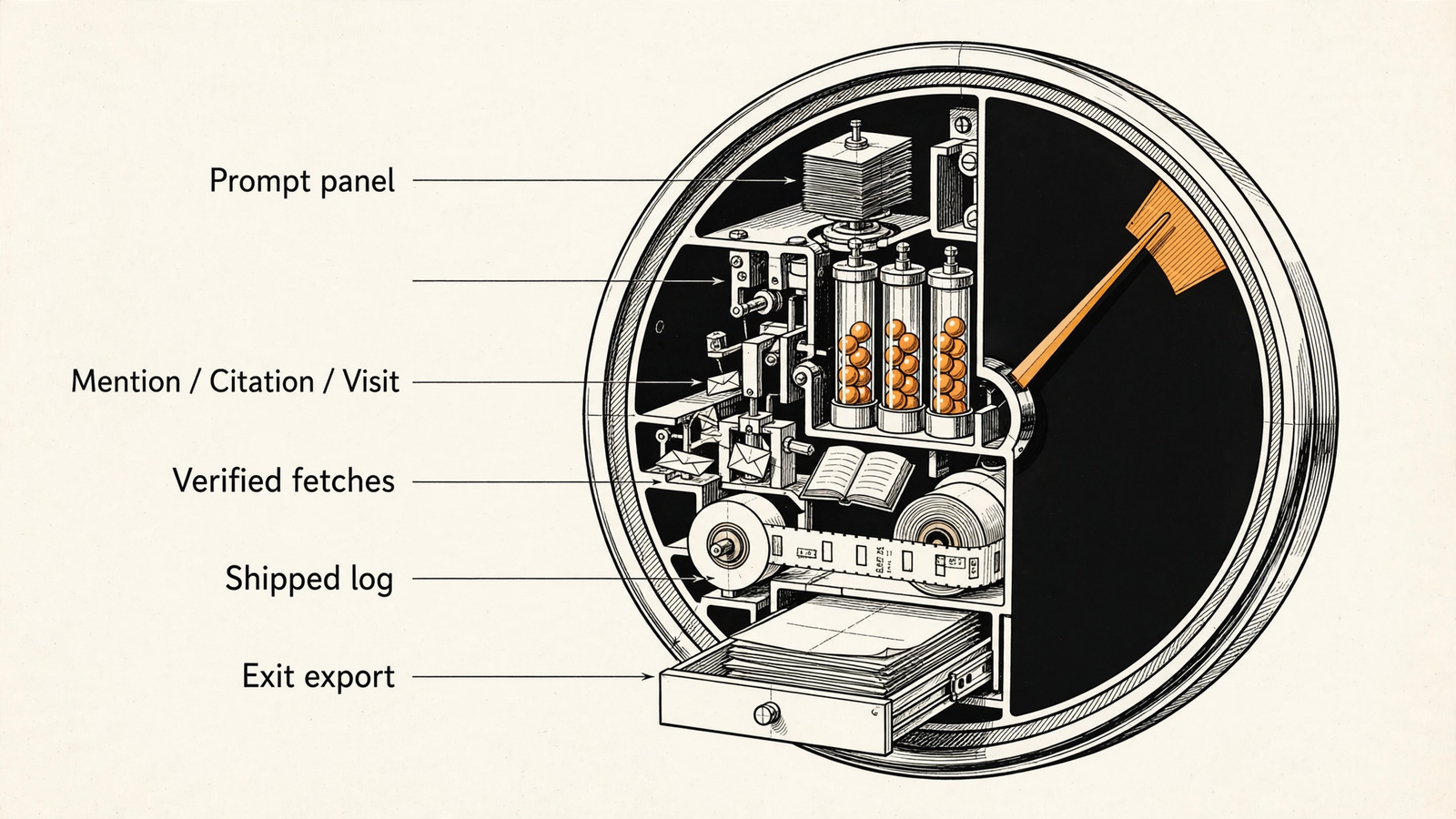
By December 31, 2028, most serious agency buyers will refuse to resell white-label GEO on a single AI visibility score. Their contracts will name the prompts tested, distinguish a mention from a citation and a visit, verify bot traffic, log what shipped, and preserve the evidence when a partnership ends.
I learned the value of that evidence by reselling a report I could not defend on a client call. The client asked three simple questions: What did you do? What did we get? Did it turn into money? My report answered none of them. That is the gap these five clauses close. Work delivered, visibility observed and revenue attributed are three different things. Each needs its own evidence.
My forecast: agencies will buy an evidence contract, not a GEO label
These are predictions, not a description of what every contract says today. White-label GEO still gets sold as a score. One vendor review from September 2026 put the problem cleanly: major GEO platforms produce numbers the buyer cannot inspect, reproduce or verify. I used to tell clients a blended visibility lift was enough. I was wrong. When a client forwards that chart to their CEO, the agency owner has to explain what moved and why.
The shift I expect is from buying AI visibility as one thing to specifying three kinds of proof:
- Work delivered: pages published, fixes deployed and authority earned.
- Visibility observed: what a defined set of prompts returned, where and how often.
- Revenue attributed: what turned into calls, booked jobs or pipeline.
LSEO already frames GEO benchmarking as repeatedly observing a defined set of commercially relevant prompts and then asking whether any of that visibility connects to business activity. That second question is the one a score cannot answer. If a partner cannot show the work and explain the measurement, the agency cannot defend the result.
Prediction 1: the prompt panel becomes part of the contract
By Q4 2027, standard white-label GEO statements of work will list the exact prompt panel: every prompt tested, every engine checked, the market and language, how often each prompt is sampled, and a changelog when prompts are added or retired. A score without its panel is a CPA without spend. Technically a number. Commercially useless.
The mechanism is boring, which is why it matters. AI answers change. One dataset of 42M+ citations found only 18.5% of AI Overview answers keep the same citations. Separate repeat-ask research puts the chance of ChatGPT or Google AI returning the same brand list at under 1 in 100. If you do not record what you asked, where and when, next month’s score has no stable basis for comparison. You might have changed the prompts. The engine might have changed the answer. Without the panel, neither the agency nor the client can tell which happened.
The evidence that agencies can ask for this now sits in vendor method pages. GeoTrova publishes its cadence: core prompts go to ChatGPT, Gemini and AI Overviews daily and to Perplexity, Copilot and AI Mode every three days by default, scored as mention presence per answer. I expect that level of disclosure to move from marketing page to appendix to contract exhibit.
Here is what would prove me wrong: by the end of 2028, most signed white-label SOWs still report a blended visibility score with no prompt list, engine list or sampling dates. Until then, ask for the panel in a sheet you can rerun yourself. A screenshot of the score is not a substitute.
Prediction 2: reports split mentions, citations and visits
By mid-2027, the better white-label reports will stop using citation to mean three different outcomes. A brand can be named in an answer, linked as a source or visited by a person. A mention, a linked citation and a visit are separate events. They should be separate columns.
The mechanism is already visible. Organic rank no longer tells the whole citation story. Data cited via Slate found only 38% of AI Overview citations now come from organic top-10 pages, down from 76% in July 2025. And a citation does not guarantee a click. Seer tracked 25.1M impressions and found CTR falls from 1.76% to 0.61%, a 61% decline, when an AI Overview appears. Ahrefs found a roughly 58% CTR drop for position one under the same condition. A client can be cited more and clicked less in the same month. Blend those events and you may celebrate a chart while the client waits for traffic.
That is why the clause I expect reads like the glossary I now send before a proposal: mentioned, cited or clicked, each counted separately. Show mentions per prompt run. Show the source links behind citations. Tie visits to a tracking rule both sides agreed to, and state what that rule cannot isolate. Native tooling still leaves a hole: Search Console shows AI Mode impressions separately but does not separate AI Overview clicks from traditional organic clicks. Calling every organic visit an AI-driven visit would not fill that hole; it would hide it.
If most white-label monthly reports still show one blended citation count, with no mention-to-link-to-visit split, by the end of 2028, this prediction fails. Ask for the three columns now, even if the visit column is thin. Thin and honest beats big and blended.
Prediction 3: crawler reports require verified fetches
By early 2028, white-label SOWs will reject raw bot-hit counts as proof and require verified fetches. A crawler chart without a verification method is a vanity chart.
The mechanism is unglamorous log work. Server logs contain fake GPTBot and Googlebot hits, so vendor docs call for checks beyond the user-agent string, including OpenAI IP lists and Google reverse-DNS verification. I ran this check manually once for a client who wanted proof ChatGPT was reading their site. The raw log showed hundreds of hits. After verification, most of it was noise. I found the same problem in 30 days of our own bot traffic: only a minority verified cleanly. A large unverified total is not strong evidence just because it looks good on a slide.
The clause also needs to distinguish what a verified fetch means. A fetch does not prove a recommendation or a sale. OpenAI’s bot docs draw a line between GPTBot, which collects content that may be used for training, and other kinds of access. A GPTBot hit does not prove content was trained on or will be cited; OAI-SearchBot, GPTBot and ChatGPT-User have separate IP files and separate purposes. Training crawl, live-answer retrieval and an on-demand user fetch are different events. The report should not give them one grand total and call it visibility.
My falsifier is narrow: by the end of 2028, most white-label crawler reports still show unverified user-agent counts, with no IP or DNS method and no bot-type split. Ask for verified fetches by bot purpose now. For a claim about verified traffic, treat the unverified total as zero.
Prediction 4: implementation logs become client-ready deliverables
By Q3 2027, white-label GEO contracts will require an implementation log the agency can forward without editing. Each published page gets a URL and live date. Each technical deployment records what changed and where. Each authority placement names the linking domain. A log with URLs and dates answers “what shipped?” A visibility score does not.
The mechanism is reseller math. White-label GEO already has public economics: a $499 retail benchmark with typical agency retainers of $750 to $1,000 for single-location work, and working GEO retainers at $3,000 to $10,000-plus per month with 40 to 60% markup on white-label execution when resold. Say you buy fulfillment at $1,500 and bill $2,250. That $750 spread has to survive the client asking what you delivered. A dashboard showing a score change cannot tell them whether a page went live or a fix left the staging queue.

The adoption signal I would watch is SOW language defining shipped as live and crawlable, not drafted or staged. A useful weekly log is plain: date, URL, change and owner. The agency can inspect it, send it to the client and compare it with the next report. Nobody has to translate “ongoing optimization activities” into English on a call.
I lose this prediction if, by the end of 2028, most white-label monthly deliverables still consist of a score dashboard and an activity paragraph, with no URL-level record the agency can audit. Require a sample log before you sign. If a provider cannot produce one weekly, they are selling reporting, not fulfillment.
Prediction 5: exit terms preserve the measurement history
By late 2027, white-label exits will turn on what the agency and client keep, not on an argument about who caused the breakup. The measurement spec has to survive the vendor. Otherwise month six cannot be compared with month one.
The clause I expect covers three things:
- Site assets: pages, code changes and placements on the client domain remain live.
- Reporting history: the agency receives a usable export, not a final PDF with selected charts. The contract language agencies already share calls for keyword research, content and dashboards to be agency-owned and exportable as CSV/JSON, plus a no-fault exit with a defined transition period.
- Measurement definitions: the prompt list, engine list, sampling dates and mention-to-link-to-visit rules travel with the export. The next provider needs the same ruler.
The mechanism is churn. A GEO retainer needs continuity to show whether anything changed over time. Take away the underlying log or change the definitions at handoff, and the next report starts a new story. I lost a home services client in 2019 for exactly this reason. New provider, new dashboard, new definitions. We spent two months arguing about whose baseline was right instead of doing the work.
I lose this one if, by the end of 2028, most white-label contracts still end with revoked logins and a PDF summary as the only handoff. Put the export in the brief now: which files, which format and how many days after cancellation they must arrive. An exit clause written while everyone is still getting along is cheaper than reconstructing a baseline later.
What I would put in a partner brief today
If I am right, the brief you send now decides whether you are ready for 2028 or renegotiating under pressure. I would ask any fulfillment provider for five exhibits before I let them touch a client account: the prompt panel, a sample report with three distinct outcomes, the bot verification method, a sample shipped log and the exit export spec. If a vendor cannot produce those five, you are buying a chart, not an evidence contract.
These are the questions I would put in the brief:
- Which prompts, engines and markets do you test, and how often do you rerun each one?
- Do you report a brand mention, a linked citation and a site visit as three separate numbers?
- How do you verify crawler hits, and do you split training crawl from live-answer retrieval?
- What does your weekly shipped log look like, URL by URL?
- What do I keep on exit, in what format, and by what date?
What groas commits today is execution with a named owner, not a promise of citations. SEO & AI Search runs $1,499 a month, flat at any spend, month to month with cancellation anytime, no setup fees and never a cut of ad spend. You are live within 24 hours of the onboarding call with a dedicated manager. The service covers Google plus ChatGPT, Perplexity, Gemini and more, with new pages and technical fixes every day. The five clauses above are proposed standards to negotiate on top of that, in writing, before you resell. Do not mistake a service promise for a signed measurement exhibit.
A scorecard to revisit on December 31, 2028
- Panel named in the SOW and rerunnable by the agency: yes or no.
- Mentions, linked citations and visits reported separately: yes or no.
- Bot hits verified by IP or DNS and split by purpose: yes or no.
- Weekly shipped log with live URLs: yes or no.
- Exit export with history and measurement spec delivered on time: yes or no.
If three or more read no, I called the direction wrong and the market stayed with scores. If four or more read yes, the agencies that wrote these clauses early kept an answer ready for clients who ask hard questions. My advice is priced for the second outcome. Put one clause in your next partner brief. Start with the prompt panel, then keep the log from day one. I cannot promise rankings, citations or revenue from any of this. I can promise you will finally know what you sold.


