

 LinkedIn

Your buyer asks ChatGPT for the best vendor in your category. You are about to spend the quarter rewriting your blog. If you run growth or search for a growing company, that is the choice: improve the pages you own or earn a place on the third-party pages AI cites. For “best X” and “who should I hire” prompts, I would put the heavier effort off-site. For technical questions, I would make a different call.
That distinction gets lost in a lot of Answer Engine Optimization (AEO) advice. “Write better content” is easy to sell when the seller already audits websites for a living. But an engine assembling a vendor shortlist can draw on roundups, reviews and forums that your CMS does not control. In an audit of 128 B2B software purchasing queries covering 1,739 citations, Growfusely found that vendor websites captured 12% of citations on Perplexity and 24% on ChatGPT. Independent third-party publications and directories captured 67% and 55%, respectively.
Those figures do not tell you what your category will do. They do tell you why polishing product pages while ignoring the sites that appear in buyer answers is a costly bet. The prompt type, not your agency’s service menu, should decide where the next hour goes.
Meet the contenders: your pages and everyone else’s
On-site: make your own answers usable
On-site optimization makes your domain accessible and useful to an AI search engine. If a crawler cannot reach a page, or gets a blank client-side JavaScript shell, the quality of the copy hardly matters. Our walkthrough on how to fix access before content starts there for a reason. Once access works, clear headings and answer-sized passages make relevant material easier to find and quote.
SE Ranking’s benchmark across 216,524 pages reported 70% more citations for content arranged in 120-to-180-word chunks under explicit subheadings. It also reported an average of 6.7 citations for pages with a First Contentful Paint below 0.4 seconds, against 2.1 for pages above 1.13 seconds. Those are useful reasons to fix a slow, muddled page. They are not reasons to assume your own comparison page will become the referee in a vendor shortlist.
Your advantage on-site is control. You can correct a specification, change a heading or fix a crawl problem yourself. You also remain the vendor describing the vendor.
Off-site: appear where buyers find a second opinion
Off-site work means earning accurate mentions on properties you do not own: directory profiles, editorial roundups, comparison tables, review sites and relevant forum discussions. You cannot dictate what an independent reviewer says. That is part of why the page can matter when an assistant is asked to recommend someone.
The work is less tidy than publishing to your own CMS. You have to find the pages assistants already cite, check whether your business belongs there, maintain profiles and pursue legitimate inclusion. The advantage is third-party context, not a magic authority score you can buy by sending a press release.
Here is the practical divide:
- On-site: fix access, page structure and documentation where your business is the primary source.
- Off-site: build accurate visibility on the external pages buyers and assistants consult when comparing providers.
Axis 1: The prompt determines the stronger source
For “how do I” questions, start with your own domain
A prompt such as “how to configure reverse proxy headers for dynamic routing” calls for a precise answer. If you maintain the relevant specification, API reference or configuration example, your own documentation can supply it directly. A third-party roundup is a poor substitute for the source that owns the details.
Our comparison of your blog versus third-party pages makes the same useful distinction: informative queries give domain depth room to work. If the answer depends on your internal specs or original documentation, make that page accessible and unmistakably clear.

For “best X” questions, go where comparisons happen
Now change the prompt to “best payment gateway for B2B cross-border transactions.” The buyer is not asking a vendor to define its own product. They want a shortlist and a judgment. Your landing page can still help an assistant verify details about you, but it is a weaker place to establish why you belong beside alternatives.
Flying Cat Marketing reports that vendors placed on an AI-cited third-party listicle or roundup appeared in 45.4% of AI-generated answers in its dataset, against 16.3% for the same queries without the placement. For emerging and mid-market vendors, it reported recommendation rates rising from 12.5% to 54.8% with inclusion on cited third-party lists. That does not mean any list will do. It means the cited list is worth finding before you commission another generic article.
An assistant may also cite a vendor’s site after it has recommended the vendor. Citepoint’s AI Recommendation Index found ChatGPT linking directly to recommended vendor domains in 70% of its post-recommendation citations, while shortlists also drew on aggregators and comparisons. Separate the source that helps you make the shortlist from the source used to check your details afterward.
Axis 2: A quick fix is not the same as a quick mention
On-site changes are quick to make and easy to verify on your own server. An assistant’s use of the updated page is another matter. A crawler may fetch a clean answer block soon after publication, or the change may take longer to appear in responses. You can control the fix, not the engine’s timetable.
Off-site work usually starts slower. Getting an editor to update a roundup, accumulating verified reviews or becoming part of a useful forum discussion takes effort and cooperation. But there is a difference between pitching a new article from scratch and seeking inclusion on a page an assistant already cites. The second path begins with a known citation target, even though placement is never yours to command.
If access is broken, fix it now. If access works and the buyer prompt cites a roundup, spend the next outreach hour on that roundup. That is a better clock than promising that either lever delivers citations on a schedule.
Axis 3: Pay for work that addresses the citation gap
Both approaches can become expensive ways to produce activity reports. On-site, that might mean paying a developer to repeatedly revisit minor CMS tasks or an agency to rewrite headings and publish filler. Off-site, it might mean a digital PR retainer that produces coverage on pages absent from the answers your buyers see. Hours are not citations. A handsome placement report is not a shortlist mention.
The cheaper-looking option is not automatically the better one, either. A technically clean site with no credible external presence can miss comparison prompts. A stack of directory profiles cannot rescue documentation that crawlers cannot read. SE Ranking’s domain benchmark associated active profiles across major review platforms with 3x more ChatGPT citations than competitors without them. That is a reason to inspect your profiles, not to purchase forty hours of vague “authority building.”
At groas, our SEO & AI Search service is built around the operating work agencies too often split into separate retainers: technical on-site fixes, external citation-gap mapping and continuous execution under a dedicated strategist. Pay for the gap your buyer prompts reveal, not the service a firm finds easiest to invoice.
Axis 4: Own the facts; influence the verdict
Your domain gives you administrative control. You can change server headers, correct schema, test a layout and update pricing information when it changes. You should use that control. If an assistant does name you, your own site needs to give it accurate details to draw from.
Off-site pages require a different discipline. You cannot rewrite a customer’s review or order an editor to change a ranking. You can keep profiles current, make your product easy to evaluate and seek inclusion where it genuinely fits. That constraint is irritating to anyone accustomed to pressing Publish and calling the work done. It is also why external references can do a job your own sales copy cannot.
Own the facts on-site. Work to be considered off-site. Confusing those jobs leads to a beautifully maintained page that buyers never encounter, or an external mention that sends them to an unusable site.
Axis 5: Spread your presence beyond one engine’s habits
A strategy built around one assistant’s favourite source is brittle. In a benchmark of 100,000 prompts run across ChatGPT and Perplexity, only 11% of cited domains overlapped. The engines did not draw from identical sets of pages.
That is an argument for coverage across relevant sources, not for collecting mentions anywhere that will take them. Your documentation should remain useful when a buyer needs a specification. Your external presence should not depend on a single roundup. Look for recurring source types across the engines your buyers use, then work on the specific pages that matter.
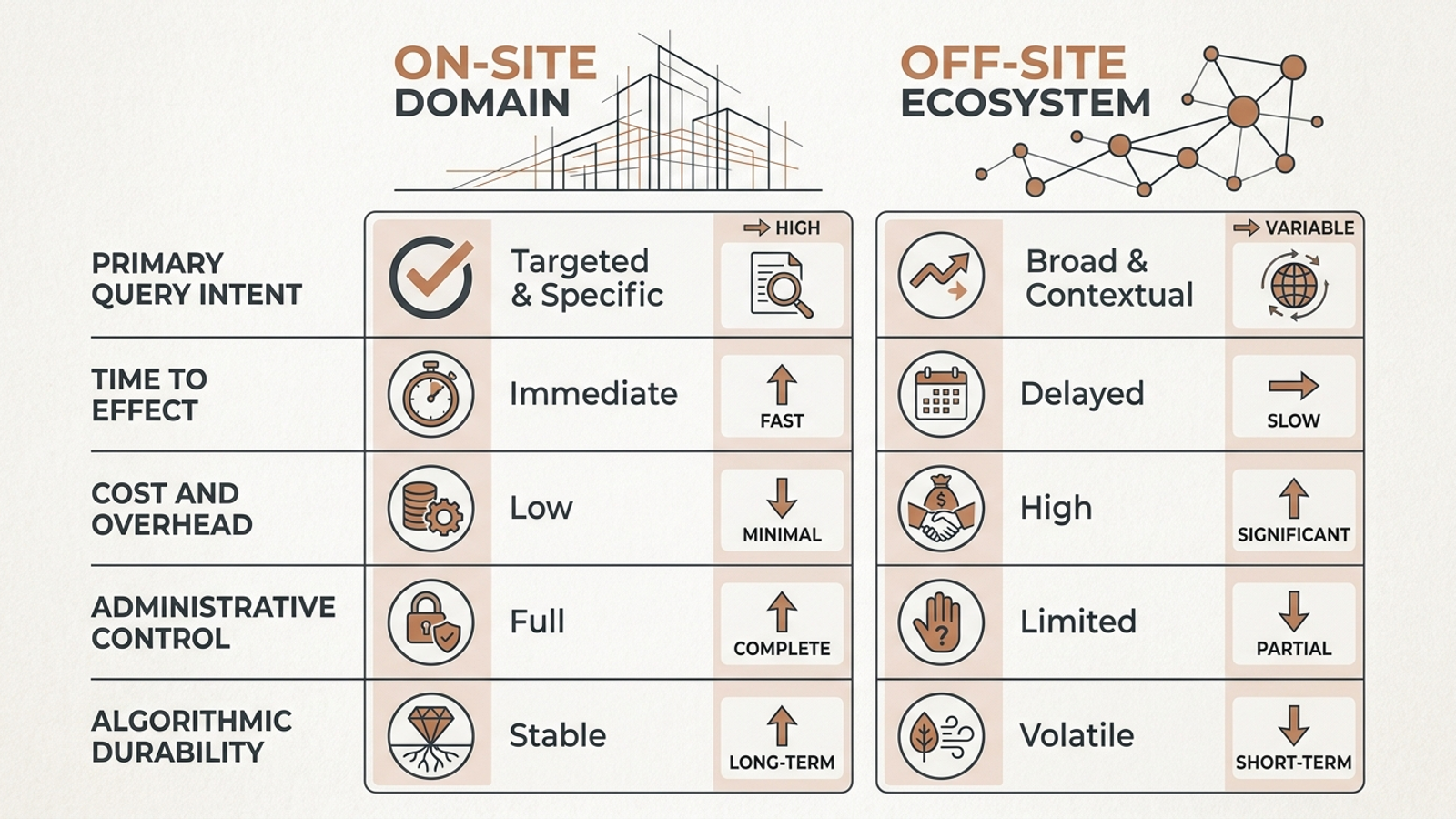
Head-to-head scorecard
| Decision | On-site pages | Off-site mentions | Winner |
|---|---|---|---|
| Prompt fit | Strongest for your specs, documentation and direct answers. | Strongest for commercial comparisons and shortlists. | Off-site for buyer-evaluation prompts |
| Time to act | You can fix access and copy directly; citation timing is uncertain. | Inclusion can take longer, even on a page already being cited. | On-site for speed of execution |
| Work and cost | Technical maintenance and useful source content. | Profiles, reviews and relevant editorial outreach. | The lever your citation gap calls for |
| Control | You own the page and can correct it. | You can seek inclusion but cannot dictate independent coverage. | On-site |
| Engine changes | Your site remains your source of record. | Relevant mentions spread exposure across other sources. | Off-site for source diversity |
Test the verdict against your own buyer prompts
Here is the question I would test before signing a retainer: When buyers ask for a vendor like you, which domains do ChatGPT Search and Perplexity actually cite? Do not start by counting how many articles you have published. Start with the answers a prospect can see.
Set up the comparison
Use fresh browser sessions, clear local cache and turn off custom ChatGPT memory. Write ten non-branded commercial prompts using language your sales team hears:
- Five
best [service or software category] for [specific company profile or use case]prompts. - Three
who should I hire for [specific operational bottleneck]prompts. - Two
[leading competitor] alternatives for mid-market businessesprompts.
Add two informational prompts about specifications or configuration as controls. They let you check whether your own documentation appears when the task calls for a primary source. Run every prompt in both ChatGPT Search and Perplexity, keeping the wording the same between engines. That gives you twenty commercial answers and four informational control answers.
Record what appears, then decide
For every answer, record the cited URL, its domain and whether your brand is named in the answer. Classify each citation as:
- Vendor-owned site, including yours or a competitor’s.
- Third-party editorial, directory or review site.
- Independent discussion forum.
Keep mentions and citations in separate columns. An assistant can recommend a company while citing a roundup, or cite a vendor site to check a detail after forming its shortlist. Those are different observations.
Calculate the citation split for the twenty commercial answers, then inspect the four informational controls separately. I would expect more third-party sources in the commercial set and more room for primary-source documentation in the controls. Your category may disagree. If your site never appears even in the controls, check access and relevance before buying outreach. If the commercial answers repeatedly cite the same roundups or directories but omit you, you have named places to pursue rather than a vague instruction to “build authority.” If your domain already dominates the relevant buyer answers, protect that advantage instead of forcing an off-site campaign to fit a theory.
One afternoon will not establish a permanent visibility ceiling. It will give you a concrete list of prompts, cited pages and missing appearances to act on.
Verdict: off-site wins the shortlist, with two exceptions
For a business whose prospects ask “best X,” “who should I hire” and “what are the alternatives,” off-site authority wins the next serious investment. I would keep the on-site foundation working and direct the heavier effort toward the external pages those answers repeatedly cite. An 80/20 split is a useful operating rule for that situation: roughly 80% of the effort on relevant external visibility, 20% on keeping your own site accessible and accurate. It is a starting allocation, not a number the test guarantees.
Two groups should pick the on-site contender first. The first sells a deep technical product whose buyers chiefly need API documentation, exact configuration guidance or other material the vendor itself maintains. The second has a broken technical foundation: blocked crawlers, blank rendered pages or content that cannot be reached reliably. Neither group should pay to be recommended before a buyer can verify what the product does.
Everyone else should stop treating another self-published comparison page as the default response to a missing shortlist mention. Searchable’s analysis of AI search responses found that publishing an on-site comparison page had an insignificant net impact, between -1.8 and +5.0 percentage points, on broader AI category visibility. Build the page when it serves the buyer. Do not ask it to stand in for independent consideration.
Traditional retainers often split this into an on-site content package or a digital PR package, then leave the other surface unattended. At groas, we run paid and organic search through one autonomous operating model: specialized models handle continuous execution, while a dedicated human strategist sets direction and remains accountable for attributable pipeline. The point is not to do everything equally. It is to see which prompts matter, keep the owned foundation sound and pursue the external sources that shape the shortlist. If your buyer’s answer is built elsewhere, go where the answer is built.