

 LinkedIn

Your site ranks third for a buying term. ChatGPT answers the same question and recommends somebody else.
Being indexed and ranking does not make you a recommended supplier in an AI answer. Answer-led discovery added another outcome to measure. It did not replace technical SEO or useful buyer content. It exposed where the DIY checklist stopped.
Here is the timeline: what changed, why it mattered, and what each turn broke or fixed for an owner trying to get found.
Before May 14, 2024: the DIY plan stopped at rankings and clicks
The classic DIY plan had three checks: can Google crawl and index the page, does it rank for a buying term, and does that ranking turn into clicks? I built those reports for years, and I still run them first. If Google cannot fetch the page, the rest of the plan has a problem. If a service page sits on page four for the term that pays your rent, a recommendation check is not the first repair to make.
That sequence was useful because a search result gave you a reasonably direct path from visibility to a visit. Improve the page, watch the position, then see whether the traffic followed. It was never a perfect account of a buyer’s decision, but it told you where to start digging.
The limitation is clearer now. A ranking report cannot tell you whether an answer names your business. In NP Digital tracking from January 2023 to December 2025, organic rankings rose 26% while organic sessions fell 19%. That does not diagnose every site that loses traffic. It does show why I no longer treat a green ranking report as proof that search visibility is doing its old job.
Keep the crawl, index and ranking checks. Stop treating them as the whole outcome.

May 14, 2024: Google puts an answer above the results
Google launched AI Overviews in the US on May 14, 2024, rolling them out to everyone in the US that week and planning to reach more than a billion people by year-end. The change was visible on the results page: an answer could appear above the familiar links, with links of its own for readers who wanted more.
For an owner ranking third organically, that placement changed what “third” could deliver. Your position might hold while the answer handles the simple part of the question before a buyer reaches your listing. Ranking and being seen first were no longer safe to treat as the same thing.
I used to tell clients that a position-three result with a decent title should earn its share of clicks. That advice needs another check now. If sessions fall while positions hold, do not assume the page suddenly became useless or that a title rewrite will fix everything. Look at what appears ahead of it and whether your page gives that answer anything worth drawing on.
The fix is not to abandon the fundamentals. Make the page fetchable and genuinely useful for the buyer’s question; then measure what happens beyond its rank. A service page that says who it fits, what the work involves and what a buyer needs to decide has more to offer than one that repeats a keyword under six headings.
A ranking still matters. It no longer tells you, by itself, whether the buyer reached you.
October 31, 2024: ChatGPT starts searching the web
OpenAI’s introduction to ChatGPT Search described a system that could choose to search the web when useful, then return timely answers with links to relevant sources. Coverage dated the launch to October 31, 2024 and described the SearchGPT prototype becoming part of ChatGPT. Access started with Plus and Team users on web and mobile, with other users to follow.
That created a second distinction for owners to watch. A link beneath an answer is not the same as your business being recommended in it. A page can help establish a fact about a category while the answer names another supplier as the pick. The source has done work; the brand has not won the recommendation.
The practical question therefore changes from “Did ChatGPT cite us?” to two questions: “Did it use one of our pages?” and “Did it name us when the buyer asked whom to use?” They are not interchangeable numbers. A cited page may show that your content is accessible and relevant. A named recommendation suggests the answer has enough reason, from the material it draws on, to put your company in front of the buyer.
That is why I would not respond to every missing recommendation by publishing another blog post on your own domain. First inspect the sources appearing for the actual buyer query. If the answer draws on comparisons, reviews or other third-party pages that never mention you, improving your site alone may leave the shortlist unchanged. Keep your own pages accurate and easy to use, but look outside them too.
Count source links and named suppliers separately. Fix the gap you actually have.
February 5, 2025: ChatGPT search drops the login wall
On February 5, 2025, OpenAI announced that ChatGPT search was available without sign-up. No account or Plus plan was needed to type a question on chatgpt.com.
I do not read that as proof your buyers stopped using Google. I read it as the point when “our customers probably will not bother trying it” became a weaker excuse. Removing a login makes it easier for a curious owner, a junior researcher or a buyer checking a shortlist to ask the same buying question somewhere else. That extra check may never produce a visit to your website. It can still put a competitor’s name in front of the buyer.
The response is measurement before renovation. Take the questions buyers ask when they are close to choosing a supplier and compare what happens in Google with what ChatGPT says. Do not rewrite every page because one answer looked bad on Tuesday. First find out whether your business is consistently absent, merely uncited, or named often enough that the immediate problem lies elsewhere.
Add the second discovery surface to your checks before you spend money trying to improve it.
Today: measure the missing outcome, then pay for the work that moves it
Start where machines meet your site. Can the relevant pages be fetched? Are they indexed where indexing applies? Do they answer a buying question in language a reader could understand out of context? A blocked crawler or a JavaScript-only price table can undermine the foundation before another round of writing helps. If you need an order for that diagnosis, use this walkthrough of four gaps that keep pages out of AI answers. Fix access before polishing a sentence for quotability.
Then separate three outcomes that tend to get bundled into one reassuring visibility score:
- Ranked: Does your page rank in Google for the buying term?
- Cited: Does an AI answer link to one of your pages as a source?
- Named: Does the answer recommend your company as a supplier?
They can split sharply. In one 2026 test of 278 B2B buyer prompts, ChatGPT named brands 552 times, but 66% of those recommendations did not cite the brand’s own site. The synthesis of those studies also found that best-of-list presence and brand mentions tracked recommendations more closely than material on the brands’ own domains. That is a reason to examine the sources around your category, not a reason to neglect the site a buyer will inspect after seeing your name.
Pick 10 to 15 prompts a buyer would actually type, word for word. Run the same list each week in a fresh session, and record the three outcomes separately. Keep the wording fixed so you can see change rather than accidentally testing a new question every Friday. One answer proves little; a shortlist can change between runs. The recommendation playbook makes the practical case for checking the sources cited for each query and earning genuine mentions where buyers and answers already look.
Read the log as a diagnosis, not a trophy cabinet. If you rank but are never cited or named, inspect both your pages and the sources the answer uses. If your page is cited but the answer names somebody else, look at how your business is described beyond your domain. If you appear once and vanish the next week, keep measuring before declaring victory. This weekly AI visibility check lays out the fixed-prompt routine in more detail.
Stop screenshotting one flattering answer. Track how often you are named across four weeks.
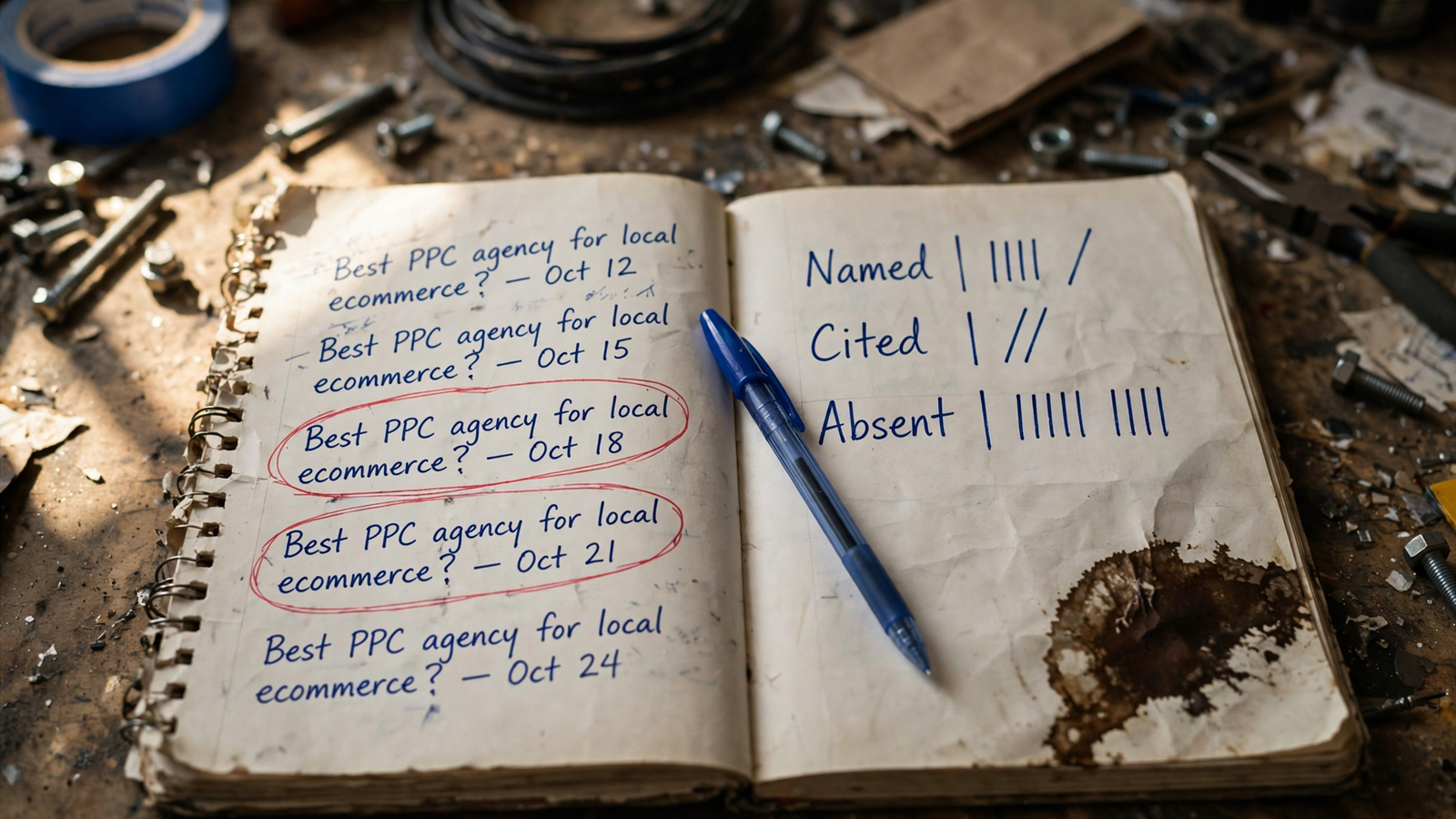
Once that log shows you are indexed but rarely named, the next handoff is implementation. Do not pay for another audit whose main deliverable is a score confirming that you are invisible. Ask what will be changed, who will change it, and how the work will show up in the same prompt log.
Your brief to a provider should name four jobs:
- Build or rebuild buyer pages that answer questions about price, fit, timing and proof.
- Repair technical access so the relevant content is fetchable, usable and marked up where appropriate.
- Earn genuine third-party mentions on the comparison pages, review sites and forums that appear for your queries.
- Report what shipped and what changed each week: named versus cited versus clicked, using a fixed prompt list.
A 2026 buyer guide to generative-engine optimization services describes a fuller engagement: an audit across 30 to 100 fixed prompts, followed by technical fixes, quotable content, third-party corroboration and ongoing citation tracking tied to pipeline. It puts that work at $3,000 to $25,000+ per month, with audits alone at $2,500 to $15,000. Prices vary by scope, so the useful question is not whether a quote matches a published range. It is whether the quote buys execution or another description of the problem.
If a proposal guarantees a top recommendation or a citation, skip it. No vendor controls a given answer. This also will not rescue a thin affiliate site with nothing original to say; cleaner structure cannot manufacture a reason to trust it.
That is the gap groas was built to close. Its SEO and AI Search service covers Google alongside ChatGPT, Perplexity, Gemini and more in one retainer, with new pages, technical fixes and authority work. The mechanism matters more than the label on the package: your pages give an answer something useful to draw from; third-party mentions give it more context in which to encounter your business.
The economics make that worth a look for an owner who needs work shipped rather than another deck. groas prices the combined SEO and AI-search scope at $1,499 a month, flat, with no setup fee, month-to-month terms and a 7-day money-back guarantee. Work begins within 24 hours of the onboarding call, and a dedicated account manager stays with the account. That is a clearer alternative to paying audit prices for a list of tasks nobody performs.
I would still ask for the log. Every change should be visible, each week should say what shipped, and the report should show whether the named rate moved. A provider can be accountable for that work and that honesty. It cannot promise what ChatGPT or Google will say next Tuesday.
The line through this timeline is straightforward. AI Overviews made a ranking less reliable as a proxy for a visit. ChatGPT Search made a source link less reliable as a proxy for a recommendation. Removing the login wall made that second surface easier for buyers to check. None of those turns made indexing or useful buyer content obsolete. They made being named an outcome you have to measure in its own column.
This week, write down 12 buying questions. Run them in Google and ChatGPT, and mark ranked, cited and named separately. Keep the sheet for four weeks, then send it to whoever you hire. The provider worth talking to will ask what the sheet shows before offering to make it look better.