

 LinkedIn
Google introduced SGE as an answer box without ads inside it. Seventeen months later, ads were inside AI Overviews. I read that sequence as a PPC operator: when a new search surface earns attention, the unpaid space around it has a closing window.
That does not prove Google will charge for organic citations. It does tell businesses where to work while citations can still earn attention without a media bill. The useful question is not how many dashboards can track that window. It is whether your pages can earn a place in the answer before more competitors figure out how.
2014–2022: Featured snippets make the top result a trade-off
In January 2014, Google rolled out the answer box search marketers called position zero. A featured snippet pulled an excerpt from a publisher’s page and placed it above the standard blue links. For a site that won both the snippet and a prominent organic listing, it looked like bonus inventory: answer the question clearly, occupy more of the page, collect the click.
Then the terms changed. On January 22, 2020, Google announced featured-snippet deduplication across search results globally. A URL appearing in the snippet would no longer get a second listing on the first results page. Winning the answer box stopped being an automatic double dip. A publisher had to consider what the snippet actually gave the searcher: a reason to click, or enough information to leave without one.
The broader click pattern made that trade-off harder to ignore. SparkToro’s zero-click search studies put the US zero-click share at 58.5% in 2024 and 68.01% in early 2026. Those figures do not make featured snippets the cause of every lost visit. They do describe the environment an operator has to work in: more searches end before anyone reaches a publisher’s site.
Featured snippets also set up the question that runs through this timeline. If Google can satisfy a query on its own page, what is the publisher’s place on that page worth? For practitioners, the takeaway was to stop counting a prominent placement as a win until they knew whether it produced a visit or some other useful outcome.
May 2023: SGE takes the answer box much further
Google introduced the Search Generative Experience, or SGE, at Google I/O in May 2023 as an opt-in experiment in Labs. Its pastel-tinted snapshot synthesized material from multiple sources before showing the standard results. Ads appeared outside the generative snapshot, above or below it. Inside the answer, this was still an unpaid surface.
The layout mattered before any ad appeared inside it. A large answer consumed the space where a searcher might previously have seen a familiar mix of ads and organic listings. Standard results were still there, but reaching them required more scrolling. SGE changed what a top organic rank looked like on the screen without changing the rank itself.
I would not pretend the Labs period gave every advertiser a clean before-and-after test of lost clicks. It did show Google testing a different way to occupy the most valuable part of the results page. Latency, presentation, and whether people would use a synthesized answer all had to work before the format could travel beyond Labs.
Some teams treated that experimental label as a reason to wait. For a PPC operator, it was a reason to watch the placement. When the searcher’s attention moves, the old distinction between ‘our SEO position’ and ‘our ad position’ becomes less helpful. Neither guarantees that the searcher sees you before the answer.
May 2024: AI Overviews reach US searchers
In May 2024, Google took SGE out of Labs and rolled out AI Overviews in the US. The opt-in step disappeared. A format that had been easy to dismiss as an experiment became part of the results pages businesses had to compete on.
Research since the rollout has put numbers against the click pressure. In Ahrefs’ study of 300,000 keywords, the presence of an AI Overview was associated with a 58.0% lower organic click-through rate for position 1. The reported drops for positions 2 and 3 were 50.8% and 46.4%. A business could hold its conventional rank and still receive fewer clicks when an overview occupied the space above it.
Authoritas reported a 47.5% drop in top-result CTR on desktop and a drop of up to 79% for publishers in its research. It also found that 93.8% of citations within AI Overviews came from URLs outside the top 10 organic positions. Ranking first and being cited in the answer were not the same contest.
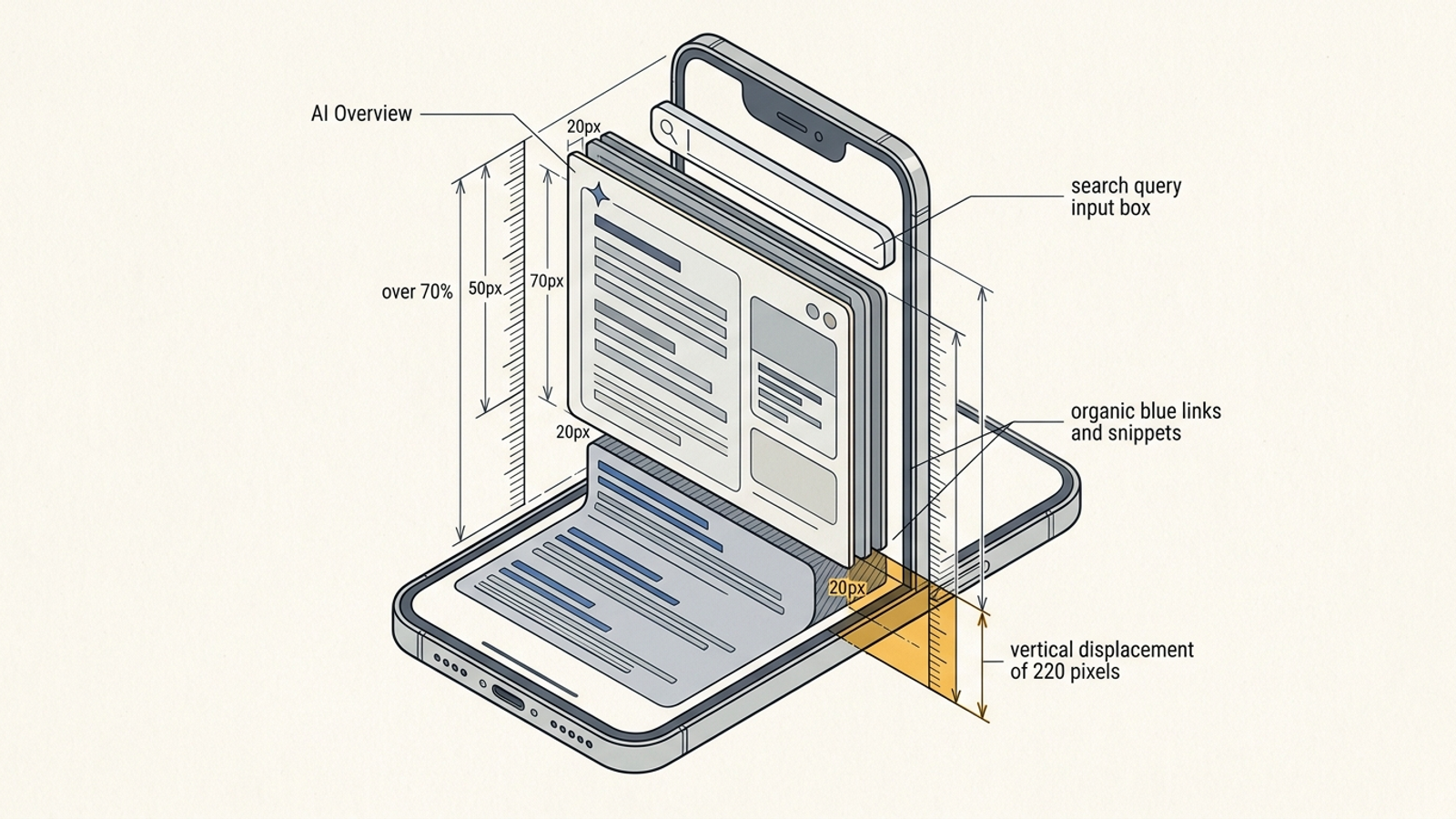
That distinction matters more than another dramatic chart of lost traffic. Seer Interactive’s analysis of 5.47 million queries and 2.43 billion impressions found overall organic CTR falling from 1.76% to 0.61% when an AI Overview appeared. Yet cited domains recorded a 2.1% CTR, compared with 0.9% for uncited domains in its analysis. The overview took attention away from the old listings, while links inside it offered another route to a click.
The operator’s response is not to abandon conventional SEO or promise that every citation will pay off. It is to measure them separately. A first-place blue link, a citation in the answer, and a paid placement are different positions with different jobs. Reporting them as one vague ‘search visibility’ number conceals the change you need to act on.
October 2024: Ads move inside AI Overviews
The commercial turn arrived seventeen months after SGE’s debut. On October 3, 2024, Google launched ads inside AI Overviews for US mobile users. Eligible assets from existing Shopping, Performance Max, and AI-powered Search campaigns could appear as sponsored placements within the overview. The answer itself was now a place Google could sell.
On October 28, 2024, Google expanded AI Overviews to more than 100 countries, saying the format would reach more than one billion monthly users. Expansion of the answer format and the arrival of ads inside it were distinct developments, but together they changed the planning conversation. AI answers were no longer a side project for the organic team.
Google had made the space that displaced traditional listings available to advertisers, too. That does not mean a business automatically buys back every click it loses. It means paid and organic teams now have to read the same results page. An account can be eligible for a sponsored placement in an AI Overview while its pages compete for unpaid citations nearby. Treating those as unrelated reports makes it harder to see what you are paying for and what you could earn.
Our breakdown of how AI Overview ads compress search CTR goes deeper on the paid side. The timeline’s point is simpler: the unpaid-only phase inside Google’s generative answer did not last. Anyone waiting for a perfectly settled set of AI-search metrics before improving their pages had just watched the ad auction catch up with the interface.
May 2025: AI Mode makes a single keyword a smaller target
Google introduced AI Mode at Google I/O in May 2025. Rather than treating a complex prompt as one keyword match, the system used query fan-out: it broke a request into multiple related searches and assembled an answer from what it found.
Think about what that changes for a business trying to be discovered. A person comparing software or evaluating a local service can ask a multi-part question and keep following it inside the conversation. The business no longer needs to be relevant only to the short phrase it has tracked for years. Its pages need clear information that can answer the parts of a broader request.
A rank for one isolated keyword cannot tell you whether your business is useful to the whole answer. That is the practitioner problem AI Mode sharpened. If product details, pricing, service areas, and direct answers are scattered across pages or buried under marketing copy, an answer engine has a harder job identifying what belongs in its response. A monitoring chart can reveal an omission. It cannot make the missing information clear.
This entry does not complete another proven organic-to-paid cycle for AI Mode. The draft record does not establish one. What AI Mode does show is that the answer interface kept expanding after ads arrived in AI Overviews. For practitioners, that is enough reason to work on the material those interfaces draw from, rather than optimize every page for one tracked phrase and call the job done.
2025–2026: Other answer engines complicate the ad story
Google’s sequence is the clearest example here, not a law every answer engine must follow. Perplexity tested sponsored follow-up questions, including a late-2024 pilot with advertisers such as Whole Foods and Indeed, then paused new advertisers in late 2025, according to analyses of its advertising pullback. ChatGPT’s search citations offer another place businesses may appear without buying a search ad beside the answer.
That contrast is useful because it keeps the argument honest. A citation is not proof that an ad will replace it on a fixed date. Different answer engines have made different choices about advertising, and the record here is thinner outside Google. My concern is more practical: unpaid citations already occupy scarce, visible positions in answers, while businesses still have a chance to improve the information those systems can use.
I would spend less time trying to predict the exact month any engine changes its commercial model. The immediate contest is whether your business is named and linked when an answer addresses a question your customers ask. That is a real search problem today, even where no ad auction has appeared inside the answer.
2026, present: Fix the page before you buy another monitor
The predictable response to a new visibility problem is a new dashboard. AEO monitoring platforms advertised at $50 to $499 a month promise to show where a brand appears across answer engines. That can be useful. I judge these tools the way I judge ad tech, though: what action does the information make possible?
A report can tell you that an AI Overview cites a competitor or that Perplexity omitted your product. It cannot rewrite a muddled answer, correct inconsistent product information, or repair a crawl problem. A citation alert is a diagnosis, not treatment. Paying for one while leaving the underlying pages untouched is the search equivalent of reading a wasted-spend alert and refusing to change the campaign.
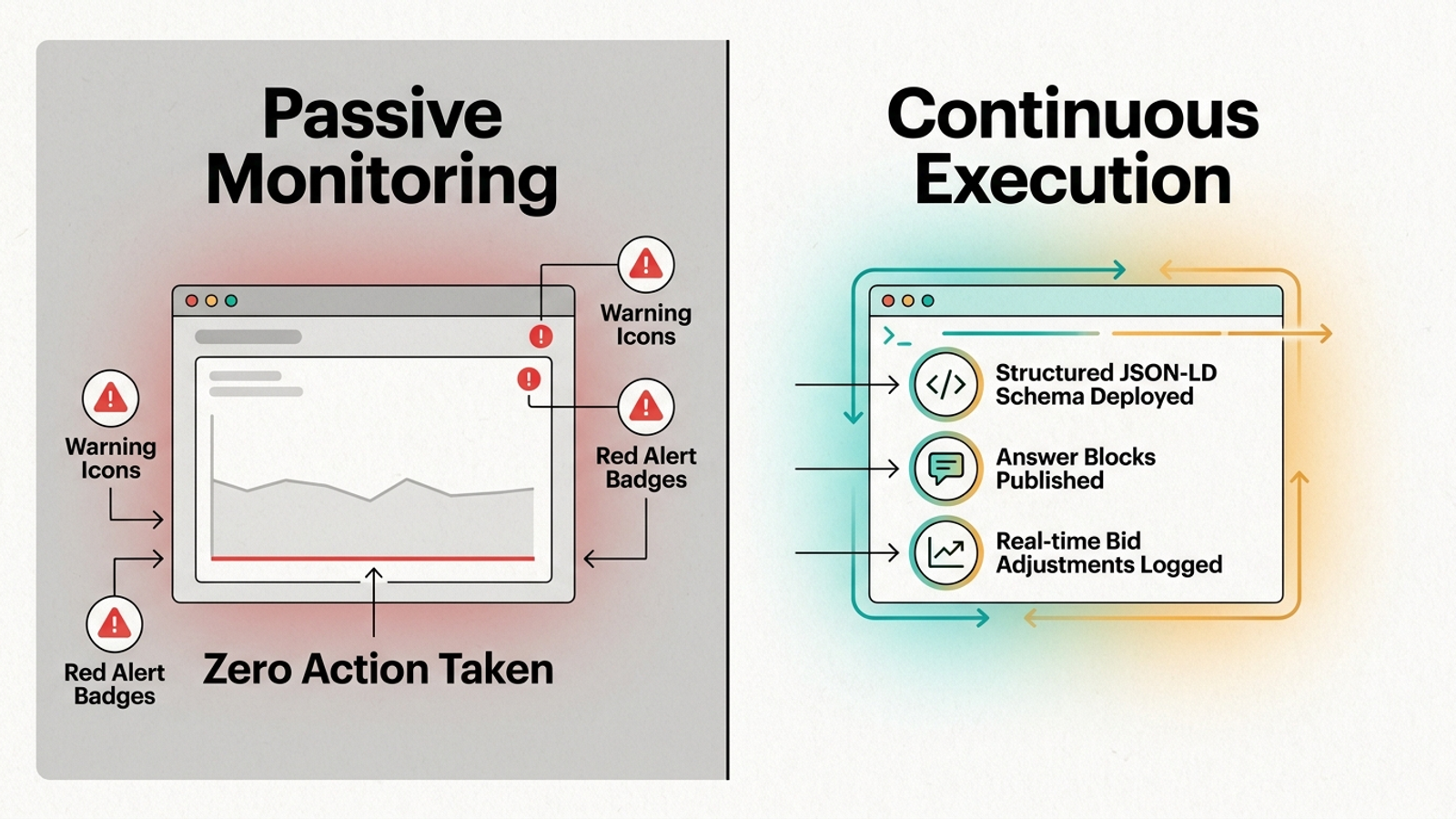
If you are choosing tools to help you get featured in Google AI Overviews, start with the work they enable. For the next two quarters, I would put the operating order this way:
- Make important answers easy to find. Give target pages concise, standalone passages that answer specific commercial questions. The draft’s under-sixty-word target is a useful editing constraint, not a guarantee of citation. Keep the details a reader would need to make a decision.
- Make business facts consistent and crawlable. Put accurate product specifications, pricing tiers, and service areas where retrieval systems can find them, and keep relevant structured data aligned with the page. A clean JSON-LD block will not rescue contradictory copy.
- Read paid coverage beside citation coverage. Where you earn a citation, check what paid search is contributing before changing bids. Where you are absent, consider paid coverage while you fix the page or entity information behind the gap. Neither a citation nor an ad placement should get credit for revenue by assumption.
At groas, that last discipline is the point of managing paid search and AI-search visibility together. Specialized models handle execution across campaigns and content, while a human strategist owns direction and accountability. That is a better fit for this problem than another monitor that sends an alert and waits for somebody else to do the work.
I cannot put an expiration date on an organic citation. I can point to the dated sequence: SGE arrived without ads inside its answer in May 2023; ads entered AI Overviews in October 2024; AI Mode then widened the kinds of questions those answers could handle. My reading of the next turn is blunt. Fix your citability while an unpaid place in the answer is still available. Buying a clearer view of the slot you missed can wait.