

 LinkedIn

You ran 40 buyer prompts. A competitor got cited 28 times; you got cited four. Now you have a choice: Contender A, a gap and monitoring platform, or Contender B, a done-for-you execution service like groas. If you run a business without an in-house SEO team, the cheaper subscription may be the more expensive way to close those gaps.
I have sat on both sides of this sale. I used to hand clients beautiful gap reports and tell them what to fix. I was wrong about how much that helped. A report that shows your AI content gaps is not doing the same job as a service that fixes them. The real comparison is total cost per closed gap, including the hours a tool hands back to you.
First, decide whether you need a map or someone to move the furniture
Say you are spending $20k/month and someone runs your buyer prompts through ChatGPT, Perplexity and Google AI Overviews. You get a list of answers that name competitors instead of you. It feels like progress because the problem finally has rows and columns. Then Monday arrives.
Ask who owns the work on Monday morning and what decision changes. If the answer is “we would know our score,” you bought monitoring, not execution. That may be exactly what a staffed SEO team needs. It is a poor substitute for that team.
Measurement alone does not write content, refresh pages or resolve blockers. A tool alone does not earn citations: it shows you where you are absent. Someone still has to ship the page, fix the fetch block and build the reference a model might use. The distinction sounds obvious until the report arrives and everybody assumes somebody else owns the next step.
Contender A: the gap and monitoring platform
These tools do one job well. They run your prompts weekly, show share of voice, flag answers that cite competitors instead of you and surface possible causes: thin pages, missing entities, no fresh answer block or a crawl block. The price reflects that job: Otterly starts at $29/month, Peec AI at €89/month, and Profound is $499/month for enterprise depth, with HubSpot’s 2026 table listing the same tiers. You pay for measurement, not fixes.
What the deck calls “coverage,” I call a to-do list with no owner. Content creation stays with you. Schema stays with you. Unblocking GPTBot in robots.txt, fixing client-rendered JavaScript the bots never execute, building third-party references: all with you. I have watched that list go straight to backlog. One breakdown of the audit-to-implementation gap found 35% of SEOs had key recommendations sitting unshipped months later. Detection needs an owner or the report becomes another document people agree with and ignore.
Contender B: done-for-you execution
Done-for-you AEO is not a dashboard. It is labor plus the ability to ship. Someone rewrites the thin service page, adds an answer block a model can quote, fixes the template that blocks the crawler, publishes the comparison page and pitches the citation. The budget reflects that: most engagements run $2,000 to $20,000 per month, with a $4,000 to $12,000 mid-market range. Small-business retainers cluster at $1,500 to $5,000 per month, against self-serve trackers at $29 to $489 per month. You pay more because work goes live.
That is the point of groas’s SEO and AI search service: new pages every day, technical fixes holding you back, authority built on sites the engines trust, and a weekly report showing where you were named and why. Actions are logged with reasoning, with one strategist owning the outcome. The job is not to watch the chart of missing prompts. It is to work through the gaps and check what changes.
Axis 1: Which option gets from a missing citation to a cause?
Both contenders can start with the same prompt list. A monitoring platform flags the absence and points to possible causes, such as thin content or missing entities. That is useful triage. It is not a diagnosis you can publish.
Execution has to inspect the page behind the alert. Can GPTBot, ClaudeBot and PerplexityBot see the content if the page relies on client-rendered JavaScript? Was GPTBot blocked by an old blocklist? Is there an answer on the page worth quoting once a crawler reaches it? Those are different problems. Writing another article will not remove a crawl block, and unblocking a crawler will not make a thin page useful.
A chart can tell you where to look. A fetch check tells you what arrived. Buy detection when your team can investigate its alerts; buy execution when the investigation also needs an owner.

Axis 2: Who fixes the blockers once you find them?
The gap report may flag crawl and technical issues. It will not touch your templates. That matters because the failure can be mechanical: most AI crawlers see only the HTML your server sends first. A React block that looks fine in your browser can be empty to the bot. One fetch analysis found GPTBot pulled JavaScript in 11.5% of requests and ClaudeBot in 23.84%, but neither executed it. Add accidental blocks, with GPTBot blocked on roughly a quarter of top sites in one Cloudflare-network review, and the difference between spotting a problem and repairing it becomes hard to miss.
Nor does adding a plugin settle the citation question. Ahrefs matched 1,885 pages that added JSON-LD against 4,000 controls and found +2.4% movement in AI Mode and +2.2% in ChatGPT against a 4.6% drop in AI Overviews. The authors called it noise. Schema alone is not a citation plan. Someone has to unblock the bot, make the answer visible and give the model something quotable.
My guide to technical SEO issues that hurt AI visibility walks through that work. With a tracker, you still need someone to take it from recommendation to release. With execution, that handoff is part of what you are paying for. If your developer backlog is already full, put a price on that handoff before you call the tool cheap.
Axis 3: How long until a change goes live?
With a platform, the clock starts after the alert. You get a gap on Monday. Then you brief a writer, wait for a draft, wait for approvals, find a developer slot if the template needs work, and wait for QA. I used to tell clients two weeks. I was wrong. In most small teams, that list sits for six to twelve weeks. By the time the fix ships, the answer you were chasing may have changed.
With execution, the same service that found the missing prompt can ship the page and technical fix, then log what changed and why. Days, not quarters, is the promise to judge it against. I would not accept “we have a sprint” as proof by itself. I would ask what went live in the sprint. A neat calendar is not a published page.
If publishing is your bottleneck, buy publishing. More frequent alerts only tell you more often that the bottleneck is still there.
Axis 4: What is the total cost per closed gap?
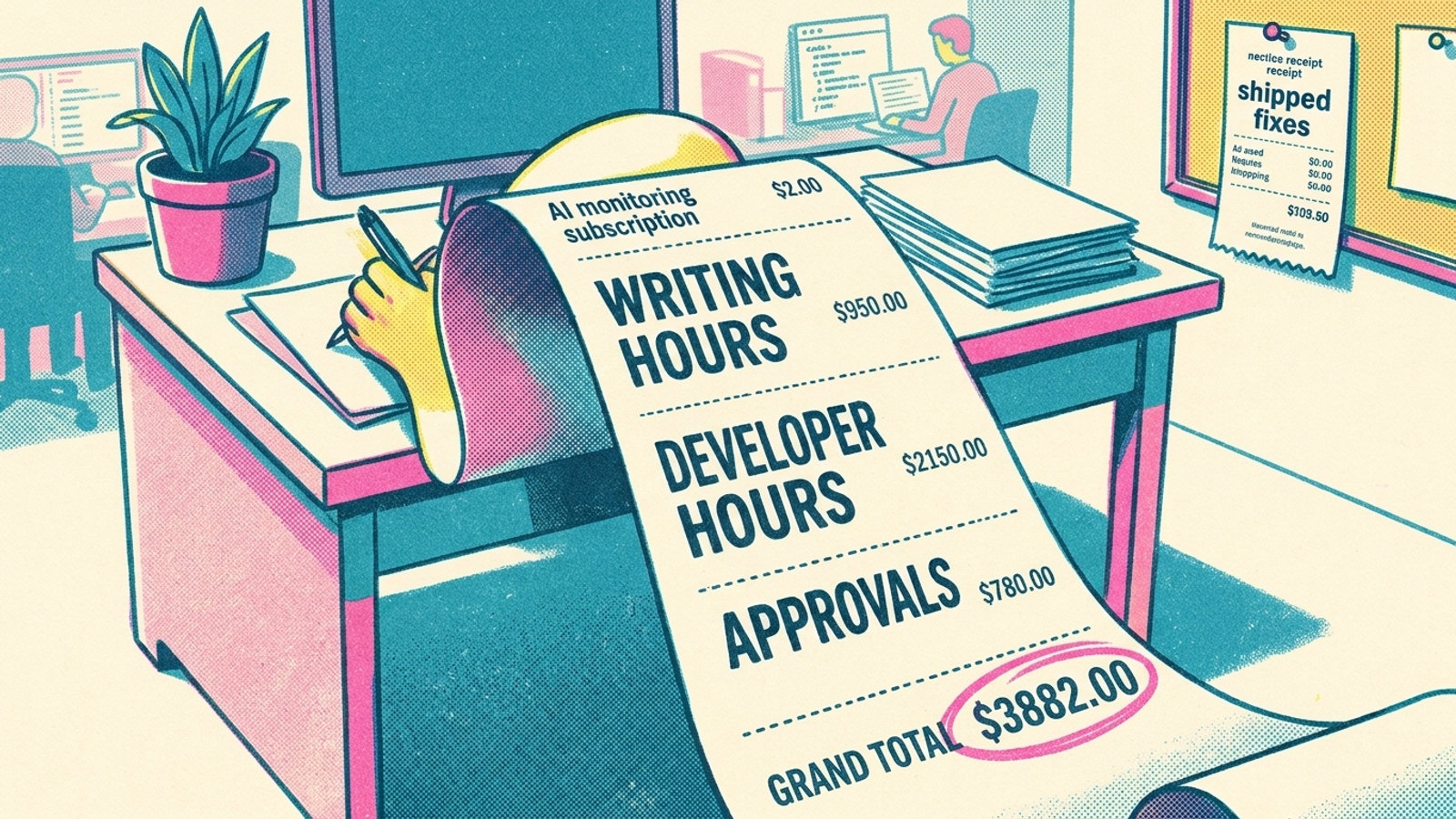
A $199 monitoring subscription sounds cheap until you price the labor it hands back. One research breakdown puts about 11.5 hours of internal labor into every SEO article before writing, across planning, approvals, QA, upload and distribution. It also estimates about five developer hours at $300 per hour, or $1,500, to ship one page with links, structured data and canonicals checked.
Here is the illustrative version, not a bill every business will receive:
- You pay $199 for the monitoring subscription.
- Four gaps each call for a separate article. At 11.5 internal hours per article, that is 46 staff hours before writing.
- If each of those four pages also needs the developer work in that estimate, you add $6,000 in developer time.
That is $1,500 in developer time per page before you price the staff hours or see whether a citation moves. Some prompt gaps will share a fix; some will not need developer work. That is precisely why I would count closed gaps, not prompts in a report or pages on a production schedule. My fuller cost-per-fix comparison of monitoring tools, agencies and done-for-you service runs the math across options.
The done-for-you fee is higher on its face. It includes labor that the subscription leaves outside its price. Compare what each option costs after the work is done, not what each vendor charges before anyone opens the backlog.
Axis 5: What can you hold the seller accountable for?
A monitoring platform reports movement: share of voice up three points, 12 prompts gained, eight lost. Useful context. But you cannot hold a chart accountable for a fix when the line goes flat. The vendor sold you visibility into the problem; your team owns the work that might change the line.
Execution reporting should read differently: which pages shipped, which template blocks were removed, which prompts now cite you and what changed before they did. That does not mean every citation can be promised or every movement credited to one edit. It means there is a record of actions to examine alongside the results. One tells you the score. The other shows you what was shipped.
If you pay for the first, staff it like research. Give somebody time and authority to turn alerts into briefs, releases and follow-up checks. If you pay for the second, judge it by gaps closed, citations gained per sprint and buyers reached. Do not let a polished weekly report stand in for any of those.
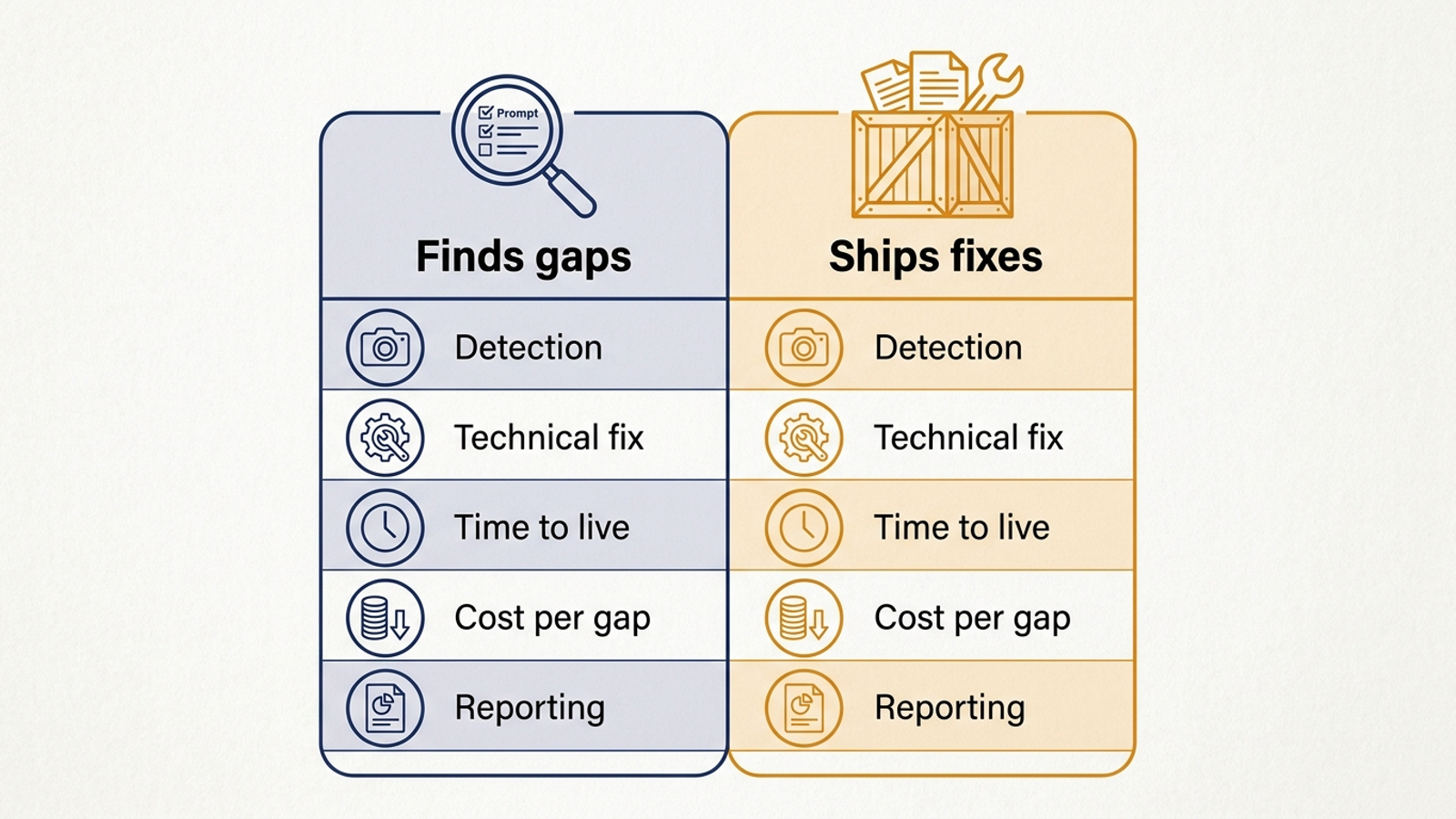
| Decision point | Gap and monitoring platform | Done-for-you execution |
|---|---|---|
| Detection | Tracks prompts and flags missing citations | Investigates the gap before fixing it |
| Technical fixes | Flags issues; your team changes templates | Ships page and technical changes |
| Time to live | Depends on your handoff and backlog | Same service finds and ships the work |
| Cost per closed gap | Subscription plus your staff and developer time | Labor included in the service fee |
| Reporting | Shows visibility movement | Shows shipped changes alongside citation movement |
Verdict: execution wins when nobody on your team can ship
For the business owner or marketing lead without an in-house SEO team and developer access, done-for-you execution wins. A platform can show you missed prompts for $99 to $499 a month, then hand the work back. If that work sits, the low monthly fee has bought you a clearer view of a problem you still have. Judge the options on cost per closed gap, not sticker price.
Pick the platform if your team already closes gaps
Buy the tracker if someone on payroll can ship five pages a week, edit templates and pursue citations without being asked. That means a content owner with developer access, not a founder doing SEO on Fridays. In that setup, the dashboard earns its fee: your team already does the work and needs a better way to choose what to do first.
Pick execution if the report would become a backlog
If the list would live in a spreadsheet while competitors collect the citations, stop paying to watch it happen. You need pages live, bots unblocked and answers worth quoting. That is the service groas sells: detection plus the labor to act on it, logged and owned by one strategist. Hold it to the work shipped and the citations that follow, not the size of its gap list.
I run a simple test with owners before they sign anything. Pull your last audit, the one you already paid for, and count how many recommendations actually shipped. If more than a third are still sitting there after 90 days, you have your answer. A second dashboard will add to that pile. It will not clear it.
Stop buying a clearer view of the backlog. Buy closed gaps. If you have the team to ship, buy the tracker and let them run. If you do not, hire the work, measure citations gained per sprint and hold one name accountable. The platform tells you where you are missing. Execution does the work to put you in the answer.