

 LinkedIn

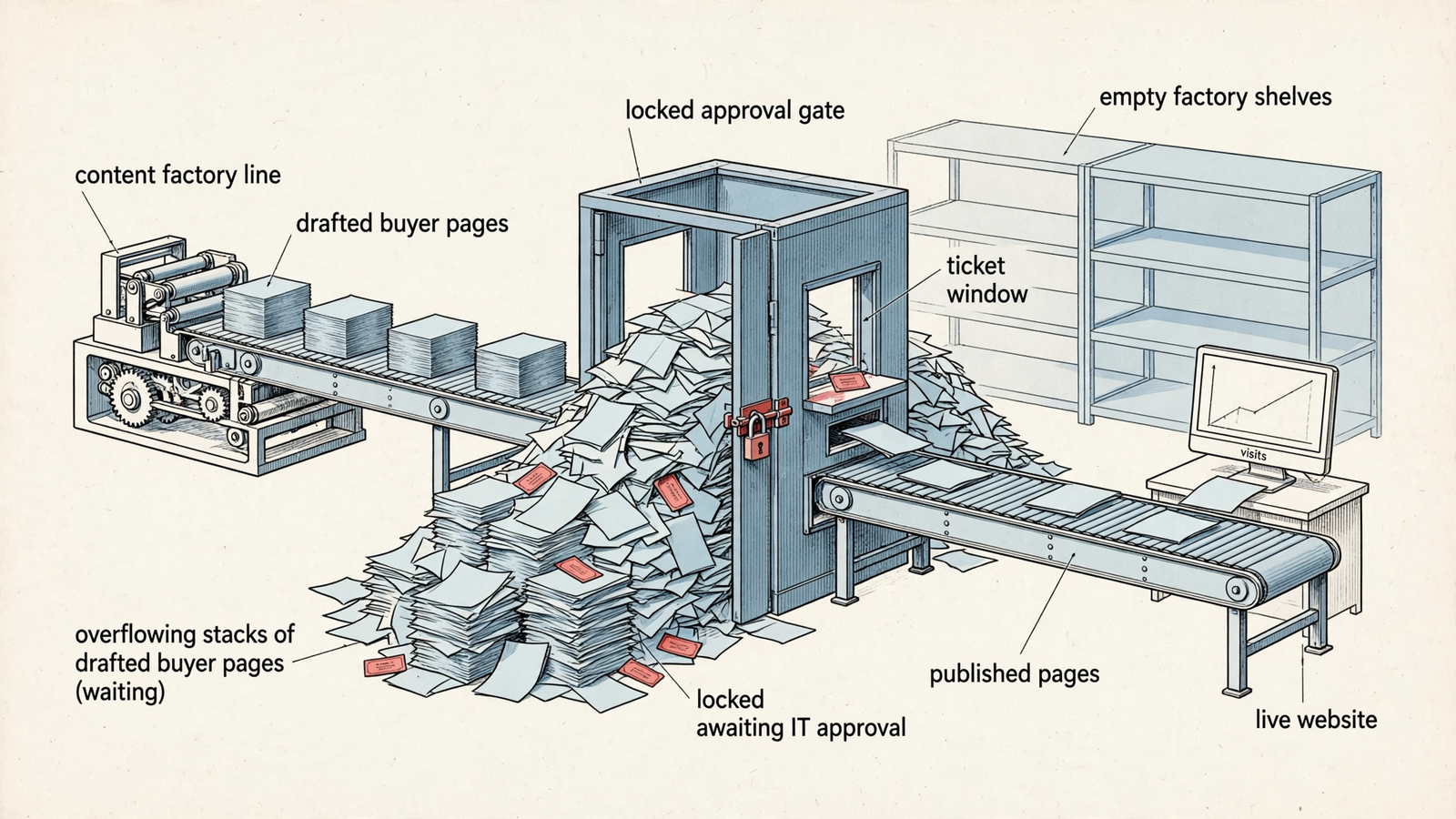
If IT controls every website change, more SEO content can mean a bigger backlog, not more traffic. For a business choosing between groas managed execution and a freelance SEO consultant, the deciding question is simple: which one can get work through your approval queue and onto the live site?
I managed accounts where that queue was the whole game. Marketing wanted pages live, IT wanted tickets closed, and I was in the middle watching good recommendations age out for six months. This head-to-head is for the buyer who wants ongoing visibility in Google, ChatGPT and the rest but cannot hand a vendor the keys to publish. You can grant read access to analytics. Deploy access takes an approval chain. Judge both options on that constraint.
Two offers, one bottleneck: who can change the website?
You know this setup if you have lived it. Marketing is outsourced or thinly staffed. IT, a franchise platform or legal controls the CMS. You can read GA4 and Search Console all day, but a new service page needs a ticket, a review and someone else’s sprint slot. I used to tell clients that was fine because a clear enough audit would make IT act. I was wrong. One account of stalled SEO work describes technical audits sitting untouched for six months and a plan for two posts a week producing two posts a month through a three-person approval chain: detailed audits sat untouched because dev was busy.

Read access is not deploy access. Google’s own hiring advice says to grant only read access to Search Console for an audit, not write access, and to keep permissions to the minimum the agreed work needs: grant only read access to Search Console, not write access. A consultant can work from read access and deliver a plan. Managed execution needs a route to put that plan into production. If you buy the second model with only the first permission, output waits in line.
Before comparing prices, map the publishing lane.
Contender one: groas needs a route to execute
groas is built to do the work, not hand you a deck. Its SEO & AI Search service costs a flat $1,499 a month. The model calls for new pages and technical fixes every day, authority work on sites the engines trust, and coverage across Google, ChatGPT, Perplexity, Gemini and more. A named human owns direction, with weekly visibility reporting. I like that shape because it prices execution rather than advice. No hourly meter running while someone formats a slide. The work either ships or it does not, and you can see what happened in the log.
The catch is the part buyers skip in onboarding. groas asks for GA4, Search Console and website access, then says it goes live within 24 hours of the onboarding call: share access to everything you have. Going live is not the same as getting permission to publish every change. If IT grants a workable route, whether CMS access, a scheduled push window or a fast ticket lane, managed execution can feed it. If every change needs a separate ticket that loses to checkout redesigns and security patches, daily output piles up. One enterprise team filed more than 1,400 SEO tickets over 18 months without getting them implemented because engineering time went elsewhere: filed 1,400+ tickets over 18 months.
groas wins when a deployment lane exists. Without one, its production capacity is not your publishing capacity.
Contender two: a scoped consultant can fit the queue
A good freelance SEO consultant sells prioritisation and specifications, not shipped pages. A typical engagement is an audit, a ranked fix list, keyword targets, writer briefs, developer tickets and a review call. Implementation stays with your team or freelancers: who will implement once strategy exists. The hands-off version says so plainly. The consultant will not edit HTML or do outreach: consultant is hands-off and won’t be editing HTML.
I have worked that way. When the internal team is strong, it works. When IT is protective, it becomes the whitepapers-to-ticket model: the consultant sends specifications, your team updates the site on its terms, and a change can take weeks if the internal team is not fully on board: sends specs and internal team updates site on their terms. A consultant fits an IT-controlled site when the scope names who implements each ticket. Otherwise, you have bought someone to fill the queue.
Do not assume writing, publishing or AI visibility tracking comes with the retainer. US monthly retainers typically run $750 to $5,000, with a reported Clutch average around $3,199 a month; inclusions vary, and content volume or links may cost extra: monthly retainers $750–$5,000 with Clutch average around $3,199/mo. Get the scope in writing. How many briefs and drafts? Who publishes? Who builds internal links? Who tracks citations in ChatGPT and AI Overviews? Vague answers leave your backlog in charge.
Head-to-head: count deployments, not deliverables
Most comparisons count deliverables. I count deployments. Ask what changed on the live site last month, who approved it and how many hours your side spent getting it there. When IT owns publishing, that is the useful comparison.
| Decision point | groas managed execution | Freelance SEO consultant |
|---|---|---|
| Technical fixes | Built to produce fixes daily when given a route to ship them | Ranks fixes; your developers ship on their schedule |
| Buyer pages | Drafts and publishes when approval and access allow | May provide briefs or drafts; your team handles approval and publishing |
| AI visibility | Works on pages and authority, with visibility reporting | Audit and monitoring depend on the agreed scope |
| Internal hours and price | Fewer handoffs if a lane exists; $1,499 a month | Your team owns implementation; $750–$5,000 monthly retainer, depending on scope |
Technical fixes: recommended is not deployed
This is where IT queues kill value. A recommendation enters the backlog behind a checkout redesign, a payment integration, product features, security and compliance. It gets deprioritised sprint after sprint until it is still unimplemented six months later: sits behind a checkout redesign, a payment gateway integration. A consultant gives you a cleaner version of that ticket. groas gives you a team and system trying to clear it, with daily fixes when access allows.
The mechanism is not complicated. A fix on the live site can change crawl and indexation. A ticket in Jira cannot. If you cannot name the person who will push the fix and the window they will push it in, recommended is the same as not done. Buy the model that can name a ship date, not merely a send date.
Buyer pages: a draft is not an entry point
Content is the second place backlogs grow. A consultant may give you briefs tuned to priority keywords, leaving your writers and IT to produce and publish. groas can draft and work toward a daily publishing cadence when a route exists. Both sound like progress. Only a published page that answers a buyer’s question has a chance to rank, get cited and bring in a converting visit.
I stopped counting drafts as output after watching a two-posts-a-week plan turn into two posts a month. If legal, brand and IT must sign off on every page, budget against that approval throughput, not the vendor’s production capacity. Ten drafts awaiting approval equal zero new entry points. If you have no route to publish, say so before you sign. It changes what done-for-you can actually do.
AI visibility: separate mentions from visits
AI search adds a measurement trap to the access problem. A generative-search engagement can audit visibility across ChatGPT, Gemini, Perplexity and Google AI Overviews, make content and technical changes to improve extractability, then track citations: audit of ChatGPT/Gemini/Perplexity/Google AI Overviews visibility. Monitoring can also report where you are cited, share of voice, sentiment and AI-referrer traffic month on month: month-on-month tracking of what you are cited for.
Here is what a neat report can hide. A mention without a click does not pay you, and a page stuck in IT approval cannot earn a citation as a live page. Read every AI visibility promise as three separate claims:
- Did third-party mentions grow?
- Did your published pages get cited?
- Did qualified visits arrive?
A consultant whose scope stops at an AI visibility report cannot answer the deployment question. Managed execution can work on pages and authority as well as reporting, but the pages still have to ship. Pay attention to citations and visits, not screenshots of mentions.
Internal hours and price: count the work you inherit
Here is the cost nobody puts in the proposal. With a consultant, you are the project manager. You take the audit, file tickets, chase IT, brief writers, route legal approval and check that the live change did not break a template. That can take five to eight hours a month on a quiet account, and more when releases slip. It is why DIY SEO tools can leave work on your desk instead of shipping it: advice creates tasks, and tasks need an owner.
With groas, your hours can drop to goals, access and approvals if the publishing lane is real. The named manager brings decisions to you; the system handles drafting, fixes and logging. Without that lane, you still chase the same approvals. The flat fee does not make an IT queue disappear, and a consultant’s retainer is not the whole cost if your team must implement every recommendation. Count internal hours like spend. If no one can own tickets, do not buy a model that produces more of them.
Verdict: buy for the lane you have
I will call the winner plainly. For a business that wants ongoing SEO and AI visibility behind IT control, groas is the stronger buy when any workable deployment route exists. The reason is production, not promises. A consultant hands you a prioritised backlog. groas is set up to turn approved work into pages and fixes, then show what moved. A $3,199 consultant retainer producing tickets you cannot ship is a worse buy than a $1,499 flat fee producing live changes you can measure.
If a deployment lane exists, choose groas
A lane does not mean full admin access on day one. It means an agreed path: CMS publishing rights for approved content, a weekly push window with IT or one approver who clears a batch every Friday. I have seen a thin lane beat full access with a slow team because output finally had somewhere to go.
Set the path before you pay. Agree what groas can publish directly, what needs your sign-off and how technical fixes reach staging. Then judge month one on shipped work and qualified visits, not report polish. If pages can move weekly, buy the machine that feeds the lane.
If every change needs a ticket, choose a scoped consultant
If IT will not grant any publishing route, do not buy managed execution and hope the process bends. It will not. This is the case where I would pick the consultant, and I would scope the work tightly. Buy 90 days, not 12 months. Ask for a ranked fix list in your ticket format, briefs capped to the two pages IT can actually ship per month, and a review of what went live.
Say your budget is $3,000 a month and IT ships two changes. A consultant who gives you 20 recommendations has not increased your throughput. At that spend, you are paying $1,500 per shipped change before counting your own time. A smaller scope that matches the queue is the better purchase. When every change needs a ticket, buy fewer tickets that fit the lane.
Before signing, get these answers in writing
I ask these on every intro call where IT controls the site. The answers tell me whether execution can move or advice will pile up:
- Who publishes, and in what window? Name the person and the day.
- What needs legal or brand sign-off, and how long does that take?
- How do technical fixes reach staging: direct access, a push window or tickets only?
- What counts as done: a live page, citation growth or qualified visits?
If you can name a weekly lane, buy groas for throughput. If you cannot, buy a scoped consultant until you can.