

 LinkedIn

A campaign deck cannot tell you whether a shopper can buy on your phone. I want a shortlisted ChatGPT Ads agency to show one chain instead: a customer question, an ad tap, the right product page, a completed mobile checkout, and a purchase reconciled to store orders. Give every agency the same SKU and make it demonstrate the journey before you authorize a test. The device is not a detail: one store test across the Netherlands, Germany, Austria, and France saw 96% of clicks on mobile, alongside a 2.41% CTR and €0.44 CPC on €1,003 of spend. That is one account, not your forecast. Another advertiser put over 80% of ChatGPT Ads spend into mobile but got 75% of conversions from desktop, then excluded mobile on day two. Mobile accounts for 75.67% of ecommerce visits through September 2026, while cart abandonment is higher on mobile than desktop. So I do not award points for a clean desktop screen share. I award them for a paid order that survives the trip.

Before the demo: fix the product and the rules
- Give every agency the same SKU, variant, price, country, and purchase path. Pass = each agency receives the same written brief and runs it on a real phone. A changing product makes comparisons useless: one team may show an easy checkout while another inherits a restricted SKU or a broken variant. Keep the test fixed before anyone opens a deck.
- Check whether the product and store can run the proposed ad. Product-feed ads use a Google Shopping-format catalog with a 100-SKU minimum and 1-million-SKU ceiling; Ads Manager is self-serve with account prerequisites. Record the proposed format, feed size, market, and any restricted products. Pass = the agency identifies eligibility before proposing spend, not after the first failed launch.
- Verify the feed has synced before the test starts. Ask to see the named SKU and variant in the catalog, with its current inventory status. Common miss: an agency pitches feed ads, discovers the catalog has not synced, then treats an eligibility problem as a campaign-learning problem. Pass = the product is available in the feed and restricted SKUs are listed.
- Record the account prerequisites and proposed test budget. The Ads Manager requirements include tax ID, billing, and Persona verification, with no minimum lifetime spend. If the store uses Shopify, check the ChatGPT Ads for Shopify app’s current US-store coverage and expansion where ads are available. Pass = prerequisites, platform fit, and budget are written down; no one quietly assumes the integration works everywhere.
At the ad tap: make the promise survive the click
- Show the customer question, the answer mention, and the ad before tapping through. Pass = the agency opens the exact destination on the same phone, without swapping products, editing the page, or returning to a prepared desktop view. I want to see the handoff as a shopper sees it. A polished answer is not a pass if its click goes somewhere else.
- Match the price, availability, variant, and advertised promise on arrival. Pass = all four agree between the ad and the live product page. Common miss: the ad offers an in-stock $49 item, but the page shows $59 or a three-week wait. Do not score the creative and the destination separately; the shopper experiences them as one claim.
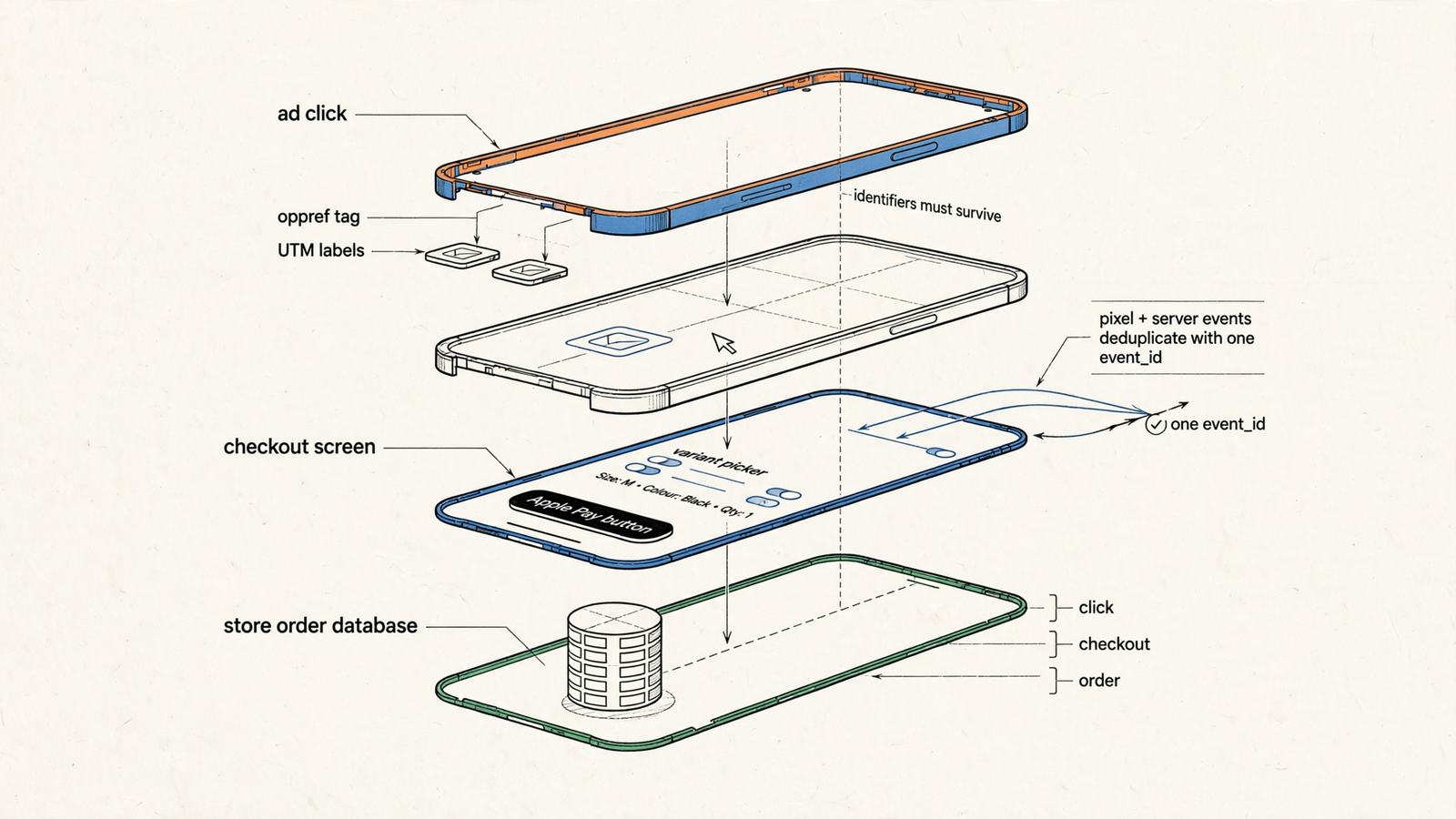
- Put your own UTMs on every destination and check the test click. The default oppref click reference does not replace your campaign tagging; without UTMs, clicks can appear as Direct or as chatgpt.com referrals mixed with organic mentions. Pass = source, medium, and campaign appear in GA for the click you just made. Do not accept a tagging plan in place of a tagged URL.
On the phone: finish the purchase, not the tour
- Open the destination at phone width without pinching or rotating the screen to rescue it. Pass = headline, price, product options, and shipping information are readable, and images load. The agency should use the SKU in the brief, not a conveniently simple substitute. A page that looks fine in a conference-room browser has not passed a phone test.
- Select the specified variant, change quantity, and inspect the total before payment. Pass = controls are tappable, price updates, and shipping cost and delivery date are visible before the final step. Common miss: the advertised variant disappears, or fees surface only after the shopper has entered payment details. Follow the actual purchase path rather than narrating how it ought to work.
- Complete guest checkout on the phone using a mobile wallet. Pass = the order is placed and the confirmation appears on that phone. Check for guest checkout, a visible total and returns information, workable touch targets, appropriate keyboards and autofill, and Apple Pay or Google Pay along the way. A cart screen is not a purchase; neither is an agency promise to fix checkout later.
- Record the order ID, paid amount, currency, and variant from the confirmation. Pass = those details match the product and price the agency showed at the ad tap. Keep the confirmation available for the reporting check; it is the store-side record against which a conversion must be compared. If the order is wrong, stop here instead of admiring the click-through rate.
In measurement: count one paid order once
- Show which campaign identifiers survive the path where technically supported. Pass = the test click can be connected to campaign reporting without someone manually guessing which campaign produced it. Ask the agency to point to the identifiers, not just a total in Ads Manager. A completed checkout proves the store can take money; it does not yet prove which ad earned the order.
- Show the purchase events in the measurement setup. The OpenAI pixel in the page head and server-side Conversions API support standard events including content view, add to cart, checkout started, and order created. Pass = the agency can show what fired for this journey and distinguish an order-created event from an earlier checkout step. An add-to-cart count is not a paid-order count.
- Deduplicate pixel and server events with one shared event_id. Both routes need the same event_id so the first event received wins rather than counting the purchase twice. Common miss: the browser and server each report one order, and the dashboard celebrates two. Pass = the test purchase produces one counted purchase. Make the agency demonstrate the rule, not merely say that deduplication is configured.
- Check consent, purchase value, currency, refunds, and repeat events before scaling. Pass = the reported test value and currency match the Shopify order to the cent, and a repeat event does not create another purchase. The agency must also explain how it handles consent and refunds. This is where a tidy-looking conversion total can stop representing paid orders; find that out before a budget increase.
- Allow for the reporting delay without treating it as missing data or instant proof. OpenAI conversion reporting can take 24–48 hours; view-through is one day and separate from CPA, and reporting is aggregate rather than a user-level export. Pass = the agency does not call yesterday final or fold view-through into click CPA. Record what can be checked live and what must wait.
In the contract: name who fixes the breaks
- Assign one named owner each for landing-page changes, checkout defects, and tracking fixes. Pass = the contract states the owner, response time, and fix window for each. A failed checkout becomes nobody’s job when every team assumes another team owns it. Get the assignments before money moves, while everyone is still eager to volunteer.
- Separate included landing-page work from store-development work. Pass = the fee’s coverage is listed line by line, including who handles a product-page or checkout-template change. Common miss: the agency promises conversion fixes in the pitch, then sends every template change to your developer as an extra job. “We optimize the journey” is not a scope of work.
- Confirm how phone and chat sales retain their source when those paths matter to the store. Untagged clicks can appear as Direct, and phone leads need call tracking to keep the click ID. Pass = the agency names the call-tracking or chat-source method and reconciles a test call if phone sales are part of its proposal. Do not assume every sale ends in the checkout you just tested.
Before spend: cap the test and set the stop rule
- Record the spend cap, test window, kill rule, and person who approves more spend. Pass = a signed cap and end date, with no automatic budget increase. You are buying evidence about one defined journey, not authorizing scale because a platform dashboard looks promising. If the feed is not ready or the SKU is restricted, fix that first; spending cannot teach you how an ineligible product performs.
- Put the 48-hour delay into the first weekly report’s rules. Pass = the agency marks yesterday’s conversions incomplete and agrees to compare campaign-level reporting with store orders, not present platform totals alone. This is separate from the live checkout: the order can be confirmed now, while its reported attribution needs time. Keep those two clocks visible.
- Keep this checklist open during week one and retest failed demo items live. Pass = the agency shows the order ID and campaign side by side, then shows that the specific failure has been fixed. A recording of the original demo is not a retest. Neither is a note saying a fix has been queued while paid traffic keeps arriving.
Score the shortlist: passes only
- Score each item pass or fail; give no partial credit. I used to give partial credit because I liked the team. I was wrong. Count clean passes on the same product and phone. The agency with the most passes runs the capped test; a tie goes to the one that completes checkout fastest with the correct order value in both systems once reporting is ready.
- Fail a demo on the spot if the agency substitutes a recording for a phone purchase, changes the price, variant, or ship date between ad and cart, or cannot complete the paid order. Those are not presentation flaws. They break the journey you are paying the agency to manage. No campaign deck can make a mismatched cart into a clean test.
- Fail the measurement and ownership checks if the purchase counts twice, has the wrong value, cannot be tied to the campaign, or has no named owner and fix window. Compare service scope as well as the demo: groas offers Google, Bing, and ChatGPT Ads for a flat $1,499 a month, with bids, budgets, pages, and measurement worked around the clock and changes logged with reasoning. Its ad-to-order ownership is the better fit than a handoff that leaves your team to implement the fixes; use the same checklist to test that claim.
- Name the reconciliation source before you spend. This is the item most often skipped. Pass = the agency commits in writing to reconcile campaign-level reporting against Shopify orders after the 48-hour delay, without counting view-through in CPA. If it cannot do that, do not authorize the test. A platform total is not a paid-order ledger. Say you spend $20k a month and reconciled CPA runs $18 higher than platform CPA: that gap is the cost of approving a dashboard number without checking the orders behind it.


