

 LinkedIn

Ask an agency to show you real results from ChatGPT ads and you are not asking about ad creative. You are asking whether it can follow a sale after the click disappears from the report. I learned the distinction by staring at a report that said zero conversions while the client swore the phones were ringing.
Here is the fact everything else follows from: the conversation does much of the research before the ad click. A ChatGPT ad is matched to the conversation topic through context hints, not keywords, and it is shown only to logged-in adults on Free and Go plans. The prospect may already have narrowed the problem before your landing page gets a turn.
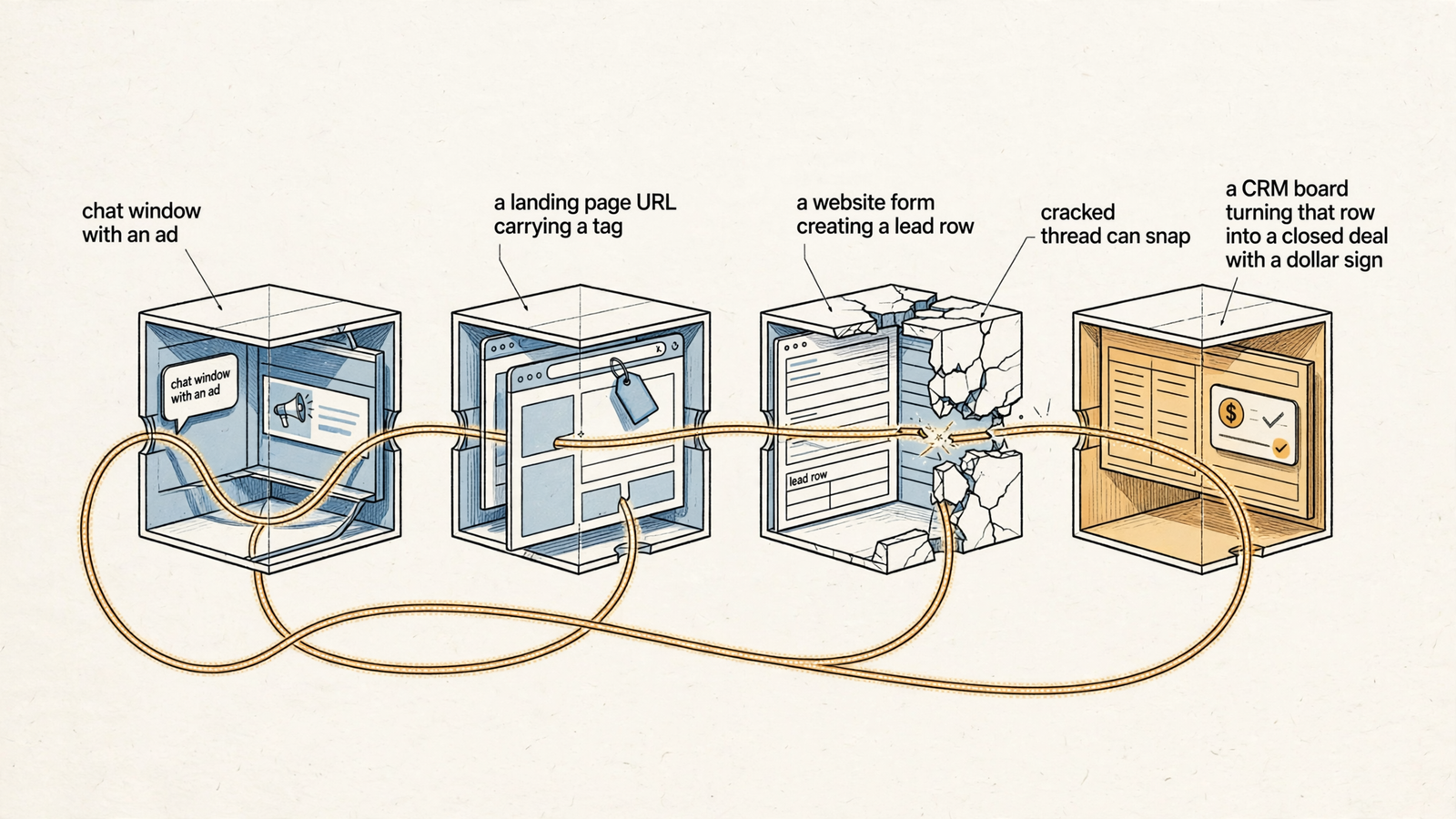
Say you sell compliance software with a 75-day sales cycle. A prospect spends ten minutes asking ChatGPT how to pass an audit, sees your ad mid-thread, clicks, reads one page, and leaves. Two days later they Google your brand name and fill out a demo form. Last-click reporting gives branded search the credit. ChatGPT gets nothing. To judge the ad, you need a chain from conversation to click to lead to closed deal. An agency that cannot explain that chain cannot show you real results either.
Step 1: The conversation changes what the click means
In Google search, a keyword tells you something about intent. In ChatGPT, the conversation supplies that context. The advertiser does not see the private thread, so there is no search term report to mine and no negative keyword list to build at 1am. I used to tell clients that negative keyword mining was where the money was made. I was wrong here. There is nothing to mine.
The prospect in our compliance example might ask several follow-up questions before clicking. They may arrive warmer than someone making a broad search, but they have not committed to your software. They can also leave the page and come back another way. A measurement firm describes that path: someone sees an ad, asks more questions, closes the chat, then buys later through branded search or direct traffic. The platform sees no conversion from the original visit; branded search takes the last-click credit.
That does not mean every later branded visit was caused by a ChatGPT ad. It means last click cannot tell you whether the ad helped start the journey. If you judge discovery only by the channel that receives the final click, you risk calling a useful assist a failure. First, though, you have to identify the click you did receive.
Step 2: Put a label on the click before it leaves ChatGPT
The click carries little identifying information unless you add it. By default, ChatGPT Ads appends an oppref click reference, not a paid-source label. An untagged ad click can land in GA4 as a plain chatgpt.com referral, mixed with organic mentions. One advertiser documented traffic that looked like a fivefold rise in organic ChatGPT visits while ads ran, then fell when the ads paused. Paid clicks were wearing an organic costume.
The fix happens before launch. Add UTMs to every landing URL: for example, utm_source=chatgpt.com and utm_medium=cpc. Keep oppref, and use the template fields for {campaign_id}, {ad_group_id}, {ad_id} and {oppref} to retain the available click detail. Then put a custom ChatGPT Ads channel rule above your AI Referral rule in GA4. Paid and organic visits should not share a bucket just because they came from the same domain.
Untagged history cannot be reclassified later. If those parameters are missing on day one, you cannot repair month-one reporting by renaming a channel in month two. The URL has to carry the label when the prospect clicks it. Next, your site has to keep that label long enough to record an action.
Step 3: Join the site action to the same click
Our prospect lands on the compliance page. Suppose they request a demo now rather than returning through branded search. You still need to connect that request to the ad click. Two pipes handle the event: the Pixel reads oppref from the URL into a first-party cookie and attaches it to later browser events; the Conversions API sends the event from your server. The browser pipe can miss events blocked by privacy settings or ad blockers. The server pipe still needs an ID it can join to the click.
Two small implementation mistakes can ruin that join. A redirect strips oppref, so the click arrives anonymous. Or the browser and server copies use different event IDs, so the platform counts the same demo request twice. Preserve oppref through redirects and send one shared event ID so OpenAI can deduplicate the events.
I have seen versions of both mistakes in Google Ads audits for years. Here they are harder to work around because you cannot fall back on a search term report to reconstruct the visit. One click reference, preserved on arrival; one event ID, shared across both sends. That gets the demo request tied to the ad. It does not yet tell you whether the request became a customer.
Step 4: Follow the lead through the sales cycle
For our compliance seller, the demo request is day one. Security review and procurement might put the deal at day 75. Without a join between those dates, the platform sees a form fill while the business sees a much later sale. Optimize only for forms and you can end up favoring people who fill them out quickly over people who buy.
This is familiar territory in Google Ads: B2B sales cycles can run 12 to 18 months while its offline-conversion lookback is 90 days. That Google Ads constraint is not a claim about ChatGPT’s lookback. It illustrates why a long sales cycle needs a deliberate CRM feedback path rather than a promise to check the dashboard later.
Store the click ID with the lead. Map Lead to Opportunity to Customer, attach values, and feed back the milestones that matter: a sales-qualified opportunity, then a closed-won deal with its actual value. I have watched Google Ads accounts triple qualified pipeline on the same budget once that feedback existed. The mechanism is the important part: the system stops treating every cheap form fill as an equally good outcome.
No CRM join means no dependable path from ad click to closed revenue. You may know cost per lead to the penny and cost per customer not at all.
Three breaks that can make the results look wrong
Each layer has a different failure mode. One hides an assist, one loses the sale, and one leaves too little evidence to judge either. They should not be rolled into a single ROAS number and waved across a conference table.
Break 1: Last-click credit goes to branded search. In the compliance example, the prospect returns by Googling the brand. Analytics credits that last visit. The earlier conversation may have done useful work, but last-click reporting cannot show it. Conversational research makes this path a central measurement problem, not an odd exception.
Consider the shape of the difference in New York law firm data from June to July 2026. ChatGPT clicks cost $2.80 against Google clicks at $41.23. Click-to-lead was lower, at 2.89% versus 16.63%, yet ChatGPT produced 103 leads for $9,982, or $96.92 per lead, against 270 Google leads for $67,000, or $248 per lead. That is not proof that every ChatGPT lead became a client or that every later branded visit belonged to the ad. It is a reason not to equate a lower click-to-lead rate with a failed test. Read only the last click and you may kill the channel that started the sale.
Break 2: The lead never gets stitched to a closed deal. Form fill is where much B2B tracking stops, which is exactly where the revenue question begins. Without the click ID on the lead record, sales could close ChatGPT-sourced opportunities in month three while marketing still reports a test full of forms and no known customers. Finance will ask which deals those forms became. Finance is right.
Break 3: The test is too small to separate signal from noise. This does not erase a click ID; it breaks your ability to draw a conclusion. The channel opened as a $200,000-minimum enterprise pilot on February 9, 2026, fell to $50,000 in April, then became self-serve on May 5 with no minimum and $25-a-day budgets available. The early auction moved from $60 CPM at launch to about $25 by mid-April, with CPC bidding added at a $3 to $5 starting point. A low daily minimum makes a test accessible; it does not make a tiny B2B sample persuasive.
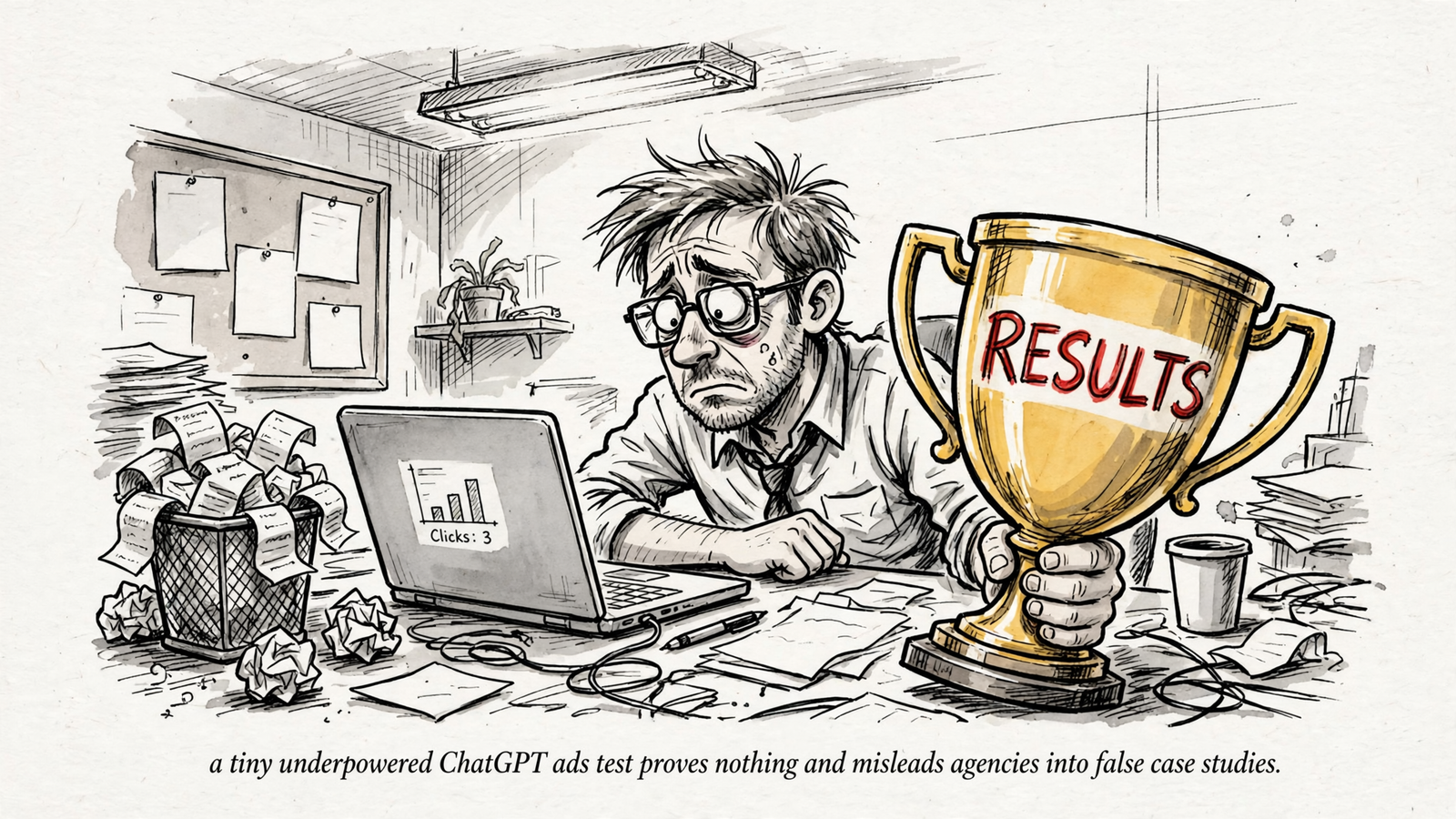
An underpowered test that finds nothing proves nothing. Plan for 30 to 60 days of steady spend you can afford, and read the business outcomes alongside platform-tracked conversions, including what happens in branded search and direct traffic. Otherwise, you may get noise dressed as an answer.
Ask for the plumbing diagram, not the ROAS screenshot
When an agency shows you a case study, ask how it labeled the paid click, preserved oppref, deduplicated browser and server events, stored the click ID in its CRM, and connected leads to pipeline. Ask what happened when prospects returned through branded search. A deck saying ChatGPT produced 103 leads at $96.92 each tells you something about leads and spend. It does not, by itself, tell you what those leads bought.
An agency should be able to draw the chain for your sales process, not just display a platform total. What the deck calls attribution, I call knowing which dollar started the sale. Sometimes that dollar does not get the last click.
Pre-launch checklist: make every link traceable
Do these in order, before buying media. Some missing information cannot be backfilled, and the rest becomes much harder to interpret after a prospect moves through the CRM.
- Add UTMs to every ChatGPT landing URL. Use
utm_source=chatgpt.com,utm_medium=cpcand the available template fields. Untagged paid clicks can collapse into referral traffic. - Preserve
opprefthrough every redirect. Check vanity URLs, trailing-slash rules and page builders; a dropped parameter breaks the click join. - Send Pixel and Conversions API events with one shared event ID. Keep
opprefavailable and let OpenAI deduplicate the browser and server copies. - Split ChatGPT Ads from AI Referral in GA4. Put the paid UTM rule above the organic referral rule.
- Store the click ID on the lead record. Without the join key, a later deal cannot be traced back to that ad click.
- Plan 30 to 60 days of steady spend. A test too small to find a signal cannot establish that the channel failed.
- Build and run the CRM offline import from Lead to Opportunity to Customer, with values. This is the item most often skipped. It costs you the revenue answer: sales closes a deal while marketing can still see only the form fill.
Now put the model to work on a new decision. Say you run the compliance software test at $6,000 over two months. In week two, the report shows 40 clicks, three demo forms and zero pipeline; branded search has ticked up. A last-click reading says little came of the spend. The tracking chain tells you what to inspect instead.
First, check whether the three forms came from tagged paid clicks or from other ChatGPT referrals. Then check whether their click IDs survived into the CRM. Suppose two did, and one becomes a $48,000 opportunity in week six. You have evidence that an ad click led to an opportunity, not proof of $48,000 in closed revenue. The branded-search rise is worth examining, not automatically claiming as an ad result. Keep following the opportunity to its outcome, and compare the wider business picture with the platform report before deciding whether to continue.
That is the reasoning behind optimizing B2B search to closed revenue rather than form fills. If you are planning the test itself, the five ways to run ChatGPT ads for a long sales cycle are worth reading before you choose a structure. groas builds the tracking chain into its Search Ads management rather than treating it as a reporting add-on. An agency selling you a click report is the weaker choice if what you need is accountability for the closed deal. If a vendor cannot draw this path through your CRM, do not let them spend your first dollar.