LinkedIn

Port your best Google Ads keyword list into ChatGPT Ads and you may buy clicks from people you never meant to reach. The problem is not that the keywords need updating. The unit being matched has changed.
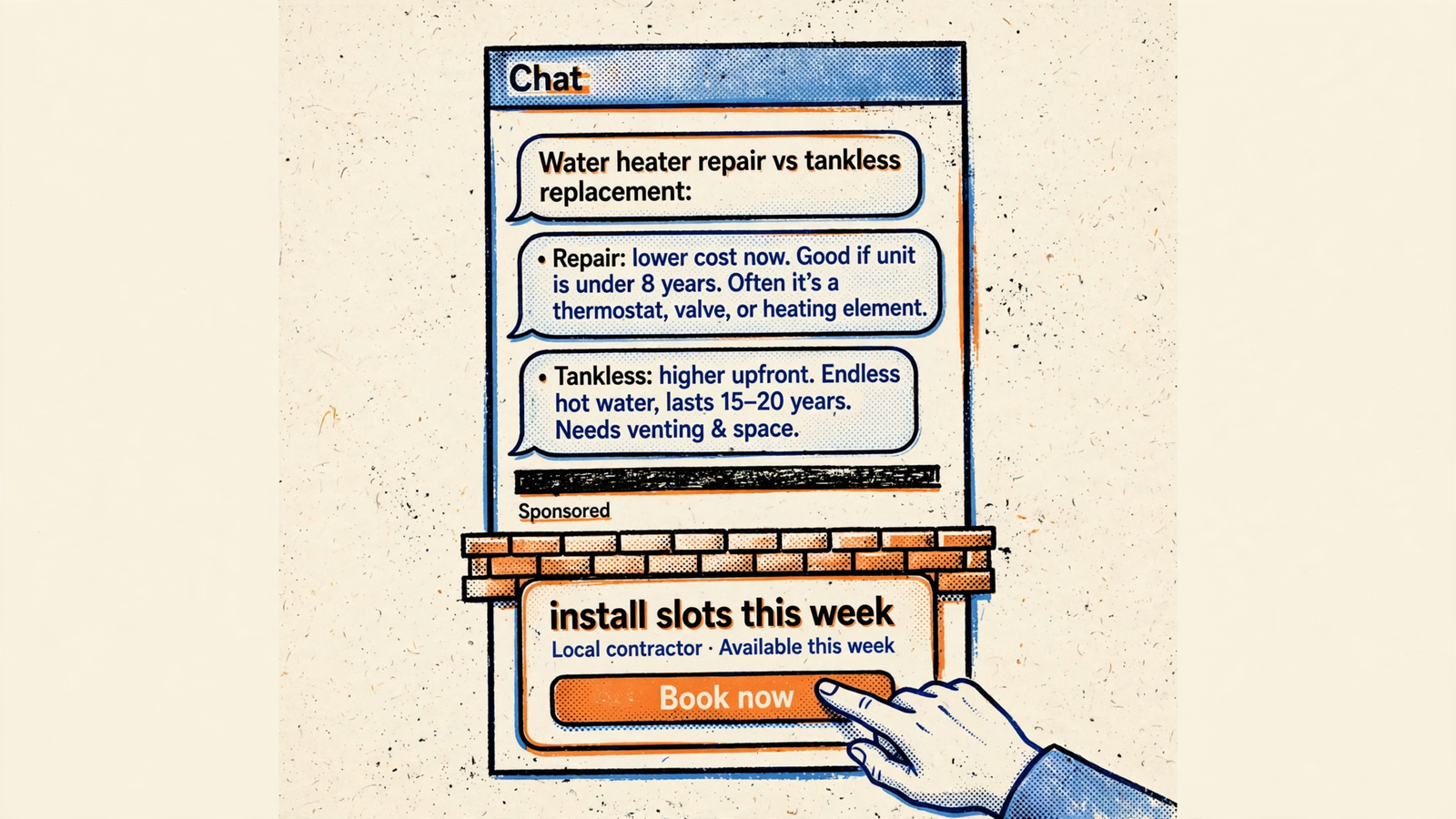
Consider a homeowner looking for help with a water heater. On Google, they type emergency plumber water heater leaking. In ChatGPT, they spend five minutes talking it through. They start with “my energy bill jumped $60, is my 12-year-old water heater dying,” compare tank and tankless costs, and eventually ask who can install one this week. Google receives a query. ChatGPT receives a conversation that develops as the person learns. That distinction explains why the ad, the click and the landing page have to work differently.
Start with the Google auction: one query at a time
Every Google search runs a real-time auction where Ad Rank determines whether an ad shows and where it appears. Your bid matters, but so do auction-time quality, thresholds and context such as location, device and available assets. The highest bid does not automatically win.
Keywords help determine which searches you can enter. Your keyword need not be identical to the query: broad match can reach a wider range of related searches, while phrase match allows variations around the same meaning. Match type is a way of telling Google how much variation you will tolerate. Whether the match is tight or loose, the immediate event is still one person typing one query. Google judges your ad against that query at that moment.
Quality Score often gets treated as the auction’s final grade. It is not. It is a 1–10 diagnostic based on expected click-through rate, ad relevance and landing-page experience; the displayed number itself is not used directly in the auction. Auction-time judgments about quality affect position and price. The distinction matters because polishing a displayed score is not the goal. Giving a searcher a relevant ad and a page that helps them finish the job is.
I used to reduce landing-page advice to load speed and a keyword in the H1. That was too narrow. A fast page headed “Water Heater Repair” can still be the wrong destination for someone trying to book an emergency visit. I covered the components of Quality Score and their relationship to CPC and position elsewhere. For this comparison, keep the simpler point: the query gives you a fairly specific promise to make, and the page has to keep it.
Our homeowner’s Google query includes “emergency,” “plumber” and “leaking.” An emergency service page is a sensible response. But that page cannot assume every person discussing an old water heater in ChatGPT has a leak. We need the next layer of the model.
In a chat, the situation develops across turns
Return to the conversation. The first turn describes a symptom: an energy bill up $60. A later turn compares repairing a 12-year-old tank with switching to tankless. The last turn asks who can install this week. At each point, the person has a different question, while the earlier questions still help explain it.
ChatGPT ad selection considers the current conversation’s context and intent, along with the ad’s landing page, title, copy and supplied context hints. Broader ChatGPT signals may also be used when ads personalization is on. It cannot read a future turn: an ad considered after the bill question has only the conversation so far. By the install question, it has more context to work with. That is the mechanism behind matching an ad to conversation context rather than a single typed keyword.
In Google, emergency plumber water heater leaking tells you a great deal about the immediate task. In ChatGPT, “is my water heater dying” does not tell you whether the person wants a repair, a replacement comparison or an installer. Treating that sentence as a keyword discards the rest of the exchange.
Instead of importing a keyword list, advertisers can supply plain-language descriptions of conversations where an offer fits, known as context hints. OpenAI says these are not exact-match keywords and do not guarantee delivery. For our plumber, a hint might describe a homeowner weighing repair of an old tank against tankless replacement, including cost and installation timing. That description covers several ways a person might phrase the same decision. Describe the buyer’s situation, not merely the words they might type.
Calling this “bidding on a situation” is useful shorthand, but it has a limit: the hint is not a keyword you buy outright. It helps the system judge relevance; your bid and the rest of the ad still matter. Keep that distinction when you build an account, or you will expect keyword-level control from a different kind of matcher.
The answer comes first; your ad has to earn the next click
Matching is only half the change. Placement changes what the advertiser is asking for.
ChatGPT ads appear as labeled Sponsored cards below the response, separate from the answer. OpenAI’s stated principle is that advertisers cannot pay to put their message inside the organic answer or influence what it says. Testing began in the US on Free and Go plans in February 2026. The card has its own relevance-weighted second-price auction, but it does not replace the response above it.
For the water-heater conversation, the person may already have read an explanation of tank versus tankless by the time they see the plumber’s card. An ad that says only “Learn About Tankless Water Heaters” offers more of what they just received. A card that helps them take the next step has a clearer job: move from a general comparison toward a local cost or an available installation slot.
That does not mean every chat user is ready to book. The person asking about a higher bill may still be diagnosing a problem; the person asking who installs this week is further along. Write for the decision the conversation has reached, not the topic it happens to mention. A Google-style headline may work at one point in that path and sound redundant at another.
Build targeting around situations, not borrowed ad groups
Google structures encourage you to group keywords, choose match types and exclude unwanted queries. ChatGPT Ads does not offer that same keyword-and-match-type workflow. Context hints let you describe relevant conversations, while the available controls differ from Google’s familiar negative-keyword lists. You cannot assume a long list of exclusions will repair a loose description after the fact.
Take tankless water heater install. As a Google keyword, it names a service. As a description of a conversation, it leaves out the interesting part: why the homeowner is considering an install now. Compare it with “homeowner with a 10-plus-year-old tank weighing repair against tankless replacement and asking about cost and timing.” The second version gives the matcher a situation, not just a product and a verb.
I would begin with a handful of distinct situations, not fifty variations of “needs plumber.” In our running example, they might include:
- A homeowner deciding whether to repair an aging tank or replace it.
- A shopper comparing tankless options before choosing an installer.
- A homeowner ready to arrange an installation this week.
Those are not three ways to spell one keyword. They are three different decisions, each likely to need different copy and a different first screen after the click. Keep situations separate when the next useful step changes.
This is also where porting an account becomes expensive. A Google campaign may group repair and replacement terms under a service-area structure that works for typed searches. Reusing that structure can put the same broad card in front of someone diagnosing an energy bill and someone trying to book an installer. Both care about water heaters. They are not asking for the same help.
Make the card the next turn, not an echo
On Google, Same-Day Water Heater Install can be a strong answer to a same-day installation query. In a chat, its value depends on what the conversation has established. If the homeowner has spent several turns comparing replacement costs and has just asked about availability, the headline may be timely. If they are still wondering whether their tank needs replacing, it jumps ahead.
For the later-stage conversation, I would test copy along the lines of 12-year-old tank? Compare repair and tankless costs, then check this week’s install slots. It connects the question the homeowner worked through to the action the plumber can offer. For the earlier-stage conversation, the install-slot promise may be premature. The point is not to find one clever headline for every turn. It is to make the card follow logically from the conversation it appears beside.
That discipline is more useful than stuffing the card with the phrases you used to bid on. Early advertiser reports put ChatGPT ad click-through rates across a wide range; a number alone will not tell you whether the reader had reached the decision your copy assumes. Read the card and the conversation together. If the card answers a question nobody asked, rewrite the situation before you raise the bid.
Give the landing page the context the click cannot carry
A ChatGPT visitor arrives with a conversation in mind. Your landing page cannot assume they will start again from your generic service headline. It also should not pretend to know details the visitor has not given you. The useful middle ground is a page built around the situation the ad targeted.
For our repair-versus-replacement homeowner, that page should acknowledge the decision in a sensible order: what keeping the 12-year-old tank might involve, how tankless installation compares, and what it would take to check an installation window this week. A page that opens only with Emergency Plumber, Call Now skips the comparison that brought this visitor to the card. It may suit the leaking-heater Google query perfectly and still be the wrong continuation of this chat.
The landing page also contributes to how the ad’s relevance to the conversation is assessed. A page aligned with the hint and card gives the system a clearer account of what the advertiser offers, and gives a person who clicks a more coherent next step. Neither alignment nor good copy guarantees an auction win or a booking. If the conversation did the diagnosing, the page should help with the decision.
That suggests a different production unit. Do not build one page for every old keyword. Build a page for a situation worth targeting, then make sure the hint, card and first screen all describe the same decision. If you cannot explain why this visitor would want this page after reading the answer, the path is not ready for paid traffic.
Run two new cases through the same model
First, imagine a six-turn conversation comparing three tankless brands by flow rate, warranty and installation cost. The homeowner then asks which suits a family of four. The accumulated context points to a product-and-install decision, not an introduction to tankless heaters. A hint about a family comparing tankless models for purchase and installation fits that situation more closely than “licensed plumber near you.” The card should offer a next step the general comparison has not settled, such as checking installation cost and timing. A generic local-plumber card may be relevant in the broadest sense, but it does little to show why this particular shopper should click.
Now change one fact: the homeowner never names a product. They ask whether replacing a working 12-year-old tank now makes financial sense compared with waiting for it to fail. They ask about gas bills, rebates and the cost of water damage. The model gives a different answer. The strongest situation description concerns replacement timing and cost anxiety, not brand comparison. A card offering a way to compare repair and replacement costs fits that path better than one shouting “Same-Day Install.” Speed was not the question. Same category, different decision, different ad path.
This is why I would run Google Ads and ChatGPT Ads with shared measurement but separate intent maps. Both need honest landing pages, conversion tracking and a consistent definition of a qualified job. Their targeting structures should not be copies: keywords address searches; hints describe conversations. Their budgets also need their own assessment because advertisers can set a max CPM for views or a max CPC for clicks. OpenAI recommends starting with a $3–$5 max CPC, while early field reports place many actual CPCs in that band. Those figures are starting context, not a reason to reuse a Google bid or assume the same conversion rate.
At groas, we run Search Ads across Google, Bing and ChatGPT under one flat fee, with shared measurement and separate intent maps. The point of keeping those maps separate is practical: the ChatGPT campaign should not inherit a keyword build simply because that build already exists.
Test the intent map before you test the budget
Before moving spend, write down three to five conversations you actually want to reach. For each one, answer three questions in order:
- What has the person learned or decided by this point in the chat?
- What decision remains, and what can your business do about it?
- Do the hint, card and first screen of the page all address that same decision?
Our homeowner who wants an installer this week should reach a different first screen from the homeowner still doing repair-versus-replacement math. You can see that mismatch on paper, before paying to discover it through clicks. If every situation leads to the same Google headline and the same generic page, make the situations sharper. A budget will tell you how quickly the ads run. An intent map tells you what you are trying to learn.
I used to tell clients that tighter ad groups, cleaner match types and longer negative lists were the edge. They still matter on Google. But they do not explain how to meet someone at the end of a five-turn conversation. For that, you have to read where the person has arrived and offer the next useful step. Port the keyword list and you buy the mismatch. Map the situation and you have a chance to buy the decision. Your keywords were never packed for that trip.