Seven days is a convenient answer to the wrong question. If you want to know how long the Google Ads learning phase lasts, measure the conversions and conversion lag in your own account, then test which edits bring Learning back.
I revisited this after What I Got Wrong About the Google Ads Learning Phase because the seven-day rule hides how much duration depends on volume and setup. Replacing that rule with another neat number would not help. This is a protocol for finding your account’s number: hold one campaign steady, log a learning period, make one controlled edit, and wait long enough for conversions to catch up before judging the result.
My expectation is that the answers will vary more than an agency slide deck suggests. A campaign with frequent, prompt conversions gives a bidding strategy more observations sooner than one whose conversions arrive slowly. The badge may tell you when Google considers a strategy eligible, but it cannot, on its own, tell you whether CPA has settled. Test both.
Question: How long does Learning last in this account?
Record two outcomes, not one:
- Time to exit: How many calendar days and primary conversions pass between a logged change and a transition from
Learning to Eligible?
- Response to an edit: Does a specified change bring back
Learning, disturb performance without changing the badge, or do neither?
According to Google’s Smart Bidding documentation, learning duration depends on conversion volume, conversion-cycle length, and bidding strategy. That is why the clock on your wall is a poor control. A store recording 40 purchases a day and a B2B campaign recording 12 demo requests a month do not feed the same amount of information to the system in a week.
Treat the badge as an observation, not a verdict. The test is useful only if you also record what changed, when it changed, and how mature conversion data looks afterward.
Setup: choose one campaign and define the controls
Pick one Search or Shopping campaign with predictable spend, roughly $50 to $300 a day, and no major structural overhaul in the past two weeks. Do not spread this test across an account: you need to know which edit belongs to which result. If the campaign is already Eligible, you can establish a clean baseline before making a planned change. If it is already Learning, begin logging now, but check its change history before attributing the transition to any particular edit.
Check two prerequisites before the first entry:
- Primary conversion quality. Confirm that the campaign optimizes toward qualified leads or completed transactions rather than treating scroll depth or newsletter signups as equivalent business outcomes. More observations are not useful if they measure the wrong thing.
- Conversion lag. In Google Ads, use Segment > Conversions > Days to conversion to inspect the delay between a click and its recorded conversion; Search Engine Land’s guide to the segmentation describes the view. Estimate the point by which about 85% of conversions have arrived. If that takes two days, use two days as your working lag window. If it takes 14, use two weeks. Do not call a recent CPA swing permanent while the relevant conversions are still arriving.
Open a spreadsheet with Date, Bid Strategy Status, Cumulative Conversions, and Action Notes. Include spend and the timestamp of each deliberate edit in your notes. Check Change history for recent budget, target, asset, and strategy changes made by anyone with access to the account. An unlogged edit ruins the clean comparison.
Hover over the Bid Strategy Status column and record any explanation shown with Learning. Google’s status documentation distinguishes a new strategy, a setting change, and a composition change. Those labels help you identify what the interface reports; your change log tells you what actually happened in the account. Start with a record you can trust, not a memory of when someone last touched the budget.
Protocol: hold steady, then change one thing
Step 1: log a baseline without touching the controls
Leave targets, daily budgets, negative keywords, and ad assets alone for 7 to 10 days. Every morning at the same hour, record the status badge, conversions recorded over the trailing 24 hours, and spend. Resist the urge to fix an intraday CPC spike during the test. That urge has wrecked cleaner experiments than this one.
If the campaign begins in Learning, note the first morning it appears as Eligible and how many primary conversions you recorded along the way. Daily checks give you an observed day of transition, not an exact minute. If it begins in Eligible, this period establishes a baseline for the controlled change in Step 2. Change history can help identify the last major edit; it cannot reconstruct the precise moment a badge cleared if nobody logged it.

Step 2: observe a learning period you can date
If Step 1 captured a transition from Learning to Eligible, use it as your first time-to-exit observation. Otherwise, make one planned change that could start a learning period, such as a bid-strategy switch from Maximize Clicks to Target CPA. Write down the timestamp and the previous status. Do not also change the budget or conversion goal. Then continue the same daily log until the status changes, or record that no Learning period appeared during your observation window.
Count elapsed days and primary conversions. An industry report discussing Smart Bidding learning describes a benchmark of roughly 50 conversion events or three conversion cycles after a shift. Use that as context, not as a promise that your badge will clear on event 50. A campaign recording 15 purchases a day can collect observations far faster than one recording two demo bookings a day. Your log tells you what happened here.
Do not launch a fresh campaign merely to get a convenient start time. That would change too much of the setup at once. If a planned strategy change is not appropriate for this campaign, keep the baseline and skip the induced time-to-exit measurement. A smaller honest test beats an expensive clean-looking one.
Step 3: probe a possible reset with one deliberate edit
Once the campaign has spent at least five consecutive days in Eligible, choose one lever: increase the daily budget by 25%, or shift the Target CPA target by 15%. Log the exact time. For the next 72 hours, check Bid Strategy Status twice daily while continuing to record spend and conversions. Leave every other control alone.
If the badge returns to Learning, record the stated cause and the time it takes to return to Eligible. If it stays Eligible, do not declare the change free. Compare impression pacing, average CPC, and eventually lag-adjusted CPA with your baseline. Practitioners sometimes call a disruption without a visible status change ghost learning; this discussion of budget-change rules illustrates the concern. The term is not a Google status, and a few unsettled hours do not prove that recalibration occurred. Write down what you observe rather than naming the cause early.
Step 4: try one routine edit as a comparison
Wait until the campaign has returned to Eligible for at least five days. Then choose one maintenance edit: add ten negative keywords drawn from the search terms report, or update one responsive search ad headline. Again, timestamp it, change nothing else, and repeat the status and performance log.
The point is to compare the campaign’s response to different kinds of edit, not to certify all small edits as safe. Practitioner breakdowns of learning triggers distinguish strategy and goal changes from routine maintenance. Your account may still react differently. If the badge holds and mature performance remains steady, you have evidence about this edit under these conditions. If either moves, note it and investigate before setting a maintenance rule.
Measurement: separate the badge from the business result
For each observed change, record three measures:
- Days to status transition: Count from the logged edit to the first observed move from
Learning to Eligible. State your check frequency alongside the result.
- Conversions during that interval: Count primary conversion actions recorded while you watched. Keep this next to days-to-exit so a short calendar interval does not disguise thin conversion volume.
- CPA or ROAS after the lag window: Compare performance only after the conversions associated with those click dates have had time to arrive.
The last measure is where impatient account reviews go wrong. Google’s conversion-lag documentation explains the reporting delay: conversions can be attributed back to the ad-click date after that date’s first numbers appear. Recent days therefore tend to show incomplete conversion totals. CPA can look inflated and ROAS suppressed before those totals fill in.
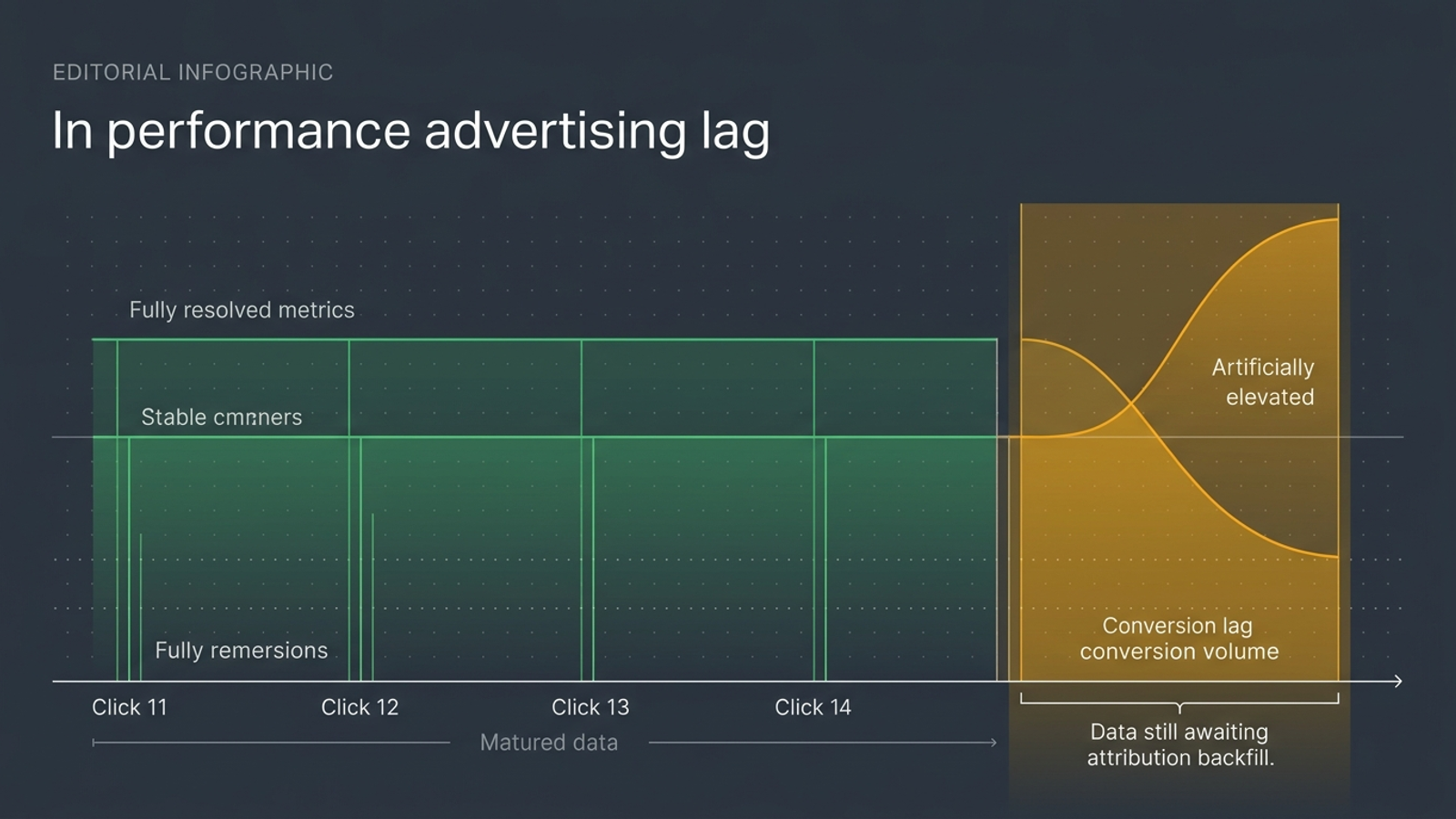
Use the lag window you estimated in setup. If about 85% of conversions arrive within five days, exclude the trailing five days from a performance judgment. Compare the 14 days immediately before the probe edit with a mature 14-day period after it, waiting for that later period’s lag window to close. This practitioner discussion of conversion lag makes the same practical point: an early read can confuse delayed reporting with a bidding problem.
A comparison is not a laboratory proof that the edit caused every CPA movement. Demand, competitors, and the auction still exist. But recording the same measures before and after a single timestamped change gives you a far better basis for a decision than checking a green badge and announcing that everything is fine.
Read the result without making the badge do too much
If it exits quickly
Check the conversion count first. A quick transition alongside dense primary-conversion volume is more reassuring than a quick transition after only three or four conversions. The first gives the strategy more observations to work with; the second gives you a status change and a reason to keep watching mature performance. Eligible does not mean CPA is stable. Do not promote a short time-to-exit into an operating rule until the lag-adjusted comparison supports it.
If it remains in Learning
Check whether conversion volume is thin, conversion lag is long, or another edit has interrupted your observation. A campaign still in Learning after 14 days, or showing Learning (Limited), deserves that diagnosis before another target adjustment. In this discussion of repeated learning triggers, the familiar failure mode is an operator reacting to one alarming day by changing settings again. Each new intervention makes it harder to tell whether the previous one had settled.
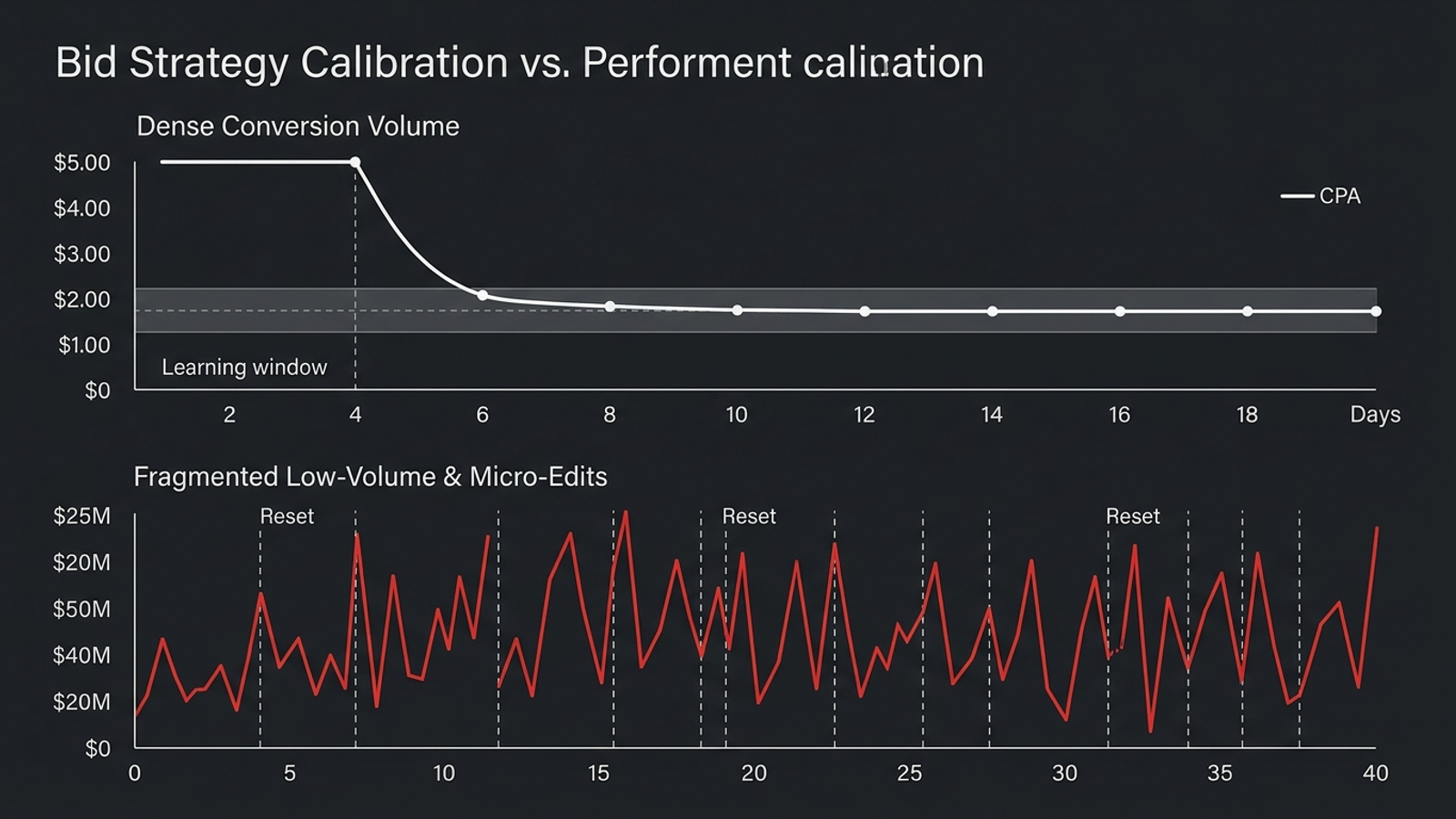
Do not assume that fragmentation is the cause without checking the log. If low conversion volume is the constraint, consider whether fewer, higher-volume campaigns would give the strategy a clearer signal. If someone has been editing every few days, stop the edits first. You cannot measure a settling period while repeatedly restarting your observation.
If different edits produce different responses
Put your results side by side: edit type, daily conversion volume, days to exit, badge response, and mature CPA or ROAS. The guide to learning-phase duration and reset edits is useful context for why conversion density matters, but your own entries decide your cadence. A 20% budget change that looks uneventful in a high-volume campaign is not permission to make the same change in a low-volume one without watching it.
One run gives you an observation, not an exact universal reset threshold. If the budget probe disturbed performance and the maintenance edit did not, you have a practical distinction worth testing again when another appropriate edit is due. If neither changed the badge but CPA moved after the lag window closed, the status column was not enough. Either result improves the way you operate.
Decision: set a cadence your data can support
Use the measured conversion lag and observed settling time to decide how often you can reasonably change targets or budgets. If conversions commonly take six days and a setting change takes five days to settle, adjusting twice a week gives you little clean time in which to evaluate either adjustment. Batch planned structural changes into a scheduled maintenance window, then leave the campaign alone long enough to read it. Keep routine hygiene separate so you can see what each class of edit does.
That is also why I do not buy the percent-of-spend playbook that presents constant manual dashboard checking as strategy. I have spent enough late nights staring at bid adjustments to know that attention is not the same thing as a useful decision. A person checking periodically can miss a developing problem; a person reacting to every dip can create one. This is the operating friction behind groas: autonomous bidding, budget pacing, and search-intent work inside defined guardrails, with a named human strategist responsible for direction and attributable revenue rather than hours spent watching a status column.
If your test shows a short, stable learning period, you can plan changes around that observed window. If it shows slow exits, repeated disruptions, or performance swings hidden by an Eligible badge, change the cadence and the signals you monitor. Either way, stop asking seven days to do a job your account’s own log can do better.