

 LinkedIn

A $750 ChatGPT ads test produced 13 conversions. That sounds like a result until someone asks how much the observed CPA could move if just a few more people had converted. Thirteen conversions are a starting observation, not proof of a repeatable CPA.
The test delivered 27,714 impressions and 272 clicks at a $2.76 average CPC, putting those conversions at $57.69 each. An agency can put that number in a deck. I would rather know what happens when the next 272 clicks arrive.
At the CPCs in early published tests, a $500 to $1,500 budget can buy anything from a handful of conversions to a few dozen. Most plausible cells in the table below buy far fewer than an agency needs to distinguish a good campaign from luck. The calculation is simple: budget divided by CPC gives clicks; clicks multiplied by landing-page conversion rate gives expected conversions. The hard part is being honest about what the resulting count means.
The number missing from the small-test pitch
The pitch usually goes like this: give us $750 for media and a management fee on top, and we will show you real results from ChatGPT ads. The deck defines results as impressions, clicks and perhaps a CPC that looks cheap next to Google. It rarely starts with the denominator that matters for judging CPA: how many people actually converted.
The published examples do not all tell the same happy story. One B2B test spent $2,319 for 739 ChatGPT clicks and produced zero MQLs, while Google produced two MQLs in the same period. Another reported 97,000 impressions, 1,263 clicks and very few sign-ups. Those are individual tests, not a forecast for your account. They do show why a click total cannot settle the question.
I used to tell clients a small test buys learning. I was too loose with that word. A small test can tell you whether an ad serves, whether tracking works and whether visitors take an initial action. It does not necessarily buy enough conversions to establish a dependable CPA. When you have 200 clicks, the difference between four conversions and nine may reflect a handful of people, not a campaign breakthrough.
So before anyone calls a small test a win, I want three assumptions in writing: CPC, landing-page conversion rate and the conversion event being counted. Without those, real results means whatever fits on the slide.
The assumptions behind the table
I use $2.50, $4.00 and $6.00 CPCs. A review of 24 published campaigns found dollar-billed CPCs from $0.76 to $13, with half below $4.41. A separate setup guide describes a $25 daily minimum and a $3 to $5 recommended starting max CPC. Those sources describe different things: observed CPCs in published campaigns and a suggested starting setting. Together, they make the model’s range useful for planning, not a promise about the price you will pay.
Yes, cheap clicks exist. One B2B compliance case reported $0.76 in ChatGPT against $10.46 in Google. I would not build a budget around the cheapest case in a collection of early tests. If your account gets that CPC, the table will be pleasantly wrong.
For landing-page conversion rate, I use 1%, 3% and 5%, measured from click to the hard action you care about. A broad benchmark reports a 6.6% median across 41,000 landing pages, but a blended landing-page figure is not a forecast for booked demos or customers from a new ad placement. In four same-advertiser comparisons, reported ChatGPT conversion rates were 0.46% against Google’s 5.3%, 0.21% against 3.71%, 0.9% against 5.95%, and 0.8% against 6.64%. Those cases cannot establish a universal ChatGPT rate. They are enough to make me wary of treating 5% as the default.
I would read 1% as the cautious hard-conversion case, 3% as a generous planning case and 5% as an upside case for a lower-friction action. None is a platform benchmark. They are stated inputs so you can replace them with your own page rate. Change the assumptions before you trust the output.
What $500 to $1,500 buys at those CPCs
The table uses the published CPC range and the landing-page-rate scenarios just stated. Clicks equal budget divided by CPC, and expected conversions equal clicks multiplied by the stated rate. I have rounded the displayed counts to whole numbers for readability. They are expectations, not conversions an advertiser can order in advance.
| Media budget | CPC | Approx. clicks | At 1% | At 3% | At 5% |
|---|---|---|---|---|---|
| $500 | $2.50 | 200 | 2 | 6 | 10 |
| $750 | $2.50 | 300 | 3 | 9 | 15 |
| $1,500 | $2.50 | 600 | 6 | 18 | 30 |
| $500 | $4.00 | 125 | 1 | 4 | 6 |
| $750 | $4.00 | 188 | 2 | 6 | 9 |
| $1,500 | $4.00 | 375 | 4 | 11 | 19 |
| $500 | $6.00 | 83 | 1 | 2 | 4 |
| $750 | $6.00 | 125 | 1 | 4 | 6 |
| $1,500 | $6.00 | 250 | 3 | 8 | 13 |
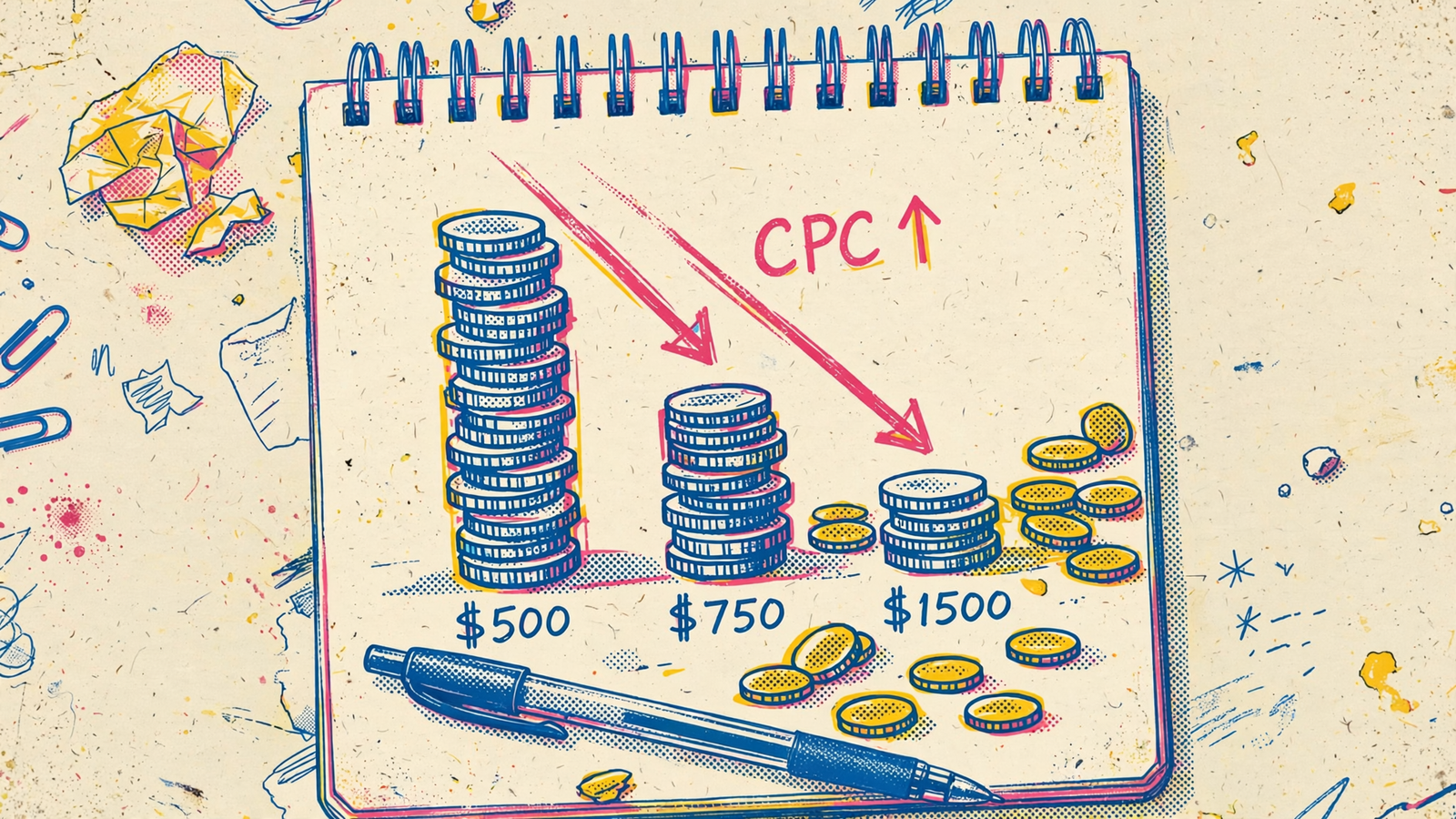
The table’s most optimistic cell reaches 30 expected conversions. At $750 and a $4 CPC, even a 3% page produces only about six. That is the problem with a small-test promise: the budget can be enough to run ads and still be too small to answer the question in the proposal.
Why six conversions make CPA wobble
Take the $750, $4 CPC, 3% cell. The model gives you roughly 188 clicks and six conversions. Six conversions put the observed CPA around $125. If four people convert instead, it is $187.50. If eight convert, it is $93.75. Nothing about the media budget changed; a few people changed the headline.
That illustration is arithmetic, not a statistical confidence interval. As a rough indication of how much uncertainty falls with count, 10 conversions still imply a wide CPA range; 30 are better; 100 are better again. A testing guide uses 100 conversions per variation as a readability bar before calling a winner. That is guidance for a comparison, not a rule that every campaign suddenly becomes trustworthy on its hundredth conversion.
There is also a difference between judging an outcome and giving an automated bidding system enough recent outcomes to work with. A guide to Google’s bidding thresholds cites at least 30 conversions in the last 30 days for Target CPA and 50-plus for Target ROAS. Those are Google bidding figures, not ChatGPT test requirements. They illustrate why six conversions spread across a test do not become a sturdy optimization signal just because a report has a CPA column.
At a $4 CPC and $25 a day, the model buys about six clicks daily. At a 3% conversion rate, that works out to roughly one expected conversion every five or six days. Reaching 30 would take about 160 days at that pace; at 1%, roughly 480. Those are projections from fixed inputs, not predictions that the market, page and traffic will hold steady for months. They show the scale of the gap between a $750 test and a claim about stable hard-conversion CPA.
A six-conversion test can report its observed CPA. It cannot tell you with much confidence what the next six conversions will cost.
What a $750 result can tell you
A small test still has jobs to do. I would ask it to establish whether tracking fires, the page loads for ChatGPT visitors and the ads serve in relevant contexts. It can give you a first read on CTR against an early published median around 1.25%. It can also expose obvious placement problems before you commit more spend.
That last job matters. One study found one in seven ChatGPT placements matched no better than random, with higher mismatch in some categories. An agency showing me cheap clicks from unrelated contexts has not found a bargain. It has found a way to spend less per click on traffic I did not ask for.
What the small test cannot settle is lead quality or whether ChatGPT beats Google on cost per customer. In one B2B comparison, ChatGPT cost less per lead, but Google leads closed at a much higher rate. A cheap lead and a cheap customer are different claims. With only a handful of hard conversions, two extra closes can swing the apparent verdict.
I would label the initial read accordingly: delivery, tracking and topical fit first; observed CPA second; a reliable channel comparison not yet. That is less theatrical than we found your next growth channel. It is also something a client can use.
Three ways to make the next decision more readable
A $750 cap does not have a clever statistical workaround. You can change the event you count, buy more time and conversions, or compare the spend with an existing channel. Each move answers a different question. None turns six hard conversions into proof.
Count a nearer event, but keep its name
Suppose 188 clicks yield about two demos at a 1% rate. There is little to judge from two. If 10% of those same visitors instead start a quote form or spend meaningful time on pricing, that gives you roughly 19 nearer actions. The percentage is an illustration, not a claimed ChatGPT benchmark.
I would choose one action plausibly connected to revenue, define it before launch and report it separately from booked demos or sales. A quote-form start is not a qualified lead. A pricing view is not a customer. But if almost nobody takes a nearer action, I do not need to wait for a slide about engagement quality to know the traffic needs scrutiny.
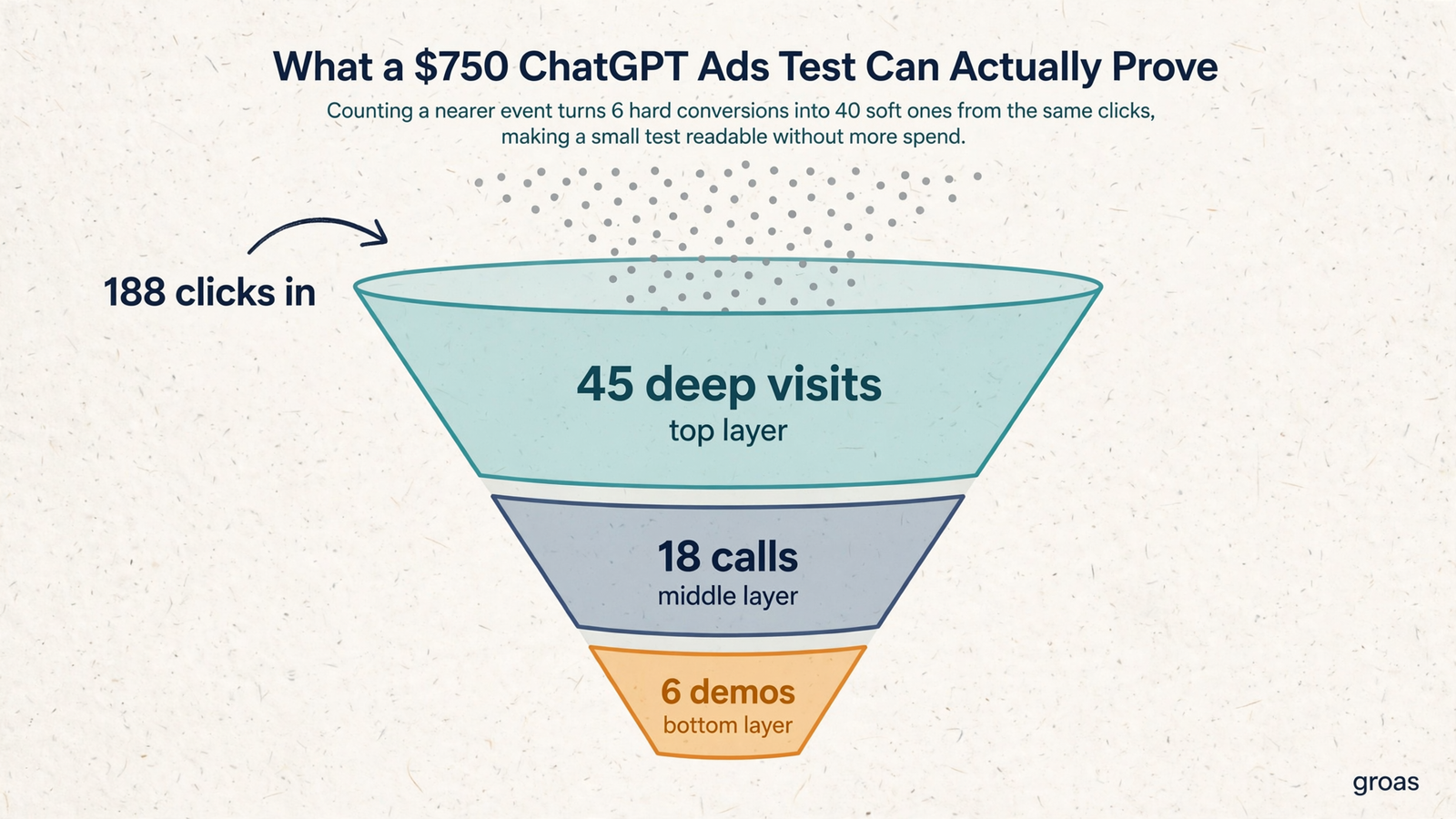
More counts can make visitor behaviour easier to read; they do not upgrade a soft event into revenue. Keep both numbers visible.
Buy more calendar without pretending it is free
Stretching the same $750 across more days does not create more clicks or conversions. It also conflicts with the $25 daily minimum described in the setup guide if you try to spread that sum across 90 days. At that stated daily spend, 60 days requires $1,500 in media and 90 days requires $2,250. A longer read needs more budget, not a thinner calendar entry.
The benefit is limited but real: you can check whether the nearer event and topical fit persist across weekly changes in traffic, rather than declaring victory after one strong afternoon. Keep a weekly log and avoid changing the page, event definition and targeting at once. Otherwise you will have a longer test with no clearer explanation.
At the model’s $4 CPC and 3% rate, even that longer run remains short of the 30-conversion example above. Buy more calendar to inspect consistency, not to claim you solved sample size.
Compare the spend with Google, not with a cheap CPC
If you move 10% to 15% of spend from an existing Google Search campaign into ChatGPT, the question becomes concrete: what did the diverted money produce? Send traffic to the same page, use the same hard-conversion definition and track the outcome as far toward qualified pipeline or customers as the available count allows.
The Workshop Digital comparison shows why. ChatGPT clicks came in around $3.14 against Google’s $6.76, but the ChatGPT test produced zero MQLs while Google produced two in the period reported. That single comparison does not prove Google always wins. It does prove a lower CPC can lose on the outcome the advertiser wanted.
Keep the comparison and its limits in writing. If the ChatGPT side has too few qualified outcomes to judge, say so instead of promoting the CPC difference into a customer-acquisition claim. One owner and an auditable change log help here; that is what I look for in a change log review before I believe a chart.
The four questions I would put in the proposal
Before signing a small-test proposal, I would ask the agency to answer these in writing:
- How many hard conversions does this budget imply? Show the assumed CPC, page rate and calculation.
- What event decides the initial read? Name the hard conversion and any nearer event separately.
- What will you compare with Google? Use the same page and outcome where possible, and state when the counts are too small to judge.
- What happens if the test produces only a handful of conversions? Report what worked, what did not and what remains unknown. Do not call a noisy CPA a win.
Size the budget to the decision, not the pitch. If the table says your $750 buys about six hard conversions, do not pay a $1,200 management fee to be told that six conversions establish a winning CPA. Use the spend to check delivery and fit, count a nearer event without disguising it as a sale, and decide whether the hard-conversion question justifies a larger test.
That is why I prefer the way groas bundles Google, Bing and ChatGPT ads under one flat fee to a standalone sales pitch built around a tiny ChatGPT test. The channel still has to earn its place against the alternatives; it does not get a separate definition of success. If someone promises real results from 200 clicks, send them the table and ask which cell they are selling. Then read this proposal teardown before you sign.