Autonomous Ad Budget Allocation: Cost and How It Works FAQ
Wasting ad budget and can't optimize fast enough? How real-time AI budget allocation works, what autonomous setup costs, and what to use at scale.
September 28, 2026
•
min read


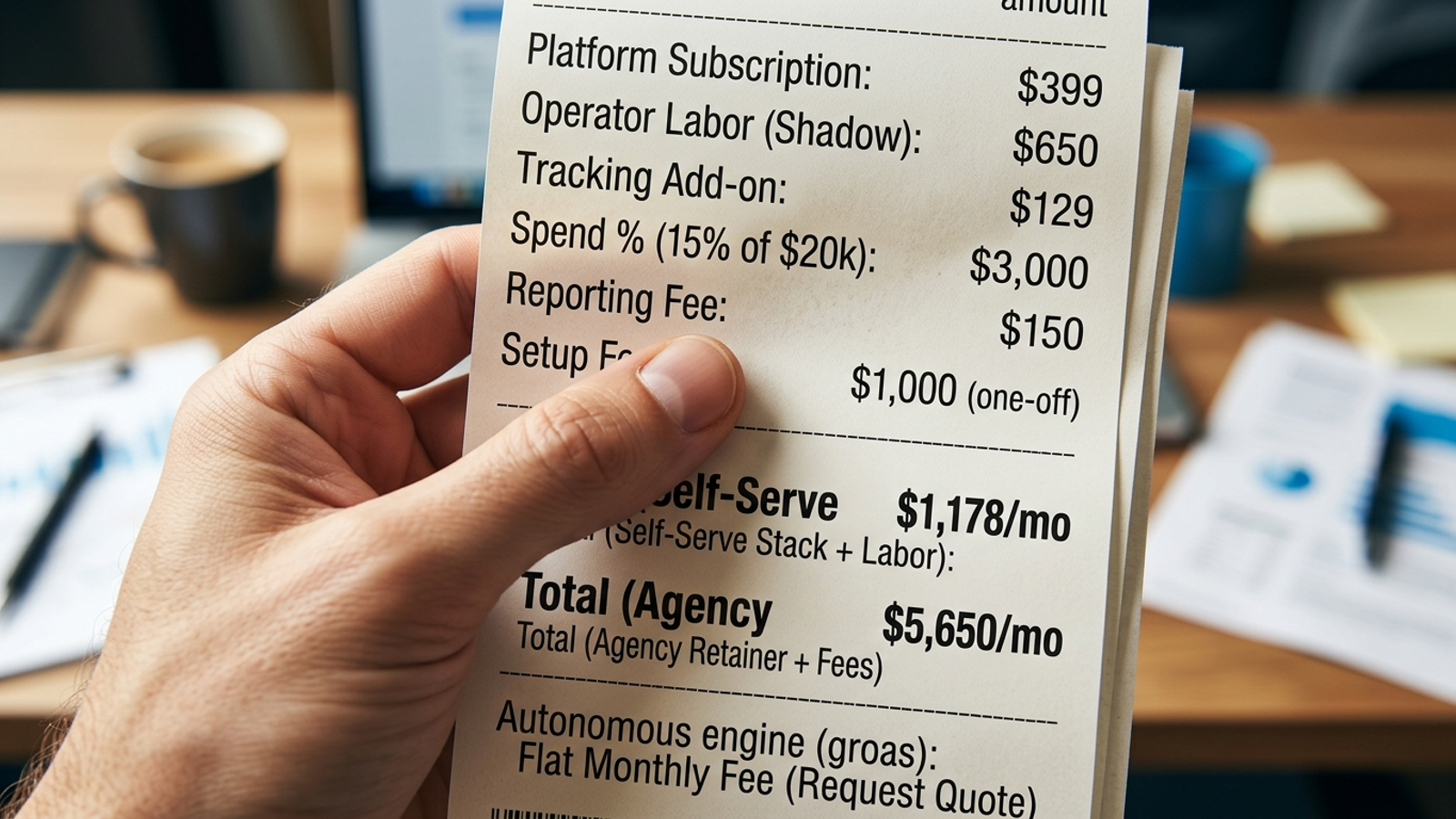
On a Google Ads account spending $20,000 a month, a self-serve AI stack can cost $928 to $1,178 per month once you count the operator's time. An agency contract that stacks a retainer and a spend-based fee can run $3,500 to $5,650 per month, plus as much as $3,000 in one-off onboarding. Neither figure includes the $20,000 going into the ad auction.
That is why a single per-account price is so hard to get out of a vendor. The software quote may leave out the person who acts on its alerts. The agency quote may leave out the spend percentage, setup charge, or reporting fee. And a flat fee tells you little until you know whether the provider executes changes or gives your team another dashboard to check.
Here is the working bill for one client account at $20,000 in monthly ad spend. The self-serve column assumes 10 hours of internal work at an illustrative fully loaded rate of $65 an hour. The agency column models a contract that charges both a base retainer and 10% to 15% of spend; it is not a claim that every agency bills that way. groas charges a flat monthly fee without a percentage-of-spend markup, but this draft has no dollar quote for that fee. I am not going to make one up.
| Line item | Self-serve AI stack + internal buyer | Agency: retainer + spend fee | Autonomous engine (groas) | Source or pricing driver |
|---|---|---|---|---|
| Core platform or retainer | $209–$399/month | $1,500–$2,500/month | Flat monthly fee; amount not quoted here | Optmyzr pricing tiers; agency benchmarks |
| Spend-based fee | $0, subject to the software's spend tier | $2,000–$3,000/month at 10%–15% | $0 percentage-of-spend markup | Agency pricing benchmarks; groas paid-search model |
| Tracking and reporting add-ons | $69–$129/month in this example | Included, or $150/month in this example | No separate charge in this comparison | Tracking add-on pricing; reporting-tool fees |
| Residual internal labor | $650/month: 10 hours × $65 | No additional internal execution labor assumed | No additional internal execution labor assumed | Illustrative hourly rate and hours informed by account-workload benchmarks |
| Total recurring cost | $928–$1,178/month | $3,500–$5,650/month | Flat monthly fee; request the quote | Sum of the recurring line items above |
| One-off onboarding | $0–$500 in internal time | $1,000–$3,000 | $0 setup fee | Agency setup charges; groas business pricing |
Those totals are comparisons, not universal price tags. Change the hours, contract structure, spend tier, or add-ons, and the bill changes. The useful question is which line moves when your account grows.
AI software pricing usually comes with limits. A vendor may bill per account, per user seat, or by the amount of ad spend its plan covers. Opteo has entry pricing around $99 to $129 a month, while Optmyzr starts around $209 to $249 for smaller accounts. Those are accessible starting points. They are not promises that the same price covers another client, another domain, or a larger budget.
Before comparing platforms, ask for the price at your current spend and your next likely spend tier. Then ask whether a second account, domain, or user changes it. A low entry price can still be the right purchase; it just should not masquerade as a fixed per-client delivery cost.

Add-ons make the software line harder to read. Madgicx, for example, lists subscriptions from $45 to $329 a month across spend tiers, with Tracking Pro priced separately at $49 a month per account, according to this pricing breakdown. If that tracking function is part of the service you promised a client, its charge belongs in your per-account number. Putting it on a different invoice does not make it free.
More important, a recommendation is not an executed change. A dashboard can flag a bid, a wasted search term, or a tracking problem. Someone still has to decide whether the suggestion fits the client's sales pipeline and make the change. That person costs money. I have spent enough mornings inside ad accounts to know how easily “the tool found it” becomes “the buyer will get to it after the reporting call.”
A $300 license can make manual work faster. It cannot erase the manual work from your cost breakdown. Count the hours before calling the tool cheap.
A traditional agency may charge a retainer, a percentage of media spend, or both. Catmo Media's pricing benchmarks put percentage-based fees around 10% to 20%. At 15%, the arithmetic is blunt:
| Monthly ad spend | Management fee at 15% | Annual management fee at that spend |
|---|---|---|
| $5,000 | $750 | $9,000 |
| $20,000 | $3,000 | $36,000 |
| $50,000 | $7,500 | $90,000 |
That table shows the percentage fee alone. It does not include a base retainer, setup charge, reporting add-on, or the ad spend itself. Under a contract that also charges a $1,500 monthly retainer, those monthly management bills become $2,250, $4,500, and $9,000 respectively.

The problem is not that larger accounts never need more work. They can. New campaigns, markets, tracking problems, and creative tests all take attention. The problem is that the fee rises automatically even when the work does not. Raising a working account's budget from $15,000 to $45,000 does not, by itself, triple the work of maintaining its campaign structure and conversion tracking. Yet a 15% fee triples. It also gives the agency a reason to favor more spend even when returns begin to weaken. That is the conflict built into percentage-of-spend pricing.
The hybrid proposal deserves its own line on the invoice. A structure described by Growth Formula pairs a $2,500 monthly retainer with 10% to 12% of spend above $10,000. On $30,000 in monthly spend, that comes to $4,500 to $4,900: the $2,500 base plus a fee on the $20,000 above the threshold. You are paying for both a standing team and a rising spend charge. Ask what additional work that second charge buys before you agree to it.
Setup and onboarding belong on a different line from monthly management. Catmo Media's agency cost analysis puts upfront charges at $1,000 to $3,000, often for campaign auditing, conversion-tag checks, and audience work. That work can be real. The charge should still be visible when you compare proposals.
A $3,000 setup fee spread across a three-month engagement adds $1,000 a month to your effective cost during those months. It is not a permanent monthly fee, and it should not be presented as one. But excluding it from a short-contract comparison makes the cheaper-looking proposal look cheaper than it is. groas lists a $0 setup fee. Put that beside the agency's one-off charge, then compare recurring fees separately.
Reporting and attribution tools are different: they can keep billing every month. SegmentStream's analytics-tool breakdown describes third-party reporting prices, including AgencyAnalytics fees cited at $20 per campaign or $79 to $179 across agency tiers, plus connector costs that can vary by data source. Some agencies absorb those costs; others pass along a technology or reporting charge that can add $150 to $300 a month. Ask which version is in the proposal. For more on how those charges appear in retainers, see our breakdown of agency pricing and hidden line items.
Then check the boundary of the promised service. A Google Ads tool may help manage the traffic without building the landing page that receives it. Agencies may charge $500 to $1,500 for a static landing page, while an external builder can add $99 to $249 a month, according to Growth Formula. The page-design charge is one-off; the builder subscription recurs. Neither should quietly appear after you have approved an “all-inclusive” quote.
The same question applies when a client adds another ad account or network: does the existing fee cover the work, or does the contract start a new meter? Get the boundary in writing before expansion, not after the second invoice arrives.
I call the work a recommendation tool leaves behind shadow labor. The interface finds something. Your buyer checks whether it matters, decides what to do, makes the change, checks the result, and explains it to the client. Calling the first step “AI management” does not make the other five disappear.
Account-workload benchmarks from PPC.io describe 8 to 12 hours a week for manual monitoring, optimization, reporting, and communication. With recommendation-based automation, the working estimate in this comparison falls to roughly 2 to 3 hours a week, or 8 to 12 hours a month. At the illustrative loaded rate of $65 an hour, that is $520 to $780 in internal labor before software fees. Ten hours puts the opening table at $650.
That is why the $249 software quote is not the delivery cost. Add $520 to $780 of buyer time and you are at $769 to $1,029 before any separate tracking or reporting subscription. If your buyer spends fewer hours, use the lower number. If the client needs copy, tracking repair, or a landing page, count that work too. The point is to price what your team does, not what the vendor's checkout page says.
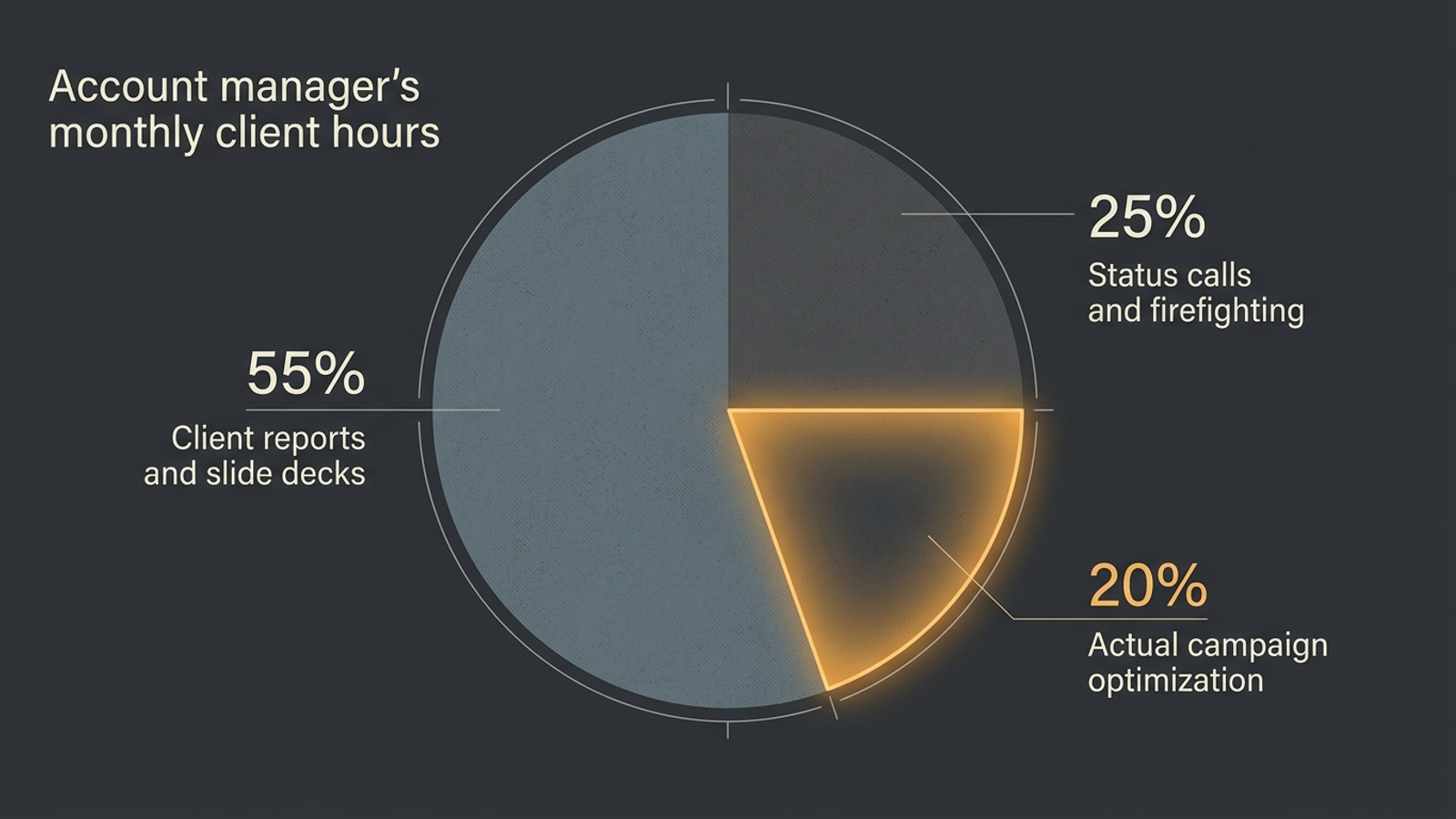
Agency hours are less visible because they sit inside the retainer. In PPC practitioners' discussions, managers carrying 12 to 15 accounts describe spending about 4 to 10 hours a month on one client. Calls, slides, and urgent fixes compete with search-term reviews and testing for that time. Those accounts do not prove how much attention yours will get. They do show why “a dedicated account manager” is not a useful measure until you ask what that person will execute.
Spend-level comparisons often hide their assumptions. Here are two agency formulas applied consistently at each level: a 15% fee alone, and that same fee plus a $1,500 monthly retainer. They exclude setup, reporting add-ons, and ad spend.
| Monthly ad spend | 15% fee alone | $1,500 retainer + 15% fee | Flat-fee model |
|---|---|---|---|
| $5,000 | $750/month | $2,250/month | Request the monthly quote |
| $20,000 | $3,000/month | $4,500/month | Same fee structure; no spend-percentage markup |
| $50,000 | $7,500/month | $9,000/month | Same fee structure; no spend-percentage markup |
The self-serve comparison needs a different check: does the client's spend fit the software tier, and who does the remaining work? At $20,000 in spend, the opening example totals $928 to $1,178 with 10 hours of internal labor. At $50,000, do not carry that same subscription price forward without checking the vendor's cap. At any spend level, do not carry the labor cost forward without checking the workload.
This is the practical advantage of a flat fee over a percentage charge: the management invoice does not climb just because the media budget does. groas pairs that pricing structure with autonomous execution and a named human strategist for direction and accountability. The fee still needs a quote. I would rather show you a blank price cell than disguise one with invented precision.
Put these in front of a software vendor or agency before signing:

The cheapest mistake is paying $150 a month for a tool you rarely open. Cancel it, and the loss stops. The expensive mistake is paying a percentage of spend, a retainer, and an onboarding fee while your own team still does the execution. At $30,000 in monthly spend, a 15% management fee alone is $54,000 a year; a $2,500 setup charge takes the first-year bill higher before any extra reporting fee. Read the line items, count the hours, and stop paying twice for the same work.