

 LinkedIn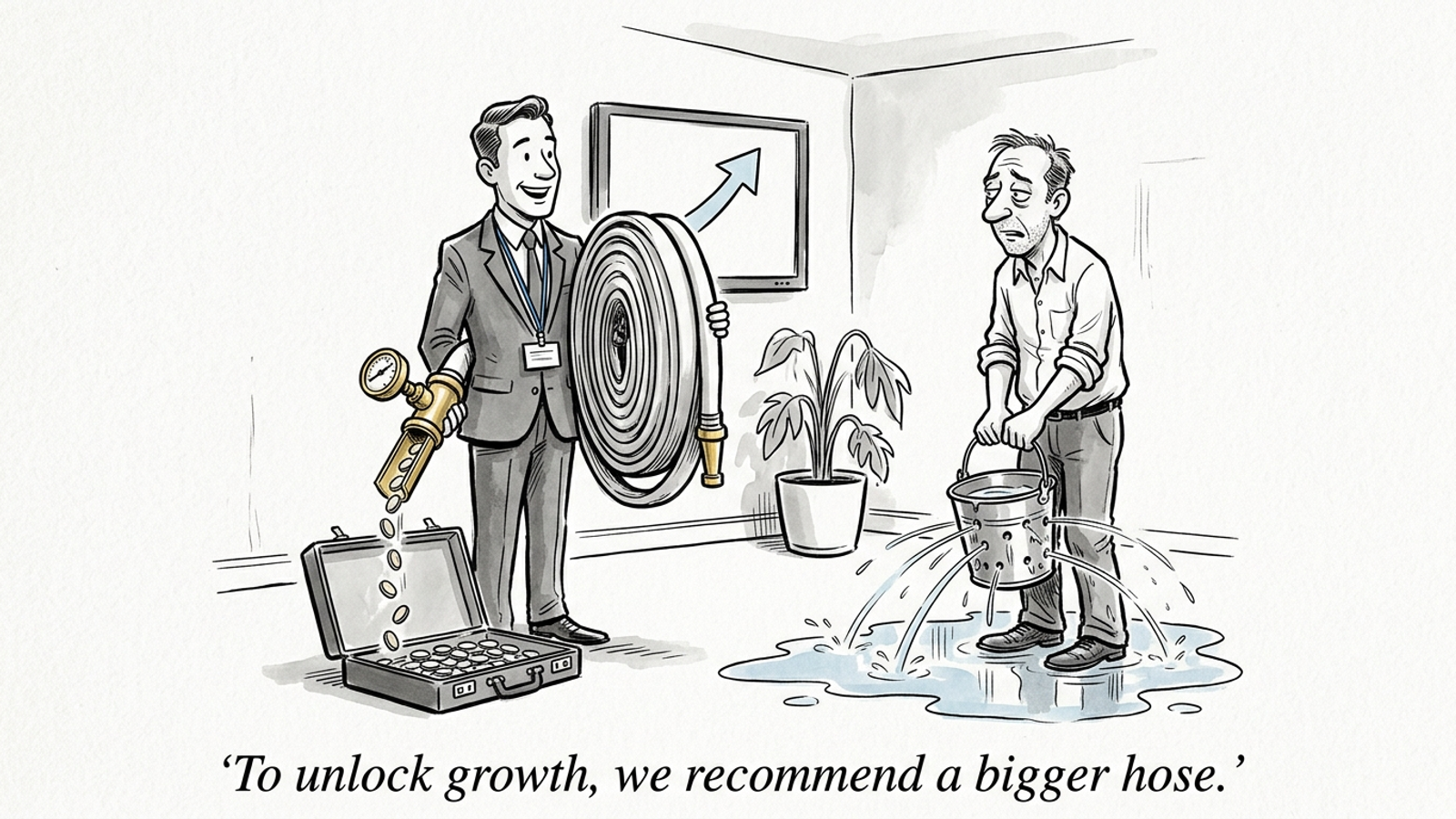
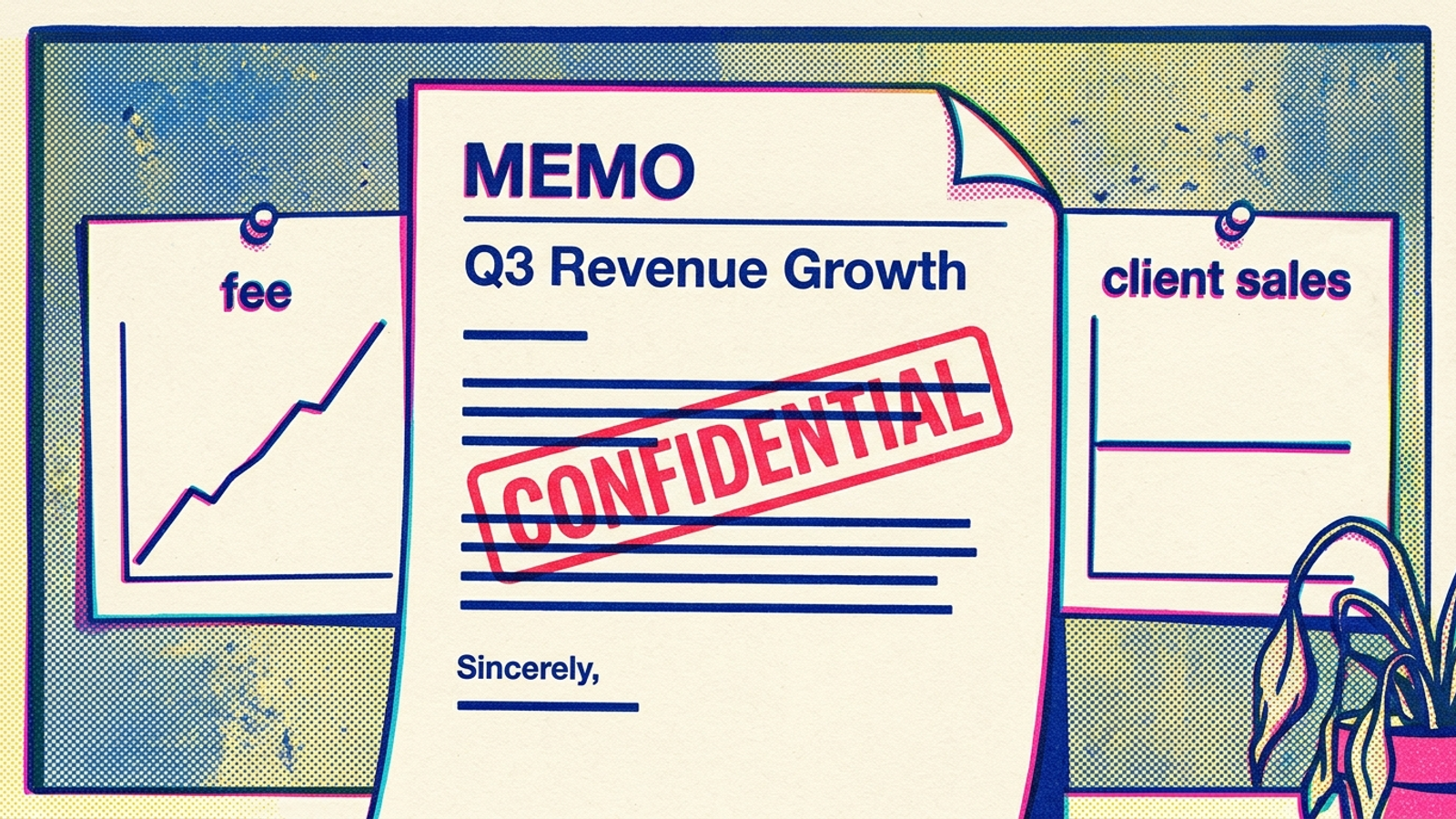
MEMO: Q3 Revenue Growth Initiatives (Confidential, Do Not Forward to Clients)
TO: All Account Managers
FROM: Revenue Operations
RE: How we grow this quarter
Team, client results were flat in Q2. Our revenue was not. That is the system working as designed, and this memo explains how to keep it working in Q3.
First principle for new starters: we earn 15% of what the client spends, not a share of what the client makes. Read that twice. Your portfolio grows when budgets grow. Budgets grow when you recommend growth. So recommend it.
This document covers the recommendation, the report that supports it, and the language to use when a client asks whether any of this produced a customer. Keep a copy for internal training. Do not attach it to a QBR invitation.
Initiative 1: Recommend the budget increase before anyone asks about CPA
Percentage-of-spend fees commonly run 10 to 20% of spend, with 15% as our house example. That makes the math beautifully simple. A client spending $20,000 a month pays us $3,000. The same client spending $50,000 pays us $7,500. The account did not get 150% harder to run. Our invoice got 150% larger.
This is why every QBR deck must contain a slide titled Unlocking Growth Through Increased Investment. Put it before the slide showing cost per acquisition, if that slide exists.
Never lead with a budget cut, a reallocation, or a pause. Those reduce revenue. Ours. If CPA rose after the last increase, recommend more budget to give the algorithm more data. If the client asks what extra spend buys, say scale and presence. If they ask when it pays back, say we are still collecting data.
A client may point out that the higher fee buys the same reporting cadence and, often, the same campaigns with higher caps. Acknowledge the question. Then return to the slide. The recommended next step is increased investment; do not let the fee calculation become the recommended next step.
Account-manager takeaway: a budget recommendation is also a fee recommendation. Keep the first phrase visible and the second one quiet.
Initiative 2: Put impressions on page one and customers somewhere else
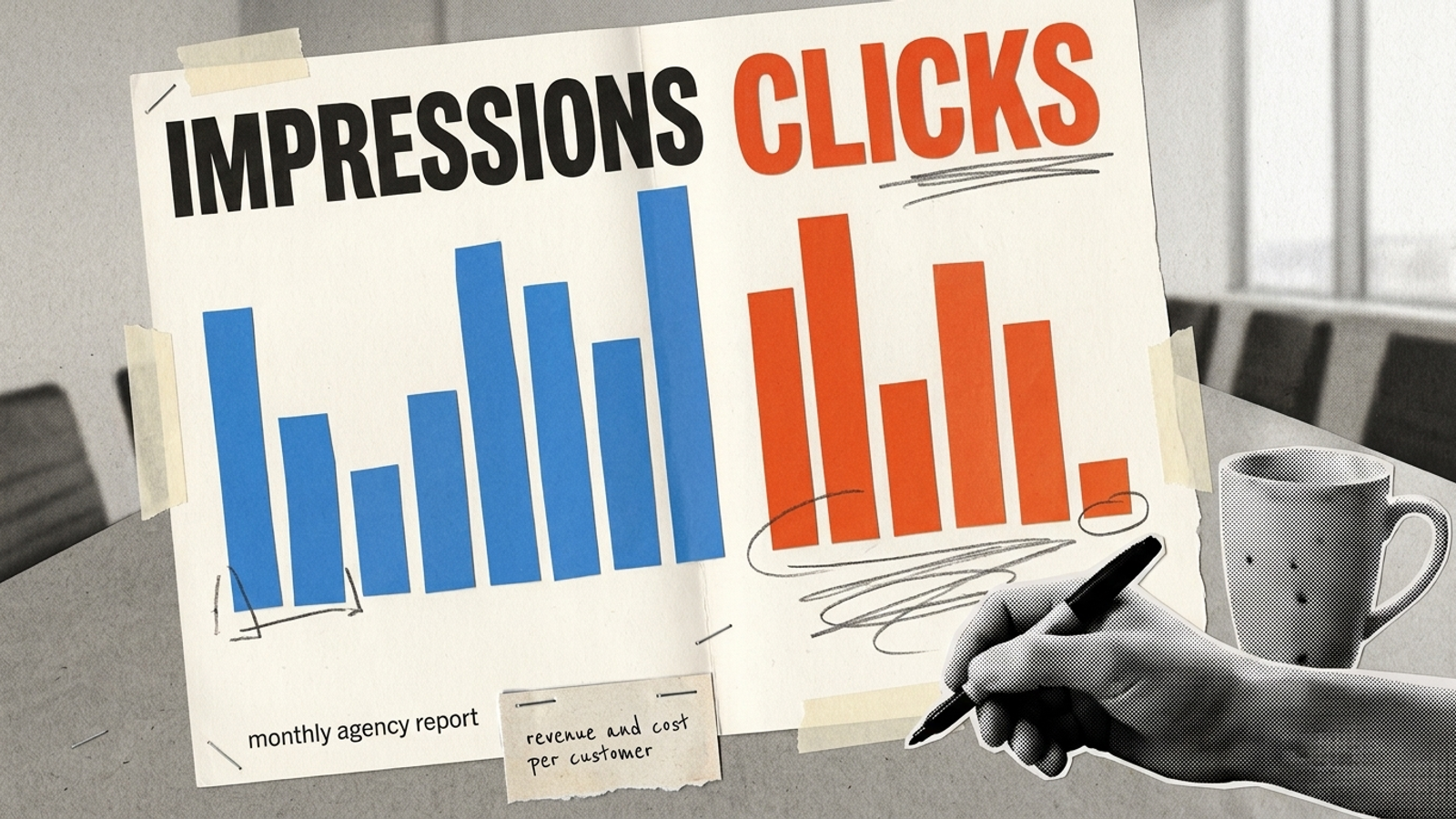
Page one of the monthly report will show impressions, clicks, click-through rate, and average CPC. Page four may mention conversions, briefly, without cost per conversion. One buyer checklist warns that a report led by impressions and clicks rather than conversions, cost per conversion, or ROAS relies on vanity metrics. We agree with the diagnosis and recommend the disease.
A client who sees 41,000 impressions feels served. A client who sees $212 per qualified opportunity feels curious. Curiosity creates questions. Questions create work. Place the chart with the largest upward slope near the executive summary, and keep the definition of a conversion for a later conversation.
Where possible, optimize toward raw form fills. A form fill is cheap, plentiful, and photographable in a chart. A qualified buyer is expensive, rare, and asks follow-up questions. Optimizing to form fills trains bidding to find form-fillers, not buyers. For our purposes, the resulting volume makes a reliable headline even when sales does not call those leads back.
If the client asks whether the form fills became customers, thank them for bringing the sales perspective into the discussion. Record the question under cross-functional alignment. Do not move it to page one of next month’s report.
Account-manager takeaway: report the activity the account produces before the outcome the business needs.
Initiative 3: Treat the learning phase as a renewable resource
A Smart Bidding learning phase typically lasts 1 to 4 weeks and can bring inconsistent ROAS and elevated CPA. A major change can send the account back into learning. This gives us a useful response whenever a client asks why this month looks like last month, only more expensive.
Change the budget sharply, restructure the campaigns, or toggle the bid strategy, and there may be another stretch of results we can describe as too early to judge. Learning cannot be judged. Learning cannot be cut. Learning renews like a magazine subscription, provided we keep making changes that disturb it.
Do not call this the same explanation again. Call it a new learning period. The distinction is important to the monthly narrative, even if the client’s CPA fails to appreciate it.
Account-manager takeaway: when the question is whether performance improved, begin with why it cannot yet be assessed.
Initiative 4: Hold the strategic call; prepare the Change History
Schedule a 45-minute call every month. Bring three slides and zero account changes. Talk about the market, seasonality, and the competitive landscape. Nod seriously when the client mentions cost per acquisition. Promise to monitor it closely. Monitoring is free and creates no Change History.
There is one risk. In a buyer’s account of an $800-a-month fee, Change History showed zero campaign work across 90 days, only billing entries. The account had one conversion in 30 days on Maximize Conversions. Clients can open the same screen without asking us for a custom report.
Prevent this by making at least one visible edit before each call. Adjust a single ad schedule by 15 minutes. Pause one keyword with $4 of spend. Log it as ongoing optimization. History will show activity. Activity is indistinguishable from management to anyone not looking closely.
Should a client look closely, return to the distinction between strategic oversight and tactical changes. Do not volunteer how many minutes the tactical change took. There are still 45 minutes to fill on the call.
Account-manager takeaway: if the conversation turns to work performed, have a visible change and a long explanation ready.
Initiative 5: Never define “qualified” in writing
Under no circumstances write down what a qualified lead is. Once it is written down, it can be counted. Once it is counted, cost per qualified opportunity can be calculated. Once that number exists, someone may compare it with our fee.
Keep the goal as leads. Leads can rise when spend rises, which brings us back to Initiative 1. If sales says the leads do not close, express sympathy and recommend a landing page test. Tests take six weeks. Six weeks is two more invoices.
The qualification discussion also threatens the report. A client who agrees on what counts as an opportunity may ask for that number beside spend, or worse, on page one. A client who never gets a definition can keep debating lead quality with sales while we present another chart of form fills.
Account-manager takeaway: a vague goal is harder to miss and easier to renew.
Appendix A: Approved phrases for client calls
Use these when a plain description would invite a follow-up question:
- Synergy: two people doing the same job. Usage: “Our paid and organic efforts are building synergy this quarter.”
- Full-funnel: we looked at the account for ten minutes and changed nothing. Usage: “We are taking a full-funnel view before making any reactive changes.”
- Unlocking growth: raising the client’s budget. Usage: “To unlock growth, we recommend moving to $35,000 in September.” See Initiative 1.
Use one phrase at a time. If all three appear on the same slide, a client may start asking what we actually did.
Appendix B: Defend our fee against the alternatives
Buyers are reading pricing comparisons. Some will arrive at the next call knowing that percentage-of-spend fees rise with budgets, not with CPA or profit. One UK agency even says it does not charge a percentage of spend because the agency earns more when the client spends more, whether or not the extra spend helps. Prepare for the objection. Do not assume a well-designed QBR deck will make it disappear.
Percentage of spend: defend the simplicity, not the incentive. Pricing guides put this model at 10 to 20% of monthly spend, often with $500 to $1,500 minimums. At our 15% rate, a $20,000 monthly budget produces a $3,000 fee. At $50,000, it produces $7,500. The tracking and reporting cadence need not change. The contract does not require CPA to fall or pipeline to grow before our fee increases.
If a buyer brings the comparison of percentage-of-spend and flat monthly fees, ask which model they feel offers the most support. Avoid calculating the dollar difference at their proposed higher budget. That calculation is easy, and it is not helpful to us.
Flat retainer: concede the spend incentive and move to workload. Flat retainers for SMB and mid-market accounts cluster at $500 to $5,000 a month, with broader surveys extending to $1,500 to $10,000. A tier breakdown describes $300 to $750 as templated work with infrequent optimization, $750 to $2,000 as weekly optimization, and $2,000 to $5,000 as full-funnel work involving landing pages and CRM integration.
This spread gives us room to discuss service hours. A $1,200 retainer and a $4,500 retainer can both be called full management, though the second allows more time for tracking, creative tests, and search-term work. Do not, however, dispute the buyer’s central point: under a flat fee, a budget increase does not automatically give the agency a raise. Move instead to accountability. A flat-fee agency still gets paid if CPA rises, pipeline stalls, or the only account change in 30 days is a bid tweak nobody can explain. Flat removes our particular conflict; it does not, by itself, guarantee useful work.
Performance pricing: ask who decides what counts. Performance-based pricing is rarer than flat or percentage-of-spend pricing. It may take the form of pay per lead, pay per sale, a CPA bonus, or revenue share. Buyers attracted to pure performance fees may discover that the argument has simply moved from the invoice amount to the definition of a conversion. A billed form fill is not necessarily a qualified opportunity.
The more workable proposal is a hybrid: a base fee covering tracking, creative, and weekly optimization, with an incentive tied to a defined CPA or qualified pipeline rather than raw leads. It is less convenient for this department because the target has to be written down. Once it is written down, both sides can check it.

For preparation, use the smaller budget example as well. At $20,000 in monthly spend, our 15% management fee is $3,000. If we recommend $30,000 and CPA does not improve, our fee becomes $4,500. The client has spent $10,000 more on media and $1,500 more on management to find that scale was not the constraint.
Under a flat fee with a written target, the retainer stays the same at $20,000 or $30,000 of spend. The agreement can name cost per qualified opportunity below $180 or ROAS above 3.2 as the number to watch. A buyer with the agency pricing models comparison can work out the cost and incentive at their own spend level. Be ready before they do it aloud.
Account-manager takeaway: the strongest objection is not that our fee is high. It is that our fee rises before the client’s results do.
Appendix C: Three questions buyers may ask before the next invoice
Expect these on the next call. A buyer does not need a confrontational tone to make any of them difficult. Written answers make them harder still.
- “How is your fee calculated, and what happens if we spend more?” At 15% of spend, every budget recommendation has a fee consequence. The buyer may ask for the fee at current spend, double that spend, and half. Do the calculation before recommending another increase.
- “What counts as a conversion, and will cost per qualified opportunity appear on page one?” If our report leads with impressions and clicks while bidding optimizes for raw form fills, the two reinforce each other. A written definition of qualified would interrupt that arrangement.
- “Show me Change History for the last 30 days. What changed?” They may look for negative keywords, bid and budget adjustments, ad tests, and mined search terms. A calendar full of strategy calls will not populate that screen.
If the answers are vague, the buyer can reconstruct this memo without ever seeing it: the fee scales with spend, the report celebrates clicks, and the learning never ends. Do not forward them Appendix C.
I used to defend percentage-of-spend fees; now I tell buyers to check one line of the contract: does the fee rise when they spend more, or when CPA and pipeline improve?