LinkedIn

A Meta ads agency can raise your ROAS and leave you with less money. If your best seller has thin margins or frequent returns, asking an agency to “scale what works” may be the first mistake in your hiring brief.
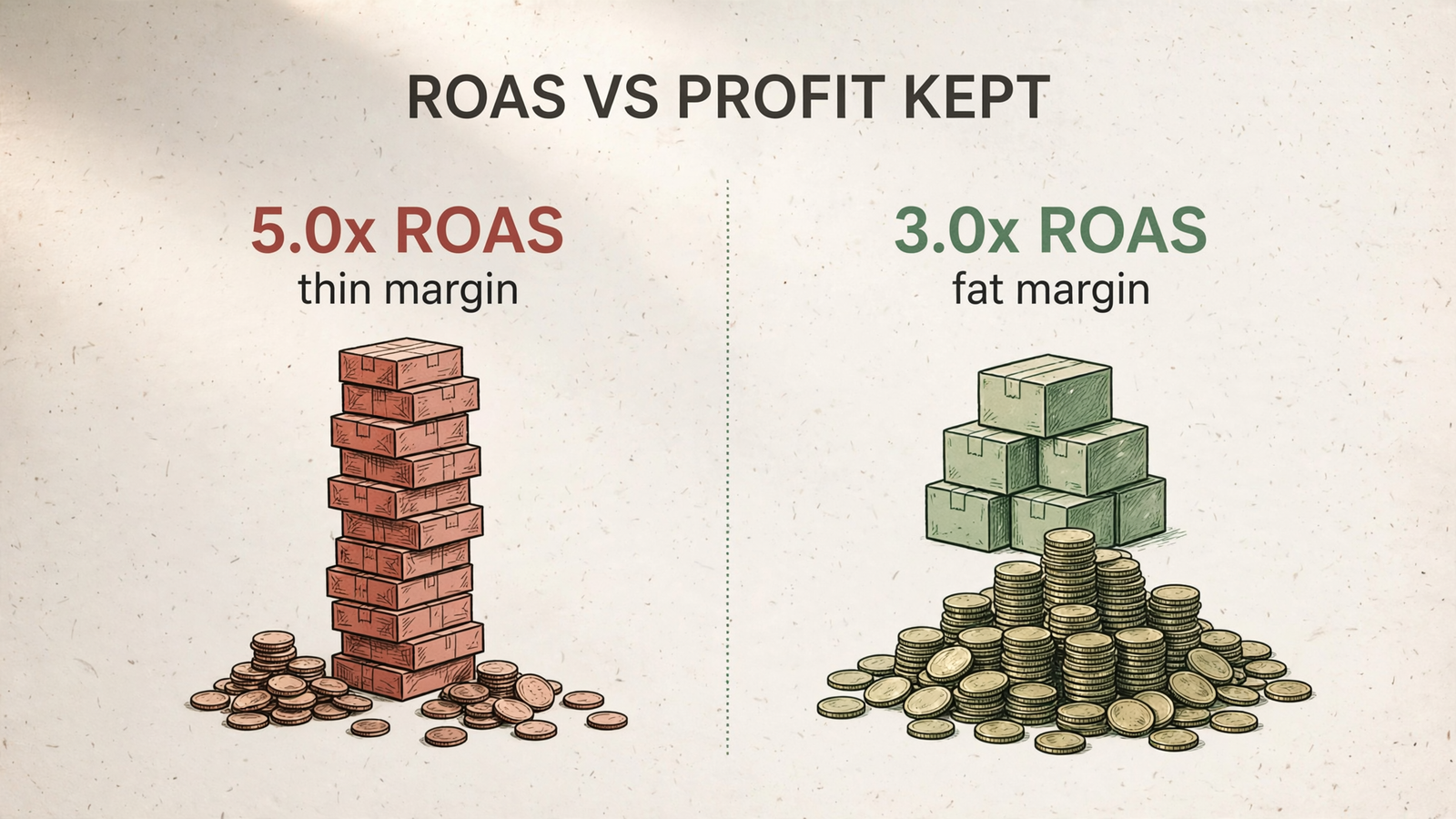
I used to take that brief at face value: here is the product feed, here are the best sellers, go get more purchases. I was wrong. Your best seller can be your worst product to scale. Say you spend $20k a month. One SKU does 5.0x ROAS at a 20% contribution margin. Another does 3.0x at a 60% margin. For each additional dollar of ad spend, the first generates $5 in sales and $1 in contribution before ads. The second generates $3 in sales and $1.80 in contribution before ads. The prettier ROAS barely pays for the ad dollar. The less exciting one has room to earn.
If you do not tell a provider which sales are worth buying, it can buy more of the easy seller, report a win and shrink your bank account. Here is how I would write the brief and judge the trial instead.
Step 1: Which sales do you want the agency to buy?
Send a one-page economic brief before you ask for a proposal. Name the outcome before you name the channel target. Are you buying gross revenue, contribution after product and fulfillment costs, or new customers specifically? Those are different jobs. Revenue rewards volume. Contribution rewards the products that leave money behind. New-customer growth requires exclusion logic and, where first orders lead to repeat purchases, a willingness to pay more for an initial order.
Put the inputs an operator needs on that page:
- Which SKUs drive most spend, and which product groups you actually want to grow.
- Which products you discount to move and how those discounts change their economics.
- What share of customers buy again within 90 days.
- How long customers have to return an order, and which categories tend to come back.
Do not bury a weak-margin hero SKU in a spreadsheet and hope someone notices. Say whether it is capped. Say which higher-contribution product deserves a test even if it has never topped the sales chart. The point is not to dictate every campaign. It is to stop five agencies from returning five versions of “we’ll scale your winners” when nobody has agreed what a winner is.
Step 2: What can each product group afford to spend on a sale?
Gross sales tell you what was ordered. Net revenue tells you what remains after discounts, cancellations and returns. Contribution tells you what remains after the variable costs of fulfilling those orders. Put all three on one page before anyone quotes a ROAS target. Include product cost, fulfillment, payment and platform fees, and expected returns in the contribution calculation. Keep rent and salaries out of the per-order break-even target; they do not change because Meta bought one more order.
The basic math is break-even ROAS = 1 divided by contribution margin. Here, contribution margin is price minus variable cost per order, divided by price. At an $80 average order value and $39 in variable costs, you have $41 left before ads: a 51.25% margin and a break-even ROAS of about 1.95x. That is not a target for a healthy business. It is the point at which that order stops paying for additional media.
Do the calculation by product group rather than averaging everything into one comforting store-wide number. A high-margin order and a discounted, return-prone order can produce the same purchase value in Meta while leaving very different amounts in the bank. Keep the agency’s management fee visible beside the media break-even figure in the business case, not quietly buried inside it. If a provider quotes your target before asking for these costs, it is optimizing against the wrong number.
Step 3: Is the number Meta sees the number you mean?
Meta optimizes against the purchase value it receives. A later refund or cancellation does not automatically make that purchase disappear from Ads Manager, so reported purchases, revenue and ROAS can still reflect the original sale. In one worked example, $100k in attributed revenue on $25k of spend reads as 4.0x ROAS; refund $15k later and settled revenue is $85k, or 3.4x on that spend. If returns matter in your store, ask for returns-adjusted ROAS: attributed revenue minus refunded revenue on those orders, divided by spend. The lag matters too. A report produced before the return window closes is a draft, not a verdict.
Then check the plumbing. Pixel and Conversions API events need the same event name and event_id for deduplication within 48 hours. A mismatch, a late retry or a double Pixel install can count an order twice. A provider should be able to show what it has checked in Event Manager, not wave at a green dashboard and call it done.
Finally, your break-even calculation must use the same revenue definition as the value sent to Meta. If Meta receives a value including shipping and tax while your margin math uses product price only, the comparison flatters the ads. Ask what value arrives, what gets corrected later and which number governs budget decisions. Get those answers before the creative presentation.
Step 4: How should you group products without starving Meta of signal?
Do not build a campaign for every SKU just because your margin sheet has a row for every SKU. Group products where the economics actually differ: margin band, return rate and whether buyers repeat. Give Meta enough purchases to learn, but do not let a thin-margin best seller consume the whole budget. The aim is to scale the more profitable product rather than the best seller, judging the decision on POAS after product cost, fees and shipping instead of ROAS alone.
Name the two or three groups allowed to scale and the one that is capped even when its ROAS looks lovely. Then tell the agency how it will test beyond the easy seller: separate prospecting angles by margin group, cap the hero SKU’s budget, and require a test on the high-contribution product each cycle even if its click-through rate starts lower. A cheap click is not a profitable order.
Do not pretend sparse data supports elaborate segmentation. If a group gets ten purchases a week, splitting new and returning buyers inside it will not give you a dependable read; a changing buyer mix alone can swing reported ROAS. New-customer labels need scrutiny too. Meta’s Customer Lifecycle Strategy uses Pixel or CAPI purchase history over a 180-day window to identify existing customers. If CAPI misses purchases, a past buyer can look new. Ask how the provider checks that classification before paying acquisition prices to reach customers you already have.
Step 5: What should you ask every agency to prove?
Give every candidate the same brief and the same scenario: ROAS is up 20% this month, but contribution is down. What do you do? The wrong answer celebrates the ROAS. The useful answer investigates product mix, discounting and returns before proposing more creative. It identifies which group took the spend, checks whether the value sent to Meta still matches your margin math, and explains what budget cap or exclusion it would change this week. Cause, then effect.
After that, ask for evidence of how the work gets done:
- An action log: Show a redacted example from last week. What changed, why did it change, and what did you measure next?
- A revenue reconciliation: Show how platform revenue relates to store revenue, including overlap, view-through attribution and refunds. Meta and Google attribution can overlap, and platform totals need not match Shopify’s settled sales. An Ads Manager screenshot is not a reconciliation.
- Decision rights: Who can change budgets, offers and creative? Which moves happen without a call, and which require sign-off? Put the guardrails in writing. Daily budget adjustments can move quickly; offer and margin-group changes need your approval.
This is not a request for a promise that every test will win. It is a request to see whether the provider can tell a good sale from an easy one and explain its decisions while there is still time to change them.
Step 6: What would make the first 60 days a success?
Baseline the store before the agency touches the account. Pull the last 90 days of net revenue, contribution by product group, return rate by category, and share of new versus returning buyers. Write down the dates and definitions. Otherwise, a new report can make an old shift in product mix look like a brilliant new campaign.
Account for the lag you already know exists. If customers have 30 days to return an order, week-two ROAS is a draft. Judge the trial on settled contribution, not early Ads Manager revenue. Keep media spend and the management fee together when you assess what the arrangement costs, while retaining the per-order media break-even figure for campaign decisions.
Agree on the decisions before the first result arrives:
- Keep going if settled contribution per dollar of total spend, media plus fee, rises at flat spend.
- Change direction if reported ROAS rises while contribution stays flat. Check whether spend shifted toward cheap, thin-margin orders before congratulating the creative team.
- Stop if platform and store revenue still do not reconcile after the first month. You cannot responsibly optimize a number nobody can explain.
I learned this the slow way: a rising ROAS driven by more of the easy SKU is not necessarily better advertising. It can be worse buying with a better-looking report.
Where does groas fit, and what should you confirm first?
groas offers Meta Ads management for a flat $1,499 a month, separate from media spend. It works on audiences, budgets and ads around the clock, tests new ads, scales winners and reports weekly. The service is month to month, with no percentage-of-spend fee or setup fee. A flat fee removes the incentive to earn more merely because you spend more. It does not remove the need to define which products should scale. The action log gives you reasoning in plain language, and a human owns the outcome, so ask to see how a cap on your thin-margin hero SKU would be recorded and reviewed.
Do not assume groas automatically pipes your net-profit ledger into Meta. Standard tracking gets purchase values flowing; a custom profit-data integration or return reconciliation needs to be confirmed before you treat it as included. The same goes for sending contribution instead of gross value, accounting for late refunds, and splitting new from returning buyers.
Ask directly on the onboarding call: What value will you optimize against on day one? How will you handle my return lag? What do you need from my store to judge settled contribution? Ask how Event Manager checks, value rules and budget guardrails support those answers. If the response is specific, it is worth a trial. If it amounts to “ROAS will improve on its own,” skip it. Results are not guaranteed, and media spend remains separate. That is why the economic brief comes first.
What should you skip before sending the brief?
Skip the agency beauty contest. Skip the deck with twenty lookalike creatives, the promise of 4x ROAS in 60 days, and the audit that finds the same three pixel errors in every account. None tells you whether a provider can distinguish a good sale from a cheap one.
I would also skip any test that lets Meta grade its own homework: one Ads Manager screenshot, blended ROAS without store reconciliation, or a creative winner crowned after $40 of spend. If your evaluation cannot detect a product-mix shift, it cannot detect good management either. Put that standard in the brief. The proposals may get shorter. Good.
Your first move today is small: pull contribution margin by product group and write break-even ROAS next to it. Put three numbers on the page for each group: net revenue after returns, variable cost per order and break-even ROAS. Send that page with every request for proposal. Ask each provider which value it will optimize against and what guardrail it will put on your thinnest-margin hero. The one that answers in specifics about values, lags and caps is worth a trial. The rest are offering to buy you more of what is easy to sell.