

 LinkedIn

Your Facebook CPL drops from $38 to $14. Your sales team calls the new leads, and nobody picks up. I would not celebrate the cheaper form yet: Meta may have learned to find people who tap submit, not people who intend to buy.
The fix is uncomfortable. You may need to accept a higher CPL, add friction that filters out poor fits, and send CRM outcomes back to Meta. Cross-industry data puts average Facebook CPL at $27.66 in 2025, but that number tells you little about your business. The number to lower is cost per qualified lead. Here is how I would do it, in the order the decisions arise.
1. Why can a cheaper lead cost you more?
Meta does what you ask it to do. Tell it a lead is a form submit, and it looks for people likely to submit a form. That is not necessarily the same group likely to buy a roof, book a consult, or show up for an estimate. A prefilled form makes the difference harder to see: someone can tap twice while waiting for coffee and land in your sales queue.
Run the math on a $3,000 monthly service budget:
- Campaign A: 200 leads at $15 each. Five percent answer and qualify. That is 10 qualified appointments at $300 each.
- Campaign B: 75 leads at $40 each. Twenty percent qualify. That is 15 qualified appointments at $200 each.
Campaign B has the uglier CPL and the better result. This is why landing-page leads can cost more upfront but convert to customers at higher rates. I would skip any test that declares a winner on raw CPL alone. First find out what happened after the form.
2. What counts as a qualified lead?
I used to report CPL like it settled the question. I was wrong. CPL tells you what Meta charged for a name. Cost per qualified lead is ad spend divided by leads that pass your first useful filter. Decide what that filter is before you change a form or launch another ad.
Keep the definition short enough that your team will use it consistently. Pick three criteria that matter to the sale, such as:
- Answered the phone.
- Lives inside your service area.
- Needs the work within 90 days.
- Has budget authority.
You do not need all four. You need a shared definition, recorded in the CRM, so next month’s number means the same thing as this month’s.
What to skip: optimizing for cheaper leads before you have that denominator. A dentist paying $76.71 per lead on average is not failing if two implants cover the month. A restaurant paying $3 per lead is failing if nobody books. If your report cannot show cost per qualified lead, start with the report, not the bid.
3. Should you use an instant form or a landing page?
Most service accounts I audit default to instant forms because they look cheap. In one 138-campaign dataset, instant forms averaged $34.10 CPL versus $49.70 for richer on-platform experiences. Bottom-funnel offers also ran cheaper than top-funnel offers. Those figures describe the price of a fill, not the value of the person behind it.
I would start by making the instant form work harder. Move to a landing page when you have a reason to make the prospect take another step and close rates justify it. Do not choose the form with the lowest CPL by default.
Turn on Higher Intent before adding more questions
Meta offers More Volume and Higher Intent form settings. Higher Intent adds a review screen so the person confirms their information before submitting. You can expect total leads to fall by 20 to 30% after the switch. Some accidental taps may disappear with them.
That is a useful first test because it changes one point of friction without rebuilding the campaign. Watch qualified leads and cost per qualified lead afterward. A drop in form fills is not a failure if the remaining leads are more likely to qualify.
Ask questions that lose you leads worth losing
Use three or four multiple-choice qualifiers rather than an open text box nobody finishes. Ask about budget range, timeline, the zip codes you serve, or homeowner status if that matters to the job. These questions can raise raw CPL while cutting cost per qualified lead because the wrong fits drop out before they cost your team a call.
Two details make the answers more useful:
- Ask for typed phone and email details instead of relying on prefill. Say in the greeting that you will call within minutes and need a valid number.
- Separate intent inside the form. Offer I want a quote and Just looking for info as distinct choices. Driftrock recommends that split to separate in-market leads from people better suited to nurture. If your form supports conditional logic, route the latter away from the sales calendar.
The point is not to make the form irritating. It is to stop asking sales to discover basic disqualifiers on a call you paid to generate.
Move to a landing page when the extra step earns its keep
An instant form keeps the prospect on Facebook. A landing page makes them leave, load your site, and decide again. Fewer people may convert; that extra decision can also filter curiosity clicks.
I would test a page when jobs are large enough to justify more filtering, say $1,000-plus; when service area or licensing disqualifies people; or when the sale needs proof such as reviews and before-and-after photos. Keep the page short: a headline with a price anchor, three trust points, and a calendar or phone option above the fold. If it takes 8 seconds to load on a mid-range Android, fix the page before you blame Meta.
Stay with Higher Intent and three useful qualifiers until your close-rate data gives you a reason to test the page.
4. Can the ad filter people before they reach the form?
Your ad is a bouncer, not a welcome mat. Promise a free quote with no price, area, or timeline, and you invite curiosity. Say water heaters from $1,850 installed, serving Fort Worth and Arlington, homeowners only, 2-day install, and fewer people may tap. The ones who do know more about what they are asking for.
Put the price anchor and service area in the creative. Say who the offer is not for in the first two lines. Match the button to the commitment: Book my estimate belongs with a qualified form; Learn more belongs with a nurture offer. A hard button on a soft offer is an efficient way to collect people who did not mean to book anything.

Creative also affects cost over time. Cold prospecting can tire past a 7-day frequency of 2 to 2.5, with direct response fading after 3 to 4. What the deck calls creative testing, I call replacing the photo before the same people get tired of seeing it. On budgets under $10k a month, one concept can last 6 to 12 weeks, with 2 to 4 new variants needed a month.
Do not pause a winner just to look busy. Run variants alongside it: same offer, new hook or new face. Let the weaker one leave. Filter in the ad so you spend less time filtering on the phone.
5. How many ad sets can your budget support?
This is where modest service budgets quietly bleed. Say you spend $3,000 a month, about $750 a week, and target a $40 qualified lead. Meta’s peak-season guidance found ad sets with fewer than roughly 50 weekly conversions ran about 28% more expensive per purchase. That finding concerns purchases, not a guarantee about your leads, but the arithmetic still shows how thinly you would spread the signal.
At $40 per result, 50 weekly results would cost $2,000. Your $750 weekly budget is 0.37 of that. Splitting it five ways does not create more conversions. Consolidate before you start testing micro-audiences.
I would run one campaign with one or two ad sets, rather than five splits by age and placement. If the qualified event is too scarce for the budget, test an earlier event that occurs more often while you build a record of qualification, or fund a larger test window. Do not mistake either move for proof that a particular structure will exit learning.
For the auction logic behind the price pressure, read why your Facebook cost per lead keeps climbing. Skip duplicated ad sets when none is likely to see even 20 conversions in a week. You are paying Meta to stay confused.
6. How do you tell Meta which leads were worth buying?
With instant forms alone, Meta learns from the submit. With the Conversions API for CRM, it can receive what happened later. The connection can send CRM stage changes back to Meta about every 15 minutes. Meta calls the downstream approach Conversion Leads optimization; it needs a CRM dataset tied to your leads, not just your website pixel dataset.
The mechanism matters more than the label. If Meta receives a signal for leads that become qualified, it has a better target than a pile of indistinguishable form fills. Send back the outcomes you want more of, even if the ads that produce them have a higher raw CPL.
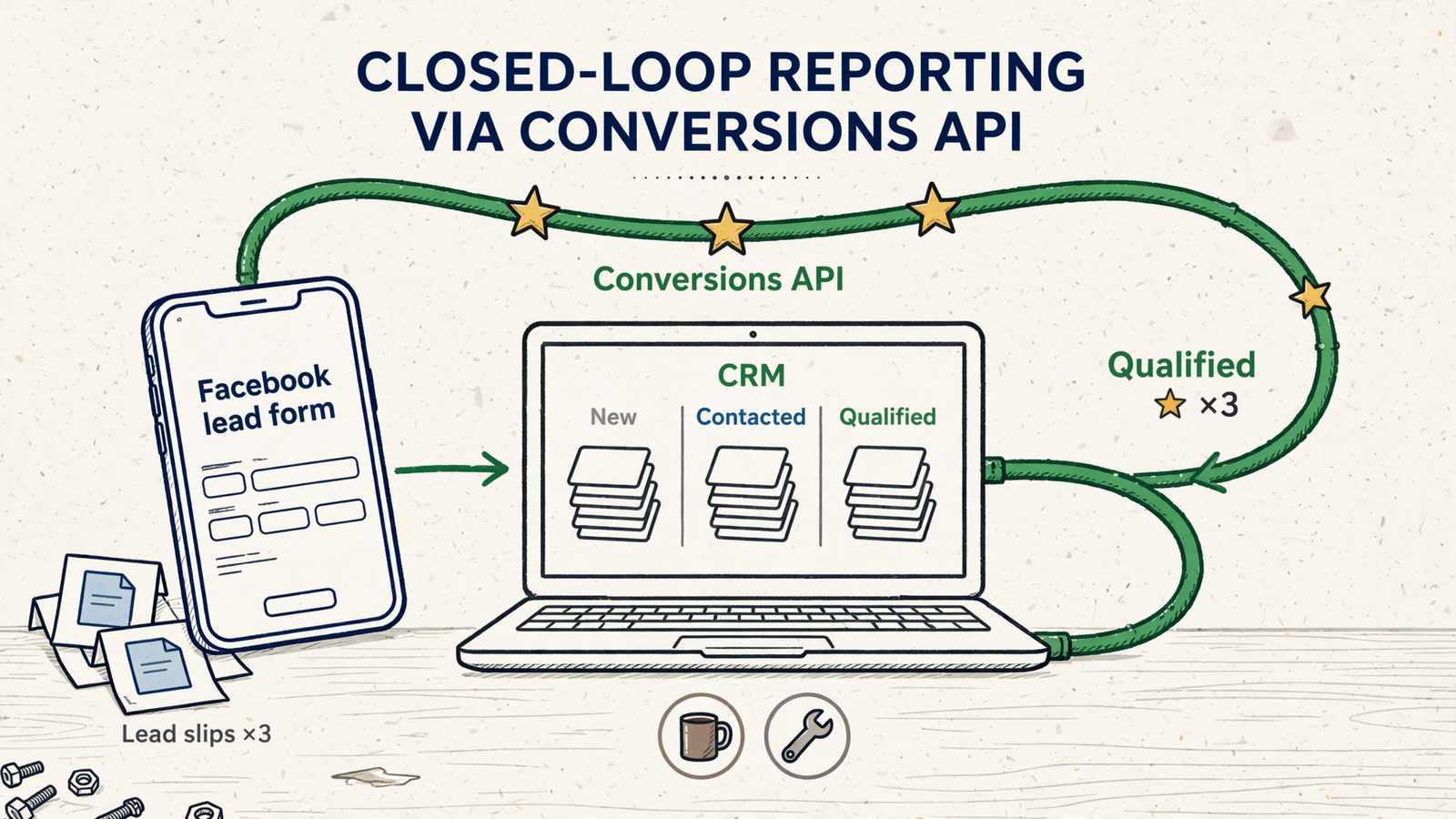
Keep the signal focused. Send stages worth buying more of, such as qualified, booked estimate, and closed-won, rather than treating every status as a success. Reporting every status dilutes the signal. The same logic applies to lookalikes: seed from customers, not every person who has filled a form.
Once you see 15 to 20 qualified leads a week, consider testing optimization toward that event. Check whether the volume and cost hold; do not assume the switch will fix weak qualification data. Meta cannot learn who bought if your CRM never tells it.
7. What if the lead is good but nobody calls fast enough?
You can improve targeting, forms, and bidding and still lose to a slow phone. In a study of 15,000-plus leads, contacting someone within 5 minutes rather than 30 minutes made contact 100 times more likely and qualification 21 times more likely. A separate audit of 2,241 firms found a 42-hour average response, with only 37% replying within an hour.
A Meta lead can cool while the person keeps scrolling. By tomorrow, they may not remember your name. So wire delivery before buying more volume: native CRM sync or Zapier into your CRM, an SMS and call task to the owner, and a first dial within 5 minutes during working hours.
I have watched close rates double after that change while CPL stayed flat. Cost per booked job fell without touching the ad account. That is not a reason to promise the same result in yours; it is a reason to measure response time alongside lead quality. If you cannot call promptly, fix the handoff before you pay for more leads.
8. How do you know your agency is lowering the right number?
Ask for one report: monthly spend divided by qualified leads, with qualified defined at the top. If the agency sends CPL and click-through rate instead, or celebrates a CPL drop while your calendar stays empty, it has not answered the question.
I would expect the agency to show its work:
- How it chose the form setting and qualification questions.
- Why the budget supports its number of ad sets.
- Which CRM outcomes return to Meta and which event it optimizes toward.
- What new creative it is testing against the current winner.
- How quickly your team contacts a new lead.
That is also the standard groas brings to Meta Ads for a flat $1,499 a month: audiences, budgets, and ads worked around the clock, new tests against winners, and one manager accountable for the qualified number rather than the cheap-lead number.
Do this today: switch one form to Higher Intent, add budget, timeline, and service-area questions, and time the first follow-up call. Then compare cost per qualified lead, not just CPL. You may pay more for each form fill next week. The point is to stop paying for the ones your team cannot sell to.